Nifty 50
- BSE₹3,368137.20 (4.25%)
- Shriram Finance₹829-36.00 (-4.16%)
- Dr. Reddy's Labs₹1,27343.50 (3.54%)
- Tata Consumer ₹928-35.90 (-3.72%)
- JSW Steel₹1,217.5032.00 (2.70%)
- HDFC Life Insurance ₹515.25-8.50 (-1.62%)
- Adani Ports₹1,74239.30 (2.31%)
- Asian Paints₹2,274-33.00 (-1.43%)
- Kotak Mahindra Bank₹438.958.45 (1.96%)
- Infosys₹1,143.25-10.55 (-0.91%)
- Hindalco Industries₹883.7513.90 (1.60%)
- Bajaj Finance₹920.50-8.45 (-0.91%)
- Eternal₹321.504.10 (1.29%)
- Hindustan Unilever₹1,800-14.70 (-0.81%)
- Coal India₹402.304.85 (1.22%)
- Nestle₹1,165.50-9.50 (-0.81%)
- InterGlobe Aviation₹4,601.7052.70 (1.16%)
- ICICI Bank₹1,383.50-10.70 (-0.77%)
- Cipla₹1,35012.00 (0.90%)
- SBI Life Insurance ₹1,628-12.00 (-0.73%)

- Offerings
- Tools & Platforms
Tools & Calculators
- Open API
- Calculators
- SIP Calculator
- CAGR Calculator
- Compound Interest Calculator
- FD Calculator
- RD Calculator
- EPF Calculator
- Retirement Calculator
- HDFC SIP Calculator
- Mutual Fund Return Calculator
- Lumpsum Calculator
- Step Up SIP Calculator
- ETF SIP Calculator
- Brokerage Calculator
- Equity Margin Calculator
- SWP Calculator
- EMI Calculator
- MTF Calculator
- Margin Pledge Calculator
- Algo Strategy
- Markets
Stocks
F&O
Mutual Funds
- More
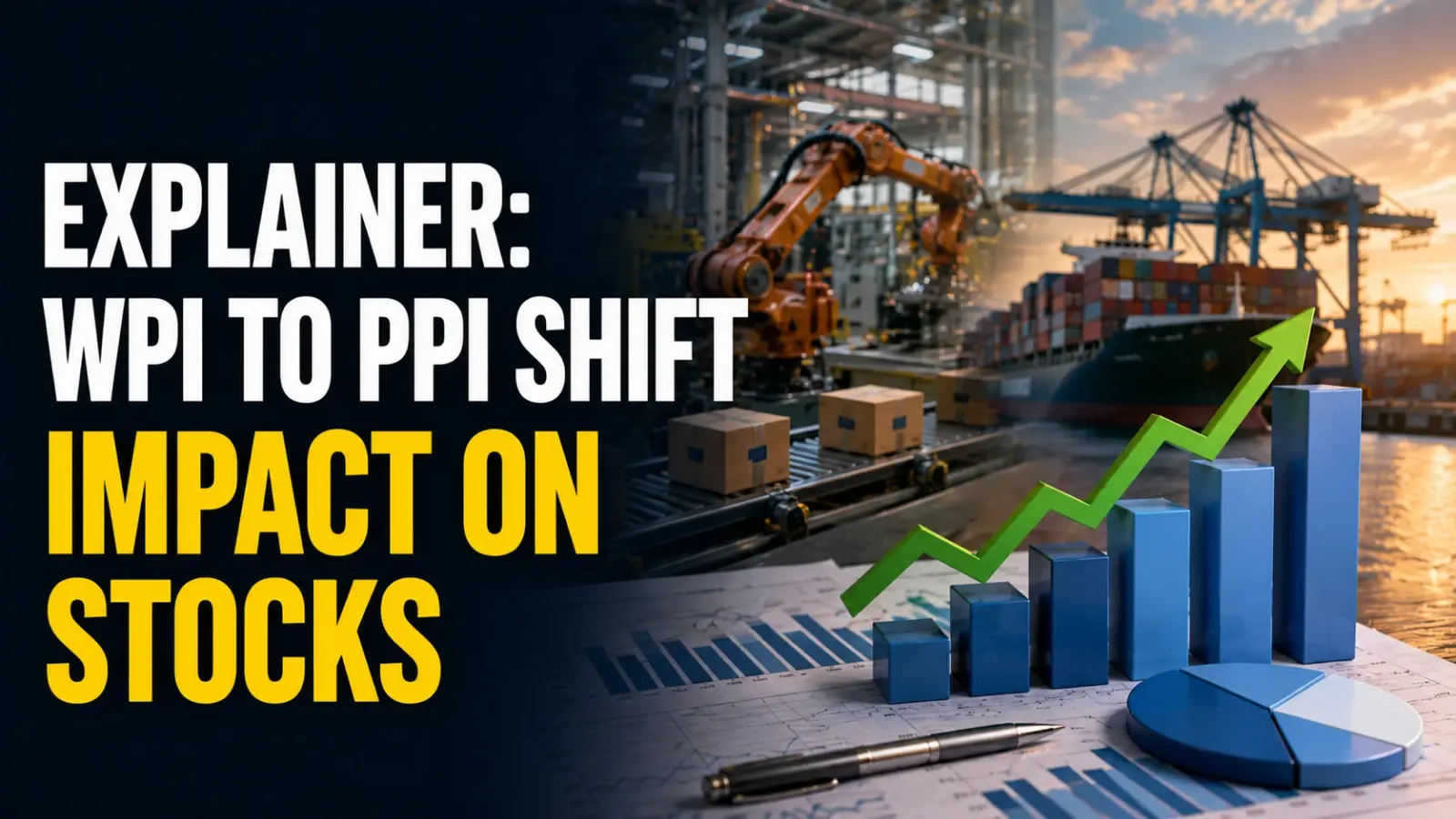
Explainer: What Is the Producer Price Index, Why India’s Switch from WPI to PPI Matters, How PPI Shift Will Impact Stocks
Authored By HDFC SKY | Last Modified: Jun 4, 2026 02:50 PM IST
Open Free Demat Account
Open Free Demat Account
Mumbai, June 4: India is set to overhaul its inflation measurement architecture: the government has decided to gradually phase out the Wholesale Price Index (WPI) and replace it with a comprehensive Producer Price Index (PPI) system, a move aimed at modernising the country’s pricing data framework and aligning it with global best practices.
The Commerce and Industry Ministry has approved a revision of the WPI’s base year from 2011-12 to 2022-23, with the revised WPI and the new PPI series both scheduled for release on June 15 — and the WPI will continue to be published for five more years alongside the PPI to give users adequate time to transition. Notably, the number of items covered under the new WPI series has expanded significantly from 697 to 957, broadening its representation of economic activity even as it prepares for its eventual retirement.
What Is the Producer Price Index?
The Producer Price Index (PPI) measures the average change over time in the prices received by domestic producers for their output — essentially tracking inflation from the seller’s side of the transaction rather than the buyer’s. It covers the full supply chain: raw materials at the extraction stage, intermediate goods being processed, and finished products ready for sale. Where the Consumer Price Index (CPI) asks “what are people paying at the checkout?”, the PPI asks “what are manufacturers and farmers getting paid at the factory gate or the farm?” — a fundamentally different vantage point that reveals price pressures before they reach the consumer.
Because production costs typically take weeks or months to flow through the supply chain and into retail prices, the PPI functions as a leading indicator of consumer inflation. When input costs for a steel manufacturer or a chemical producer rise sharply, those increases do not appear immediately in the CPI — but they will, eventually. Central banks, bond markets and economists therefore watch PPI data closely as an early-warning signal: a sustained PPI rise today is often a reliable predictor of a CPI rise tomorrow.
How Is It Calculated?
A PPI is constructed by collecting price data directly from producers — manufacturers, miners, farmers, service providers — at the point of first commercial transaction, before any retail markup or distribution cost is added. The prices collected are weighted by each sector’s share of total output in the economy, and the resulting index tracks how those weighted prices move over time relative to a fixed base year. The new Indian PPI will use 2022-23 as its base year, replacing the outdated 2011-12 base that had made India’s WPI increasingly unrepresentative of the country’s evolved economic structure. Internationally, the methodology is standardised by the IMF’s Producer Price Index Manual, ensuring cross-country comparability — one of the key reasons the government cited global alignment as a driver of the change.
PPI vs CPI vs WPI: What’s the Difference?
Understanding the three indices requires understanding where in the economic chain each one sits. The Consumer Price Index or CPI measures prices at the end of the chain — what the final consumer pays in a shop or market. The Wholesale Price Index or WPI, India’s current producer-price proxy, measures prices at the wholesale level — bulk transactions between traders and businesses, not between producers and their first buyers. The Producer Price Index or PPI, by contrast, measures prices at the very start of the chain — what the producer receives the moment goods leave their hands for the first time. This makes the PPI the purest measure of production-side inflation.
India’s reliance on the WPI as a producer-price measure has long been a methodological criticism: the WPI captures wholesale trading prices rather than true producer prices, conflates multiple stages of the supply chain, and has historically been skewed by commodity price movements in ways that obscure underlying domestic price dynamics. The PPI corrects for this by going directly to the source — the producer — and is the standard used by virtually every developed economy, including the United States (published by the Bureau of Labor Statistics), the European Union and Japan.
Why India’s Transition Matters
India’s WPI has for decades served a dual purpose: as a measure of producer-level inflation and as the index most widely used in price escalation clauses in government contracts, infrastructure agreements and commodity-linked financial instruments. The transition to PPI will affect every stakeholder who currently uses WPI as a benchmark — from road contractors and real estate developers to exporters and banks. The Ministry’s decision to run both indices in parallel for five years reflects an awareness of how deeply embedded WPI is in India’s contractual and regulatory framework, and gives the ecosystem time to rewire without disruption.
How the PPI Shift Will Impact Stock Markets
The transition from WPI to PPI is not merely a statistical housekeeping exercise — it will have real and measurable implications for how equity markets price inflation risk, how companies report cost pressures, and how sectors are valued relative to one another. Because the PPI captures producer prices more accurately than WPI, it is likely to produce readings that more precisely reflect actual input cost dynamics across industries, potentially changing how analysts model margin compression or expansion for listed companies. Sectors whose input costs have historically been understated by WPI — or overstated, depending on commodity cycles — may see their inflation pass-through assumptions re-calibrated as the market adjusts to the new benchmark.
- Commodity and materials stocks — steel, cement, chemicals, fertilisers — may experience re-rating as analysts rebuild their input cost and margin models around PPI data, which will more accurately reflect what producers are actually receiving at the factory gate; companies whose pricing power has been masked by WPI’s wholesale-level bluntness could see either upward or downward earnings revisions as the new index reveals true production economics.
- Infrastructure and capital goods companies — Larsen & Toubro (L&T), Bharat Heavy Electricals (BHEL), NCC, IRB Infrastructure — whose long-duration contracts carry WPI-linked price escalation clauses will need to renegotiate or rebase those clauses to the new PPI over the five-year transition window; the process introduces near-term contract-pricing uncertainty but ultimately provides a more accurate escalation mechanism, which is positive for long-run project economics.
- FMCG and consumer staples companies — Hindustan Unilever (HUL), Nestle, ITC, Tata Consumer — which rely on WPI trends to guide raw material cost forecasts and pricing decisions will benefit from a PPI that more cleanly separates agricultural input inflation from downstream wholesale price noise; cleaner producer-price data should improve the accuracy of gross margin guidance, potentially reducing the valuation discount markets apply for earnings uncertainty.
- Monetary policy and rate-sensitive sectors — banking, NBFCs, real estate — will be most indirectly affected: if PPI readings prove structurally different from WPI in ways that alter the RBI’s inflation assessment, the interest rate path could shift, repricing the entire rate-sensitive universe; a PPI that consistently shows lower producer-price inflation than WPI had implied could, over time, provide the RBI more room to cut rates, which would be broadly positive for borrowing-heavy sectors.
Sources:
https://newsonair.gov.in/government-to-replace-wholesale-price-index-with-producer-price-index-system/
U.S. Bureau of Labor Statistics — https://www.bls.gov/ppi/
Investopedia explainer — https://www.investopedia.com/terms/p/ppi.asp
IMF methodology guide — https://www.imf.org/en/Data/Statistics/PPI
Disclaimer
If you have any concerns, questions, or wish to point out any discrepancies in our content, please feel free to write to us at content@hdfcsec.com.
Please Note: The information shared is intended solely for informational purposes and does not make any investment recommendations
Disclaimer
At HDFC SKY*, we take utmost care and due diligence in curating and presenting news and market-related content. However, inadvertent errors or omissions may occasionally occur.
If you have any concerns, questions, or wish to point out any discrepancies in our content, please feel free to write to us at content@hdfcsec.com.
Please Note: The information shared is intended solely for informational purposes and does not make any investment recommendations.
HDFC SKY from HDFC Securities, one of most trusted trading platforms in India, has been recognized with the *Next-Gen Digi Content Awards 2025-26.
 Join Us
 Add as preferred source on Google


More Business News










Open Free Demat Account
Open Free Demat Account











Invest Anytime, Anywhere


By signing up I certify terms, conditions & privacy policy