Nifty 50
- TCS₹2,456.4080.20 (3.38%)
- Tata Steel₹162.90-15.10 (-8.48%)
- Shriram Finance₹99422.00 (2.26%)
- Axis Bank₹1,395.10-50.90 (-3.52%)
- Tech Mahindra₹1,784.5038.30 (2.19%)
- HDFC Bank₹820.35-25.65 (-3.03%)
- HCL Technologies₹1,36520.60 (1.53%)
- Hindalco Industries₹902.15-27.35 (-2.94%)
- Titan Company₹4,67050.00 (1.08%)
- ICICI Bank₹1,593.50-46.50 (-2.84%)
- Max Healthcare₹1,090.959.95 (0.92%)
- Kotak Mahindra Bank₹502.50-13.30 (-2.58%)
- Apollo Hospitals₹9,27878.00 (0.85%)
- SBI₹1,135.70-29.40 (-2.52%)
- Infosys₹1,1079.00 (0.82%)
- JSW Steel₹1,304.70-32.30 (-2.42%)
- Maruti Suzuki₹14,124113.00 (0.81%)
- UltraTech Cement₹12,651-288.00 (-2.23%)
- ITC₹301.102.00 (0.67%)
- Tata Motors PV₹260.65-5.70 (-2.14%)

- Offerings
- Tools & Platforms
Tools & Calculators
- Open API
- Calculators
- SIP Calculator
- CAGR Calculator
- Compound Interest Calculator
- FD Calculator
- RD Calculator
- EPF Calculator
- Retirement Calculator
- HDFC SIP Calculator
- Mutual Fund Return Calculator
- Lumpsum Calculator
- Step Up SIP Calculator
- ETF SIP Calculator
- Brokerage Calculator
- Equity Margin Calculator
- SWP Calculator
- EMI Calculator
- MTF Calculator
- Margin Pledge Calculator
- Algo Strategy
- Markets
Stocks
F&O
Mutual Funds
- More
India VIX Closes 3.12% Higher at 17.89 as Banking Sell-Off and Nifty Reversal Drive Volatility
Authored By HDFC SKY | Published at: Nov 23, 2026 03:59 PM IST
Open Free Demat Account
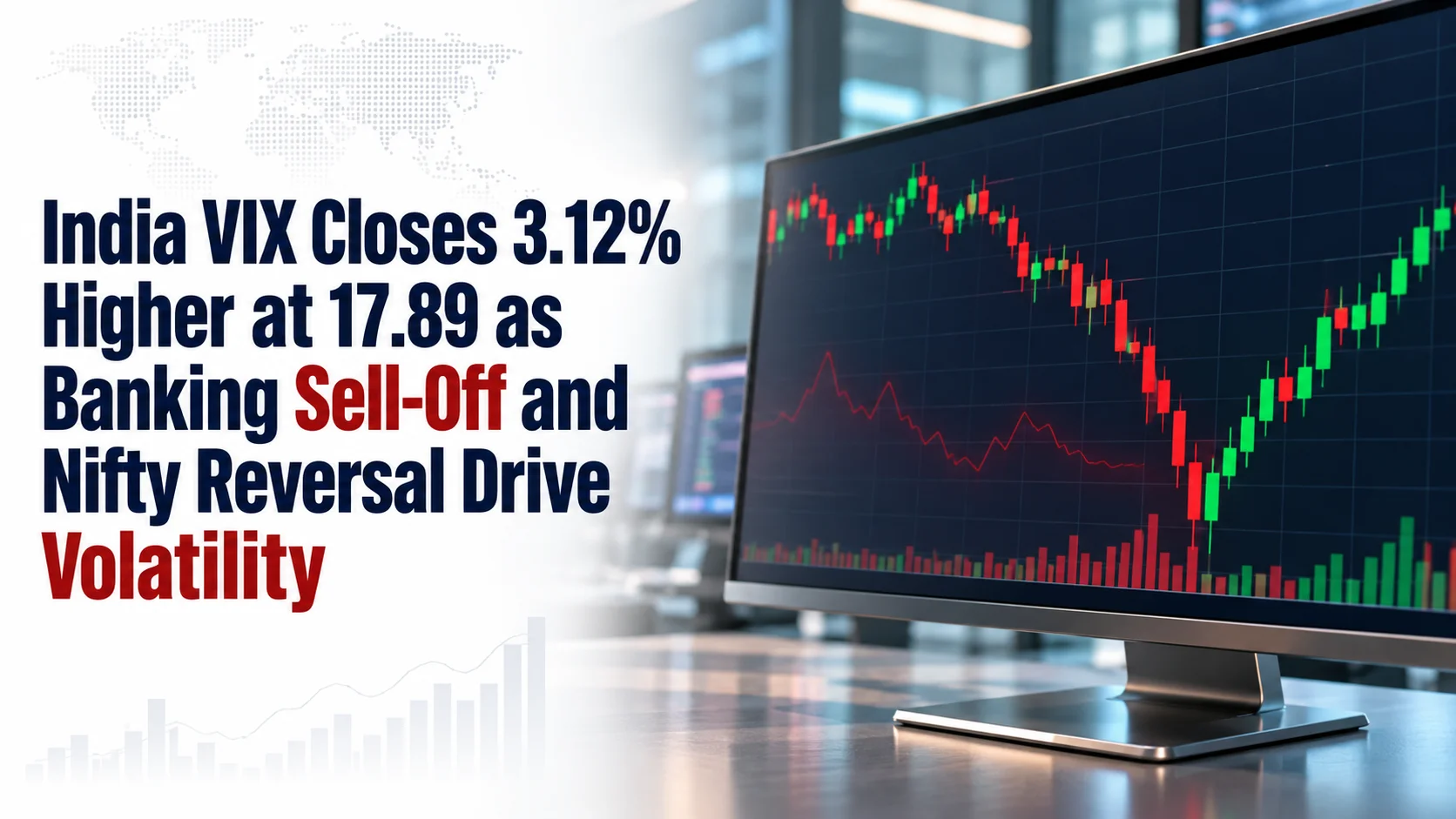
Mumbai, 23 November 2026: India VIX, the National Stock Exchange’s volatility index, closed at 17.89, rising 0.54 points or 3.12% from its previous close of 17.32, as a sharp reversal in Indian equities, banking-sector losses and derivatives positioning contributed to market volatility. The index touched an intraday high of 18.65 and a low of 17.04, reflecting substantial fluctuations during Monday’s trading session.
The rise followed a steep reversal in the Nifty 50, which retreated from nearly 26,000 to below 25,500, alongside widespread weakness in banking and metal stocks. Global technology-sector concerns and declining Asian equity markets added to the day’s uncertainty.

India VIX Hits 18.65 as Nifty Reverses 501 Points
India VIX opened at 17.32, matching its previous closing level, before climbing to 18.65, an intraday increase of approximately 7.6%. Although the index subsequently moderated, it remained elevated at the close.
The Nifty 50 opened near 25,929, advanced to 25,992.60 and subsequently declined to 25,491.30, recording an intraday high-to-low movement of approximately 501 points.
The reversal followed four consecutive weeks of equity-market gains, with profit booking emerging across several sectors. The sharp benchmark fluctuations coincided with increased implied volatility in Nifty options, contributing to the higher India VIX reading.
Nifty Bank Falls Over 2% as Financial Stocks Weaken
Banking stocks emerged as major contributors to Monday’s market decline, with the Nifty Bank index falling more than 2% intraday after reaching multiple record highs during the preceding week.
Selling extended across public-sector and private-sector lenders. Union Bank of India, Bank of Baroda and Canara Bank were among the weaker banking stocks, while Axis Bank and other financial heavyweights also declined.
The sector’s substantial representation in the Nifty 50 made its weakness particularly relevant to broader benchmark movements. Banking-sector declines coincided with heightened index volatility as the market reversed its early gains.
Tata Steel Falls 8% as APL Apollo Drops 17%
The metal sector experienced substantial selling following the announced strategic transaction involving Tata Steel and APL Apollo Tubes.
The arrangement involved transferring Tata Steel’s steel tubes and colour-coated products businesses alongside Tata Steel’s proposed acquisition of a substantial stake in APL Apollo.
Following the announcement, Tata Steel declined approximately 8% intraday, while APL Apollo fell around 15–17% during reported morning trading. The Nifty Metal index dropped approximately 3%.
The declines contributed to broader sectoral weakness, with Tata Steel’s presence in the Nifty 50 adding to the pressure on the benchmark.
Derivatives Expiry Adds Pressure Ahead of 24 November Holiday
Derivatives positioning remained an important feature of Monday’s session as traders approached the monthly expiry period.
Market participants were managing, closing and rolling futures and options positions amid sharp benchmark fluctuations. Changes in options pricing and hedging requirements coincided with the rise in implied volatility.
The Indian equity market was also scheduled to remain closed on 24 November 2026, shortening the trading week and concentrating position adjustments into Monday’s session.
Expiry-related activity and the approaching holiday formed part of the day’s trading conditions, although their individual contributions to India VIX cannot be separately quantified.
Foreign Inflows Reach ₹10,308 Crore Despite Market Weakness
Foreign institutional investor activity presented a contrasting picture to the equity-market decline.
Foreign investors had purchased approximately ₹10,308 crore of Indian equities during the preceding session on 20 November, while reported November foreign equity inflows approached $13 billion.
These purchases preceded Monday’s positive market opening. However, foreign investors had also reduced net index futures exposure, indicating differences between cash-market participation and derivatives positioning.
Meanwhile, the rupee initially strengthened to approximately ₹92.49 per US dollar, compared with its previous close near ₹92.68, before weakening intraday to approximately ₹92.85.
RBI Rate Uncertainty Persists After 6.09% Inflation Reading
Domestic monetary-policy uncertainty remained relevant following India’s reported 6.09% consumer inflation reading for October. Market attention centred on the Reserve Bank of India’s upcoming 4 December monetary-policy meeting, including the possibility of an interest-rate increase.
Currency fluctuations accompanied the equity-market decline, adding another dimension to domestic financial conditions.
The monetary-policy outlook remained an underlying consideration during Monday’s session, rather than a newly announced policy decision.
Fourteen of Sixteen Sectors Decline as IT Gains 3%
The weakness extended beyond banking and metals, with 14 of India’s 16 major sectoral indices declining at approximately 10:16 a.m. IST. Mid-cap and small-cap indices also weakened, indicating that the selling was not confined to benchmark heavyweights.
Information technology provided a notable exception, with the Nifty IT index gaining nearly 3% during morning trading. Shares including TCS, Infosys and LTM supported the sector’s relative strength.
Despite the technology sector’s gains, the broader market decline coincided with elevated volatility.
Asian Markets Slide as Kospi Falls Around 5%
Global equity weakness added to the challenging domestic trading environment. South Korea’s Kospi declined approximately 5% during early trading, while Hong Kong’s Hang Seng fell around 1.4% and China’s Shanghai Composite dropped approximately 1.1%.
Japan’s cash equity market remained closed for a public holiday. The regional declines followed renewed concerns surrounding artificial-intelligence valuations and substantial technology-sector expenditure. The Nasdaq’s weakness in the preceding US session remained part of the international market backdrop.
Fed Rate Concerns Persist as Brent Trades Near $91.83
International monetary-policy developments remained in focus ahead of the US Federal Reserve’s 9 December meeting. Market participants were assessing the possibility of higher US interest rates alongside upcoming personal consumption expenditures inflation data.
Meanwhile, Brent crude traded near $91.80–$91.83 per barrel, while West Texas Intermediate crude hovered around $83 during early Monday trading.
Oil prices eased despite continuing Middle East geopolitical concerns and attention surrounding the 29 November OPEC meeting. Gold recovered approximately 1% during Asian trading, while US Treasury yields and dollar movements remained relevant to global financial conditions.
India VIX Ends at 17.89 After Reaching 18.65
India VIX remained volatile throughout the session. It reached 17.99 at approximately 10:13 a.m., representing a 3.87% increase, and was subsequently reported at 18.03 around 11:58 a.m., up 4.10%.
The index’s intraday peak of 18.65 contrasted with its final reading of 17.89, indicating that volatility moderated from its highest level before the close.
Its 52-week range stood between 8.72 and 28.90, while the reported year-to-date increase reached 88.92%. The index’s daily technical rating remained neutral.
India VIX closed 3.12% higher at 17.89 on 23 November 2026, after touching 18.65 intraday. The session featured a 501-point Nifty reversal, banking and metal-sector declines, derivatives positioning and weakness across Asian markets. The closing reading remained below the day’s peak, while the index continued to reflect elevated near-term market volatility.
Disclaimer
The information shared here is intended solely for informational and educational purposes and does not constitute investment recommendations. While we practice strict due diligence in curating daily market data, readers must perform independent research before trading. To flag any real-time data discrepancies or content concerns, please write to us at content@hdfcsec.com.
 Join Us
 Add as preferred source on Google


More APLAPOLLO News








Open Free Demat Account
₹1,675.40











Invest Anytime, Anywhere


By signing up I certify terms, conditions & privacy policy