Nifty 50
- Bajaj Auto₹10,077299.00 (3.06%)
- Tech Mahindra₹1,469.60-44.50 (-2.94%)
- Dr. Reddy's Labs₹1,226.5029.50 (2.46%)
- ITC₹258.70-7.30 (-2.74%)
- Mahindra & Mahindra₹2,830.6034.40 (1.23%)
- Bharti Airtel₹1,767.70-37.40 (-2.07%)
- Eicher Motors₹7,11868.00 (0.96%)
- SBI₹939.55-19.55 (-2.04%)
- BSE₹3,316.8029.60 (0.90%)
- NTPC₹306.25-5.75 (-1.84%)
- Bharat Electronics₹370.702.55 (0.69%)
- Hindustan Unilever₹1,826.30-30.40 (-1.64%)
- HDFC Life Insurance ₹560.403.75 (0.67%)
- Coal India₹404.95-6.60 (-1.60%)
- JSW Steel₹1,173.505.50 (0.47%)
- L&T₹3,645.60-57.70 (-1.56%)
- Eternal₹324.901.45 (0.45%)
- ICICI Bank₹1,335.50-19.50 (-1.44%)
- Trent₹2,930.8012.60 (0.43%)
- Nestle₹1,320.80-12.20 (-0.92%)

- Offerings
- Tools & Platforms
Tools & Calculators
- Open API
- Calculators
- SIP Calculator
- CAGR Calculator
- Compound Interest Calculator
- FD Calculator
- RD Calculator
- EPF Calculator
- Retirement Calculator
- HDFC SIP Calculator
- Mutual Fund Return Calculator
- Lumpsum Calculator
- Step Up SIP Calculator
- ETF SIP Calculator
- Brokerage Calculator
- Equity Margin Calculator
- SWP Calculator
- EMI Calculator
- MTF Calculator
- Margin Pledge Calculator
- Algo Strategy
- Markets
Stocks
F&O
Mutual Funds
- More
India VIX Falls 4% to 11.86 as August Volatility Stays Below July’s 14.68 Spike
Authored By HDFC SKY | Last Modified: Aug 11, 2026 04:54 PM IST
Open Free Demat Account
Open Free Demat Account
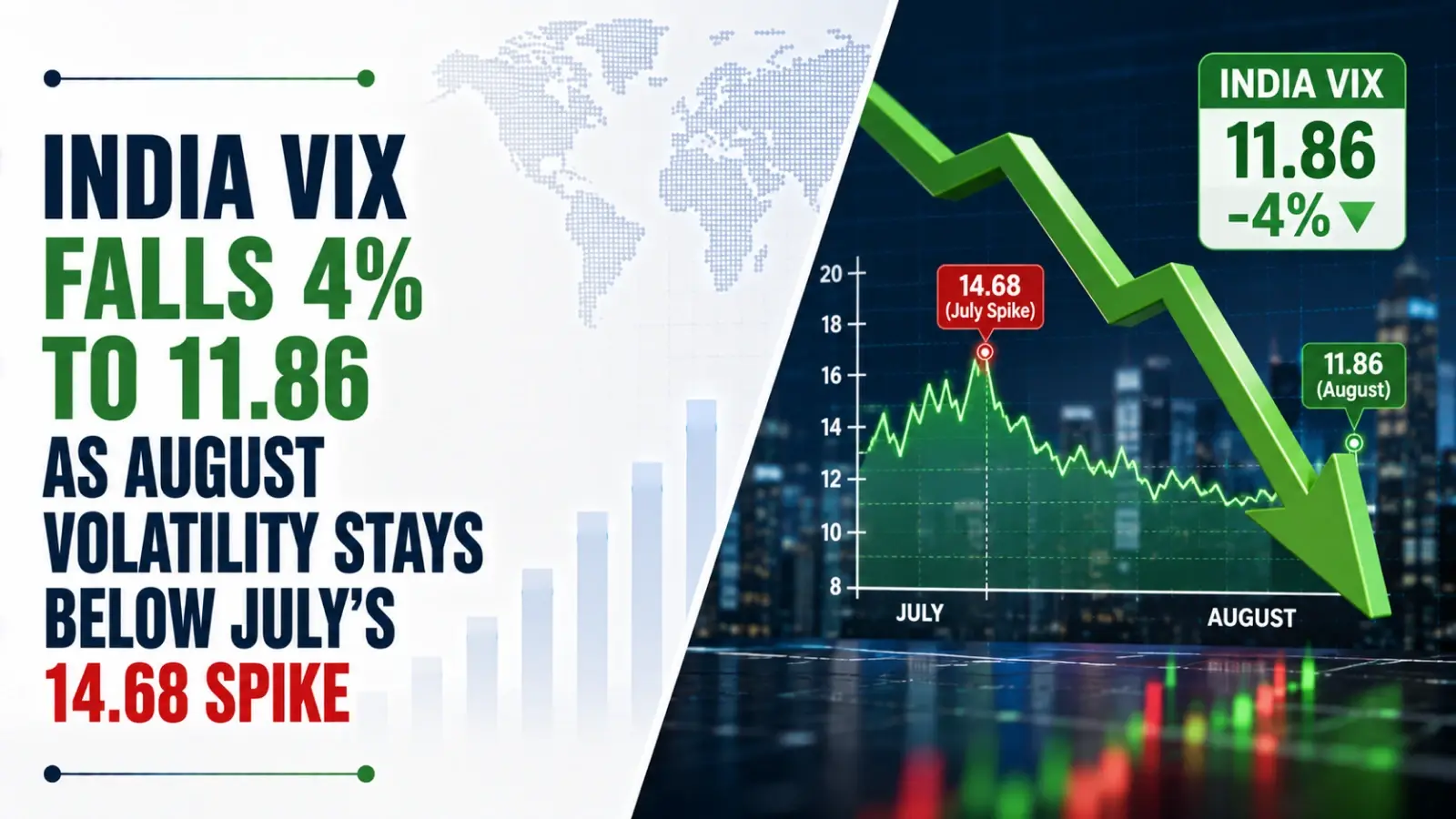
Mumbai, Aug 11: India VIX declined 0.49 points, or 4%, to 11.86 in Tuesday’s closing session, extending the cooling in volatility seen after the sharp spike in July. The index opened at 12.24, against the previous close of 12.25, and moved between an intraday low of 11.19 and a high of 12.45. The latest reading keeps India VIX close to the 12 level and well below its 52-week high of 28.90.

India VIX Drops To 11.86 As Intraday Volatility Cools
India VIX remained relatively contained through Tuesday’s session before ending at 11.86, down 4% from the previous close. The index began the day at 12.24, just 0.01 point below the previous close of 12.25, before moving within a range of 11.19–12.45.
The session therefore marked a reversal from Monday’s modest increase in volatility. Rather than extending the previous session’s rise, India VIX moved lower during Tuesday’s trading hours. The index’s current level also remains considerably below the elevated readings recorded during the major volatility episodes earlier this year.
The latest data show a 52-week low of 8.72 and a 52-week high of 28.90, placing the current reading closer to the lower end of its annual range. The technical rating for India VIX remains NEUTRAL.
Monday’s 12.25 Close Followed a Modest Volatility Rise
India VIX had ended Monday at 12.25, after rising from around 12.16, representing an increase of approximately 0.74%. Although the final move was limited, the index experienced a wider trading range during the session, with market coverage placing the day’s movement between approximately 10.81 and 12.91.
The increase was linked in the supplied market updates to crude oil movements, geopolitical uncertainty, positioning ahead of market events and ongoing earnings announcements, while Nifty’s consolidation around elevated levels also remained part of the market backdrop.
The Monday move was significantly smaller than the sharp volatility increase recorded on 8 July. That distinction remains important for Tuesday’s closing picture, as the latest decline indicates that the modest rise seen on Monday did not develop into another broad volatility surge.
July’s 14.68 Spike Still Defines the Recent Volatility Cycle
The most significant recent India VIX move came on 8 July 2026, when the index surged approximately 26% to 14.68 after opening at around 11.64. The sharp increase occurred alongside a major decline in Indian equities, with the Sensex falling more than 1,600 points and the Nifty dropping below 24,000.
The July 8 volatility spike was associated with higher crude oil prices, geopolitical concerns, weak global cues, rupee pressure and increased demand for downside protection. The episode followed a period of comparatively subdued volatility, making the move particularly notable.
Before the July surge, India VIX had fallen below 12. On 3 July, it closed at 11.83, down 3.70%, marking its first close below 12 since 27 February. The subsequent move to 14.68 therefore represented a sharp reversal from those lower volatility levels.
India VIX Falls from 14.68 to 11.75 By July End
The July 8 spike gradually unwound during the remainder of the month. By 31 July, India VIX had declined to approximately 11.75, down 3.37% during that session.
The sequence from July into August shows the extent of the moderation. India VIX moved from 14.68 on 8 July to approximately 11.75 on 31 July, before ending Monday, 10 August, at 12.25 and Tuesday at 11.86.
The latest reading is therefore substantially below the level recorded during the July equity-market sell-off. It also remains far below the 52-week high of 28.90, although it is above the annual low of 8.72.
August Volatility Holds Near 12 Despite Key Market Events
India VIX remained broadly around the 12 level during the first week of August. On 3 August, the index was around 11.93, while on 6 August it rose approximately 1.49% to 12.18. On 7 August, it remained around 12.15–12.18, with one market update reporting a marginal 0.18% increase to 12.18.
The period also included the Reserve Bank of India’s policy decision, making the absence of a sustained volatility spike notable within the supplied market data. The index continued to trade close to 12 despite the policy event and the ongoing presence of geopolitical and crude-related concerns.
This relatively narrow range contrasts with the much sharper movements seen during the July volatility episode.
Crude and Geopolitics Remain Key Volatility Triggers
Crude oil movements and geopolitical developments remained among the factors cited in recent India VIX coverage. These factors were particularly relevant during the July 8 spike, when rising crude prices and geopolitical concerns coincided with a sharp decline in Indian equities and a rapid increase in volatility.
The same factors were also cited in connection with Monday’s modest rise in India VIX to 12.25. Tuesday’s decline to 11.86, however, shows that these concerns did not translate into another broad increase in the volatility index during the closing session.
The current reading therefore comes after a period in which crude and geopolitical developments remained relevant to the market backdrop without producing a move comparable with the July 8 episode.
Earnings and Market Changes Keep Volatility in Focus
The Q1 FY27 earnings season remains another factor in the current market environment. According to the supplied information, more than 300 companies were scheduled to report earnings on 11 August, keeping corporate results relevant to market activity.
Market structure has also changed during the period. The new Reserve Bank of India margin rules became effective on 1 July 2026, affecting the funding of proprietary trading activities and increasing collateral requirements. Market reports indicated that derivatives volumes fell around 20–25% during the first five July sessions compared with June.
The National Stock Exchange’s new Closing Auction Session (CAS) also began from 3 August. The supplied information does not indicate that the introduction of CAS has produced a major India VIX shock, with the index remaining close to 12 during the first week of August.
India VIX Remains 59% Below Its 52-Week High
At 11.86, India VIX remains significantly below its 52-week high of 28.90 and above its 52-week low of 8.72. The latest reading therefore reflects a substantial moderation from the elevated volatility levels seen earlier in 2026.
The index’s movement from 14.68 on 8 July to 11.75 on 31 July, followed by 12.25 on 10 August and 11.86 on 11 August, shows that the July volatility episode has largely eased in the latest readings.
The technical trend remains NEUTRAL, while the classic pivot levels for the session stand at R1 13.17, R2 14.09, R3 15.27, PP 11.99, S1 11.07, S2 9.89 and S3 8.97.
August Seasonality Shows 13 Positive Years Out of 18
Historical August data also provide a separate context for the current reading. India VIX has recorded positive returns in 13 of the past 18 years during August.
The seasonality data show a maximum positive change of 68.84% in 2015, with an average positive change of 16.77%. The maximum negative change was 11.26% in 2016, while the average negative change was -6.01%. The overall average change for August stands at 10.44%. These historical figures form part of the index’s seasonality data and sit alongside the current market reading of 11.86.
India VIX closed at 11.86 on 11 August, down 4%, after trading between 11.19 and 12.45. The index remains below July’s 14.68 spike and far below its 52-week high of 28.90. Recent volatility levels continue to be shaped by crude oil, geopolitical developments, earnings, policy events and market-structure changes.
Source
- https://www.nseindia.com/reports-indices-historical-vix
Disclaimer
If you have any concerns, questions, or wish to point out any discrepancies in our content, please feel free to write to us at content@hdfcsec.com.
Please Note: The information shared is intended solely for informational purposes and does not make any investment recommendation
Disclaimer
At HDFC SKY*, we take utmost care and due diligence in curating and presenting news and market-related content. However, inadvertent errors or omissions may occasionally occur.
If you have any concerns, questions, or wish to point out any discrepancies in our content, please feel free to write to us at content@hdfcsec.com.
Please Note: The information shared is intended solely for informational purposes and does not make any investment recommendations.
HDFC SKY from HDFC Securities, one of most trusted trading platforms in India, has been recognized with the *Next-Gen Digi Content Awards 2025-26.
 Join Us
 Add as preferred source on Google


More Business News









Open Free Demat Account
Open Free Demat Account












Invest Anytime, Anywhere


By signing up I certify terms, conditions & privacy policy