Nifty 50
- Apollo Hospitals₹8,027.50361.50 (4.72%)
- BSE₹3,287.20-47.60 (-1.43%)
- ITC₹26611.00 (4.31%)
- Reliance Industries₹1,170.30-7.70 (-0.65%)
- Eicher Motors₹7,050282.50 (4.17%)
- JSW Steel₹1,168-7.20 (-0.61%)
- TCS₹2,15680.00 (3.85%)
- Cipla₹1,301-5.80 (-0.44%)
- HCL Technologies₹1,216.7039.80 (3.38%)
- Adani Ports₹1,76153.00 (3.10%)
- Infosys₹1,023.4026.40 (2.65%)
- Shriram Finance₹940.4523.20 (2.53%)
- Tata Motors PV₹279.906.90 (2.53%)
- UltraTech Cement₹10,675249.00 (2.39%)

- Offerings
- Tools & Platforms
Tools & Calculators
- Open API
- Calculators
- SIP Calculator
- CAGR Calculator
- Compound Interest Calculator
- FD Calculator
- RD Calculator
- EPF Calculator
- Retirement Calculator
- HDFC SIP Calculator
- Mutual Fund Return Calculator
- Lumpsum Calculator
- Step Up SIP Calculator
- ETF SIP Calculator
- Brokerage Calculator
- Equity Margin Calculator
- SWP Calculator
- EMI Calculator
- MTF Calculator
- Margin Pledge Calculator
- Algo Strategy
- Markets
Stocks
F&O
Mutual Funds
- More
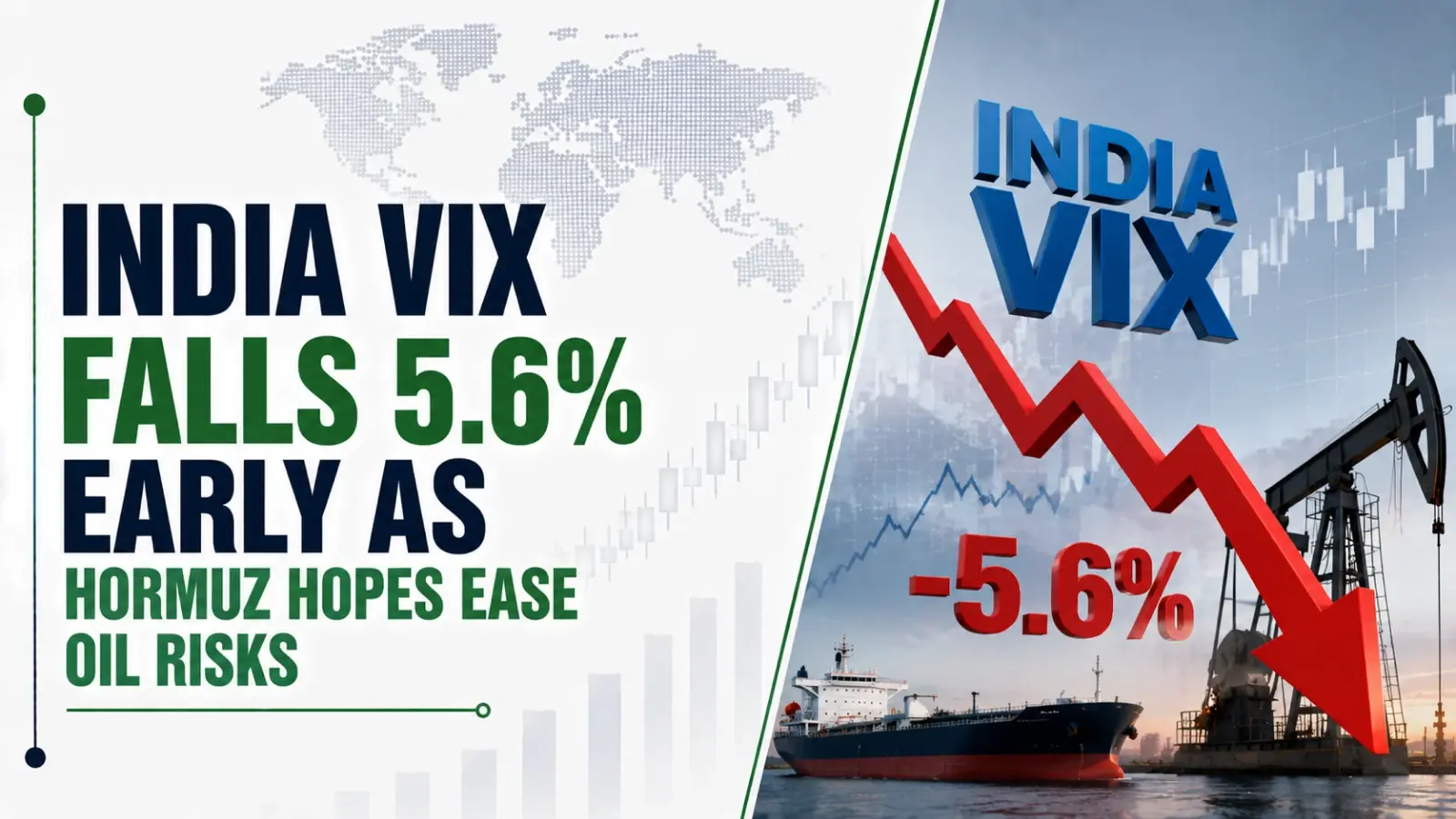
India VIX Falls 5.6% Early as Hormuz Hopes Ease Oil Risks
Authored By HDFC SKY | Last Modified: Aug 26, 2026 11:12 AM IST
Open Free Demat Account
Open Free Demat Account
Mumbai, Aug 26: India VIX opened at around 11.075, almost unchanged from its 11.08 previous close, before falling sharply in early trade. The volatility index touched an early low of 10.13 and stood at around 10.455 by 09:19 IST, down 5.64%. At 10:03 IST, India VIX was 10.76, down 0.35 points or 3.16%, with the day’s range at 10.13–11.07.

Hormuz Hopes Push India VIX Down 5.6%
The sharp early decline in India VIX followed renewed discussions between Iran and Oman on arrangements that could facilitate the resumption or normalisation of shipping through the Strait of Hormuz. The development reduced immediate concerns over a prolonged disruption to global oil supplies, easing a key source of volatility in the Indian market.
The sequence was reflected in the early movement of the volatility index: expectations of improved shipping conditions reduced pressure on crude prices, while lower energy-related risks coincided with a stronger opening for Indian equities. India VIX, which measures expected volatility over the next 30 calendar days using Nifty option bid-ask prices, therefore moved lower as the immediate requirement for downside protection moderated.
Crude Falls 2–3% as Shipping Risks Ease
Crude oil provided a significant positive cue during the early session, with prices falling by roughly 2–3% on Wednesday. Brent crude moved below or around $87–$88 per barrel, while one reported market level placed Brent at approximately $86.80, down about 2%, and West Texas Intermediate (WTI) at around $81. Another market report indicated that crude had fallen approximately 6% over two sessions.
The decline was primarily associated with renewed hopes of reopening the Strait of Hormuz. For India, lower crude prices reduced immediate concerns surrounding the trade deficit, current-account position, imported inflation, the rupee, corporate input costs, government subsidy and fiscal pressure, and future interest-rate expectations. This combination provided a lower-volatility backdrop for the domestic market.
Iran Risks Remain Despite Lower Oil Prices
The easing in India VIX does not indicate that Iran-related risks have disappeared. On 25 August, the United States expanded sanctions against four India-based companies and three Indian nationals over Iranian petroleum-related activity. Separately, reports on 26 August said Iran had blacklisted Indian and Pakistani ships among vessels accused of violations connected with the Strait of Hormuz.
These developments continue to raise concerns around India’s Iran-linked energy trade, shipping costs and insurance, payment channels, sanctions exposure for Indian businesses and the security of energy supplies. They also add complications to the wider US-India-Iran trade environment. However, the early VIX movement showed that these risks were outweighed at the opening stage by lower crude prices and expectations surrounding Hormuz shipping.
Global Stocks Add Support to India VIX Decline
Global equity markets also provided a supportive backdrop. US markets ended Tuesday higher, with the Dow Jones Industrial Average up around 0.3%, the S&P 500 up around 0.3% and the Nasdaq up around 0.7%. Semiconductor stocks recovered, with names including Nvidia, Micron, Intel, SanDisk and AMD contributing to the technology-sector rebound.
The stronger US close supported the broader global equity environment ahead of the Indian session. The technology rebound was particularly relevant because technology companies carry significant weight in the Nifty. The positive global cue therefore coincided with lower immediate volatility expectations in Indian equities.
Nvidia Results Keep a Global Risk Trigger Active
Nvidia’s earnings remained a major event for global markets ahead of its results. Investors were focused on signals concerning artificial intelligence demand, semiconductor spending, technology valuations and future global earnings growth.
The event represented an important potential volatility catalyst, although the pre-result technology-market recovery provided a relatively constructive backdrop. The uncertainty surrounding Nvidia’s results therefore remained part of the wider global risk environment without preventing India VIX from falling sharply during the opening phase.
Nifty Strengthens as Oil Relief Supports Opening
Indian equities also opened on a stronger footing, reinforcing the decline in implied volatility. Market expectations before the opening pointed to gains following lower oil prices, hopes for progress towards reopening the Strait of Hormuz and the positive global equity performance.
The Nifty was holding above 24,300, while the 24,400–24,500 zone was identified as important in the market setup. The Sensex and Nifty subsequently moved higher during the morning, with declining crude prices highlighted as a key factor supporting the domestic market.
The relationship was straightforward: a stronger Nifty and Sensex reduced immediate downside pressure, while lower perceived downside risk coincided with reduced demand for protective Nifty options and lower implied volatility.
Tuesday’s 11.08 Close Sets Up Further Compression
The 26 August move followed a decline in India VIX during the previous session. On 25 August, the index opened at around 11.53, after rising 2.95% in the preceding session amid Iran-related risks, expiry-related activity and the new closing-auction mechanism. It subsequently moved lower during Tuesday’s session and closed at 11.08, down approximately 3.9%.
Today’s opening decline therefore extended the recent moderation rather than following a fresh volatility shock. India VIX had moved from a temporary increase associated with geopolitical concerns towards lower levels as the equity market stabilised and crude-related pressure eased.
India VIX Near 10.45 Returns Towards August Lows
The early reading around 10.45 placed India VIX close to the lower levels recorded during August. The index stood at 10.57 on 20 August, after falling 6.63% as the Nifty recovered, and rose to 11.18 on 21 August, an increase of 3.9%. It then opened at 11.53 on 25 August before closing at 11.08.
The current early-session level therefore brought India VIX back towards the subdued range seen earlier in August. Its 52-week range remains 8.72–28.90, while the latest displayed YTD return is 13.50%. Seasonality data also shows that India VIX has recorded positive returns in 12 of 18 Augusts, with an average August change of 9.94%.
No Fresh Domestic Policy Shock Drives the Opening
There was no fresh Reserve Bank of India monetary-policy announcement driving the opening move, while no major negative domestic macroeconomic release or broad-based Indian corporate earnings shock was identified as the cause of the early decline.
The key distinction remains that the fall in India VIX reflects a reduction in immediate volatility expectations, particularly through oil and Hormuz developments, rather than the disappearance of geopolitical uncertainty. The continuing sanctions, shipping-related developments and Iran-US tensions remain part of the broader risk backdrop.
India VIX fell from 11.08 to an early low of 10.13, with the index around 10.45 at 09:19 IST, as Hormuz reopening hopes and lower crude prices eased immediate volatility pressures. By 10:03 IST, it stood at 10.76, down 3.16%, while geopolitical and sanctions-related risks remained active.
Source
- https://www.nseindia.com/reports-indices-historical-vix
Disclaimer
If you have any concerns, questions, or wish to point out any discrepancies in our content, please feel free to write to us at content@hdfcsec.com.
Please Note: The information shared is intended solely for informational purposes and does not make any investment recommendations
HDFC SKY, one of India’s most trusted trading platforms, has been recognized with the Next-Gen Digi Content Awards 2025–26.
Disclaimer
At HDFC SKY*, we take utmost care and due diligence in curating and presenting news and market-related content. However, inadvertent errors or omissions may occasionally occur.
If you have any concerns, questions, or wish to point out any discrepancies in our content, please feel free to write to us at content@hdfcsec.com.
Please Note: The information shared is intended solely for informational purposes and does not make any investment recommendations.
HDFC SKY from HDFC Securities, one of most trusted trading platforms in India, has been recognized with the *Next-Gen Digi Content Awards 2025-26.
 Join Us
 Add as preferred source on Google


More Business News







Open Free Demat Account
Open Free Demat Account











Invest Anytime, Anywhere


By signing up I certify terms, conditions & privacy policy