Nifty 50
- Apollo Hospitals₹8,027.50361.50 (4.72%)
- BSE₹3,287.20-47.60 (-1.43%)
- ITC₹26611.00 (4.31%)
- Reliance Industries₹1,170.30-7.70 (-0.65%)
- Eicher Motors₹7,050282.50 (4.17%)
- JSW Steel₹1,168-7.20 (-0.61%)
- TCS₹2,15680.00 (3.85%)
- Cipla₹1,301-5.80 (-0.44%)
- HCL Technologies₹1,216.7039.80 (3.38%)
- Adani Ports₹1,76153.00 (3.10%)
- Infosys₹1,023.4026.40 (2.65%)
- Shriram Finance₹940.4523.20 (2.53%)
- Tata Motors PV₹279.906.90 (2.53%)
- UltraTech Cement₹10,675249.00 (2.39%)

- Offerings
- Tools & Platforms
Tools & Calculators
- Open API
- Calculators
- SIP Calculator
- CAGR Calculator
- Compound Interest Calculator
- FD Calculator
- RD Calculator
- EPF Calculator
- Retirement Calculator
- HDFC SIP Calculator
- Mutual Fund Return Calculator
- Lumpsum Calculator
- Step Up SIP Calculator
- ETF SIP Calculator
- Brokerage Calculator
- Equity Margin Calculator
- SWP Calculator
- EMI Calculator
- MTF Calculator
- Margin Pledge Calculator
- Algo Strategy
- Markets
Stocks
F&O
Mutual Funds
- More
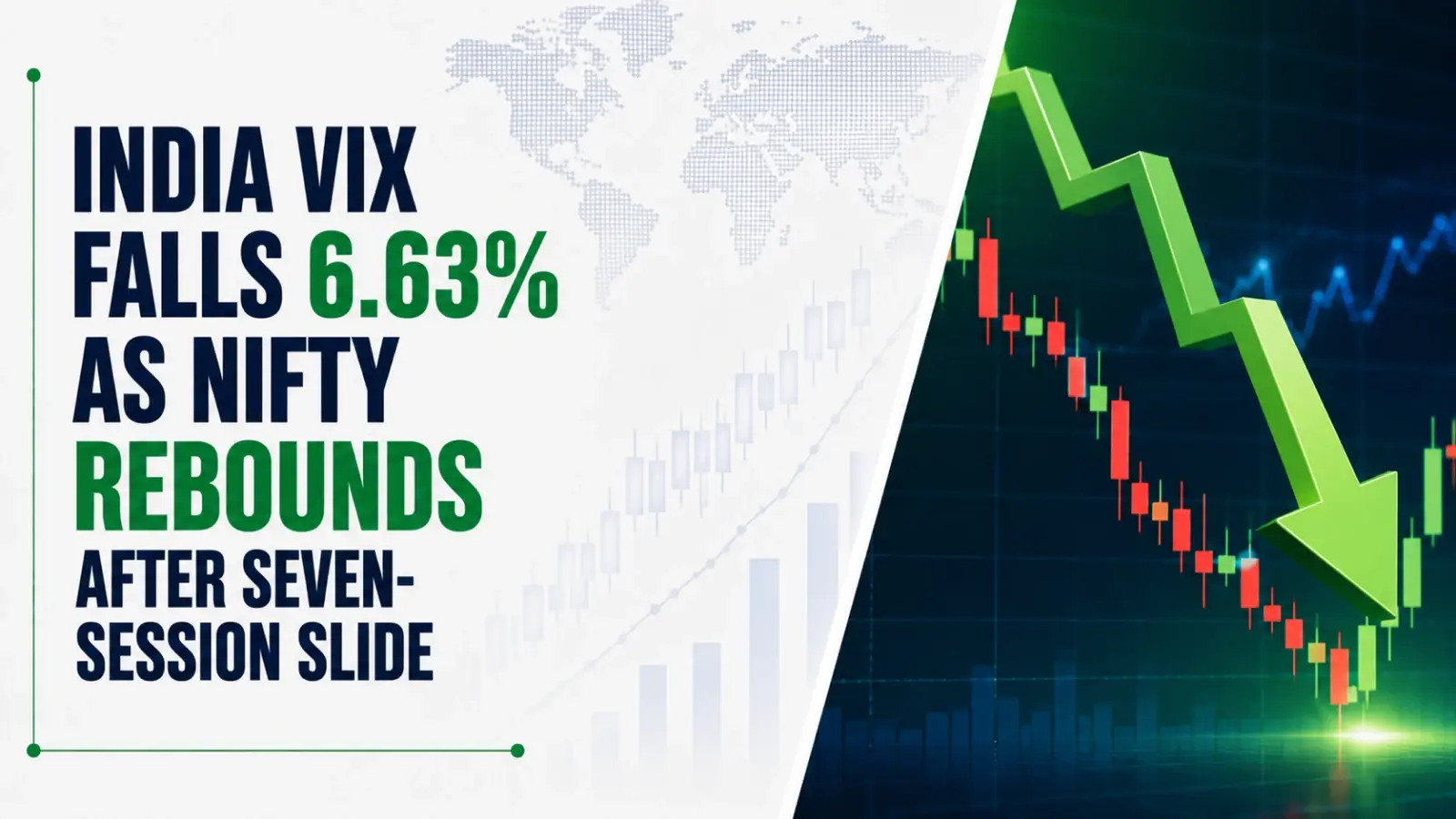
India VIX Falls 6.63% as Nifty Rebounds After Seven-Session Slide
Authored By HDFC SKY | Last Modified: Aug 20, 2026 04:10 PM IST
Open Free Demat Account
Open Free Demat Account
Mumbai, Aug 20: India VIX declined sharply during Thursday’s closing session, falling 0.75 points or 6.63% to 10.57 as of 15:43 IST, compared with the previous close of 11.32. The volatility index opened at 11.32, touched an intraday high of 11.32 and fell to a low of 9.33. The move came as the Nifty 50 ended a seven-session losing streak, while global bond yields eased and Indian equities recovered.

India VIX Falls 6.63% as Market Stress Eases
The sharp decline in India VIX indicates that near-term volatility implied by Nifty options has moderated. India VIX measures expected volatility over approximately the next 30 calendar days, based on Nifty option prices. Historical data also showed the index at approximately 10.665, down 0.6575 points or 5.81%.
The index remains close to the lower end of its recent range. Its 52-week range is 8.72 to 28.90, leaving the latest reading substantially below the yearly high. The intraday low of 9.33 also places India VIX relatively close to its 52-week low.
Nifty Ends Seven-Session Slide as Equities Recover
The immediate domestic backdrop for the decline in India VIX was the recovery in Indian equities after seven consecutive sessions of losses. The Nifty 50 rose around 0.50% to 24,197.48, while the Sensex gained around 0.66% to 77,431.57. Information technology stocks advanced around 1.4%, financials gained approximately 0.7%, and 13 of 16 major sectors moved higher.
The rebound followed a prolonged period of weakness and reduced immediate downside pressure in the broader market. Short covering was also identified as a factor behind the recovery. Such a move can reduce the immediate requirement for downside protection, contributing to lower option premiums and implied volatility.
US Treasury Buybacks Push Yields Lower
A major global development was the US Treasury’s decision to double the size of certain longer-duration Treasury buyback operations to at least $4 billion per operation after a sharp rise in long-term Treasury yields.
Following the announcement, the US 30-year Treasury yield fell around 9 basis points to 5.195%, while the 10-year yield declined more than 5 basis points to around 4.653%. Lower US yields eased an immediate source of pressure for emerging markets and supported a broader recovery across global equities, creating a more stable external backdrop for Indian markets.
Asian Markets Rally as Global Risk Pressure Eases
Asian equities also strengthened following the US Treasury action, providing another supportive factor for the Indian market. South Korea’s KOSPI recorded a strong rebound, while Japanese and other Asian markets also advanced.
The sequence of lower US bond yields, stronger Asian equities and a recovery in Indian benchmarks reduced immediate market stress. With the Nifty recovering after its extended decline, the combined backdrop was consistent with lower demand for near-term hedging and a decline in India VIX.
Rupee Strengthens as Dollar and Yield Pressures Ease
The Indian rupee also strengthened during Thursday’s session. Reports placed the currency at around ₹95.56 per US dollar, representing an improvement of approximately 17–19 paise, helped by a softer US dollar, Reserve Bank of India intervention and improved global bond-market conditions.
Currency stability is relevant because a weaker rupee can add pressure through imported inflation, crude-import costs, corporate margins and foreign-investor returns. The rupee’s movement today therefore removed another immediate source of uncertainty while India VIX was declining.
Brent Near $92 Keeps Inflation Risk Elevated
The decline in volatility occurred despite crude oil remaining elevated. Brent crude was around $91–$92 a barrel, with reports placing it at approximately $91.7 and other intraday references above $92.
Higher crude prices remain relevant for India because they can raise the import bill and contribute to pressure on the rupee and inflation. However, the elevated oil price did not represent a fresh shock during Thursday’s session. This allowed the market to absorb the existing risk while equity prices recovered and India VIX moved lower.
US-Iran Tensions Keep Geopolitical Risk Active
Geopolitical risks also remain in the background. The ongoing US-Iran and broader Middle East tensions continue to influence crude prices, with concerns surrounding regional energy supplies and shipping contributing to the elevated oil market.
The risk has therefore not disappeared even as India VIX declined. The current move instead reflects reduced immediate market stress without removing the geopolitical factors that remain relevant to oil and Indian markets.
RBI Minutes Highlight Fresh Rate Risks
The Reserve Bank of India’s August Monetary Policy Committee minutes added another domestic risk factor. The RBI retained the repo rate at 5.25%, while policymakers discussed inflation risks and the possibility of future rate increases if pressures intensify.
Higher oil prices and supply-side pressures were among the factors discussed. The development creates a chain between crude prices, inflation, monetary policy and equity-market conditions, although it did not prevent India VIX from declining during Thursday’s session.
Strong DII Buying Adds to Market Stability
Cash-market data for 19 August 2026 showed Foreign Institutional Investor and Foreign Portfolio Investor net buying of approximately ₹408 crore, while Domestic Institutional Investors recorded considerably stronger net buying of around ₹3,974 crore.
The strong DII activity, alongside the market rebound on Thursday, formed part of the supportive domestic backdrop. The single-day flow data, however, only describes the reported activity for that session and does not establish a broader positioning trend.
Short Covering Adds to Thursday’s Market Rebound
Short covering was another factor identified behind the recovery in Indian equities. After seven consecutive sessions of Nifty declines, traders holding short positions could unwind those positions as the index moved higher.
The resulting upward movement reduced immediate downside pressure and coincided with the fall in India VIX. The distinction is important because Thursday’s recovery included position unwinding alongside the broader improvement in market conditions.
Earnings Season Fades as Macro Risks Take Focus
The June-quarter earnings season is nearing its closing phase, leaving fewer immediate domestic corporate catalysts. As the earnings calendar becomes less prominent, market conditions remain more closely linked to crude prices, geopolitics, global bond yields, currencies, foreign flows and central-bank policy.
This shift is relevant for India VIX because company-specific earnings events are becoming less dominant while macroeconomic and geopolitical developments continue to influence the broader volatility backdrop.
India VIX Nears Lower End of 52-Week Range
At 10.57, India VIX remains well below its 52-week high of 28.90 and is only 1.85 points above the 52-week low of 8.72. The intraday low of 9.33 brought the index even closer to that lower boundary.
The August seasonality data also show that India VIX has delivered positive returns in 12 of 18 years. For August, the maximum positive change is 68.84% in 2015, the average positive change is 18.10%, the maximum negative change is -11.26% in 2016, the average negative change is -6.36%, and the average change is 9.95%.
IPO Activity Adds a Secondary Liquidity Factor
Primary-market activity is another consideration in the wider market backdrop. The recent surge in IPO activity and institutional placements has been highlighted as a potential constraint on secondary-market liquidity, as capital directed towards primary issues can reduce liquidity available in secondary markets.
This is not a direct driver of Thursday’s India VIX decline, but it remains part of the broader liquidity environment surrounding Indian equities.
India VIX Falls Despite Unresolved Macro Risks
India VIX’s decline from 11.32 to 10.57, alongside the 9.33 intraday low, shows that immediate option-implied volatility has eased as the Nifty recovered from its seven-session decline. Lower US Treasury yields, stronger Asian equities, a firmer rupee, institutional buying and short covering supported the calmer session.
At the same time, Brent near $92, US-Iran tensions, RBI inflation concerns, potential rate risks, recent Nifty weakness and global bond-market uncertainty remain unresolved factors in the broader market backdrop.
India VIX closed the session at 10.57, down 6.63%, after touching 9.33 intraday. The decline coincided with the Nifty’s recovery, lower US Treasury yields, stronger Asian markets, rupee appreciation and institutional buying, while crude, geopolitical tensions and RBI inflation concerns remained active factors.
Source
- https://www.nseindia.com/reports-indices-historical-vix
Disclaimer
If you have any concerns, questions, or wish to point out any discrepancies in our content, please feel free to write to us at content@hdfcsec.com.
Please Note: The information shared is intended solely for informational purposes and does not make any investment recommendations
HDFC SKY, one of India’s most trusted trading platforms, has been recognized with the Next-Gen Digi Content Awards 2025–26.
Disclaimer
At HDFC SKY*, we take utmost care and due diligence in curating and presenting news and market-related content. However, inadvertent errors or omissions may occasionally occur.
If you have any concerns, questions, or wish to point out any discrepancies in our content, please feel free to write to us at content@hdfcsec.com.
Please Note: The information shared is intended solely for informational purposes and does not make any investment recommendations.
HDFC SKY from HDFC Securities, one of most trusted trading platforms in India, has been recognized with the *Next-Gen Digi Content Awards 2025-26.
 Join Us
 Add as preferred source on Google


More Business News






Open Free Demat Account
Open Free Demat Account











Invest Anytime, Anywhere


By signing up I certify terms, conditions & privacy policy