Nifty 50
- Power Grid Corp₹2704.15 (1.56%)
- HCL Technologies₹1,207.70-22.10 (-1.80%)
- Tech Mahindra₹1,524.2016.20 (1.07%)
- Tata Steel₹186.75-2.00 (-1.06%)
- HDFC Life Insurance ₹519.455.45 (1.06%)
- Hindalco Industries₹1,017.30-9.60 (-0.93%)
- ONGC₹236.212.19 (0.94%)
- Sun Pharmaceutical₹1,850.80-14.10 (-0.76%)
- SBI₹1,009.208.70 (0.87%)
- InterGlobe Aviation₹4,940-35.00 (-0.70%)
- Axis Bank₹1,249.1010.60 (0.86%)
- Max Healthcare₹1,031.30-6.20 (-0.60%)
- HDFC Bank₹692.255.15 (0.75%)
- JSW Steel₹1,302.20-7.80 (-0.60%)
- Shriram Finance₹1,036.607.60 (0.74%)
- Mahindra & Mahindra₹3,132.10-17.90 (-0.57%)
- Bajaj Finance₹1,046.607.30 (0.70%)
- Eicher Motors₹7,693-41.50 (-0.54%)
- Bharti Airtel₹1,826.3011.60 (0.64%)
- TCS₹2,197.60-10.40 (-0.47%)

- Offerings
- Tools & Platforms
Tools & Calculators
- Open API
- Calculators
- SIP Calculator
- CAGR Calculator
- Compound Interest Calculator
- FD Calculator
- RD Calculator
- EPF Calculator
- Retirement Calculator
- HDFC SIP Calculator
- Mutual Fund Return Calculator
- Lumpsum Calculator
- Step Up SIP Calculator
- ETF SIP Calculator
- Brokerage Calculator
- Equity Margin Calculator
- SWP Calculator
- EMI Calculator
- MTF Calculator
- Margin Pledge Calculator
- Algo Strategy
- Markets
Stocks
F&O
Mutual Funds
- More
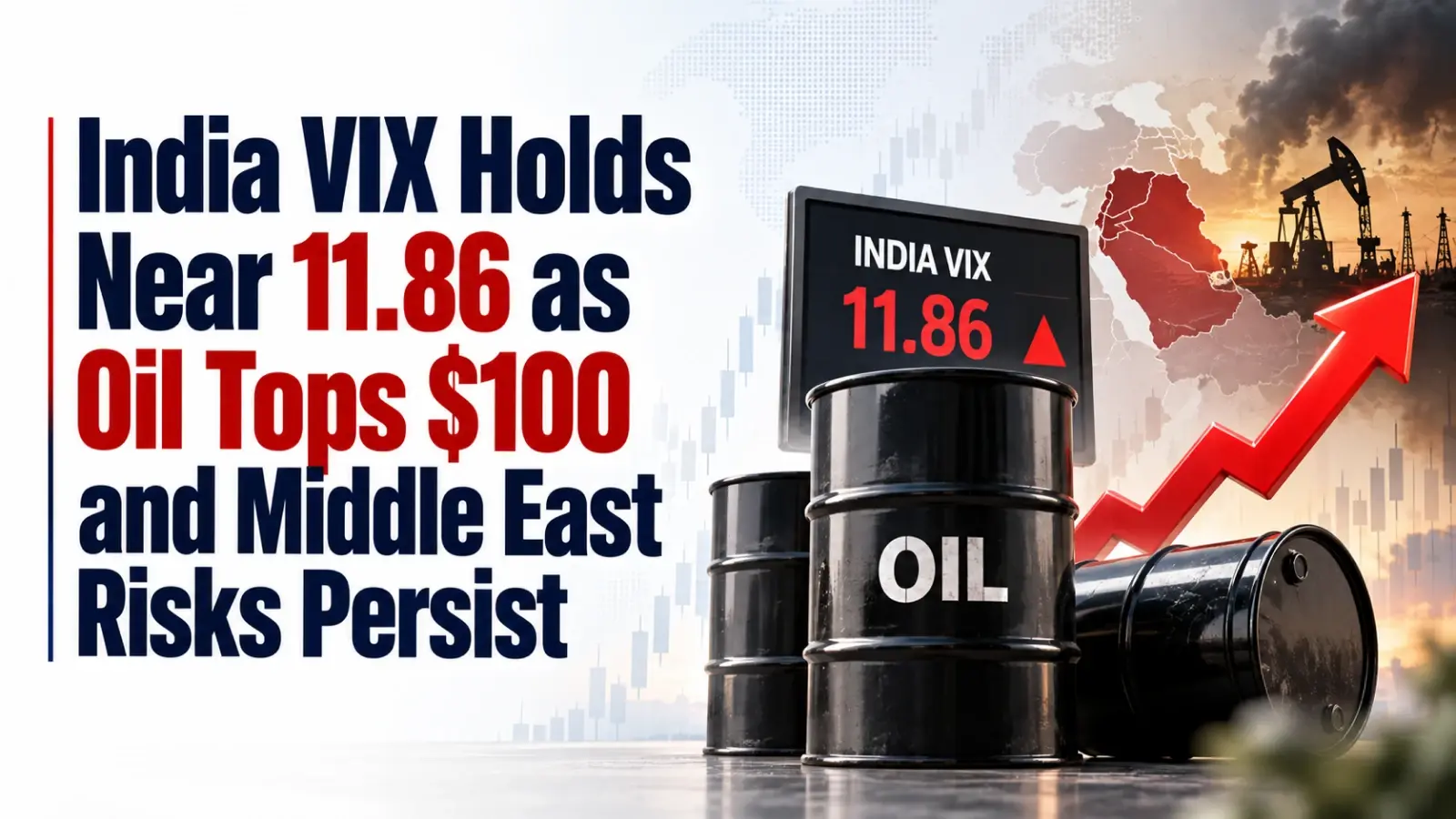
India VIX Holds Near 11.86 as Oil Tops $100 and Middle East Risks Persist
Authored By HDFC SKY | Published at: Sep 10, 2026 11:31 AM IST
Open Free Demat Account
Open Free Demat Account
Mumbai, Sept 10: India VIX was at 11.88 around 10:10 IST on Thursday, down 0.06 points or 0.5% from the previous close of 11.92, as elevated geopolitical and oil-market risks kept volatility expectations high. The index moved between 11.52 and 11.92 during the early session, after rising 6.81% on 9 September.

India VIX Stays Near 11.86 Despite Global Risk Pressure
India VIX had already absorbed a sharp increase in volatility expectations during the previous session, when it opened at 11.23, touched 12.05 and closed at 11.92. By around 10:05 IST on 10 September, the index was at approximately 11.8575, down about 0.5%, with an early-session range of 11.5275–11.8975.
The movement came as the domestic market remained relatively contained despite a weak global backdrop. The Nifty 50 opened at around 23,446.30, up 14.8 points or 0.06%, while the Sensex opened at 74,826.09, higher by around 61.86 points or 0.08%. By approximately 9:36 IST, the Nifty was at 23,429.25, down 0.01%, while the Sensex stood at 74,759.54, down 0.01%.
Hormuz Shipping Disruption Keeps Oil Above $100
The key geopolitical development entering Thursday’s session was further escalation in the US-Iran conflict around oil shipping. Iran said it had attacked 10 ships near the Strait of Hormuz following US strikes that destroyed five Iranian oil tankers. Preliminary tracking data showed only seven vessel transits through the Strait, compared with 12 the previous day and a 10-day average of 14. No LNG tankers exited the Strait in that data.
The Strait of Hormuz is a major route for global energy shipments, making the disruption an important part of the market’s oil-risk backdrop. Brent crude remained above the psychologically important $100 per barrel level on Thursday, trading at around $101.4, while other market reporting placed Brent at approximately $101.84 and West Texas Intermediate (WTI) near $96.
Brent had crossed $100 on Wednesday for the first time since July, meaning the price breakout itself was not new on Thursday. However, continued geopolitical developments kept the possibility of prolonged oil-market disruption in focus.
US VIX Rises 3.6% as Treasury Yields Climb
Global markets also carried a higher volatility backdrop into the Indian session. The MSCI Asia-Pacific index fell about 1%, while Japan’s Nikkei and South Korea’s Kospi declined by more than 1% during the morning. Other reported moves included the Nikkei 225 at around -0.9%, the Hang Seng at approximately -1.4% and the Straits Times at around -0.6%.
Wall Street had also weakened overnight. The S&P 500 fell about 0.5%, while the Nasdaq declined as oil moved above $100 and Treasury yields increased. The Cboe VIX, the US volatility index, rose 3.6% to 16.29 on 9 September, moving above its 50-day moving average for the first time since late July.
The US 10-year Treasury yield remained around 4.84%, close to its highest level since 2023. The combination of higher crude prices, elevated Treasury yields and weaker global equities added to the volatility backdrop surrounding Indian markets.
Rupee Near ₹95 Adds to Domestic Market Pressure
The rupee was another key domestic factor as it remained under pressure alongside higher crude prices. The currency was expected to open around ₹95.15–₹95.20 per US dollar, compared with Wednesday’s close of ₹95.1050. It had already weakened by around 0.7% over the preceding two sessions as oil prices increased.
The currency movement came alongside concerns about inflation, the current account, corporate costs and monetary policy. Market reporting also highlighted expectations that Reserve Bank of India (RBI) intervention could provide only limited relief while crude remained above $100.
The domestic market had entered Thursday after three consecutive sessions of Nifty declines. On 9 September, the Nifty 50 fell 0.86% to 23,431.50, while the Sensex declined 1.08% to 74,764. Thirteen of 16 major sectors fell, with Nifty IT dropping 3.24%. Mid-cap and small-cap stocks also weakened.
FII Selling Offsets DII Buying on September 9
Foreign Institutional Investors (FIIs) sold approximately ₹583 crore of Indian equities on 9 September, while Domestic Institutional Investors (DIIs) purchased around ₹1,509 crore, extending their buying streak.
The contrasting flows formed part of the domestic market backdrop as global risks remained elevated. FII selling coincided with concerns around crude prices, currency weakness, US Treasury yields and geopolitical developments, while DII buying provided a counterbalance.
The Nifty’s relatively stable opening on Thursday indicated that the domestic index had not extended Wednesday’s decline sharply during the opening session. This coincided with India VIX easing slightly rather than making a fresh move above the previous day’s 12.05 high.
US Inflation Data Raises Near-Term Volatility Risk
Markets were also focused on upcoming US inflation data, including consumer and producer price readings, because the data could influence expectations surrounding the Federal Reserve’s next policy decision. The oil-price increase added another factor to the inflation backdrop.
Global central-bank expectations also remained relevant, with markets assessing developments involving the Federal Reserve, European Central Bank and Bank of Japan. Expectations of further policy changes in Europe and Japan added to the broader interest-rate and currency-market backdrop.
For Indian markets, the combination of crude above $100, a rupee near ₹95 per dollar, the US 10-year yield near 4.84%, weaker Asian equities and higher US volatility formed the external environment in which India VIX traded on Thursday.
India VIX September History Shows 9 Positive Years
Historical seasonality data shows that India VIX has recorded positive September returns in 9 out of 18 years. Its maximum positive September change was 34.92% in 2018, while the average positive change was 17.56%. The maximum negative September change was -26.10% in 2009, with an average negative change of -9.93%. The average September change across the period was 3.81%.
At around 10:10 IST, India VIX remained within its broader 52-week range of 8.72–28.90. Its technical rating was Neutral. Previous-session pivot calculations placed the classic pivot at 11.50, with resistance levels at 12.47, 13.01 and 13.98, while support levels stood at 10.96, 9.99 and 9.45.
Solar-Energy Company Context Does Not Drive India VIX
India VIX is an index measuring expected market volatility and is not a company share. Therefore, company-specific financial information is not applicable to the index. Its movement on 10 September was instead presented against domestic equity performance, currency movements, crude prices, global markets, bond yields and geopolitical developments.
As of the early session, the central distinction was between an elevated volatility level and a fresh increase in volatility. India VIX remained close to 11.86–11.88, while the Nifty stayed around 23,400 and did not show a sharp opening decline.
India VIX remained elevated near 11.88 on 10 September, but eased 0.5% in the early session after rising 6.81% a day earlier. The key developments remained Brent above $100, Hormuz shipping disruption, a rupee near ₹95, higher US yields and weaker global equities, while domestic indices remained relatively stable.
Source
- https://www.nseindia.com/reports-indices-historical-vix
Disclaimer
At HDFC SKY*, we take utmost care and due diligence in curating and presenting news and market-related content. However, inadvertent errors or omissions may occasionally occur.
If you have any concerns, questions, or wish to point out any discrepancies in our content, please feel free to write to us at content@hdfcsec.com.
Please Note: The information shared is intended solely for informational purposes and does not make any investment recommendations.
HDFC SKY from HDFC Securities, one of most trusted trading platforms in India, has been recognized with the *Next-Gen Digi Content Awards 2025-26.
 Join Us
 Add as preferred source on Google


More Business News










Open Free Demat Account
Open Free Demat Account











Invest Anytime, Anywhere


By signing up I certify terms, conditions & privacy policy