Nifty 50
- Apollo Hospitals₹8,027.50361.50 (4.72%)
- BSE₹3,287.20-47.60 (-1.43%)
- ITC₹26611.00 (4.31%)
- Reliance Industries₹1,170.30-7.70 (-0.65%)
- Eicher Motors₹7,050282.50 (4.17%)
- JSW Steel₹1,168-7.20 (-0.61%)
- TCS₹2,15680.00 (3.85%)
- Cipla₹1,301-5.80 (-0.44%)
- HCL Technologies₹1,216.7039.80 (3.38%)
- Adani Ports₹1,76153.00 (3.10%)
- Infosys₹1,023.4026.40 (2.65%)
- Shriram Finance₹940.4523.20 (2.53%)
- Tata Motors PV₹279.906.90 (2.53%)
- UltraTech Cement₹10,675249.00 (2.39%)

- Offerings
- Tools & Platforms
Tools & Calculators
- Open API
- Calculators
- SIP Calculator
- CAGR Calculator
- Compound Interest Calculator
- FD Calculator
- RD Calculator
- EPF Calculator
- Retirement Calculator
- HDFC SIP Calculator
- Mutual Fund Return Calculator
- Lumpsum Calculator
- Step Up SIP Calculator
- ETF SIP Calculator
- Brokerage Calculator
- Equity Margin Calculator
- SWP Calculator
- EMI Calculator
- MTF Calculator
- Margin Pledge Calculator
- Algo Strategy
- Markets
Stocks
F&O
Mutual Funds
- More
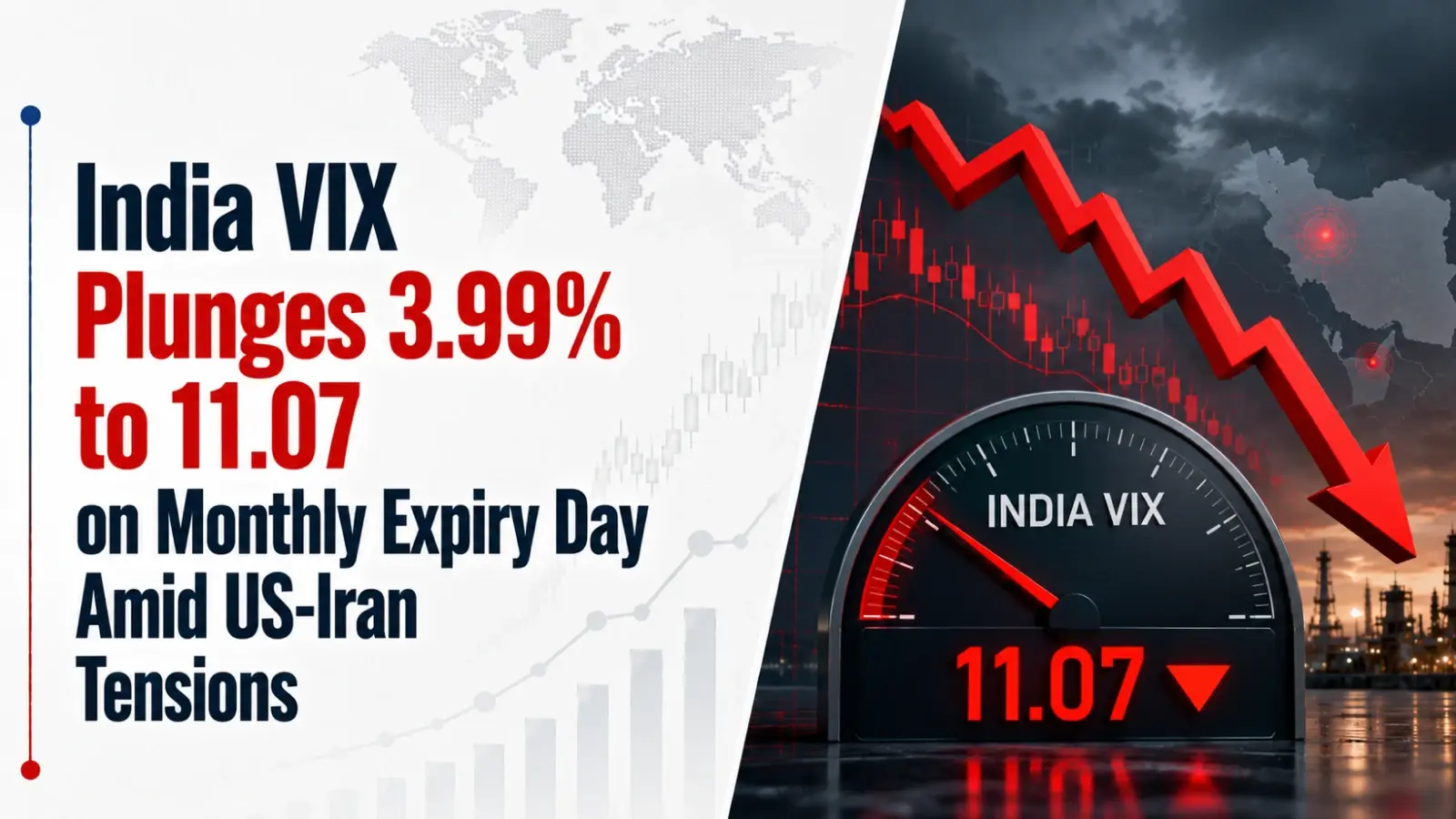
India VIX Plunges 3.99% to 11.07 on Monthly Expiry Day Amid US-Iran Tensions
Authored By HDFC SKY | Last Modified: Aug 25, 2026 05:01 PM IST
Open Free Demat Account
Open Free Demat Account
Mumbai, Aug 25: The India VIX, widely regarded as the market’s fear gauge, witnessed a sharp decline of 3.99 per cent to settle at 11.07 on Tuesday, despite opening unchanged at 11.53 following the previous session’s 2.95 per cent rise.
The volatility index touched an intraday low of 9.45 before recovering, marking a session where easing market panic outweighed escalating geopolitical tensions between the US and Iran and elevated crude oil prices hovering around $92 per barrel.
The index’s day range of 9.45 to 11.61 contrasted sharply with its 52-week range of 8.72 to 28.90, underscoring the relatively contained volatility despite multiple domestic and global triggers.

Gap-Up Opening Transforms to 3.99% Decline as Panic Eases
The India VIX opened flat at 11.53 after having risen 2.95 per cent in the prior session, but quickly established a downward trajectory throughout Tuesday’s trading. The index recorded its intraday high at 11.61 during the early minutes before declining steadily to touch a session low of 9.45 by mid-afternoon.
By 12:25 PM IST, the volatility gauge had dropped 3.01 per cent to 11.18, indicating that market participants absorbed the day’s expiry-related adjustments and geopolitical developments without triggering sustained fear. The index’s ability to recover from its lows and close significantly lower reflected a broad-based easing of anxiety as the session progressed, despite a weak start in the benchmark indices.
Nifty Monthly Expiry Locks Trading Band at 24,150-24,200 with 8.32 Cr OI
The August 25 monthly Nifty derivatives expiry emerged as the most direct structural factor influencing the India VIX, given that the volatility index is derived from Nifty option prices. The option chain revealed significant positioning, with 4.47 crore contracts in open interest at the 24,200 Call strike indicating stiff resistance, while 3.85 crore contracts at the 24,150 Put strike established a strong floor. This narrow trading band of 24,150-24,200 meant option premiums priced in a tight range, directly feeding into India VIX calculations and preventing a spike in volatility expectations.
Traders actively managed expiring positions throughout the session, with the put-call ratio declining to 0.83, suggesting a tilt towards the short side, while rollovers stood at 59 per cent as participants adjusted positions ahead of the new series. The orderly progression of the expiry without major settlement disruptions allowed the volatility index to trend lower, reflecting confidence in the market’s ability to absorb the monthly churn.
Broad Market Weakness Pressures IT and Metal Sectors at Opening
The Nifty 50 opened 0.18 per cent lower at 24,175.75, while the Sensex declined 0.10 per cent to 77,295.49, with 14 of 16 major sectors trading in the red at the opening bell. IT stocks faced particular pressure as HCL Tech and Tech Mahindra declined nearly 1 per cent each, dragging the Nifty IT index down approximately 0.4 per cent.
The Nifty Metal index dropped around 0.6 per cent, reflecting broad-based sectoral weakness triggered by global cues. This weaker market backdrop meant downside protection and option pricing were assessed against a declining equity market, directly influencing option premiums and consequently impacting India VIX.
The Nifty 50 found technical support at 24,150, which aligned with the maximum put open interest, while resistance at 24,200 matched the highest call open interest concentration.
Institutional Flows Show Divergence as FIIs and DIIs Stay Net Buyers
Foreign institutional investors remained net buyers on August 24, purchasing equities worth approximately ₹1,181 crore, while domestic institutional investors extended their buying streak to a tenth consecutive session with net purchases of ₹2,493 crore.
Despite this sustained institutional support providing a cushion to the markets, the derivatives expiry positioning with rollovers at 59 per cent and the put-call ratio at 0.83 indicated a cautious undertone among participants.
The interplay between strong domestic buying interest and global uncertainty created a balanced environment where option premiums did not escalate, allowing the India VIX to decline from its opening levels. The institutional flows acted as an indirect anchor, preventing a sharper sell-off that could have otherwise pushed volatility higher.
US-Iran Sanctions Escalate Geopolitical Uncertainty Ahead of Market Open
The dominant global trigger before Indian markets opened was the expansion of US sanctions targeting Iran, described as an “Economic D-Day” by Treasury Secretary Scott Bessent, announcing a sweeping new sanctions campaign. The escalation followed the expiry of the 60-day ceasefire window with no further talks currently planned, while Tehran threatened retaliation, keeping investors concerned about possible disruptions around the Strait of Hormuz.
This geopolitical uncertainty directly impacted risk appetite and was reflected in Indian equities at the open, with analysts noting that Indian markets were expected to witness heightened volatility due to weakness across global equities amid this renewed standoff.
However, the India VIX’s decline despite these tensions suggested market participants viewed the geopolitical risks as contained for the session, choosing to focus on the technical positioning around the monthly expiry rather than panicking over the geopolitical headlines.
Brent Crude at $92 Squeezes Rupee and Corporate Margins in Early Trade
Brent crude traded around $92 to $92.50 per barrel during India’s market hours, remaining particularly sensitive to Middle East developments and emerging as one of the biggest factors influencing investor sentiment. Elevated crude prices impact India through multiple channels, including increased import bills, pressure on the rupee, inflationary concerns, and reduced corporate margins. The rupee fell 4 paise to 95.74 against the US dollar in early trade, pressured by elevated crude prices and importer dollar demand after opening at 95.73.
The currency’s weakness added to the complex interplay of factors affecting market sentiment and option pricing throughout the session, yet the volatility index showed resilience by moving lower, indicating that the oil price shock was already priced into the market’s immediate expectations.
Weak Asian Markets Follow US Tech Sell-Off Ahead of Nvidia Earnings
Asian equities declined tracking losses on Wall Street as investors reduced exposure to technology stocks ahead of earnings reports. US markets on August 24 showed mixed performance with the Dow Jones gaining 0.26 per cent to 53,417, while the S&P 500 fell 0.28 per cent to 7,652, and the Nasdaq declined 0.76 per cent to 25,980, with technology stocks under pressure ahead of Nvidia’s earnings.
This cautious global mood reduced buying interest in Indian equities, contributing to the weak market opening and the initial pressure on the Nifty. The global risk-off sentiment influenced option pricing through reduced risk appetite, yet the India VIX’s technical strength and the expiry-driven positioning prevented any significant spike in fear, allowing the index to close substantially lower than its opening.
India VIX Technicals Signal Neutral Momentum with Support at 9.76
The technical assessment for the India VIX indicated a neutral rating across daily, weekly, and monthly timeframes, with moving averages and technical indicators showing balanced momentum.
Classic pivot levels placed resistance at R1: 12.09, R2: 12.64, and R3: 13.53, while support levels were established at S1: 10.65, S2: 9.76, and S3: 9.21. Fibonacci pivots aligned closely with classic levels, reinforcing the technical significance of these price points for future trading sessions.
Seasonality analysis revealed that in 12 out of 18 years, the India VIX has delivered positive returns in August, with an average change of 10.07 per cent and a maximum positive change of 68.84 per cent recorded in 2015.
The year-to-date return of 16.77 per cent for the volatility index reflected a relatively elevated volatility environment compared to historical averages, suggesting that while the current session saw a sharp decline, the broader trend remains one of heightened market sensitivity.
Market participants should monitor the 24,150 support and 24,200 resistance levels for the Nifty as critical reference points for future option positioning. Crude oil price movements around $92 per barrel and geopolitical developments in the Middle East warrant continued attention as potential volatility triggers. The India VIX’s technical indicators suggest neutral momentum with key support at 9.76 and resistance at 12.09, providing a framework for assessing market risk in the coming sessions.
Source
- https://www.nseindia.com/reports-indices-historical-vix
Disclaimer
If you have any concerns, questions, or wish to point out any discrepancies in our content, please feel free to write to us at content@hdfcsec.com.
Please Note: The information shared is intended solely for informational purposes and does not make any investment recommendations
HDFC SKY, one of India’s most trusted trading platforms, has been recognized with the Next-Gen Digi Content Awards 2025–26.
Disclaimer
At HDFC SKY*, we take utmost care and due diligence in curating and presenting news and market-related content. However, inadvertent errors or omissions may occasionally occur.
If you have any concerns, questions, or wish to point out any discrepancies in our content, please feel free to write to us at content@hdfcsec.com.
Please Note: The information shared is intended solely for informational purposes and does not make any investment recommendations.
HDFC SKY from HDFC Securities, one of most trusted trading platforms in India, has been recognized with the *Next-Gen Digi Content Awards 2025-26.
 Join Us
 Add as preferred source on Google


More Business News






Open Free Demat Account
Open Free Demat Account











Invest Anytime, Anywhere


By signing up I certify terms, conditions & privacy policy