Nifty 50
- Shriram Finance₹95849.25 (5.42%)
- Apollo Hospitals₹8,373-226.50 (-2.63%)
- InterGlobe Aviation₹5,406.80266.00 (5.17%)
- ONGC₹230.11-4.89 (-2.08%)
- BSE₹3,786.80185.30 (5.15%)
- NTPC₹317.80-4.15 (-1.29%)
- Bajaj Finance₹1,043.8049.80 (5.01%)
- Coal India₹394.85-4.80 (-1.20%)
- Tata Motors PV₹291.9013.40 (4.81%)
- Dr. Reddy's Labs₹1,359.20-14.80 (-1.08%)
- Maruti Suzuki₹12,522527.00 (4.39%)
- Power Grid Corp₹259.90-2.15 (-0.82%)
- Asian Paints₹2,512.8094.50 (3.91%)
- Bharti Airtel₹2,052-15.60 (-0.75%)
- Mahindra & Mahindra₹3,074.60112.70 (3.80%)
- ITC₹278.15-1.85 (-0.66%)
- UltraTech Cement₹12,208392.00 (3.32%)
- Cipla₹1,396.30-5.70 (-0.41%)
- Eternal₹355.6511.15 (3.24%)
- Reliance Industries₹1,308.40-2.60 (-0.20%)

- Offerings
- Tools & Platforms
Tools & Calculators
- Open API
- Calculators
- SIP Calculator
- CAGR Calculator
- Compound Interest Calculator
- FD Calculator
- RD Calculator
- EPF Calculator
- Retirement Calculator
- HDFC SIP Calculator
- Mutual Fund Return Calculator
- Lumpsum Calculator
- Step Up SIP Calculator
- ETF SIP Calculator
- Brokerage Calculator
- Equity Margin Calculator
- SWP Calculator
- EMI Calculator
- MTF Calculator
- Margin Pledge Calculator
- Algo Strategy
- Markets
Stocks
F&O
Mutual Funds
- More
India VIX Rises 0.26% As Global Cues and Geopolitical Developments Shape Early Market Trade
Authored By HDFC SKY | Last Modified: Nov 5, 2026 10:45 AM IST

Open Free Demat Account
Mumbai, 5 November 2026: India VIX was at 15.25, up 0.04 points or 0.26%, as of 10:22 IST on Thursday. The index opened at 15.18, compared with the previous close of 15.19, and recorded a reported day high of 15.42 and a day low of 11.62. The early session unfolded as Indian equities opened sharply higher, tracking a rally on Wall Street, lower crude oil prices and developments following the US midterm elections.

India VIX Opens at 15.18 as Nifty Gains 1.66%
India VIX began the session marginally below its previous close before rising to 15.25 by 10:22 IST. Its reported 52-week range was 8.72–28.90, while the year-to-date return stood at 60.86%. The day’s range was listed as 11.62–15.42 in the supplied market snapshot.
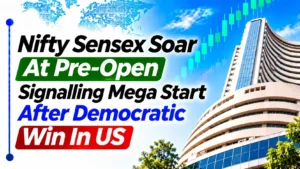
At 9:18 IST, the Nifty 50 had gained 1.66% to 24,357.30, while the Sensex rose 1.83% to 78,719.72. Both benchmarks were approaching three-month highs. Fourteen of the sixteen major sectors were advancing, and the mid-cap and small-cap indices had risen by more than 1%. The broad-based opening gain was a key domestic feature of the early session.
US Midterm Result and Iran Roadmap Shift Global Focus
The US midterm election outcome was a major overnight development ahead of Thursday’s Indian market opening. The supplied reports said Democrats had secured control of both the US House of Representatives and Senate. The result was viewed as potentially increasing political gridlock and limiting the Trump administration’s ability to pursue its policy agenda.
The outcome shaped expectations around trade, tariffs and US foreign policy, including hopes of greater scrutiny and diplomatic pressure concerning the US-Iran conflict. Iran was also reported to have proposed a seven-day roadmap towards ending the West Asia conflict. These were expectations of renewed engagement, not confirmation that the conflict had ended.
Brent Crude Near $93.50 After an 8.7% Previous-Session Fall
Brent crude was reported at around $93.50 a barrel during the Indian market opening on 5 November. This followed an 8.7% decline in the previous session and a further fall of around 1% on Thursday morning. The decline was associated with improving expectations around the US-Iran situation and the political implications of the US election result.
For India, lower oil prices were linked to reduced import costs, lower imported-inflation concerns, less pressure on the rupee and lower input costs for companies. Banking, aviation, paints, chemicals and automobile companies were identified in the supplied material as sectors sensitive to oil-price movements.
Wall Street Rally Lifts Dow 3.03% and Adds 1,569 Points
US equities closed sharply higher on 4 November. The Dow Jones Industrial Average rose 3.03%, the S&P 500 gained 1.58%, and the Nasdaq Composite advanced 1.44%. The Dow added more than 1,569 points during the session.
The rally provided a positive global backdrop before Indian trading began, alongside lower crude prices and gains in domestic benchmarks.
Asian Semiconductor Sell-Off Counters Wall Street’s Gains
Asian markets were mixed on 5 November. The South Korean KOSPI was reported lower by approximately 3.2%–4.5%, Japan’s Nikkei 225 fell around 0.4%, Taiwan’s Taiex declined approximately 1.6%, and the Shanghai Composite slipped around 0.14%. Hong Kong’s Hang Seng, by contrast, was higher by approximately 1.7%–2.5%. The reported ranges reflected readings taken at different points in the Asian session.
Technology shares, particularly South Korean semiconductor stocks, faced selling pressure. Samsung Electronics and SK Hynix were among the companies reported to have declined. Concerns cited included elevated artificial-intelligence valuations, the sustainability of data-centre investment, future semiconductor demand and the possibility of slower growth in technology infrastructure spending.
US Yields Fall to 4.84%–4.86% as Dollar Weakens
The US 10-year Treasury yield was reported at approximately 4.84%–4.86%, compared with around 4.89% previously. The dollar index was lower by approximately 0.3%–0.4%. The movements were linked with improved conditions for emerging-market assets.
The rupee had strengthened in the preceding session, closing at approximately ₹94.65 per US dollar, easing immediate concerns around imported inflation and dollar-denominated oil purchases.
FII Buying Reaches ₹7,284 Crore Before Thursday’s Session
Data available before the 5 November session showed foreign institutional investors (FIIs) as net buyers of ₹7,284.03 crore on 4 November. Domestic institutional investors (DIIs) were net sellers of ₹3,712.23 crore. The supplied information said foreign investors had recorded a fourth consecutive session of net purchases.
These are 4 November figures, not confirmed Thursday transactions. The Nifty’s opening followed five consecutive sessions of gains, and the Sensex had reclaimed its 200-day moving average in the previous session. Titan Company was scheduled to announce its September-quarter results on 5 November.
India VIX Technical Rating Neutral with 15.48 Pivot
The daily technical rating for India VIX was NEUTRAL. The classic pivot point was 15.48, with resistance at 15.85, 16.50 and 16.87, and support at 14.83, 14.46 and 13.81. Under the Fibonacci method, the pivot was also 15.48; resistance levels were 15.87, 16.11 and 16.50, while support levels were 15.09, 14.85 and 14.46.
The Camarilla pivot was 15.48, with resistance at 15.28, 15.38 and 15.47, and support at 15.10, 15.00 and 14.91. The supplied technical note said these daily support and resistance levels were calculated using the previous trading day’s price range. Moving-average and technical-indicator readings were unavailable.
November Seasonality Shows Negative Returns in 11 of 18 Years
The seasonality snapshot showed that India VIX had recorded negative returns in 11 of the 18 years considered for November. The maximum positive change was 21.46% in 2021, and the average positive change was 12.15%. The maximum negative change was 19.92% in 2020, while the average negative change was 7.20%. The average November change was 0.33%. At 10:22 IST on 5 November, India VIX stood at 15.25, up 0.26%, after opening at 15.18. The early-session backdrop included the US election outcome, West Asia diplomatic expectations, lower crude prices, mixed Asian markets and a higher Indian market opening. The daily technical rating was NEUTRAL, with a pivot point of 15.48.
Disclaimer
The information shared here is intended solely for informational and educational purposes and does not constitute investment recommendations. While we practice strict due diligence in curating daily market data, readers must perform independent research before trading. To flag any real-time data discrepancies or content concerns, please write to us at content@hdfcsec.com.
 Join Us
 Add as preferred source on Google


More Markets News


2 min read





Open Free Demat Account












Invest Anytime, Anywhere


By signing up I certify terms, conditions & privacy policy