Nifty 50
- Bharat Electronics₹39817.90 (4.71%)
- TCS₹2,436-63.10 (-2.52%)
- Adani Enterprises₹2,709.20115.90 (4.47%)
- HCL Technologies₹1,405-34.10 (-2.37%)
- Titan Company₹4,754.40192.40 (4.22%)
- Coal India₹399.65-8.35 (-2.05%)
- Jio Financial ₹222.278.00 (3.73%)
- BSE₹3,601.50-64.20 (-1.75%)
- Max Healthcare₹927.1531.65 (3.53%)
- Infosys₹1,128.20-19.90 (-1.73%)
- Shriram Finance₹908.7523.95 (2.71%)
- Eternal₹344.50-4.95 (-1.42%)
- Bajaj Finance₹99424.00 (2.47%)
- Kotak Mahindra Bank₹459.40-5.25 (-1.13%)
- Adani Ports₹1,91043.10 (2.31%)
- Asian Paints₹2,418.30-19.50 (-0.80%)
- InterGlobe Aviation₹5,140.80115.80 (2.30%)
- Tata Consumer ₹1,068-5.00 (-0.47%)
- Bajaj Finserv₹1,756.5038.40 (2.24%)
- Tech Mahindra₹1,783-6.10 (-0.34%)

- Offerings
- Tools & Platforms
Tools & Calculators
- Open API
- Calculators
- SIP Calculator
- CAGR Calculator
- Compound Interest Calculator
- FD Calculator
- RD Calculator
- EPF Calculator
- Retirement Calculator
- HDFC SIP Calculator
- Mutual Fund Return Calculator
- Lumpsum Calculator
- Step Up SIP Calculator
- ETF SIP Calculator
- Brokerage Calculator
- Equity Margin Calculator
- SWP Calculator
- EMI Calculator
- MTF Calculator
- Margin Pledge Calculator
- Algo Strategy
- Markets
Stocks
F&O
Mutual Funds
- More
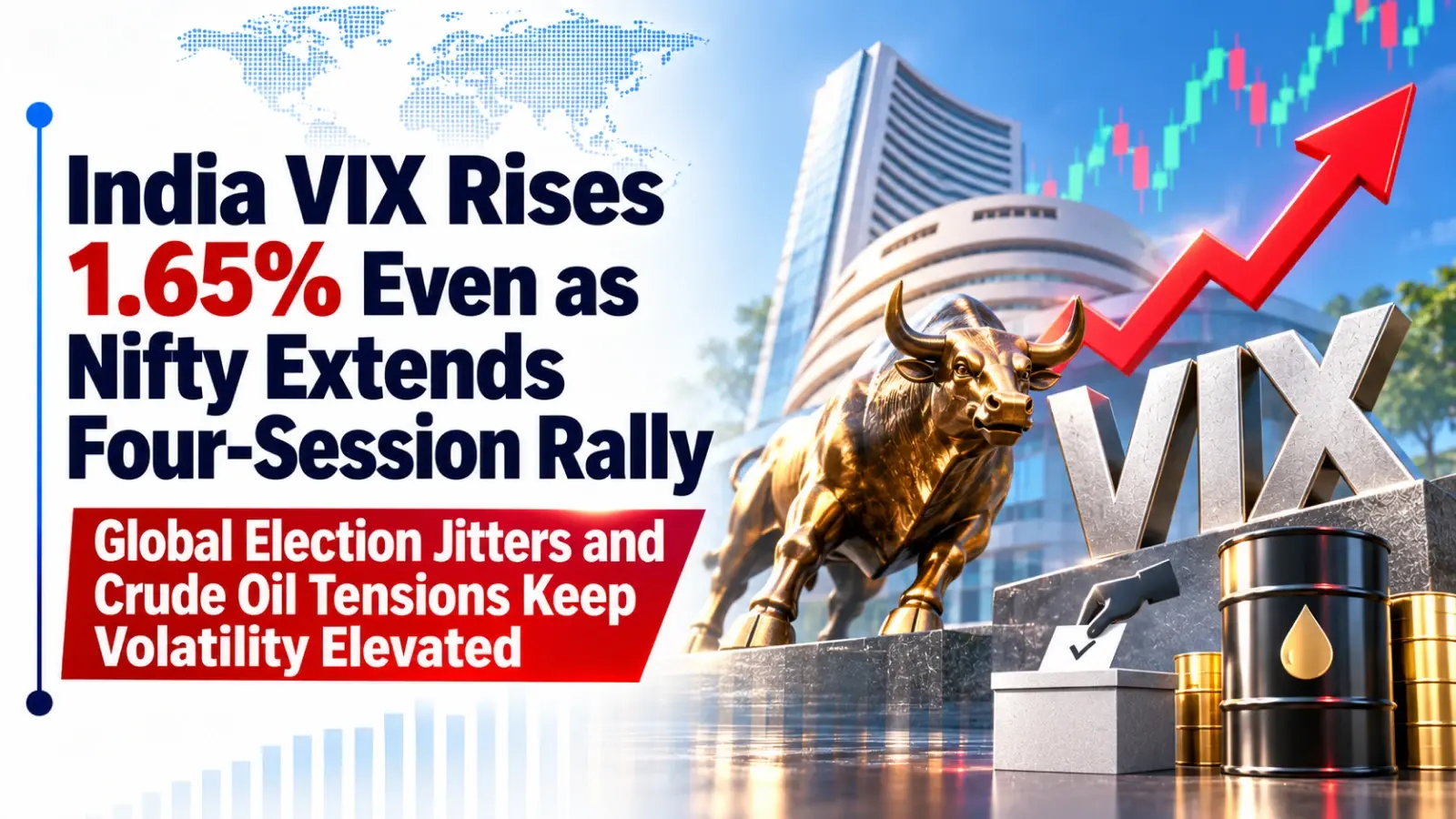
India VIX Rises 1.65% Even as Nifty Extends Four-Session Rally; Global Election Jitters and Crude Oil Tensions Keep Volatility Elevated
Authored By HDFC SKY | Published at: Nov 4, 2026 10:32 AM IST
Open Free Demat Account
Open Free Demat Account
Mumbai, 4 November 2026: India VIX, the market’s fear gauge, climbed 1.65% to trade at 15.98 as on 4 November 2026 at 10:16 IST, even as benchmark indices held marginally positive in early trade.
The volatility index opened at 15.72 and traded in a day range of 15.36 to 16.14, while its 52-week range stands wide at 8.72 to 28.90, reflecting a year of sharp swings and intermittent calm. The index had ended the previous session at 15.72 after gaining 1.44% day-on-day, marking its third consecutive session of gains despite the Nifty recording four straight sessions of advances.
On a year-to-date basis, India VIX has surged 68.78%, underscoring the extent of volatility priced into the derivatives market through 2026.

India VIX Climbs 1.65% to 15.98 Despite Nifty Holding Above 23,800 on Wednesday
The rise in India VIX on Wednesday came against a backdrop of mixed signals. The Nifty 50 had closed the previous session at 23,810.85, up 1.58%, while the Sensex ended at 76,917.85, gaining 1.62%.
Over four sessions, the Nifty added approximately 4.3%, a rally that typically tempers volatility expectations. However, options-market participants continued to price in uncertainty, with protective demand for Nifty puts remaining evident. The previous session’s opening for India VIX was 15.50, and the index’s sustained elevation suggests that traders were not entirely comfortable with the pace of the equity rally.
Technical indicators for India VIX present a neutral trend, with pivot levels placing classic resistance at 16.54 and support at 14.57, while the Camarilla method indicates immediate resistance at 15.90 and support at 15.54.
Foreign Inflows of ₹6,836 Crore Offset by DII Selling of ₹3,678 Crore as Market Breadth Weakens
Domestic institutional flows painted a mixed picture. Foreign institutional investors (FIIs) bought equities worth a net ₹6,836 crore on 3 November, continuing their buying streak for a third consecutive session.
Domestic institutional investors (DIIs), however, sold a net ₹3,678 crore, indicating that local participation was not uniformly bullish. The divergence assumes significance as sustained foreign buying generally provides buying support during corrections and can reduce expectations of sharp downside moves, potentially capping volatility. Yet the continued DII selling suggested that domestic institutions were booking profits after the rally.
At the opening bell on 4 November, market breadth was weak, with 14 out of 16 major sectors opening lower. Small-cap stocks declined 0.1% and mid-cap stocks fell 0.2%, even as the headline indices held marginally positive. By 9:17 AM, the Nifty was up approximately 0.1% at 23,840.15 and the Sensex was up 0.2% at 77,080.95, reflecting narrow market participation.
Asian Markets Slump 2-3% and US Midterm Elections Spark Global Uncertainty, Weighing on Sentiment
Global factors exerted significant upward pressure on volatility expectations. Asian markets witnessed broad weakness on Wednesday morning, with Japan’s Nikkei down around 3.2% to 3.6%, South Korea’s Kospi falling approximately 3.2%, Taiwan’s Taiex declining 2.3%, and Hong Kong and Shanghai also reporting weakness.
The sell-off was led by technology stocks amid concerns over elevated AI-sector valuations, sustainability of capital expenditure, financing requirements of data-centre companies, and potential regulatory scrutiny. The US midterm election results were another major source of uncertainty, with investors assessing the possibility of Democrats gaining control of Congress.
The outcome carried implications for US fiscal policy, trade and tariff policy, technology-sector regulation, and geopolitical developments. Closer home, GIFT Nifty traded around 23,710–23,728, lower by approximately 31–50 points, indicating a potentially weak opening for Indian equities and suggesting that traders were increasing demand for protective positions.
Crude Oil at $103–105 per Barrel and US Treasury Yields Near 4.96% Add to Inflation and Rupee Concerns
Crude oil prices remained a critical variable for India VIX. Pre-market reports showed Brent crude trading around $103–105 per barrel, while WTI was reported around $97 in one morning update.
The geopolitical situation involving the US and Iran remained uncertain, with reports of a US attack on Iranian territory creating concerns and indications that Qatar was attempting to bridge differences between the two countries. For India, a significant crude importer, sustained increases in oil prices can create inflationary pressure, raise import costs, pressure the rupee, and weigh on corporate profit margins.
Separately, the US 10-year Treasury yield was reported around 4.95–4.96%, with stronger-than-expected US job openings contributing to concerns about interest rates and inflation. Higher US yields can make US fixed-income investments more attractive, create pressure on emerging-market capital flows, and affect the dollar and emerging-market currencies, adding another layer of uncertainty for foreign institutional positioning.
Wall Street Ends Mixed as Dow Falls 0.38% and Nasdaq Gains 0.83%; India VIX Seasonality Shows November Trend
The previous US trading session ended mixed, with the Dow Jones down 0.38%, the S&P 500 up 0.36%, and the Nasdaq gaining 0.83%. The mixed performance provided neither a strong bullish nor an entirely bearish overnight signal for Indian markets. Seasonality data for India VIX shows that in 10 out of 18 years, the index has delivered negative returns in November.
The maximum positive change in November was 21.46% in 2021, while the maximum negative change was -19.92% in 2020. The average positive change for the month stands at 11.22%, the average negative change at -7.82%, and the average change at 0.65%. India VIX, which measures the expected volatility implied by Nifty options, is calculated from option premiums, strike-wise demand, time to expiry, and the options volatility surface.
Consequently, a falling Nifty does not automatically translate into a rising India VIX if option premiums are declining due to reduced demand for protection or volatility contraction. Conversely, volatility expectations can remain elevated even when the Nifty is marginally positive, as was the case on Wednesday.
Traders should monitor the actual movement of India VIX from its previous close of 15.72, along with whether the Nifty holds the 23,800 and 23,600 levels. Changes in at-the-money call and put implied volatility, put-call open interest shifts, and at-the-money straddle premiums in the Nifty option chain warrant close attention. Crude oil’s ability to sustain above $100–105 per barrel remains a key variable. These indicators together will provide a clearer picture of whether volatility is increasing or decreasing.
Disclaimer
The information shared here is intended solely for informational and educational purposes and does not constitute investment recommendations. While we practice strict due diligence in curating daily market data, readers must perform independent research before trading. To flag any real-time data discrepancies or content concerns, please write to us at content@hdfcsec.com.
 Join Us
 Add as preferred source on Google


More Markets News








Open Free Demat Account
Open Free Demat Account











Invest Anytime, Anywhere


By signing up I certify terms, conditions & privacy policy