Nifty 50
- Apollo Hospitals₹8,027.50361.50 (4.72%)
- BSE₹3,287.20-47.60 (-1.43%)
- ITC₹26611.00 (4.31%)
- Reliance Industries₹1,170.30-7.70 (-0.65%)
- Eicher Motors₹7,050282.50 (4.17%)
- JSW Steel₹1,168-7.20 (-0.61%)
- TCS₹2,15680.00 (3.85%)
- Cipla₹1,301-5.80 (-0.44%)
- HCL Technologies₹1,216.7039.80 (3.38%)
- Adani Ports₹1,76153.00 (3.10%)
- Infosys₹1,023.4026.40 (2.65%)
- Shriram Finance₹940.4523.20 (2.53%)
- Tata Motors PV₹279.906.90 (2.53%)
- UltraTech Cement₹10,675249.00 (2.39%)

- Offerings
- Tools & Platforms
Tools & Calculators
- Open API
- Calculators
- SIP Calculator
- CAGR Calculator
- Compound Interest Calculator
- FD Calculator
- RD Calculator
- EPF Calculator
- Retirement Calculator
- HDFC SIP Calculator
- Mutual Fund Return Calculator
- Lumpsum Calculator
- Step Up SIP Calculator
- ETF SIP Calculator
- Brokerage Calculator
- Equity Margin Calculator
- SWP Calculator
- EMI Calculator
- MTF Calculator
- Margin Pledge Calculator
- Algo Strategy
- Markets
Stocks
F&O
Mutual Funds
- More
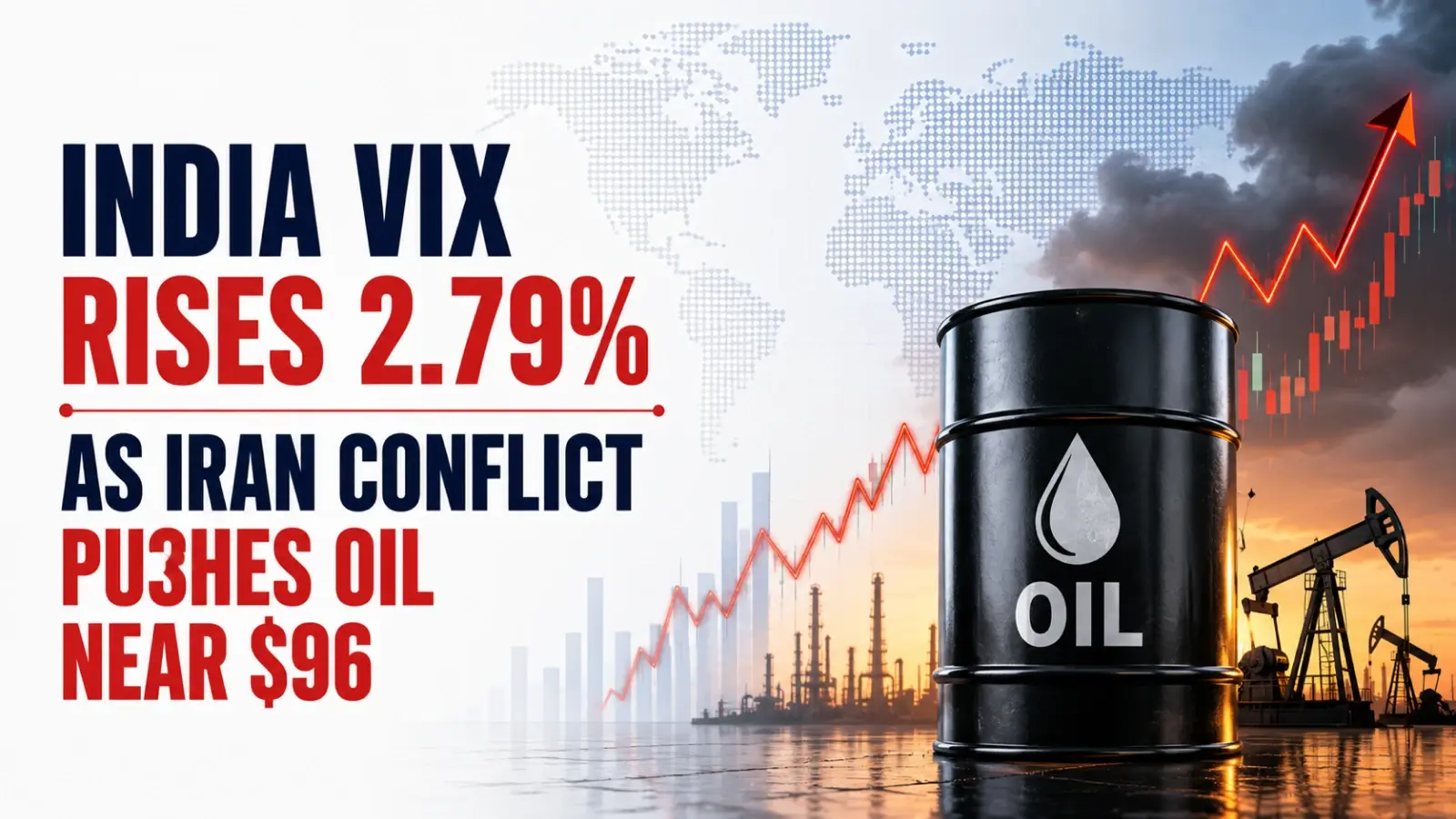
India VIX Rises 2.79% as Iran Conflict Pushes Oil Near $96
Authored By HDFC SKY | Last Modified: Sep 2, 2026 03:36 PM IST
Open Free Demat Account
Open Free Demat Account
Mumbai, Sept 2: India VIX rose 0.32 points, or 2.79%, to 11.85 at 10:13 IST on Wednesday, after opening at 11.49, as renewed US military action against Iran lifted crude prices and intensified concerns over energy supply, inflation and global bond yields. The volatility index touched an intraday high of 12.11 and a low of 10.54, while the Nifty 50 slipped towards 23,850 during the early session.

India VIX At 11.85 As Nifty Slips Below 24,000
India VIX, an options-implied measure of expected Nifty volatility, moved higher during the opening session rather than recording a sharp gap-up. At 9:44 IST, the index was reported at 11.90, up around 3.6%, after opening at 11.49. The reported range at that point was 10.5475–11.9375. By 10:13 IST, India VIX stood at 11.85, up 2.79%, with the day’s range at 10.54–12.11.
The previous session’s close was 11.49, meaning the index began almost unchanged before moving higher as Indian equities weakened. The movement indicates a gradual repricing of expected market volatility during early trade rather than an immediate spike into the higher levels seen during more stressed market episodes.
US Airstrikes on Iran Lift Geopolitical Risk and VIX
Renewed US military action against Iran emerged as the most significant fresh global development during Wednesday’s opening session. The escalation increased concerns over the wider West Asia conflict and possible disruption around the Strait of Hormuz, putting pressure on financial markets across Asia.
Indian equities declined alongside the rise in oil prices. The Nifty 50 was reported at 23,841.40, down around 0.89%, while the Sensex fell 0.79% to 76,333.20 during the morning session. The combination of geopolitical uncertainty, energy-supply concerns, inflation risks and weaker equities contributed to the increase in expected volatility reflected in India VIX.
Brent Near $96 Raises India’s Import and Inflation Risks
Brent crude climbed towards $95–96 per barrel, with reports placing it around $95.91, up approximately 1.3%, and at a five-week high. The rise in crude added another layer of pressure for India because higher oil prices can increase the country’s import bill and inflation risks.
The early-session oil move also raised concerns around corporate costs, the rupee, current-account pressures and interest-rate expectations. The possibility of further energy-price increases remained linked to the broader conflict, making the direction of crude prices less certain during the session.
Hormuz Disruption Fears Add to the Oil Shock
Concerns over potential disruption around the Strait of Hormuz amplified the market impact of the renewed fighting. The issue was not limited to the immediate increase in crude prices, as traders were also assessing the possibility of prolonged disruption to energy flows.
The heightened uncertainty around future oil supplies came as Brent approached $96, widening the range of possible outcomes for energy prices and adding to pressure on Indian equities. The geopolitical escalation therefore affected India VIX through both direct uncertainty and its implications for crude.
Asian Stocks Fall as Global Risk-Off Pressure Spreads
Indian markets also opened against a weaker Asian backdrop. The MSCI Asia-Pacific index fell 1.5%, while the KOSPI declined more than 3% and the Nikkei 225 dropped 2.6%. The declines followed renewed US–Iran tensions, higher oil prices and rising global bond yields.
The broad regional weakness provided an additional external pressure point for Indian equities. During the reported early session, all 16 major sectors were in the red, while small-cap and mid-cap indices declined approximately 0.8% and 1.1%, respectively.
US 10-Year Yield Near 4.81% Adds Rate Uncertainty
The US 10-year Treasury yield climbed to approximately 4.8122%, its highest level in nearly three years. Rising oil prices and concerns over inflation contributed to the increase, creating a combination of higher energy costs and higher global borrowing yields.
The movement also affected expectations surrounding monetary policy. Federal funds futures were reported to be pricing an approximately 67% probability of a 25-basis-point increase at the September Federal Reserve meeting. The changing rate outlook added to the uncertainty already created by the geopolitical and oil shock.
Wall Street Falls as Oil and Yields Move Higher
US equities also provided a negative overnight signal before Indian markets opened. The S&P 500 fell approximately 0.7%, while the Nasdaq declined around 1% as higher crude prices and Treasury yields increased concerns about inflation and interest rates.
The weakness in US equities, combined with declines across Asian markets, contributed to the broader global backdrop confronting Indian markets at the start of Wednesday’s session. GIFT Nifty was around 24,036 in early trading, pointing towards a muted-to-negative start.
Nifty Near 23,850 Adds Pressure After 24,000 Breaks
The Nifty 50 had closed at 24,055.80 on 1 September, with 23,950 identified as immediate support and 23,850 as another important level. During Wednesday’s session, the index moved towards and below the lower support region, with the reported level reaching 23,841.40, down approximately 0.89%.
The Sensex simultaneously declined to around 76,333.20, down 0.79%. The weakness across large-cap, mid-cap and small-cap segments added to the broad market pressure accompanying the rise in India VIX.
Rupee Faces Pressure from Oil and Higher US Yields
The rupee also came under pressure from the combination of higher crude prices and rising US Treasury yields. It had closed at approximately ₹94.95 per dollar on Tuesday, after reaching around ₹94.80, a two-month high.
The fresh external shock created renewed pressure on the currency during Wednesday’s opening session. At the same time, recent Reserve Bank of India intervention had provided support to the rupee. Foreign-currency inflows, including FCNR(B) deposits exceeding $100 billion before the 31 August deadline, had strengthened the central bank’s capacity to provide dollar liquidity.
August PMI Weakens as Manufacturing Growth Hits Five-Year Low
A fresh domestic development on 2 September was the release of August manufacturing Purchasing Managers’ Index data, which showed manufacturing growth slowing to its lowest level in five years. The data pointed to weaker demand and slower output and new orders, while employment recorded its first contraction in more than two years.
The domestic data added a growth-related concern to an opening session already dominated by geopolitical and crude-oil developments. By contrast, India’s 7.8% year-on-year GDP growth for April–June remained a background domestic stabilising factor rather than a fresh event during Wednesday’s session.
Oil Pressure Hits Airlines, Tyres and Paint Stocks
The increase in crude prices also affected sectors with direct exposure to energy and transportation costs. Oil marketing companies, tyre manufacturers, paint companies and airlines came under pressure during the session.
Company-specific developments provided some offset. Coal India rose around 3.6% after reporting a 5.5% increase in August coal supplies and announcing plans for an IPO of its Mahanadi Coalfields unit. Sun Pharma gained around 0.5% after reaching a favourable US pricing agreement that eased tariff concerns for two years. These developments, however, remained limited to individual companies and sectors.
September Seasonality Shows 3.83% Average VIX Gain
Historical seasonality data show that India VIX has delivered positive returns in 9 of 18 years during September. The maximum positive change was 34.92% in 2018, while the average positive change was 17.59%. The maximum negative change was -26.10% in 2009, with the average negative change at -9.93%. The overall average change for September stands at 3.83%.
India VIX currently has a 52-week range of 8.72–28.90. Its technical rating is Neutral. The Classic pivot levels are R1 12.66, R2 13.83, R3 15.54, PP 10.95, S1 9.78, S2 8.07 and S3 6.90.
India VIX Rise Remains Moderate at 11.85
The early-session movement remained moderate despite the fresh geopolitical shock. India VIX was at 11.85 by 10:13 IST, compared with 11.49 at the previous close. The index therefore remained well below its 52-week high of 28.90.
The opening-session developments were led by renewed US–Iran escalation, Brent crude near $96, Strait of Hormuz concerns, weaker Asian and US equities, the US 10-year yield near 4.81%, pressure on the rupee and weaker manufacturing PMI data. Against these factors, strong 7.8% GDP growth, recent RBI currency support and select company-specific developments provided counterweights.
India VIX’s early-session rise to 11.85 on 2 September followed renewed US–Iran escalation, Brent crude approaching $96, higher US Treasury yields and weaker global equities. Domestic manufacturing data also softened, while RBI support for the rupee and strong GDP growth provided counterweights. The move represented a measured increase in expected volatility during the opening session.
Source
- https://www.nseindia.com/reports-indices-historical-vix
Disclaimer
If you have any concerns, questions, or wish to point out any discrepancies in our content, please feel free to write to us at content@hdfcsec.com.
Please Note: The information shared is intended solely for informational purposes and does not make any investment recommendations
HDFC SKY, one of India’s most trusted trading platforms, has been recognized with the Next-Gen Digi Content Awards 2025–26.
Disclaimer
At HDFC SKY*, we take utmost care and due diligence in curating and presenting news and market-related content. However, inadvertent errors or omissions may occasionally occur.
If you have any concerns, questions, or wish to point out any discrepancies in our content, please feel free to write to us at content@hdfcsec.com.
Please Note: The information shared is intended solely for informational purposes and does not make any investment recommendations.
HDFC SKY from HDFC Securities, one of most trusted trading platforms in India, has been recognized with the *Next-Gen Digi Content Awards 2025-26.
 Join Us
 Add as preferred source on Google


More Business News





Open Free Demat Account
Open Free Demat Account











Invest Anytime, Anywhere


By signing up I certify terms, conditions & privacy policy