Nifty 50
- Apollo Hospitals₹8,027.50361.50 (4.72%)
- BSE₹3,287.20-47.60 (-1.43%)
- ITC₹26611.00 (4.31%)
- Reliance Industries₹1,170.30-7.70 (-0.65%)
- Eicher Motors₹7,050282.50 (4.17%)
- JSW Steel₹1,168-7.20 (-0.61%)
- TCS₹2,15680.00 (3.85%)
- Cipla₹1,301-5.80 (-0.44%)
- HCL Technologies₹1,216.7039.80 (3.38%)
- Adani Ports₹1,76153.00 (3.10%)
- Infosys₹1,023.4026.40 (2.65%)
- Shriram Finance₹940.4523.20 (2.53%)
- Tata Motors PV₹279.906.90 (2.53%)
- UltraTech Cement₹10,675249.00 (2.39%)

- Offerings
- Tools & Platforms
Tools & Calculators
- Open API
- Calculators
- SIP Calculator
- CAGR Calculator
- Compound Interest Calculator
- FD Calculator
- RD Calculator
- EPF Calculator
- Retirement Calculator
- HDFC SIP Calculator
- Mutual Fund Return Calculator
- Lumpsum Calculator
- Step Up SIP Calculator
- ETF SIP Calculator
- Brokerage Calculator
- Equity Margin Calculator
- SWP Calculator
- EMI Calculator
- MTF Calculator
- Margin Pledge Calculator
- Algo Strategy
- Markets
Stocks
F&O
Mutual Funds
- More
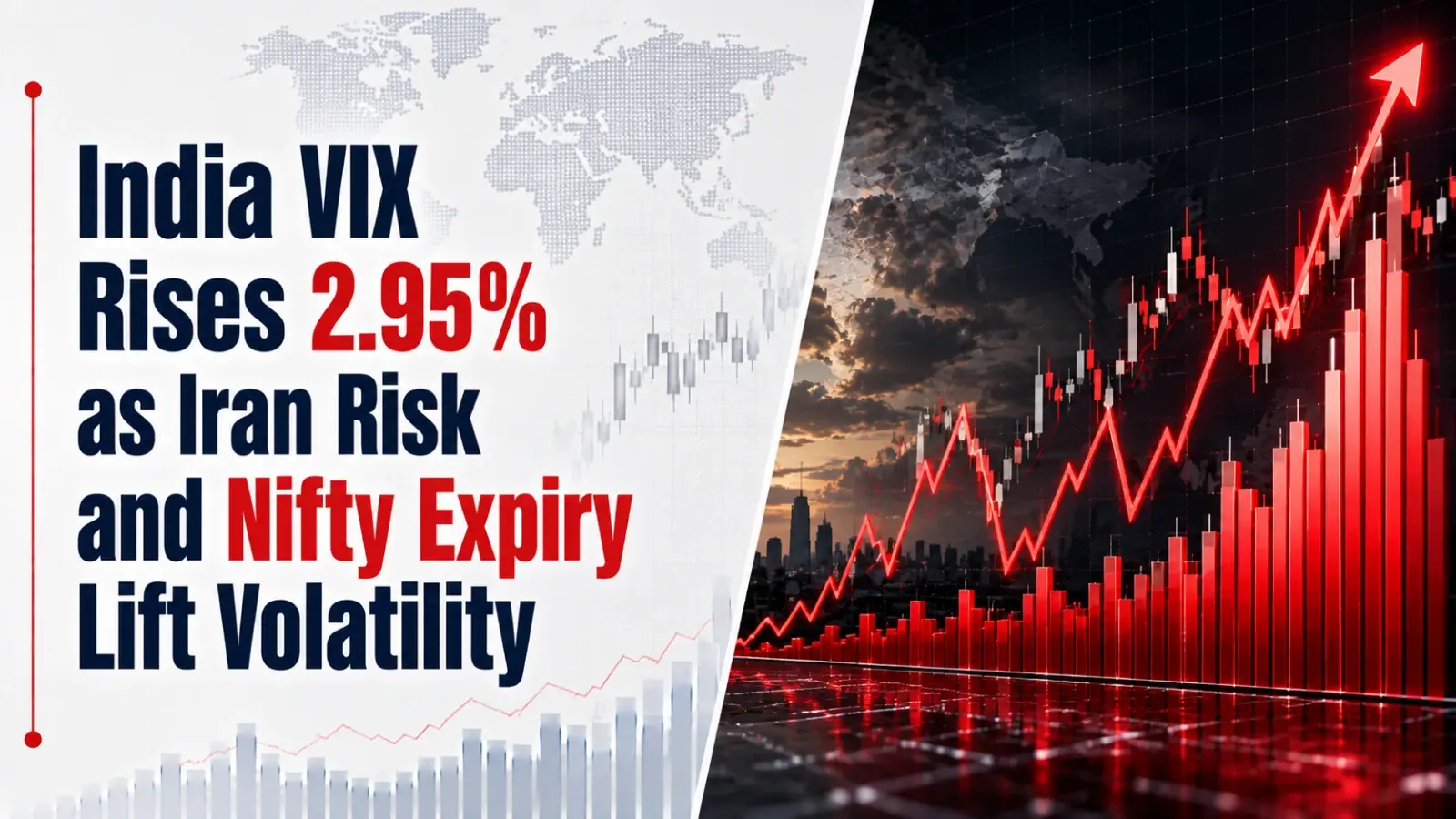
India VIX Rises 2.95% as Iran Risk and Nifty Expiry Lift Volatility
Authored By HDFC SKY | Last Modified: Aug 25, 2026 11:40 AM IST
Open Free Demat Account
Open Free Demat Account
Mumbai, Aug 25: India VIX opened at 11.53 on 25 August, unchanged from the previous close of 11.53, after rising 2.95% in the previous session. The volatility index moved in a wide early range, with a day high of 11.54 and a low of 9.45. At 10:11 IST, India VIX stood at 11.32, down 0.22 points or 1.91% from the previous close. The opening session was shaped by fresh Iran-related geopolitical risk, the monthly Nifty derivatives expiry and uncertainty surrounding the new closing-auction mechanism.

India VIX Holds 11.53 as Iran Risk Pressures Markets
The strongest fresh geopolitical development before the Indian market opened was the expansion of US sanctions targeting Iran, followed by a threat of retaliation from Tehran. The development kept attention on the possibility of further escalation in the Middle East, with potential implications for energy supplies and global trade.
The risk was reflected in Indian equities at the open. At 9:15 IST, the Nifty 50 opened 0.18% lower at 24,175.75, while the Sensex declined 0.10% to 77,295.49. Fourteen of 16 major sectors were lower at the opening, providing an immediate channel through which the geopolitical concerns reached the Indian equity market and Nifty options.
The sequence was straightforward: sanctions and retaliation concerns increased uncertainty around the Middle East, which affected expectations for energy flows and Indian equities. The weaker market opening then influenced hedging and option pricing, supporting volatility expectations reflected in India VIX.
Nifty Expiry Adds Direct Pressure to 11.53 VIX
The monthly Nifty derivatives expiry was another key factor during the opening session. Since India VIX is derived from Nifty option prices, changes in option positioning, hedging and premiums around expiry have a direct connection with the volatility index.
Market participants were dealing with expiring call and put positions, hedges, futures exposure, option spreads and potential changes in exposure around important strike prices. The monthly expiry therefore added another source of uncertainty to the session, alongside the geopolitical developments.
The impact was particularly relevant because the Nifty’s opening decline, although limited to 0.18%, meant that downside protection and option pricing were being assessed against a weaker market backdrop. Changes in Nifty option premiums consequently provided a direct channel for expiry-related uncertainty to influence India VIX.
New Closing System Raises Expiry Uncertainty
The 25 August monthly expiry also marked the first monthly derivatives expiry under the new closing-auction system. The mechanism has attracted attention following unusually large movements around earlier weekly expiry sessions, making the settlement process an additional consideration for the current expiry.
The combination of the new mechanism and monthly expiry created uncertainty around the eventual Nifty settlement. That uncertainty could feed into hedging activity and option premiums, providing another direct link to India VIX.
The market structure therefore mattered independently of the broader geopolitical environment. Traders were managing ordinary expiry-related positioning while also assessing how the new closing process could affect the final Nifty outcome.
Brent Near $92 Adds Pressure Through Energy Risks
Brent crude was around $92.5 per barrel around India’s opening, while it was later reported at approximately $92.08. Elevated crude remained relevant because Middle East tensions and concerns about energy supplies can affect India’s import bill, inflation expectations, currency conditions and equity-market performance.
However, crude prices had fallen from the previous session’s levels, limiting the immediate impact. There was also no confirmed major disruption to oil supplies. Consequently, the effect of crude on India VIX came primarily through broader market and economic concerns rather than a fresh oil-price shock.
Asian Markets Fall as Global Risk Weakens
Asian equity markets provided another negative backdrop for Indian equities. The MSCI Asia-Pacific index was down 0.5%, while the Nikkei declined 0.9% and the Kospi fell 2.7%. Technology stocks were particularly weak.
The regional decline contributed to a cautious global market environment before India’s opening. Weak Asian equities can affect Indian markets through changes in broader risk conditions, which can then influence Nifty movements and the pricing of its options. The effect on India VIX was therefore indirect rather than a direct component of its calculation.
Nvidia Uncertainty Adds to Technology Market Pressure
Investors were also monitoring Nvidia’s earnings, scheduled for Wednesday, amid elevated expectations. Revenue expectations were around $92 billion, nearly twice the level recorded a year earlier. The uncertainty surrounding the results contributed to weakness in Asian technology stocks.
The development was relevant to India through global technology and equity-market conditions. Weakness in overseas technology shares can influence Indian technology stocks and the broader Nifty, which can subsequently affect Nifty option pricing. Its contribution to India VIX was therefore secondary to the Iran developments and the monthly expiry.
Rupee at ₹95.70 Faces Pressure from Oil Risks
The rupee remained around ₹95.70–₹95.75 per dollar, with corporate dollar demand and elevated oil prices adding pressure to the currency. State-owned banks were seen offering dollars, interpreted as likely Reserve Bank of India (RBI) intervention, while the rupee remained around ₹95.7350.
Currency weakness can add to concerns around imported inflation and external balances, creating another route into Indian equities and Nifty options. At the same time, RBI intervention helped contain currency volatility, limiting this pressure on the broader market and India VIX.
FPI Inflows and Stable Oil Limit the VIX Rise
Foreign portfolio investors (FPIs) had purchased more than $2.5 billion of Indian equities during August, providing a supportive factor for the domestic market. Stronger foreign flows can help reduce the risk of disorderly market pressure, limiting the need for extreme downside hedging.
Gold also remained elevated as defensive positioning continued amid geopolitical and macroeconomic uncertainty, although its relationship with India VIX was indirect. Meanwhile, investors were monitoring US Treasury bond-buyback plans and Federal Reserve Chair Kevin Warsh’s upcoming Jackson Hole speech for clues on monetary policy. These developments remained background global factors rather than major direct catalysts for the opening move.
India VIX Range Shows Volatility Remains Measured
India VIX’s 52-week range is 8.72 to 28.90, while its year-to-date return stands at 19.41%. Its technical rating was Neutral. The classic pivot levels were 12.09, 12.64 and 13.53 for resistance, with 11.20 as the pivot point and 10.65, 9.76 and 9.21 as support levels.
Seasonality data shows that India VIX has delivered positive returns in 12 of 18 years during August. The maximum positive change was 68.84% in 2015, while the average positive change was 18.10%. The maximum negative change was -11.26% in 2016, with an average negative change of -5.66%, producing an average August change of 10.18%.
India VIX opened at 11.53 amid Iran-related geopolitical risk, monthly Nifty expiry and uncertainty over the new closing-auction mechanism. Weak Asian markets, crude near $92, rupee pressure and technology-sector concerns added indirect pressure, while RBI intervention, FPI inflows and the absence of an immediate oil-supply disruption helped contain the early volatility.
Source
- https://www.nseindia.com/reports-indices-historical-vix
Disclaimer
If you have any concerns, questions, or wish to point out any discrepancies in our content, please feel free to write to us at content@hdfcsec.com.
Please Note: The information shared is intended solely for informational purposes and does not make any investment recommendations
HDFC SKY, one of India’s most trusted trading platforms, has been recognized with the Next-Gen Digi Content Awards 2025–26.
Disclaimer
At HDFC SKY*, we take utmost care and due diligence in curating and presenting news and market-related content. However, inadvertent errors or omissions may occasionally occur.
If you have any concerns, questions, or wish to point out any discrepancies in our content, please feel free to write to us at content@hdfcsec.com.
Please Note: The information shared is intended solely for informational purposes and does not make any investment recommendations.
HDFC SKY from HDFC Securities, one of most trusted trading platforms in India, has been recognized with the *Next-Gen Digi Content Awards 2025-26.
 Join Us
 Add as preferred source on Google


More Business News




Open Free Demat Account
Open Free Demat Account











Invest Anytime, Anywhere


By signing up I certify terms, conditions & privacy policy