Nifty 50
- Apollo Hospitals₹8,027.50361.50 (4.72%)
- BSE₹3,287.20-47.60 (-1.43%)
- ITC₹26611.00 (4.31%)
- Reliance Industries₹1,170.30-7.70 (-0.65%)
- Eicher Motors₹7,050282.50 (4.17%)
- JSW Steel₹1,168-7.20 (-0.61%)
- TCS₹2,15680.00 (3.85%)
- Cipla₹1,301-5.80 (-0.44%)
- HCL Technologies₹1,216.7039.80 (3.38%)
- Adani Ports₹1,76153.00 (3.10%)
- Infosys₹1,023.4026.40 (2.65%)
- Shriram Finance₹940.4523.20 (2.53%)
- Tata Motors PV₹279.906.90 (2.53%)
- UltraTech Cement₹10,675249.00 (2.39%)

- Offerings
- Tools & Platforms
Tools & Calculators
- Open API
- Calculators
- SIP Calculator
- CAGR Calculator
- Compound Interest Calculator
- FD Calculator
- RD Calculator
- EPF Calculator
- Retirement Calculator
- HDFC SIP Calculator
- Mutual Fund Return Calculator
- Lumpsum Calculator
- Step Up SIP Calculator
- ETF SIP Calculator
- Brokerage Calculator
- Equity Margin Calculator
- SWP Calculator
- EMI Calculator
- MTF Calculator
- Margin Pledge Calculator
- Algo Strategy
- Markets
Stocks
F&O
Mutual Funds
- More
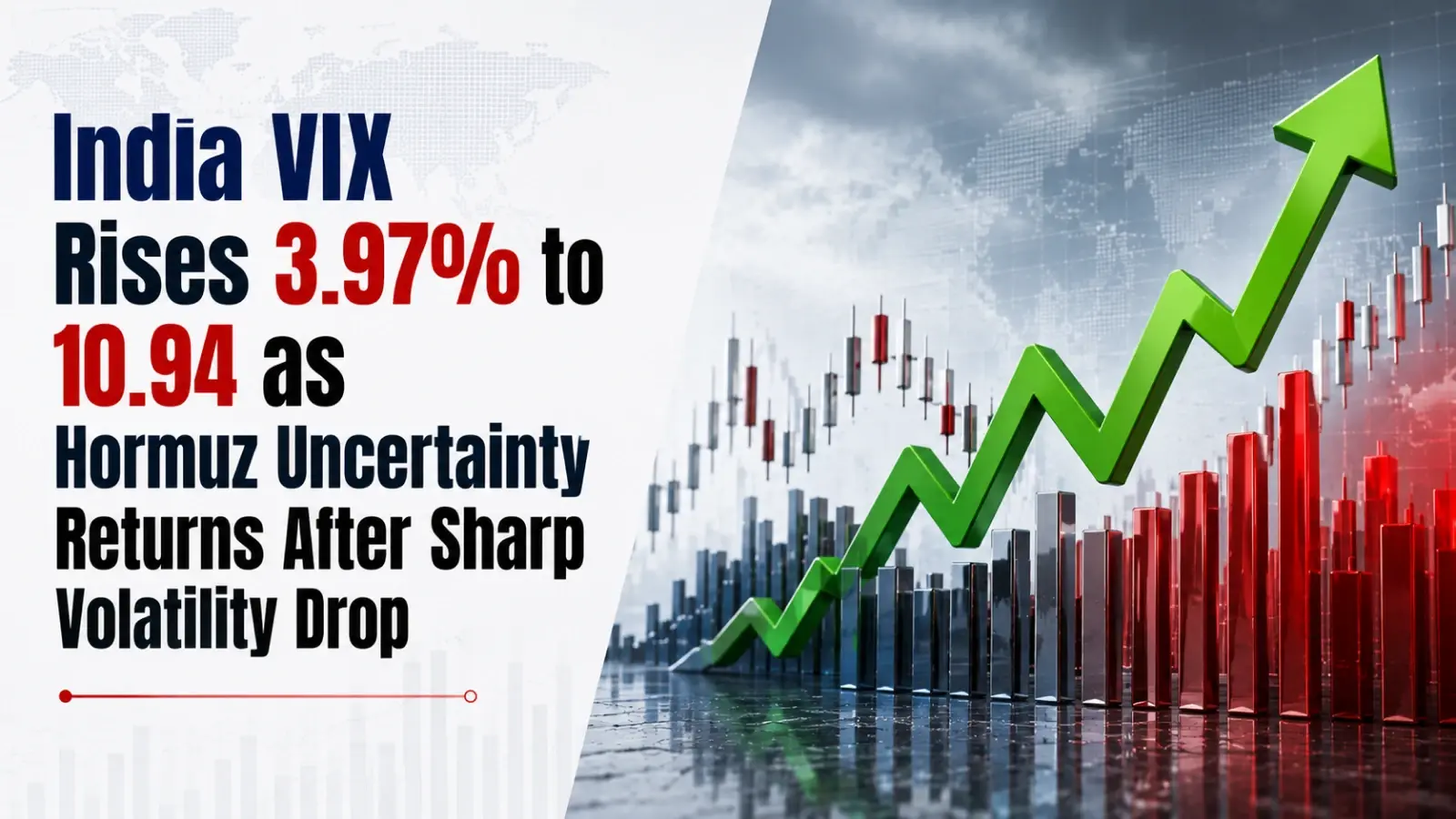
India VIX Rises 3.97% to 10.94 as Hormuz Uncertainty Returns After Sharp Volatility Drop
Authored By HDFC SKY | Last Modified: Aug 27, 2026 11:11 AM IST
Open Free Demat Account
Open Free Demat Account
Mumbai, 27 August 2026: India VIX rose 0.42 points, or 3.97%, to 10.94 at 10:08 IST on 27 August, after opening at 10.56 against the previous close of 10.57. The volatility index moved between 10.35 and 11.04 during the session, while its 52-week range stood at 8.72–28.90. The technical rating remained Neutral. The latest move follows a sharp compression in volatility during the 26 August opening session, when easing oil-supply concerns and developments around the Strait of Hormuz reduced immediate pressure on India VIX.

India VIX Falls to 10.13 As Oil Risks Ease
On 26 August, India VIX opened at approximately 11.075, almost unchanged from the previous close of 11.08, before falling rapidly to an early low of 10.13. At 9:19 IST, it was around 10.455, down 5.64%, while at 10:03 IST it stood near 10.76, down 3.16%. The index closed around 10.45–10.57, depending on the data feed, after moving within an official-day range of approximately 10.13–11.07.
The sharp early decline came as immediate concerns over oil-supply disruption through the Strait of Hormuz eased. Developments involving Iran and Oman raised the possibility of arrangements that could facilitate or normalise shipping through the strategically important waterway. The easing of that immediate risk coincided with a decline in crude prices and reduced pressure on India-linked oil and inflation concerns.
Iran-Oman Talks Reduce Hormuz Risk and VIX
Renewed diplomatic discussions between Iran and Oman over the Strait of Hormuz were the key immediate development behind the 26 August opening move. Reports indicated that discussions could support a temporary maritime corridor and improve the prospects for shipping through the waterway.
The development was significant because the Hormuz situation had remained a major source of uncertainty for global oil supplies. The prospect of improved shipping conditions reduced the immediate risk of prolonged disruption, which coincided with lower crude prices and a rapid decline in India VIX.
However, the broader Iran-US conflict, sanctions and Middle East uncertainty remained unresolved. The developments therefore represented an easing of immediate geopolitical risk rather than the removal of wider geopolitical concerns.
Brent Below $87 and WTI Near $81 Ease Pressure
Crude oil extended its decline on 26 August as markets assessed the possibility of improved shipping conditions through Hormuz. Brent moved below approximately $87 a barrel, while WTI traded around $81 during the early period. Subsequent market data showed Brent around $87.84 and WTI near $82.23, while another market report placed Brent closer to $84 during the Indian session.
Lower crude prices were important for India because they reduced concerns linked to the country’s imported oil costs. The decline also eased concerns around the import bill, the rupee, imported inflation, corporate costs and the current-account position. The oil move therefore formed an important part of the backdrop to the sharp fall in India VIX during early trade.
GIFT Nifty Signals Positive Start Near 24,564
Before the Indian market opened on 26 August, GIFT Nifty indicated a positive start. Around 7:24 AM IST, it was reported at approximately 24,563.50, up about 83.5 points. Another market reading placed it near 24,559.5, around 88 points above the previous Nifty futures reference.
The indication reduced expectations of an immediate sharp downside gap at the Indian open. This was followed by a largely stable opening in domestic equities, providing another condition for the early compression in implied volatility.
Nifty Opens at 24,342 as VIX Drops Sharply
The Nifty 50 opened at approximately 24,341.95, up about 7.4 points or 0.03%, while the Sensex opened around 77,892, higher by roughly 236 points. The Nifty subsequently touched an early high of approximately 24,378.60.
At around 9:19 AM, the Sensex was higher by about 160 points, while the Nifty stood near 24,318.65. During the same period, India VIX had already fallen substantially from its previous close of 11.08, reaching the early low of 10.13.
Post-Expiry Trading Adds to the Calmer Setup
The 26 August session followed the August monthly F&O expiry on 25 August, placing the market in a new monthly-series environment. The expiry had been completed a day earlier, making post-expiry positioning a secondary factor in the opening setup.
On 25 August, the Nifty gained 0.48% to 24,334.55, while the Sensex rose 0.37% to 77,656.09. India VIX declined about 3.9% to around 11.08, and the Nifty closed at its intraday high. This meant the 26 August session began with volatility already relatively compressed.
Global Markets Stay Supportive Ahead Of Nvidia Results
The overnight global backdrop was broadly constructive before the Indian open. US markets had recovered, with the Dow Jones rising 160.24 points, the S&P 500 gaining 24.42 points and the Nasdaq advancing 171.11 points. Asian markets were also generally positive, including gains in Japan’s Nikkei.
However, global markets remained attentive to Nvidia’s earnings, scheduled after the US market close on 26 August. The results represented an important event risk for technology and AI-related markets, with possible implications for Indian IT stocks and broader global risk appetite. As the results had not been released before India’s opening session, they remained a potential uncertainty rather than an immediate cause of the early India VIX decline.
Rupee and FII Flows Provide Additional Support
The rupee had strengthened by approximately 24 paise against the US dollar in the previous session, partly supported by lower crude prices. The currency backdrop remained connected to the oil decline, with lower crude reducing concerns around imported inflation and currency-linked costs.
Recent foreign institutional investor buying also provided a supportive positioning backdrop. Previous-session flow data showed purchases of approximately ₹1,182 crore, while another dataset cited around ₹1,593 crore for 25 August, depending on the flow dataset and cut-off used. These figures relate to earlier activity rather than a fresh 26 August flow.
No Fresh RBI Shock Keeps Volatility Pressure Low
There was no fresh Reserve Bank of India (RBI) monetary-policy announcement or major negative domestic macroeconomic release at the opening on 26 August. The absence of a new domestic macro shock meant the session did not begin with an additional event-driven source of volatility.
The combination of easing Hormuz concerns, falling crude prices, supportive global cues, a stable domestic opening and the post-expiry setup therefore coincided with the sharp early decline in India VIX.
Nifty Falls 0.52% But VIX Stays Near 10.5
The domestic market later lost some of its early strength. The Nifty, after opening at 24,341.95 and reaching 24,378.60, eventually closed at 24,207.75, down 0.52%. India VIX, however, did not record a corresponding sharp reversal and remained around 10.45–10.57.
The latest 27 August reading shows India VIX at 10.94, up 3.97% at 10:08 IST, with a day range of 10.35–11.04. Its 52-week low is 8.72, while the 52-week high is 28.90. The technical trend remains Neutral.
India VIX’s 26 August opening decline followed easing immediate Hormuz disruption concerns, lower crude prices and a stable domestic opening. The index subsequently moved to 10.94 on 27 August at 10:08 IST, with the current session’s range at 10.35–11.04, while the broader 52-week range remains 8.72–28.90.
Source
- https://www.nseindia.com/reports-indices-historical-vix
Disclaimer
If you have any concerns, questions, or wish to point out any discrepancies in our content, please feel free to write to us at content@hdfcsec.com.
Please Note: The information shared is intended solely for informational purposes and does not make any investment recommendations
HDFC SKY, one of India’s most trusted trading platforms, has been recognized with the Next-Gen Digi Content Awards 2025–26.
Disclaimer
At HDFC SKY*, we take utmost care and due diligence in curating and presenting news and market-related content. However, inadvertent errors or omissions may occasionally occur.
If you have any concerns, questions, or wish to point out any discrepancies in our content, please feel free to write to us at content@hdfcsec.com.
Please Note: The information shared is intended solely for informational purposes and does not make any investment recommendations.
HDFC SKY from HDFC Securities, one of most trusted trading platforms in India, has been recognized with the *Next-Gen Digi Content Awards 2025-26.
 Join Us
 Add as preferred source on Google


More Business News







Open Free Demat Account
Open Free Demat Account











Invest Anytime, Anywhere


By signing up I certify terms, conditions & privacy policy