Nifty 50
- Apollo Hospitals₹8,027.50361.50 (4.72%)
- BSE₹3,287.20-47.60 (-1.43%)
- ITC₹26611.00 (4.31%)
- Reliance Industries₹1,170.30-7.70 (-0.65%)
- Eicher Motors₹7,050282.50 (4.17%)
- JSW Steel₹1,168-7.20 (-0.61%)
- TCS₹2,15680.00 (3.85%)
- Cipla₹1,301-5.80 (-0.44%)
- HCL Technologies₹1,216.7039.80 (3.38%)
- Adani Ports₹1,76153.00 (3.10%)
- Infosys₹1,023.4026.40 (2.65%)
- Shriram Finance₹940.4523.20 (2.53%)
- Tata Motors PV₹279.906.90 (2.53%)
- UltraTech Cement₹10,675249.00 (2.39%)

- Offerings
- Tools & Platforms
Tools & Calculators
- Open API
- Calculators
- SIP Calculator
- CAGR Calculator
- Compound Interest Calculator
- FD Calculator
- RD Calculator
- EPF Calculator
- Retirement Calculator
- HDFC SIP Calculator
- Mutual Fund Return Calculator
- Lumpsum Calculator
- Step Up SIP Calculator
- ETF SIP Calculator
- Brokerage Calculator
- Equity Margin Calculator
- SWP Calculator
- EMI Calculator
- MTF Calculator
- Margin Pledge Calculator
- Algo Strategy
- Markets
Stocks
F&O
Mutual Funds
- More
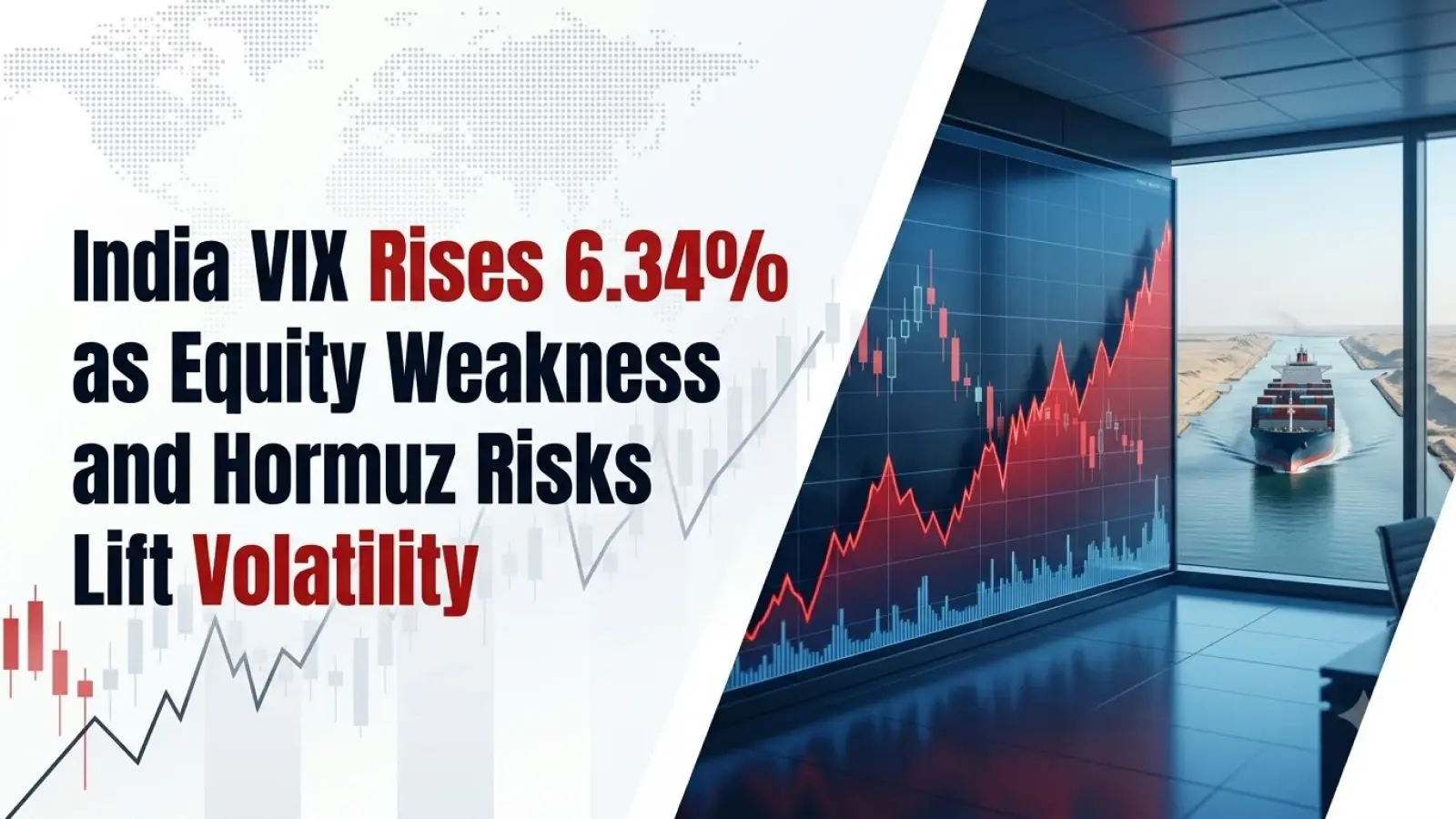
India VIX Rises 6.34% as Equity Weakness and Hormuz Risks Lift Volatility
Authored By HDFC SKY | Last Modified: Aug 27, 2026 04:36 PM IST
Open Free Demat Account
Open Free Demat Account
Mumbai, Aug 27: India VIX rose 0.67 points, or 6.34%, to 11.22 as of 3:34 pm IST on Thursday, reversing from an early low of 10.35 as Indian benchmark indices moved from initial gains to losses. The volatility gauge opened at 10.56, against the previous close of 10.57, and touched an intraday high of 11.28. The rise came as domestic equity weakness, renewed uncertainty over the Strait of Hormuz and derivatives-related activity kept market volatility elevated into the closing session.

India VIX Rises 6.34% as Equities Reverse Gains
India VIX initially remained subdued after opening at 10.56, briefly falling to 10.35 as crude prices declined and Indian equities opened higher. By around 10:08 am, however, the index had climbed to 10.94, up 3.97%, as the early strength in the equity market began to fade. It subsequently moved above 11.0, reaching 11.01, up 4.16%, during the session.
The move gathered pace as the Sensex and Nifty came under pressure. The Sensex, which had initially gained more than 150 points, later moved into negative territory, while the Nifty slipped from levels above 24,250. By the afternoon, the Sensex was down more than 250 points, while the Nifty was around 24,143.
The deterioration was accompanied by weak market breadth, with 1,613 advancing shares against 2,264 declining shares, reinforcing the broader market weakness that coincided with the rise in implied volatility.
Hormuz Uncertainty Keeps Oil Risks Alive Despite $87 Crude
The Strait of Hormuz remained a key external factor during Thursday’s session. Crude oil prices continued to decline, with Brent trading around $87.4 a barrel, extending its fall for a fourth consecutive session. The decline followed expectations that discussions involving Iran and regional parties could support the reopening of the strategic waterway and reduce concerns about prolonged supply disruptions.
However, expectations of reopening remained uncertain, with conflicting signals from Iran keeping the geopolitical risk unresolved. The combination meant that falling crude prices provided relief to India’s external position, while uncertainty over the durability of that relief continued to influence market volatility.
The Hormuz issue remains important for India because disruption around the waterway can affect crude supply, the import bill, the rupee, inflation and corporate input costs. Thursday’s India VIX increase therefore occurred despite lower crude prices, with uncertainty around the oil-supply outlook and the weakness in domestic equities proving more relevant to the volatility gauge.
Nifty and Sensex Weakness Lifts Volatility into Afternoon
The reversal in domestic equities became a direct driver of the India VIX increase. The market began with support from lower crude prices and positive global technology cues following Nvidia’s results and outlook. That support weakened as selling emerged across several large-cap stocks.
IT stocks were among the areas under pressure, while HDFC Bank, Hindalco and other heavyweight constituents also declined. At one stage, Hindalco was down around 2.8%, HDFC Bank around 2%, and NTPC around 1.6%. M&M and Shriram Finance were also lower.
The broad-based nature of the decline was significant for index-level volatility. India VIX measures expected volatility through Nifty options, meaning weakness spreading across major index constituents can coincide with higher expectations of near-term price movement. The day’s increase therefore developed alongside the wider deterioration in market breadth rather than following an isolated stock-specific decline.
Expiry and Closing Auction Add Pressure Near 3:20 Pm
Derivatives activity also remained relevant as the market approached the closing session. Thursday marked the BSE monthly derivatives expiry, while the session also took place under the newer Closing Auction Session framework.
The Closing Auction Session runs from 3:20 pm to 3:30 pm, creating an additional price-discovery period at the end of the trading day. The expiry-related positioning and the closing-auction framework made the final part of the session particularly important for index prices.
However, the day’s India VIX increase had already developed during the regular trading session. The available data therefore does not establish the Closing Auction Session as the cause of the volatility rise. Instead, expiry activity and the closing mechanism formed part of the broader trading environment as the market entered the final phase.
Nvidia Strength and $87 Oil Limit the VIX Increase
Global cues initially acted as a counterweight to domestic weakness. Nvidia’s results and outlook, released after the US market closed on 26 August, supported Asian technology shares and US equity futures during Thursday’s trading session. Nasdaq 100 futures were around 1.2% higher, while S&P 500 futures gained about 0.6%, and Nvidia shares rose around 4.2% in after-hours trading.
The positive technology signal helped support the opening tone in Indian equities. Lower crude prices also provided a favourable macroeconomic backdrop for India. Brent’s decline towards $87 reduced immediate pressure associated with energy costs.
However, European markets turned mixed to lower during India’s afternoon session, limiting the strength of the global support. Technology stocks remained comparatively stronger, while several other European sectors weakened. The combination of supportive technology cues and a softer broader global backdrop contributed to a mixed external environment.
Rupee at ₹95.4–₹95.5 Adds to Cautious Market Backdrop
The rupee remained another factor in the broader market environment. It traded around ₹95.40–₹95.50 per US dollar during the session, with lower crude prices providing some support while external uncertainties remained.
Indian government bonds also weakened despite the decline in oil prices. The benchmark 6.94% 2036 government bond yield was around 6.8619% at 10:30 am, compared with 6.8488% previously. Concerns over heavy debt supply contributed to the movement in bond yields.
These developments formed part of the wider financial-market backdrop but were not identified as the principal causes of the India VIX increase.
Fresh ₹58,000 Crore Supply Adds to Market Pressure
Fresh equity supply also remained a domestic consideration. Around ₹58,000 crore of stock supply had entered Indian equities during August through promoter and private-equity stake sales, together with government disinvestment activity.
The additional supply was cited as a factor affecting market liquidity. Alongside the day’s weakness in large-cap stocks, it contributed to the broader cautious tone, although it was not a direct trigger for the India VIX movement.
Company-specific developments added to stock-level volatility. Tata Power fell around 4% after losing a Singapore arbitration challenge involving approximately $490 million, while ICICI Prudential Asset Management declined around 5% after its promoter indicated plans to sell up to a 2% stake. Lupin also fell following a downgrade by analysts.
India VIX Holds Above 11 After 0.93-Point Intraday Range
India VIX moved from 10.56 at the open to an intraday low of 10.35, before climbing above 11 as the equity market weakened. Its reported high was 11.28, giving the index an intraday range of approximately 0.93 points. At 3:34 pm, it stood at 11.22, up 6.34%.
Seasonality also provides context: India VIX has delivered positive returns in 12 of 18 Augusts, with an average August change of 10.10%. The technical rating remained Neutral. Classic pivot levels for the day were R1 11.05, R2 11.53, R3 11.99, PP 10.59, S1 10.11, S2 9.65 and S3 9.17.
India VIX rose 6.34% to 11.22 as domestic equity weakness replaced the early gains, while uncertainty around the Strait of Hormuz remained despite Brent crude falling towards $87. Expiry activity, weak breadth, global market cues, the rupee near ₹95.5 and bond yields added to the day’s broader market backdrop.
Source
- https://www.nseindia.com/reports-indices-historical-vix
Disclaimer
If you have any concerns, questions, or wish to point out any discrepancies in our content, please feel free to write to us at content@hdfcsec.com.
Please Note: The information shared is intended solely for informational purposes and does not make any investment recommendations
HDFC SKY, one of India’s most trusted trading platforms, has been recognized with the Next-Gen Digi Content Awards 2025–26.
Disclaimer
At HDFC SKY*, we take utmost care and due diligence in curating and presenting news and market-related content. However, inadvertent errors or omissions may occasionally occur.
If you have any concerns, questions, or wish to point out any discrepancies in our content, please feel free to write to us at content@hdfcsec.com.
Please Note: The information shared is intended solely for informational purposes and does not make any investment recommendations.
HDFC SKY from HDFC Securities, one of most trusted trading platforms in India, has been recognized with the *Next-Gen Digi Content Awards 2025-26.
 Join Us
 Add as preferred source on Google


More Business News






Open Free Demat Account
Open Free Demat Account











Invest Anytime, Anywhere


By signing up I certify terms, conditions & privacy policy