Nifty 50
- Dr. Reddy's Labs₹1,268.2038.70 (3.15%)
- Shriram Finance₹825.25-39.75 (-4.60%)
- Kotak Mahindra Bank₹440.409.90 (2.30%)
- Tata Consumer ₹924-39.90 (-4.14%)
- JSW Steel₹1,205.5020.00 (1.69%)
- Asian Paints₹2,249.80-57.20 (-2.48%)
- Sun Pharmaceutical₹1,761.3013.30 (0.76%)
- HDFC Life Insurance ₹514-9.75 (-1.86%)
- Adani Ports₹1,71310.30 (0.60%)
- Bajaj Finance₹912-16.95 (-1.82%)
- Cipla₹1,345.507.50 (0.56%)
- Tata Motors PV₹260-4.60 (-1.74%)
- Max Healthcare₹818.753.75 (0.46%)
- Eicher Motors₹6,945-121.00 (-1.71%)
- BSE₹3,24413.20 (0.41%)
- Infosys₹1,137-16.80 (-1.46%)
- Coal India₹397.800.35 (0.09%)
- Hindustan Unilever₹1,789.40-25.30 (-1.39%)
- SBI Life Insurance ₹1,618.80-21.20 (-1.29%)

- Offerings
- Tools & Platforms
Tools & Calculators
- Open API
- Calculators
- SIP Calculator
- CAGR Calculator
- Compound Interest Calculator
- FD Calculator
- RD Calculator
- EPF Calculator
- Retirement Calculator
- HDFC SIP Calculator
- Mutual Fund Return Calculator
- Lumpsum Calculator
- Step Up SIP Calculator
- ETF SIP Calculator
- Brokerage Calculator
- Equity Margin Calculator
- SWP Calculator
- EMI Calculator
- MTF Calculator
- Margin Pledge Calculator
- Algo Strategy
- Markets
Stocks
F&O
Mutual Funds
- More
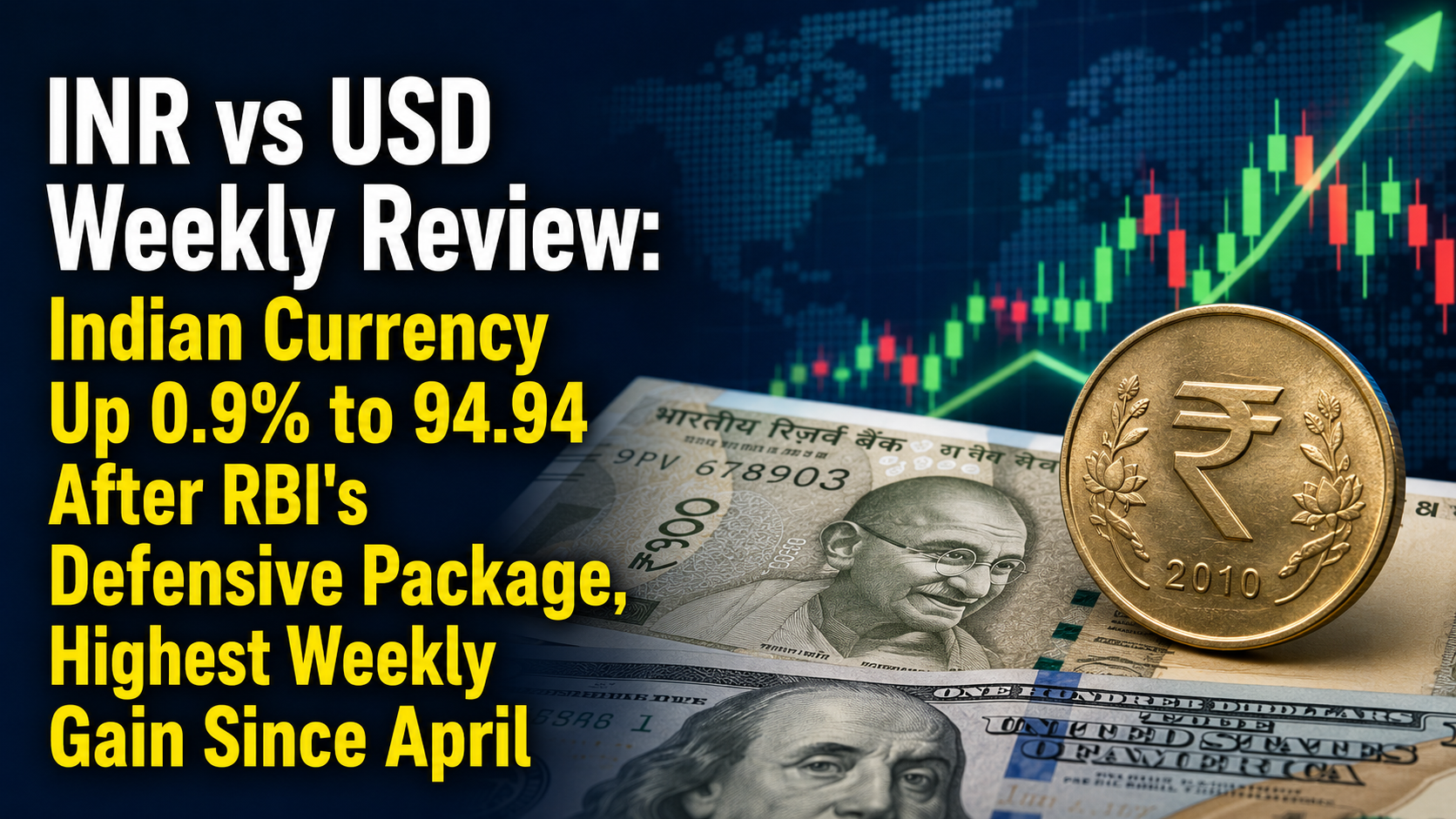
INR vs USD Weekly Review: Indian Currency Up 0.9% to 94.94 After RBI's Defensive Package, Highest Weekly Gain Since April
Authored By HDFC SKY | Last Modified: Jun 8, 2026 09:58 AM IST
Open Free Demat Account
Open Free Demat Account
Mumbai, June 7: After a week-long onslaught on the foreign exchange market from rising crude oil prices beyond $95 per barrel, heightened tension between the United States and Iran, and foreign investment withdrawals worth ₹31,114 crore, the Indian rupee recorded its largest single-day rise in almost two months.
In Friday’s trading, the local currency rose around 84 paise (0.9%) to end at 94.9450 against the US dollar after the central bank released a set of measures aimed at boosting the flow of foreign funds into the country, such as tax breaks, raising the limit of investments by non-resident Indians (NRIs) and providing favourable foreign currency deposit schemes.
The rupee gained a net 24 paise in the week, up from the last Friday’s closing level of 95.19, its best weekly performance since April 2026.
Rupee Opens Week at 94.95 on Iran-Crude Shock
On 1 June, the rupee began the week under sustained pressure. The currency depreciated 10 paise to close at 94.95 per dollar, as elevated geopolitical tensions between the United States and Iran kept crude oil prices firmly above $95 per barrel. India imports nearly 90 per cent of its crude requirements, making the rupee highly sensitive to energy price shocks.
Additionally, the strengthening of the US dollar overseas and weak risk appetite among global investors – reflected in foreign institutional investor (FII) outflows – added to the rupee’s downside.
Rupee Slips to 95.36 on Tuesday Despite RBI Dollar Sales
On 2 June, the rupee opened 7 paise weaker at 95.06 and extended losses through the session. Despite state‑run banks selling dollars aggressively – a sign of RBI‑linked intervention near the 95.50 level – the currency settled 17 paise lower at 95.36.
Traders noted that the central bank also deployed dollar‑rupee buy/sell swaps, which helped absorb dollar liquidity but also pulled down forward premiums; the one‑year implied yield dropped 12 basis points to 3.03 per cent.
Persistent foreign portfolio outflows of ₹8,363 crore kept the rupee under pressure, as overseas investors continued rotating capital towards AI‑linked markets such as South Korea and Taiwan.
Rupee Hits One-Week Low 95.7825 As Crude Crosses $95
June 3 marked the week’s most volatile session. The rupee opened 19 paise weaker at 95.45 following fresh US‑Iran military strikes that pushed crude prices higher and triggered losses across Asian currencies. The currency then tumbled to an intra‑day low of 95.7825 – a decline of roughly 0.5 per cent – tracking sharp falls in oil‑sensitive regional peers such as the Indonesian rupiah, which hit a record low, and the Philippine peso.
The rupee was further weighed down by continued foreign portfolio investor (FPI) outflows. According to provisional exchange data, overseas investors sold more than $800 million worth of Indian equities on Tuesday.
Traders, however, noted that the impact of persistent capital outflows and rising oil prices has been partly cushioned by the Reserve Bank of India’s (RBI) regular interventions across various segments of the foreign exchange market.
State‑run banks were spotted offering dollars aggressively near the 95.50 level, and traders said the losses would have been steeper without the RBI’s dollar‑selling interventions and swap operations.
Subdued Trading Pushes Rupee to 95.7850 Ahead of RBI Policy
On June 4, trading turned subdued as market participants stayed on the sidelines ahead of the RBI’s Monetary Policy Committee (MPC) announcement scheduled for the next day. The rupee closed marginally weaker at 95.7850 per dollar, having meandered in a narrow range through the session.
The rupee recovered from its record low of 96.96 hit in mid-May, supported by the Reserve Bank of India’s intervention in spot and forward markets. The RBI’s actions eased pressure on the currency, lowered FX forward premiums, reduced hedging costs for importers, and were further reinforced by expectations of measures to boost capital inflows and support the rupee.
Foreign investors pulled nearly $600 million from local stocks during the day, adding to pressure on the currency. However, traders noted that the RBI’s intervention‑led relief earlier in the week had helped stabilise the rupee, even as weaker Asian peers and importer hedging kept the currency under modest strain.
RBI Holds Repo at 5.25%, Doubles NRI Investment Limit to 10%
On 5 June, the RBI’s MPC voted unanimously to keep the benchmark repo rate unchanged at 5.25 per cent for the second consecutive meeting, maintaining a “neutral” stance. The decision was in line with market expectations, with 11 out of 15 economists surveyed by PTI anticipating a pause. However, the central bank delivered a far more consequential set of non‑rate measures to attract foreign capital:
- Tax exemptions on interest income and capital gains for eligible foreign investors in government securities, effective from 1 April 2026.
- Higher investment limits for NRIs and Overseas Citizens of India (OCIs) in listed equity instruments without requiring registration with SEBI – the individual ceiling was doubled to 10 per cent of a company’s paid‑up capital, and the aggregate NRI cap was raised to 24 per cent.
- Concessional terms for foreign‑currency deposits from non‑resident Indians under the FCNR‑B scheme.
- Subsidised hedging costs for select offshore borrowings.
- Continued dollar‑rupee buy/sell swaps with public sector banks to absorb dollar liquidity and stabilise forward premiums.
RBI Governor Sanjay Malhotra reiterated that the central bank would do “whatever it takes” to maintain orderly conditions in the foreign exchange market and curb excessive volatility, while clarifying that the RBI does not target any specific exchange‑rate level and intervenes only to counter abnormal volatility or undue speculation.
Rupee Posts Biggest Single-Day Gain of 0.9% To 94.9450
The market reaction on Friday was swift and decisive. The rupee opened 8 paise higher at 95.72 and then rallied sharply after the policy announcement, strengthening 0.9 per cent – its largest single‑day gain since 2 April 2026 – to close at 94.93 per dollar.
India’s benchmark 10‑year government bond yield fell to 6.95 per cent , and the rupee outshone all Asia‑Pacific peers, climbing 84 paise from Thursday’s close of 95.7850. The rally was driven by expectations of increased foreign capital flows into both equity and debt markets following the tax exemptions and relaxed investment caps.
Weekly Gain of 24 Paise from Previous Friday’s 95.19 Close
Over the full week (1–5 June), the rupee recorded a net gain of 24 paise when compared with the previous Friday’s (29 May) closing level of 95.19 per dollar. This marked the currency’s best weekly performance since early April 2026. Despite the sharp Friday rally, the rupee remains down more than 5 per cent since the start of 2026, reflecting the persistent structural pressure from elevated crude oil imports and sustained foreign capital rotation towards AI‑linked markets.
However, the RBI’s comprehensive defence package – combining tax incentives, relaxed investment caps, swap operations and deposit schemes – was widely seen by market participants as having established a credible floor for the currency.
Over the week of 1–5 June 2026, the rupee was shaped by crude oil above $95/barrel, sustained FII outflows, and the RBI’s decision to hold the repo rate at 5.25% while unveiling a multi‑pronged dollar‑inflow package. The central bank doubled the NRI individual investment limit to 10% of paid‑up capital, scrapped taxes on foreign investor gains in government securities, and offered concessional FCNR‑B terms, triggering a 0.9% intraday rally on Friday that closed the rupee at 94.9450 per dollar.
Source: https://rbi.org.in/
Disclaimer
If you have any concerns, questions, or wish to point out any discrepancies in our content, please feel free to write to us at content@hdfcsec.com.
Please Note: The information shared is intended solely for informational purposes and does not make any investment recommendations
Disclaimer
At HDFC SKY*, we take utmost care and due diligence in curating and presenting news and market-related content. However, inadvertent errors or omissions may occasionally occur.
If you have any concerns, questions, or wish to point out any discrepancies in our content, please feel free to write to us at content@hdfcsec.com.
Please Note: The information shared is intended solely for informational purposes and does not make any investment recommendations.
HDFC SKY from HDFC Securities, one of most trusted trading platforms in India, has been recognized with the *Next-Gen Digi Content Awards 2025-26.
 Join Us
 Add as preferred source on Google


More Business News









Open Free Demat Account
Open Free Demat Account












Invest Anytime, Anywhere


By signing up I certify terms, conditions & privacy policy