Nifty 50
- Apollo Hospitals₹8,027.50361.50 (4.72%)
- BSE₹3,287.20-47.60 (-1.43%)
- ITC₹26611.00 (4.31%)
- Reliance Industries₹1,170.30-7.70 (-0.65%)
- Eicher Motors₹7,050282.50 (4.17%)
- JSW Steel₹1,168-7.20 (-0.61%)
- TCS₹2,15680.00 (3.85%)
- Cipla₹1,301-5.80 (-0.44%)
- HCL Technologies₹1,216.7039.80 (3.38%)
- Adani Ports₹1,76153.00 (3.10%)
- Infosys₹1,023.4026.40 (2.65%)
- Shriram Finance₹940.4523.20 (2.53%)
- Tata Motors PV₹279.906.90 (2.53%)
- UltraTech Cement₹10,675249.00 (2.39%)

- Offerings
- Tools & Platforms
Tools & Calculators
- Open API
- Calculators
- SIP Calculator
- CAGR Calculator
- Compound Interest Calculator
- FD Calculator
- RD Calculator
- EPF Calculator
- Retirement Calculator
- HDFC SIP Calculator
- Mutual Fund Return Calculator
- Lumpsum Calculator
- Step Up SIP Calculator
- ETF SIP Calculator
- Brokerage Calculator
- Equity Margin Calculator
- SWP Calculator
- EMI Calculator
- MTF Calculator
- Margin Pledge Calculator
- Algo Strategy
- Markets
Stocks
F&O
Mutual Funds
- More
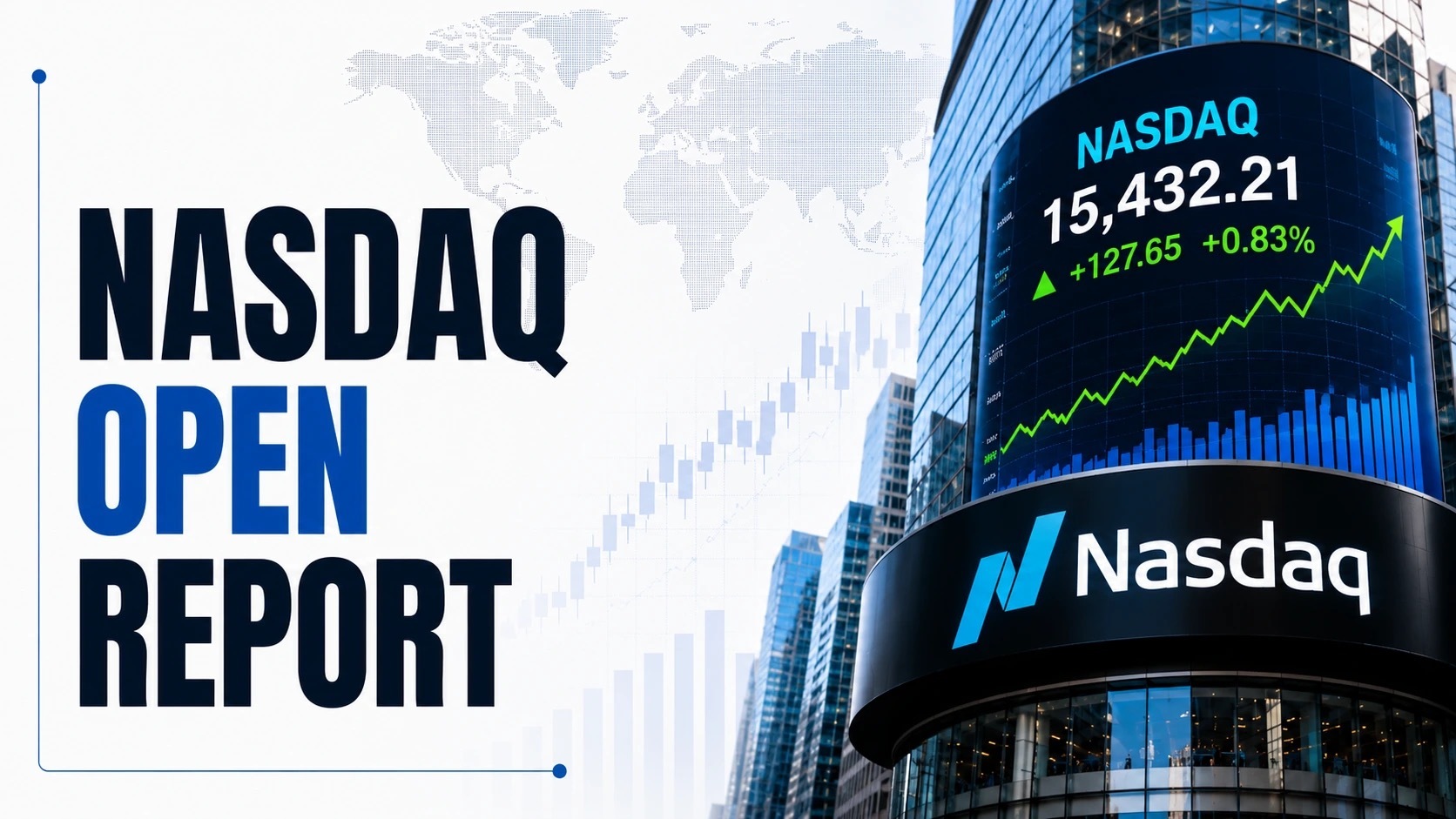
Nasdaq Slips 0.14% to 26,113.49 as Sticky PCE Inflation Data Fuels Fed Rate-Hike Bets Ahead of Nvidia Earnings
Authored By HDFC SKY | Last Modified: Aug 26, 2026 08:35 PM IST
Open Free Demat Account
Open Free Demat Account
Mumbai, Aug 26: Wall Street’s major indices opened lower on Wednesday after hotter-than-expected inflation data reinforced expectations of another quarter-point Federal Reserve rate hike this year, as investors awaited quarterly results from AI chip leader Nvidia. The Nasdaq Composite declined 37.81 points, or 0.14%, to 26,113.49, while the S&P 500 slipped 0.04% and the Dow Jones Industrial Average edged up 0.03% in early trading.
The Personal Consumption Expenditures (PCE) price index, the Federal Reserve’s preferred inflation gauge, rose 3.7% year-over-year in July, unchanged from June and exceeding economists’ forecast of 3.6%. Core PCE, which excludes food and energy, increased 3.3% annually, in line with expectations.
The data comes as markets brace for Nvidia’s fiscal second-quarter results after the closing bell, with the chipmaker’s performance seen as a critical test for the artificial intelligence trade that has driven much of 2026’s market gains.
Dow Jones Industrial Average Opens Flat at 53,592.96 as Utilities and Industrials Lead Gains
The Dow Jones Industrial Average opened nearly flat, gaining 17.08 points, or 0.03%, to 53,592.96. The index traded within a session range of 53,477.73 to 53,620.23, reflecting cautious sentiment ahead of key catalysts.
UnitedHealth Group emerged as the Dow’s top performer, jumping 1.90% after the healthcare giant reported better-than-expected membership growth in its Medicare Advantage plans. Honeywell International advanced 1.25%, while Caterpillar gained 0.81% on strong infrastructure spending data.
Merck weighed on the index, sliding 1.35% amid concerns over its cancer drug pipeline. Goldman Sachs fell 0.86%, tracking weakness in financial stocks. Trading volume on the Dow stood at approximately 1.48 million shares in the early session.
S&P 500 Slips 0.04% to 7,674.28 as Energy Stocks Drag Amid Falling Oil Prices
The S&P 500 declined 4.29 points, or 0.06%, to 7,674.28. The benchmark index opened at 7,666.88 and traded between 7,662.90 and 7,676.84 in the first hour of trading.
Oracle surged 3.30% after the software giant announced a strategic partnership with Microsoft to expand cloud infrastructure capacity. Western Digital jumped 3.76%, leading semiconductor stocks higher on expectations of a memory-chip price recovery. Dell Technologies gained 2.21% following an upgrade from Morgan Stanley. On the downside, Eli Lilly plunged 3.42% after a rival diabetes drug showed superior clinical trial results. Charles Schwab tumbled 3.77% amid concerns over its exposure to commercial real estate loans. ServiceNow dropped 2.32% as software stocks came under broad selling pressure. Volume on the S&P 500 reached approximately 183 million shares in early trading.
Nasdaq Composite Drops 0.14% to 26,113.49 as Meta Settlement Fails to Boost Tech Sentiment
The tech-heavy Nasdaq Composite fell 37.81 points, or 0.14%, to 26,113.49. The index opened at 26,099.58 and traded within a range of 26,071.20 to 26,140.32.
Also Read: How to invest in US stocks
AMD led semiconductor gains, rising 1.25% following a positive note from Bank of America on its AI accelerator sales. Datadog surged 3.37% after reporting strong cloud migration demand. Western Digital jumped 3.61%, extending gains from the previous session. However, Shopify declined 1.51% as e-commerce stocks came under pressure. Adobe fell 1.06% amid concerns over competitive pressures in the creative software market. AstraZeneca dropped 1.53% on disappointing clinical trial data for a lung cancer drug.
Meta Platforms rose 0.6% in early trading after the company agreed to settle a social media addiction lawsuit with 29 states for approximately $16.7 billion, ending a trial that had entered its second week.
The settlement, one of the largest consumer protection agreements in US history, resolved allegations that Meta developed products to hook young users and misled consumers about platform safety.
Russell 2000 Gains 0.50% to 3,010.02 as Small-Caps Outperform Large-Cap Peers
The Russell 2000 index of smaller companies rose 14.94 points, or 0.50%, to 3,010.02. The index opened at 3,004.81 and traded between 3,000.47 and 3,011.97.
Small-cap stocks continued to outperform their large-cap counterparts, with the Russell 2000 now up approximately 23% year-to-date, leading the S&P 500 by 9.1 percentage points. The index recently surpassed the psychologically important 3,000-point level for the first time in its history.
Bloom Energy led gains with a 3.08% advance, followed by Abercrombie & Fitch , which surged 28.04% after raising its full-year guidance. TTMI gained 8.00% and SMTC advanced 7.14% on strong earnings reports. On the downside, SYRE tumbled 13.01% after disappointing clinical trial results.
Philadelphia Semiconductor Index Gains 1.44% as Nvidia Ends Seven-Session Losing Streak
The Philadelphia Semiconductor Index (SOX) climbed 1.44% in early trading, extending Tuesday’s rebound that saw the index halt a run of consecutive losses. The semiconductor benchmark had been under pressure in recent weeks, trading below its late-June record highs.
Nvidia rose 0.4% in premarket trading after snapping a seven-session losing streak on Tuesday. The chipmaker, now the largest S&P 500 member with a market capitalisation exceeding $5 trillion, is scheduled to report fiscal second-quarter results after the closing bell. Wall Street projects earnings per share of $2.09 on $92.28 billion in revenue, according to FactSet.
Also Read: What Is the New York Stock Exchange (NYSE)?
Analysts expect networking revenue, Nvidia’s fastest-growing segment, to approach $17 billion, up from roughly $3 billion per quarter two years ago.
S&P 100, Dow Transports, and Utilities Show Mixed Moves
The S&P 100 tracked the broader benchmark, trading marginally lower as mega-cap technology stocks remained subdued. The Dow Jones Transportation Average outperformed, rising approximately 0.4% as falling crude oil prices reduced operating costs for airlines and freight carriers. Delta Air Lines and Union Pacific posted solid gains, benefiting from the oil price slide.
Conversely, the Dow Jones Utility Average declined roughly 0.3%, as the sector’s dividend-heavy nature faced pressure from still-elevated Treasury yields. Utility stocks, which are interest-rate sensitive, have underperformed in recent sessions as the 10-year yield holds near multi-year highs, making their income stream less attractive relative to bonds.
NYSE Composite and S&P MidCap, SmallCap Indices Advance
The NYSE Composite Index rose modestly in early trading, supported by the broader market’s resilience despite the inflation data. The S&P MidCap 400 and S&P SmallCap 600 both advanced, tracking the Russell 2000’s positive performance. Mid-cap and small-cap indices have been relative outperformers in 2026, benefiting from their domestically focused revenue streams and lower exposure to global trade tensions.
The S&P MidCap 400 gained approximately 0.3%, while the SmallCap 600 rose 0.4%, as investors continued to rotate out of large-cap growth names into smaller, value-oriented companies. The diverging performance underscores the market’s broadening breadth, with small-caps now leading large-caps by the widest margin in over a decade.
Abercrombie Leads Gainers With 28% Surge as Earnings Trigger Stock Divergence
Among the standout performers, Abercrombie & Fitch surged 28.04% after reporting second-quarter profit of $4.17 per share, well above analyst estimates of $1.92, boosted by $1.75 per share in tariff refunds. TTMI gained 8.00% and SMTC advanced 7.14% on strong earnings. The worst performers included SYRE, which plunged 13.01%, and Charles Schwab, which dropped 3.77%. Within the Magnificent Seven cohort, performance was mixed.
Also Read: US Stock Market Timings
Meta Platforms rose 0.6% on its legal settlement, Apple gained 0.28%, and Microsoft advanced 0.31%. However, Tesla declined 0.98%, Alphabet fell 0.92%, Amazon dropped 0.57%, and Nvidia traded marginally higher ahead of its results. The mixed performance among the mega-caps underscores the market’s cautious posture heading into the afternoon’s earnings release.
Sticky PCE Inflation Data Fuels Fed Rate-Hike Bets as Core Inflation Holds at 3.3%
July’s Personal Consumption Expenditures (PCE) price index showed headline inflation rising 0.2% month-over-month and 3.7% year-over-year, both 0.1 percentage point above economist expectations. Core PCE, which excludes volatile food and energy prices, rose 0.2% on the month and 3.3% annually, matching forecasts.
The data comes amid heightened sensitivity in bond markets, with Treasury yields having reached multi-year highs last week — the 30-year yield touched levels not seen in nearly two decades. On Tuesday, yields fell broadly, with the 10-year Treasury losing almost 8 basis points. Following the PCE release, yields remained relatively flat, with the 10-year Treasury yield hovering near 4.64% and the 30-year yield around 5.18%.
“With markets continuing to be sensitive to any data that could increase the odds of rate hikes, today’s mild upside inflation surprise and relative economic strength weren’t necessarily what investors — or the Fed — wanted to see,” said Ellen Zentner, chief economic strategist at Morgan Stanley Wealth Management. “It wasn’t enough to shift the balance for September’s FOMC meeting, but if subsequent data point in the same direction, the Fed may feel more pressure to move off the sidelines.”
According to the CME Group’s FedWatch tool, traders now see a 38% likelihood that the Federal Reserve will raise interest rates at its September meeting, up from 37% immediately before the PCE reading and 33% one week ago.
Technology Sector Leads S&P 500 Gains While Energy Stocks Slide on Falling Oil Prices
Among the 11 S&P 500 sectors, Information Technology was the best performer, rising approximately 0.98% in early trading. Communication Services gained 0.46%, while Materials advanced 0.35%. The technology sector was supported by semiconductor stocks rebounding from recent weakness, with the Philadelphia Semiconductor Index climbing 1.44%.
Energy was the worst-performing sector, declining 1.70% as crude oil prices extended their losing streak. Consumer Staples fell 0.87% on weaker consumer confidence data, while Industrials declined 0.30%. The Conference Board’s consumer confidence index declined to 89.4 in August from a downwardly revised 90.2 in July, missing economist expectations of 90.1.
The divergence between technology and energy sectors reflects shifting market dynamics, with investors rotating out of defensive positions and into growth-oriented stocks ahead of Nvidia’s earnings report.
Crude Oil Falls for Third Straight Session as Strait of Hormuz Talks Resume
Brent crude futures fell approximately 2.0% to $86.80 a barrel in early trading, while West Texas Intermediate (WTI) crude dropped 1.8% to $80.87 a barrel. Oil prices extended their decline for a third consecutive session as Iran and Oman resumed talks on managing the Strait of Hormuz, raising hopes for a potential temporary navigational corridor through the strategic waterway.
The discussions come amid heightened economic pressure from the Trump administration, which recently announced “Operation Economic Outcast” — an unprecedented campaign targeting Iran and its enablers. The US sanctioned nearly 60 entities, individuals and vessels, though markets appeared relieved that Washington stopped short of imposing immediate secondary sanctions on other countries.
Also Read: What Are Fractional Shares?
“While there was no real progress or details of the Iran-Oman deal, as Iran reiterated that Hormuz will remain shut until conditions are met, price action suggested that markets are quickly pricing in optimism around an interim announcement,” J.P. Morgan analysts wrote in a note. Despite the recent pullback, crude remains more than 40% higher this year as the US-Iran conflict continues to disrupt energy flows from the Persian Gulf.
Gold and Dollar Steady as Markets Await Jackson Hole Symposium
Gold futures were little changed at $4,670 an ounce, holding near their highest level in more than three months. The precious metal has benefited from safe-haven demand amid geopolitical tensions and uncertainty over the Federal Reserve’s policy path.
The US Dollar Index (DXY), which tracks the greenback against a basket of major currencies, was up 0.2% to 99.10. The dollar remained near a three-month low as investors assessed the implications of the Treasury Department’s expanded debt buyback programme.
Bitcoin, which topped the $80,000 threshold for the first time since May 15 on Tuesday, was recently trading near $78,300, down slightly over the past 24 hours.
VIX Rises Slightly as Market Volatility Persists Ahead of Key Catalysts
The CBOE Volatility Index (VIX) , Wall Street’s fear gauge, rose modestly in early trading, reflecting elevated uncertainty ahead of Nvidia’s earnings and Fed Chair Kevin Warsh’s speech at the Jackson Hole symposium on Friday. The VIX had declined in recent sessions as oil prices retreated and Treasury yields eased, but remains above its long-term average.
Investors are also eyeing Federal Reserve Chairman Kevin Warsh’s speech at the Fed’s annual symposium in Jackson Hole, Wyoming. However, analysts expect Warsh to remain cautious ahead of the Fed’s September monetary policy decision.
Also Read: What Is the S&P 500? A Simple Guide for Everyday Investors
“Given his approach to the June and July press conferences, we think it is unlikely that he would move straight to a deep dive into the current economic outlook and its implications for policy over the balance of 2026,” said Kurt Lewis, head of central bank policy at Piper Sandler. “Instead, we expect him to spend the bulk of his remarks on big-picture themes with an emphasis on the supply side.”
The July PCE data reinforces the Federal Reserve’s cautious stance, with core inflation remaining well above the 2% target at 3.3%. Nvidia’s earnings after the close will serve as a critical barometer for AI-related valuations and semiconductor sector momentum. Traders should monitor the 10-year Treasury yield’s movement around 4.64% and crude oil’s trajectory amid Strait of Hormuz developments. Jackson Hole on Friday may provide clearer signals on the Fed’s September policy direction, though Chair Warsh is expected to avoid explicit forward guidance.
Source
- spglobal.com/spdji/en/indices/equity/sp-500/
Disclaimer
If you have any concerns, questions, or wish to point out any discrepancies in our content, please feel free to write to us at content@hdfcsec.com.
Please Note: The information shared is intended solely for informational purposes and does not make any investment recommendations
Disclaimer
At HDFC SKY*, we take utmost care and due diligence in curating and presenting news and market-related content. However, inadvertent errors or omissions may occasionally occur.
If you have any concerns, questions, or wish to point out any discrepancies in our content, please feel free to write to us at content@hdfcsec.com.
Please Note: The information shared is intended solely for informational purposes and does not make any investment recommendations.
HDFC SKY from HDFC Securities, one of most trusted trading platforms in India, has been recognized with the *Next-Gen Digi Content Awards 2025-26.
 Join Us
 Add as preferred source on Google


More Business News





Open Free Demat Account
Open Free Demat Account











Invest Anytime, Anywhere


By signing up I certify terms, conditions & privacy policy