Nifty 50
- Apollo Hospitals₹8,027.50361.50 (4.72%)
- BSE₹3,287.20-47.60 (-1.43%)
- ITC₹26611.00 (4.31%)
- Reliance Industries₹1,170.30-7.70 (-0.65%)
- Eicher Motors₹7,050282.50 (4.17%)
- JSW Steel₹1,168-7.20 (-0.61%)
- TCS₹2,15680.00 (3.85%)
- Cipla₹1,301-5.80 (-0.44%)
- HCL Technologies₹1,216.7039.80 (3.38%)
- Adani Ports₹1,76153.00 (3.10%)
- Infosys₹1,023.4026.40 (2.65%)
- Shriram Finance₹940.4523.20 (2.53%)
- Tata Motors PV₹279.906.90 (2.53%)
- UltraTech Cement₹10,675249.00 (2.39%)

- Offerings
- Tools & Platforms
Tools & Calculators
- Open API
- Calculators
- SIP Calculator
- CAGR Calculator
- Compound Interest Calculator
- FD Calculator
- RD Calculator
- EPF Calculator
- Retirement Calculator
- HDFC SIP Calculator
- Mutual Fund Return Calculator
- Lumpsum Calculator
- Step Up SIP Calculator
- ETF SIP Calculator
- Brokerage Calculator
- Equity Margin Calculator
- SWP Calculator
- EMI Calculator
- MTF Calculator
- Margin Pledge Calculator
- Algo Strategy
- Markets
Stocks
F&O
Mutual Funds
- More
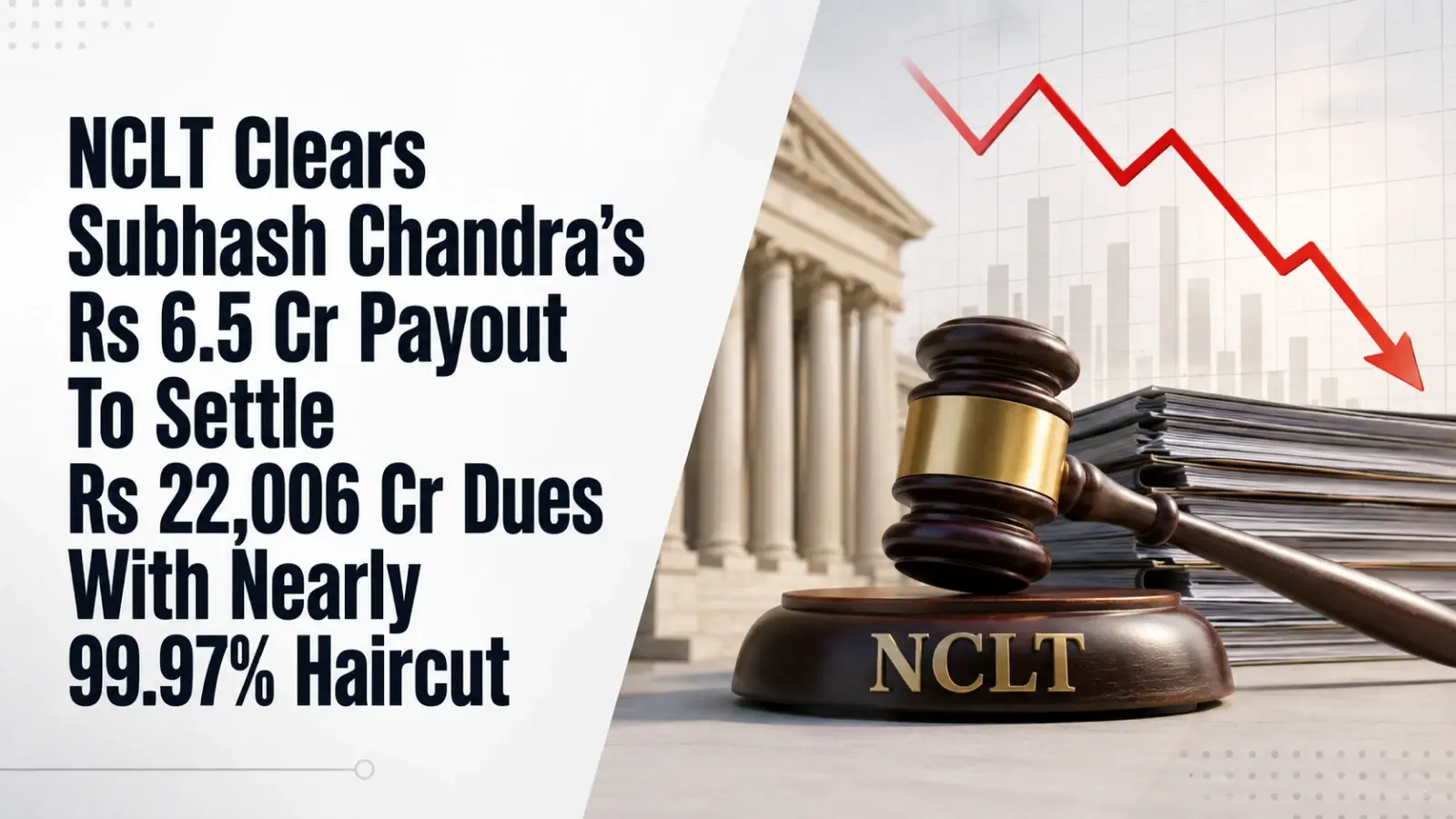
NCLT Clears Subhash Chandra’s Rs 6.5 Cr Payout To Settle Rs 22,006 Cr Dues With Nearly 99.97% Haircut
Authored By PTI | Last Modified: Aug 27, 2026 10:21 AM IST
Open Free Demat Account
Open Free Demat Account
New Delhi: The insolvency tribunal NCLT has approved a repayment plan under which media baron Subhash Chandra will pay just Rs 6.5 crore to settle admitted creditor claims of about Rs 22,006.57 crore in his personal insolvency resolution process, translating into a haircut of nearly 99.97 per cent for lenders.
NCLT Member (Judicial) Nilesh Sharma, ruling as a third member, on Tuesday approved the plan under Section 114 of the Insolvency and Bankruptcy Code (IBC), rejecting objections by lenders that the recovery was too meagre to merit approval.
Earlier, the two members of the National Company Law Tribunal had given a split verdict, after which the president of the forum appointed Sharma as the third member amid the difference of opinion.
Sharma rejected the claims of the dissenting creditors led by LIC Housing Finance, which had argued that the payout was “unviable and unlawful”.
It had contended that against admitted claims of approximately Rs 22,006.57 crore, the repayment plan proposed the payment of only Rs 6.25 crore to creditors and Rs 25 lakhs towards process costs.
“In the case of LICHFL, whose admitted claim stood at Rs 1,322.39 crore, the proposed repayment was merely Rs 38,09,294, amounting to approximately 0.028 per cent of its admitted dues. It was contended that such a negligible repayment could not receive the approval of this tribunal,” said the NCLT order recording its submission.
Further, the repayment plan itself treated even the proposed amount of Rs 6.5 crore as merely indicative and not certain, rendering the plan tentative, non-definitive, and incapable of approval.
However, the NCLT held that the objecting creditors together held less than 20 per cent of the voting share, while the plan had been approved by the required number of vote shares — 80.81 per cent share.
Sharma, in its 144-page-long order, said the resolution professional’s valuation showed Chandra’s personal estate was worth significantly less than the amount offered under the plan, and that dissenting creditors were unlikely to recover more by rejecting it, since he would then face bankruptcy rather than being able to pay from a position of financial recovery.
“If the plan is approved and the debtor’s insolvency is resolved, putting him back on his feet, the objectors would ultimately stand a better chance of recovering their debts directly from the Principal Debtors,” the NCLT observed.
The tribunal held that its role was not to substitute its own commercial wisdom for that of the creditors or to assess whether the settlement amount was adequate.
It also noted that “the commercial decision of the creditors operates within, and not outside, the statutory framework”.
“The AA (NCLT) neither substitutes its own commercial wisdom for that of the creditors nor does it conduct a wide-ranging investigation into allegations that are unsupported by reliable material. Its role is supervisory, corrective and judicial, not investigative unless the statute so requires,” the NCLT said.
It further said once approved, the plan is binding on all creditors under Section 115 of the IBC, whether they voted for or against it, and cannot be selectively enforced only against those who consented.
“Once the Repayment Plan is approved under Section 114, its binding effect is governed by Section 115 of the Code. The Adjudicating Authority (NCLT) cannot make the plan binding only on the creditors who voted in its favour while allowing dissenting creditors to independently pursue recovery of their full original debt,” it added.
The order further said section 115 does not contemplate selective application of an approved repayment plan.
“Accordingly, the approved plan is binding on all creditors covered by it, whether assenting or dissenting. Granting dissenting creditors liberty to recover the full debt outside the plan would defeat the statutory scheme and result in unequal treatment of creditors,” it said.
Approving the plan, NCLT said: “In view of the above findings, the Repayment Plan submitted by the Personal Guarantor, in my opinion, is required to be approved under Section 114 of the Insolvency and Bankruptcy Code, 2016…”.
The resolution professional is required to prepare and place on record the revised and final list of creditors after giving effect to the aforesaid exclusions and take necessary consequential steps for redistribution of the approved repayment plan value, it said.
“The approved repayment plan, in my opinion, will be binding upon all the creditors, whether assenting or dissenting to the repayment plan, in accordance with Section 115 of the Insolvency and Bankruptcy Code, 2016,” it said.
The matter will now go back to the original division bench for a formal order in line with the majority opinion, as required under Section 419 (5) of the Companies Act, 2013.
(Disclaimer: Except for the headline, this article has not been edited by HDFC Sky editorial team and is auto-generated from PTI feed.)
Disclaimer
If you have any concerns, questions, or wish to point out any discrepancies in our content, please feel free to write to us at content@hdfcsec.com.
Please Note: The information shared is intended solely for informational purposes and does not make any investment recommendations
HDFC SKY, one of India’s most trusted trading platforms, has been recognized with the Next-Gen Digi Content Awards 2025–26.
Disclaimer
At HDFC SKY*, we take utmost care and due diligence in curating and presenting news and market-related content. However, inadvertent errors or omissions may occasionally occur.
If you have any concerns, questions, or wish to point out any discrepancies in our content, please feel free to write to us at content@hdfcsec.com.
Please Note: The information shared is intended solely for informational purposes and does not make any investment recommendations.
HDFC SKY from HDFC Securities, one of most trusted trading platforms in India, has been recognized with the *Next-Gen Digi Content Awards 2025-26.
 Join Us
 Add as preferred source on Google


More Business News







Open Free Demat Account
Open Free Demat Account










Invest Anytime, Anywhere


By signing up I certify terms, conditions & privacy policy