Nifty 50
- Eternal₹317.4012.95 (4.25%)
- Shriram Finance₹865-35.90 (-3.98%)
- Apollo Hospitals₹7,730125.50 (1.65%)
- Adani Enterprises₹2,477-73.00 (-2.86%)
- ONGC₹227.502.50 (1.11%)
- JSW Steel₹1,185.50-34.50 (-2.83%)
- Asian Paints₹2,30722.20 (0.97%)
- Jio Financial ₹205.03-5.77 (-2.74%)
- TCS₹2,53023.10 (0.92%)
- Tata Steel₹167.67-4.66 (-2.70%)
- UltraTech Cement₹11,05092.00 (0.84%)
- Adani Ports₹1,702.70-47.30 (-2.70%)
- Maruti Suzuki₹11,23060.00 (0.54%)
- Tech Mahindra₹1,790-39.10 (-2.14%)
- Cipla₹1,3387.10 (0.53%)
- Tata Motors PV₹264.60-5.40 (-2.00%)
- Reliance Industries₹1,1905.50 (0.46%)
- Hindalco Industries₹869.85-15.75 (-1.78%)
- Axis Bank₹1,217.505.50 (0.45%)
- Trent₹2,727.50-48.30 (-1.74%)

- Offerings
- Tools & Platforms
Tools & Calculators
- Open API
- Calculators
- SIP Calculator
- CAGR Calculator
- Compound Interest Calculator
- FD Calculator
- RD Calculator
- EPF Calculator
- Retirement Calculator
- HDFC SIP Calculator
- Mutual Fund Return Calculator
- Lumpsum Calculator
- Step Up SIP Calculator
- ETF SIP Calculator
- Brokerage Calculator
- Equity Margin Calculator
- SWP Calculator
- EMI Calculator
- MTF Calculator
- Margin Pledge Calculator
- Algo Strategy
- Markets
Stocks
F&O
Mutual Funds
- More
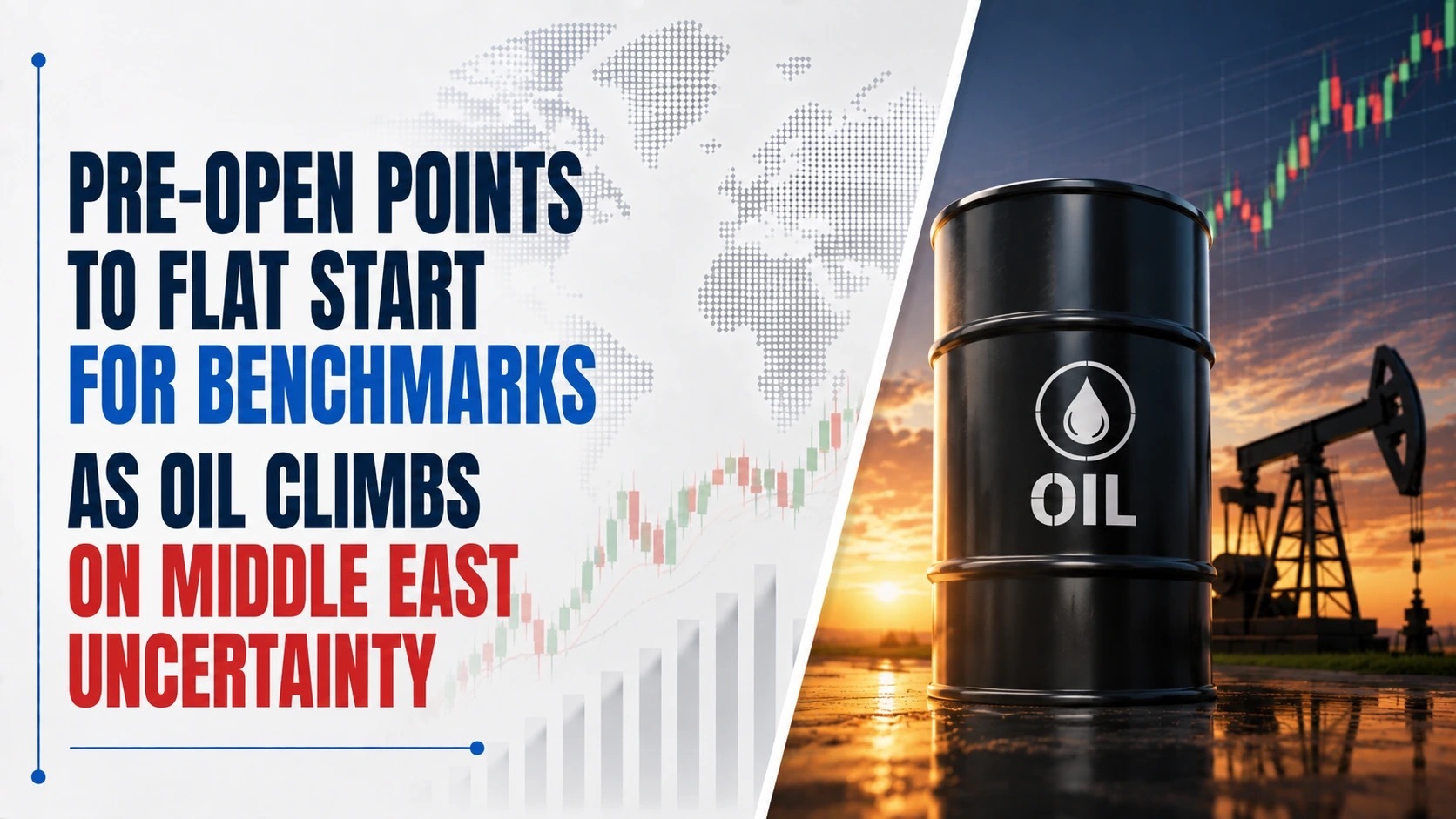
Pre-Open Points To Flat Start For Benchmarks As Oil Climbs On Middle East Uncertainty
Authored By HDFC SKY | Last Modified: Aug 19, 2026 09:24 AM IST
Open Free Demat Account
Open Free Demat Account
Mumbai, August 19: Indian shares flatlined at pre open signalling a muted start for benchmarks as oil continued to rise on Middle East uncertainty and global bond yields climbed.
Nifty 50 declined 0.05% and Sensex declined 0.01% at pre open.
Nifty 50 has been on a losing streak for six sessions now.
Rising US Treasury yields could further dampen the appeal of Indian and other emerging-market assets for overseas investors, particularly after foreign investors have already pulled a record $25 billion from Indian equities in 2026.
Despite the broader selling trend, foreign investors turned buyers on Tuesday, purchasing Indian equities worth Rs 1,652 crore ($172.66 million), provisional exchange data showed. It marked their second buying session in the past six trading days.
Investors will keep an eye on the minutes of the US Federal Reserve’s July meeting, due later on Wednesday, for clues on the path of interest rates. Markets will also look ahead to Fed Chair Kevin Warsh’s address at the Jackson Hole Symposium next week, which could offer further insight into the central bank’s policy stance.
Centella Mauritius Holdings, an investment vehicle of a TPG affiliate, is expected to offload a 7.2% stake worth around Rs 4,780 crore in Aster DM Quality Care, a report said.
RailTel secured a Rs 167-crore order from the Employees’ Provident Fund Organisation, adding to its order pipeline.
Shiprocket, the Temasek-backed e-commerce enablement and logistics company, is set to make its stock market debut after raising $170 million through its initial public offering last week.

Asian Markets Slide
South Korean equities led losses across the region, with the Kospi plunging 5.3%. Japan’s Nikkei 225 fell 2.6%, while the broader Topix declined 2.7%. Australia’s S&P/ASX 200 slipped 0.4%.
The sell-off was led by technology and semiconductor stocks, reflecting growing concerns that elevated borrowing costs could challenge the steep valuations built up during the global artificial intelligence rally. The sharp decline in South Korean equities also highlighted a broader deterioration in investor risk appetite across Asian markets.
Wall Street Retreats
The weakness in Asia followed a negative session on Wall Street, where technology stocks bore the brunt of selling. The Nasdaq Composite declined 1.33%, marking its steepest fall since July 29. The S&P 500 dropped 0.69%, while the Dow Jones Industrial Average slipped 0.22%.
Investors reassessed the outlook for risk assets amid rising US Treasury yields and uncertainty over the economic fallout from the prolonged Middle East conflict. Higher yields can weigh on equity valuations by making bonds more attractive while also raising financing costs for businesses.
The benchmark 10-year US Treasury yield briefly climbed to its highest level since January 2025, while the 30-year yield touched its highest level since 2007.
Oil Rises For Fourth Session
Crude oil prices extended their gains for a fourth consecutive session on Wednesday as uncertainty over oil shipments through the Strait of Hormuz kept supply concerns elevated.
Brent crude futures rose 0.6% to $91.6 a barrel, while US West Texas Intermediate futures gained 0.7% to $85.6. Both benchmarks settled at their highest levels since July 24 on Tuesday.
The latest gains came amid conflicting signals from Washington and Tehran over the strategic waterway. US President Donald Trump said no talks were underway with Iran and maintained that the Strait of Hormuz was open, while Iran has said the crucial shipping route remains closed.
The expiry of a temporary ceasefire on Monday has further clouded prospects of an immediate diplomatic breakthrough, keeping a geopolitical risk premium embedded in crude prices.
Higher Oil Adds To India’s Risks
For India, the combination of weak Asian markets, higher crude prices and elevated global bond yields presents a challenging backdrop. As one of the world’s largest oil importers, India remains particularly sensitive to movements in crude prices. A sustained rise in oil can increase the import bill, pressure the rupee and complicate the inflation outlook.
Higher crude prices could also weigh on margins and earnings expectations for oil-consuming sectors such as paints, chemicals, aviation and tyres. On the other hand, upstream oil producers could benefit from stronger realisations.
The broader risk-off mood could also keep foreign portfolio flows under pressure. Investors could favour defensive stocks amid heightened geopolitical uncertainty.
Source
- Exchanges
Disclaimer
If you have any concerns, questions, or wish to point out any discrepancies in our content, please feel free to write to us at content@hdfcsec.com.
Please Note: The information shared is intended solely for informational purposes and does not make any investment recommendations
Disclaimer
At HDFC SKY*, we take utmost care and due diligence in curating and presenting news and market-related content. However, inadvertent errors or omissions may occasionally occur.
If you have any concerns, questions, or wish to point out any discrepancies in our content, please feel free to write to us at content@hdfcsec.com.
Please Note: The information shared is intended solely for informational purposes and does not make any investment recommendations.
HDFC SKY from HDFC Securities, one of most trusted trading platforms in India, has been recognized with the *Next-Gen Digi Content Awards 2025-26.
 Join Us
 Add as preferred source on Google


More Markets News







Open Free Demat Account
Open Free Demat Account









Invest Anytime, Anywhere


By signing up I certify terms, conditions & privacy policy