Nifty 50
- Bajaj Auto₹10,090312.00 (3.19%)
- Tech Mahindra₹1,460.30-53.80 (-3.55%)
- Tata Steel₹176.943.14 (1.81%)
- Bharti Airtel₹1,767-38.10 (-2.11%)
- Dr. Reddy's Labs₹1,217.5020.50 (1.71%)
- ITC₹262.40-3.60 (-1.35%)
- Bharat Electronics₹374.306.15 (1.67%)
- SBI₹948.90-10.20 (-1.06%)
- JSW Steel₹1,185.7017.70 (1.52%)
- Axis Bank₹1,251.10-8.00 (-0.64%)
- Trent₹2,960.6042.40 (1.45%)
- ICICI Bank₹1,348.60-6.40 (-0.47%)
- Eicher Motors₹7,14999.00 (1.40%)
- NTPC₹310.90-1.10 (-0.35%)
- Mahindra & Mahindra₹2,832.4036.20 (1.29%)
- Hindustan Unilever₹1,851.30-5.40 (-0.29%)
- HDFC Life Insurance ₹563.556.90 (1.24%)
- Infosys₹1,022.10-1.30 (-0.13%)
- BSE₹3,326.4039.20 (1.19%)
- Coal India₹411.20-0.35 (-0.09%)

- Offerings
- Tools & Platforms
Tools & Calculators
- Open API
- Calculators
- SIP Calculator
- CAGR Calculator
- Compound Interest Calculator
- FD Calculator
- RD Calculator
- EPF Calculator
- Retirement Calculator
- HDFC SIP Calculator
- Mutual Fund Return Calculator
- Lumpsum Calculator
- Step Up SIP Calculator
- ETF SIP Calculator
- Brokerage Calculator
- Equity Margin Calculator
- SWP Calculator
- EMI Calculator
- MTF Calculator
- Margin Pledge Calculator
- Algo Strategy
- Markets
Stocks
F&O
Mutual Funds
- More
Behind the TATA Empire: Who Really Owns TATA Sons as Chairman N Chandrasekaran Bids Adieu?
Authored By HDFC SKY | Last Modified: Aug 14, 2026 10:58 AM IST
Open Free Demat Account
Open Free Demat Account
Mumbai, Aug 14: Natarajan Chandrasekaran announced his resignation as Chairman of Tata Sons, the principal holding company of the USD 400-billion Tata Group, bringing into sharp focus one of the most frequently asked questions about India’s largest conglomerate: Who actually owns the Tata Empire?
Chandrasekaran, who took charge in February 2017, will remain in the role until his current term concludes on February 20, 2027 and has formally requested the board to initiate the succession process. The announcement comes after a six-month deliberation over his reappointment, highlighting the governance dynamics that make the Tata Group structurally unique not just in India but in global corporate history.
The resignation follows discussions over Chandrasekaran’s third term that encountered resistance from Tata Trusts chairman Noel Tata. According to Chandrasekaran’s statement, the Sir Dorabji Tata Trust and Sir Ratan Tata Trust had unanimously resolved and recommended a five-year extension, which was subsequently recorded and recommended by the Tata Sons Nomination and Remuneration Committee and the board. However, when the resolution was tabled before the Tata Sons board on February 24, 2026, one board member did not support it.

66% Stake Held by Philanthropic Trusts: The Core of Tata Ownership
At the core of the Tata Empire lies a governance structure unique in global corporate history. Tata Sons is not owned by any single individual or family member. Approximately 66% of its equity share capital is held by philanthropic trusts, which use dividends to fund education, healthcare, livelihood generation, and art and culture. These charitable organisations, collectively known as Tata Trusts, comprise 13 entities, of which seven directly hold shares in Tata Sons.
The two dominant trusts are the Sir Dorabji Tata Trust (SDTT), with 27.98%, and the Sir Ratan Tata Trust (SRTT), with 23.56%, giving them a combined majority stake of 51.54% in Tata Sons. Other Tata trusts holding shares include the JRD Tata Trust (4.01%), Tata Education Trust (3.73%), Tata Social Welfare Trust (3.73%), RD Tata Trust (2.19%), and Sarvajanik Seva Trust (0.10%).
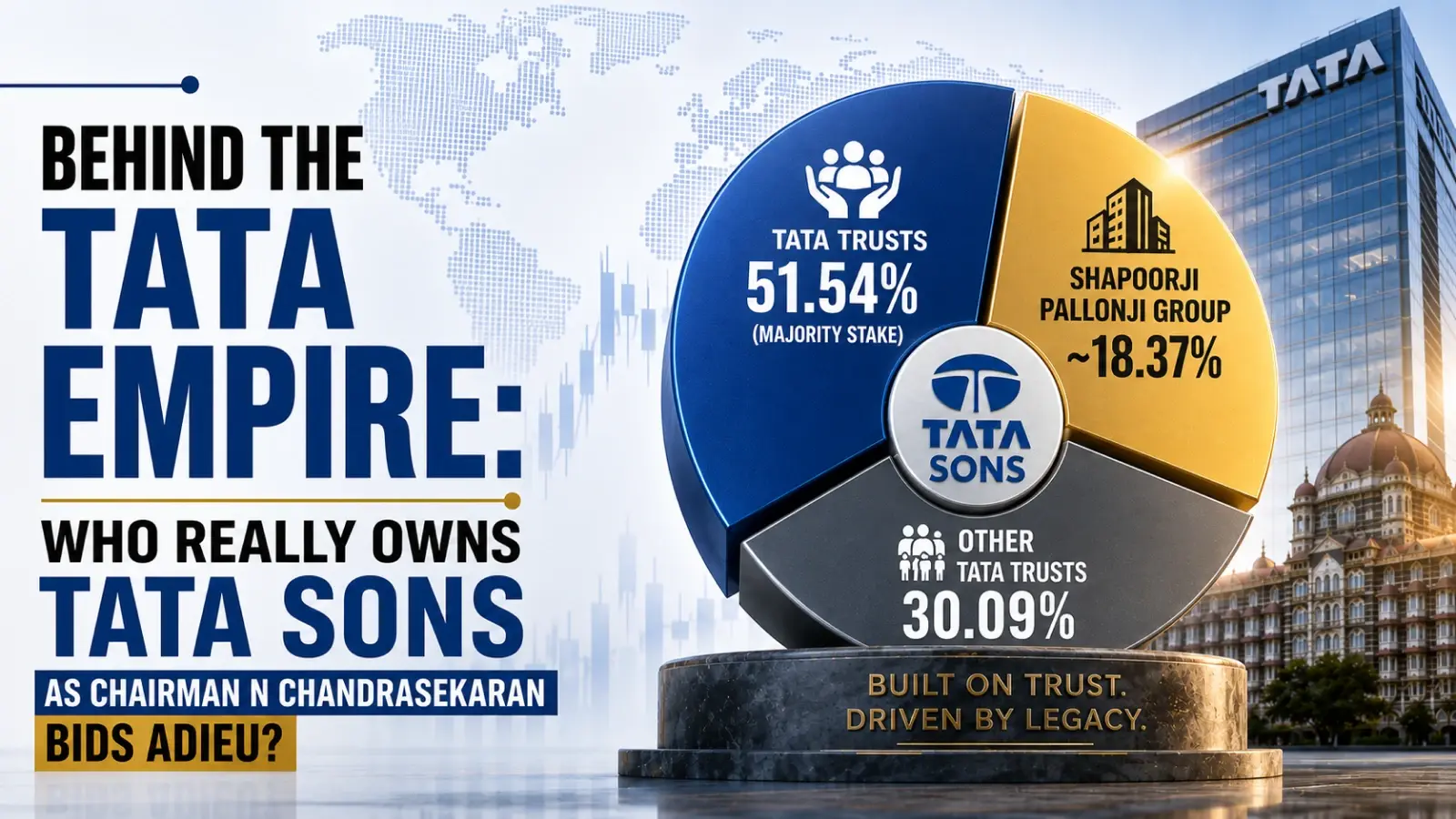
Noel Tata, the half-brother of the late Ratan Tata, chairs Tata Trusts and serves as a non-executive director on the Tata Sons board. However, he does not personally own the shares held by the trusts; the assets belong to the charitable organisations, with decisions taken through their respective boards of trustees. The Shapoorji Pallonji (SP) Group holds the second-largest stake of approximately 18.37%.
Article 118 Dictates Succession: How the Next Chairman Will Be Chosen
Unlike most corporate succession exercises, the Tata Sons board cannot simply choose a new chairman on its own. The company’s Articles of Association provide for a special selection mechanism that gives Tata Trusts, which collectively own about 66% of Tata Sons, a central role in identifying the next chairman.
Under Article 118 of Tata Sons’ Articles of Association, a selection committee has to be constituted to appoint the chairman, as long as the Tata charitable trusts collectively continue to hold the prescribed level of shareholding in Tata Sons. The key threshold requires the trusts to hold at least 40% of Tata Sons’ paid-up ordinary share capital.
The five-member selection committee comprises:
- Three members nominated jointly by the Sir Dorabji Tata Trust and the Sir Ratan Tata Trust
- One member nominated by and from the Tata Sons board
- One independent outside member selected by the Tata Sons board
The chairperson of the selection committee is chosen by the two principal trusts from among their three nominated members. A majority of the trust-nominated members must be present for the committee to conduct business. The committee recommends a candidate, but the final appointment is made by the Tata Sons board.
Noel Tata Cannot Become Chairman: The 2022 Amendment
Tata Sons amended its Articles in 2022 to formally separate the top positions. Under the change, the chairman of either the Sir Dorabji Tata Trust or the Sir Ratan Tata Trust cannot simultaneously serve as Tata Sons chairman. The amendment creates a clearer line between ownership and management.
This means Noel Tata, who currently chairs the Tata Trusts, cannot also become chairman of Tata Sons under this provision. While Ratan Tata headed Tata Sons until 2012 and later continued as chairman of the Tata Trusts, his successors, Cyrus Mistry and N Chandrasekaran, did not hold the Trusts’ top post.
Trusts Hold the Key: Governance Disputes Add Complexity
The potentially more complicated part of the process will be achieving consensus within Tata Trusts. The Trusts have been dealing with differences over governance, trustee appointments, tenure, and representation on the Tata Sons board. Some of those disagreements have spilled into proceedings before the Maharashtra Charity Commissioner involving the Sir Ratan Tata Trust, one of the two principal Tata Trusts.
In May 2026, the Charity Commissioner directed the trustees to defer a scheduled SRTT meeting. Tata Trusts subsequently said the direction had been issued ex parte, without SRTT being given notice or a hearing. The proceedings arose in the context of a complaint concerning the composition of the SRTT board.
Precedent from 2016: How Chandrasekaran Was Chosen
The succession mechanism has a recent precedent. Following the removal of Cyrus Mistry as Tata Sons chairman in October 2016, Tata Sons constituted a five-member selection committee to identify his successor. Ratan Tata was appointed interim chairman while the search was conducted.
The committee comprised Ratan Tata, Venu Srinivasan, Amit Chandra, former diplomat Ronen Sen, and Lord Kumar Bhattacharyya. It eventually unanimously recommended Chandrasekaran, who was then chief executive and managing director of Tata Consultancy Services. The Tata Sons board accepted the recommendation in January 2017, and Chandrasekaran formally took charge the following month.
The circumstances this time are different. Mistry’s removal created an immediate leadership vacuum, requiring Ratan Tata to return as interim chairman. Chandrasekaran’s resignation could give the group several months to complete the succession process before his current term expires, potentially allowing Tata Sons to move directly to his successor without requiring an interim chairman.
Understanding Tata Sons: The Holding Company at the Centre of the Empire
Tata Sons Private Limited serves as the principal investment holding company and promoter of every major Tata business. It is the company that sits at the centre of the entire Tata Group, holding controlling stakes in operating companies such as TCS, Tata Motors, Tata Steel, Titan, Air India, Trent, Tata Power, and dozens more.
Tata Sons earns revenue primarily through dividends from group companies and owns the Tata trademark registered in India and several other countries. The company holds approximately 71.74% stake in Tata Consultancy Services (TCS) alone, and close to 80% of Tata Sons’ dividend income comes from TCS. As of October 2025, the combined market capitalisation of listed Tata Group companies stood at approximately Rs 26.39 lakh crore (approximately USD 310 billion).
Each Tata company operates independently under the guidance and supervision of its own board of directors. The relationship between Tata Sons and companies using the Tata brand is governed by the Brand Equity and Business Promotion (BEBP) agreement. Companies using the Tata brand commit to operating their businesses ethically and with excellence, adopting the Tata Code of Conduct and the Tata Business Excellence Model.
Why This Unique Structure Exists: The Philanthropic Vision
The unique ownership structure of the Tata Empire traces back to the vision of its founder, Jamsetji Nusserwanji Tata, who established the group in 1868. Jamsetji believed that wealth created by business should serve the larger good of society. This philosophy was carried forward by his sons, Sir Dorabji Tata and Sir Ratan Tata, who established the charitable trusts that now hold the controlling stake in Tata Sons.
The trusts were created to ensure that profits from the group’s businesses would flow back into society through philanthropic activities. Unlike conventional family-controlled businesses where the founding family personally holds the controlling stake, the Tata family does not personally own the shares; charitable trusts linked to the family do. This structure ensures the group grows steadily over decades to fund its charitable activities, making it a long-term bet rather than an entity that optimises for quarterly profit extraction.
The trusts support causes including education, healthcare, livelihoods, art and culture, and scientific research. Some of the most prestigious institutions in India, including the Indian Institute of Science, the Tata Memorial Hospital, and the Tata Institute of Social Sciences, have been established or supported by funds from these trusts.
Seven Chairmen Who Shaped the Tata Empire
The Tata Group has been led by seven chairmen since its founding in 1868, each contributing to the evolution of the conglomerate:
Jamsetji Tata (1868-1904) established the group’s core values and laid the foundation for future industrial ventures. He founded the company that would become Tata Steel and established the Indian Institute of Science in Bengaluru.
Sir Dorabji Tata (1904-1932) , the elder son of Jamsetji, expanded the group’s presence and established the Tata Steel plant in Jamshedpur, creating India’s first integrated steel plant. He also played a key role in establishing the Tata Power Company.
Nowroji Saklatwala (1932-1938) led the group during challenging economic times and navigated the Great Depression, ensuring the group’s survival through difficult years.
Sir Jehangir Ratanji Dadabhoy Tata (JRD Tata) (1938-1991) served the longest tenure of 53 years and transformed the group into a modern industrial powerhouse. He established Tata Consultancy Services, Tata Motors, and Tata Chemicals. He was also the first Indian to hold a commercial pilot’s license and played a crucial role in developing Indian aviation.
Ratan Naval Tata (1991-2012) oversaw a period of global expansion, including the acquisition of Jaguar Land Rover and Corus Steel. He strengthened the group’s governance structures and reinforced the philanthropic ethos of the Tata Trusts.
Cyrus Pallonji Mistry (2012-2016) was the first chairman from outside the Tata family, serving a brief tenure that ended in his ouster by the Tata Sons board. His removal was subsequently upheld by the Supreme Court in 2021.
Natarajan Chandrasekaran took over as Chairman of Tata Sons on 21 February 2017, becoming the seventh chairman in the group’s 158-year history. Under his leadership, the group navigated the acquisition of Air India from the government, the merger of Vistara with Air India, and made significant forays into digital businesses, electronics, and semiconductors.
Financial Performance Under Chandrasekaran’s Leadership
The financial health of the Tata Empire remained robust under Chandrasekaran’s stewardship. Tata Sons reported a 21.8% increase in profit after tax to Rs 31,961 crore in FY26. The group’s established businesses continued to perform strongly, with TCS remaining the crown jewel of the conglomerate.
The group’s new ventures, while reporting losses, are part of a long-term strategic vision. Air India and Air India Express reported a combined loss of Rs 22,238 crore in FY26 as part of the airline’s turnaround journey, while Tata Digital reported a loss of Rs 4,974 crore during FY26. Chandrasekaran had told shareholders that transforming Air India should be viewed as a five-to-ten-year journey, indicating the patience required for such large-scale transformation projects.
Succession Process Begins: Selection Committee to Recommend Next Chairman
The Sir Dorabji Tata Trust has passed a resolution to initiate the setting up of a Selection Committee as soon as possible in accordance with the Articles of Association of Tata Sons. The committee will recommend a person for appointment as the new Chairman of the Board of Directors.
“The Sir Dorabji Tata Trust respects Mr. Chandrasekaran’s decision not to offer himself for re-appointment. We place on record our deepest appreciation for his contribution and stewardship of Tata Sons and the Tata group over the past decade,” the Trust said in a statement. “We extend our full support to Tata Sons in ensuring a smooth, timely and orderly transition of leadership, consistent with the values and long-term interests of Tata Sons and the Tata group.”
The announcement of the succession process has brought renewed attention to the unique governance structure of the Tata Group, where charitable trusts holding the majority stake exercise significant influence over the group’s strategic direction.
The Tata Empire is owned not by a single family member but by philanthropic trusts holding 66% of Tata Sons, using dividends for social causes. This unique structure, established by Jamsetji Tata’s vision, ensures long-term stability and social impact. With Chandrasekaran’s resignation after nine years, the succession process now begins, led by Sir Dorabji Tata Trust. The outcome will shape India’s largest conglomerate for years to come.
Source
- https://www.tata.com/business/tata-sons
Disclaimer
If you have any concerns, questions, or wish to point out any discrepancies in our content, please feel free to write to us at content@hdfcsec.com.
Please Note: The information shared is intended solely for informational purposes and does not make any investment recommendations
Disclaimer
At HDFC SKY*, we take utmost care and due diligence in curating and presenting news and market-related content. However, inadvertent errors or omissions may occasionally occur.
If you have any concerns, questions, or wish to point out any discrepancies in our content, please feel free to write to us at content@hdfcsec.com.
Please Note: The information shared is intended solely for informational purposes and does not make any investment recommendations.
HDFC SKY from HDFC Securities, one of most trusted trading platforms in India, has been recognized with the *Next-Gen Digi Content Awards 2025-26.
 Join Us
 Add as preferred source on Google


More Business News







Open Free Demat Account
Open Free Demat Account










Invest Anytime, Anywhere


By signing up I certify terms, conditions & privacy policy