Nifty 50
- Apollo Hospitals₹8,027.50361.50 (4.72%)
- BSE₹3,287.20-47.60 (-1.43%)
- ITC₹26611.00 (4.31%)
- Reliance Industries₹1,170.30-7.70 (-0.65%)
- Eicher Motors₹7,050282.50 (4.17%)
- JSW Steel₹1,168-7.20 (-0.61%)
- TCS₹2,15680.00 (3.85%)
- Cipla₹1,301-5.80 (-0.44%)
- HCL Technologies₹1,216.7039.80 (3.38%)
- Adani Ports₹1,76153.00 (3.10%)
- Infosys₹1,023.4026.40 (2.65%)
- Shriram Finance₹940.4523.20 (2.53%)
- Tata Motors PV₹279.906.90 (2.53%)
- UltraTech Cement₹10,675249.00 (2.39%)

- Offerings
- Tools & Platforms
Tools & Calculators
- Open API
- Calculators
- SIP Calculator
- CAGR Calculator
- Compound Interest Calculator
- FD Calculator
- RD Calculator
- EPF Calculator
- Retirement Calculator
- HDFC SIP Calculator
- Mutual Fund Return Calculator
- Lumpsum Calculator
- Step Up SIP Calculator
- ETF SIP Calculator
- Brokerage Calculator
- Equity Margin Calculator
- SWP Calculator
- EMI Calculator
- MTF Calculator
- Margin Pledge Calculator
- Algo Strategy
- Markets
Stocks
F&O
Mutual Funds
- More
- What Does FII Ownership Mean?
- Why the 10% Threshold Matters
- Common Reasons FII Ownership Falls Below 10%
- What This Signal Has Meant Historically
- How Falling FII Ownership Affects Large-Cap Stocks
- When Falling FII Ownership Is a Serious Warning
- When It May Not Be a Negative Signal
- Why Retail Investors Often Misread This Signal
- How Investors Should Analyse FII Ownership Trends
- FII Ownership Drop: Risk Signal vs Interpretation
- Conclusion
- What Does FII Ownership Mean?
- Why the 10% Threshold Matters
- Common Reasons FII Ownership Falls Below 10%
- What This Signal Has Meant Historically
- How Falling FII Ownership Affects Large-Cap Stocks
- When Falling FII Ownership Is a Serious Warning
- When It May Not Be a Negative Signal
- Why Retail Investors Often Misread This Signal
- How Investors Should Analyse FII Ownership Trends
- FII Ownership Drop: Risk Signal vs Interpretation
- Conclusion
FII Ownership Dropping Below 10% in a Large-Cap: What This Risk Signal Has Meant Historically
By Aseem Shrivastava | Updated at: May 29, 2026 06:16 PM IST
Open Free Demat Account
Open Free Demat Account
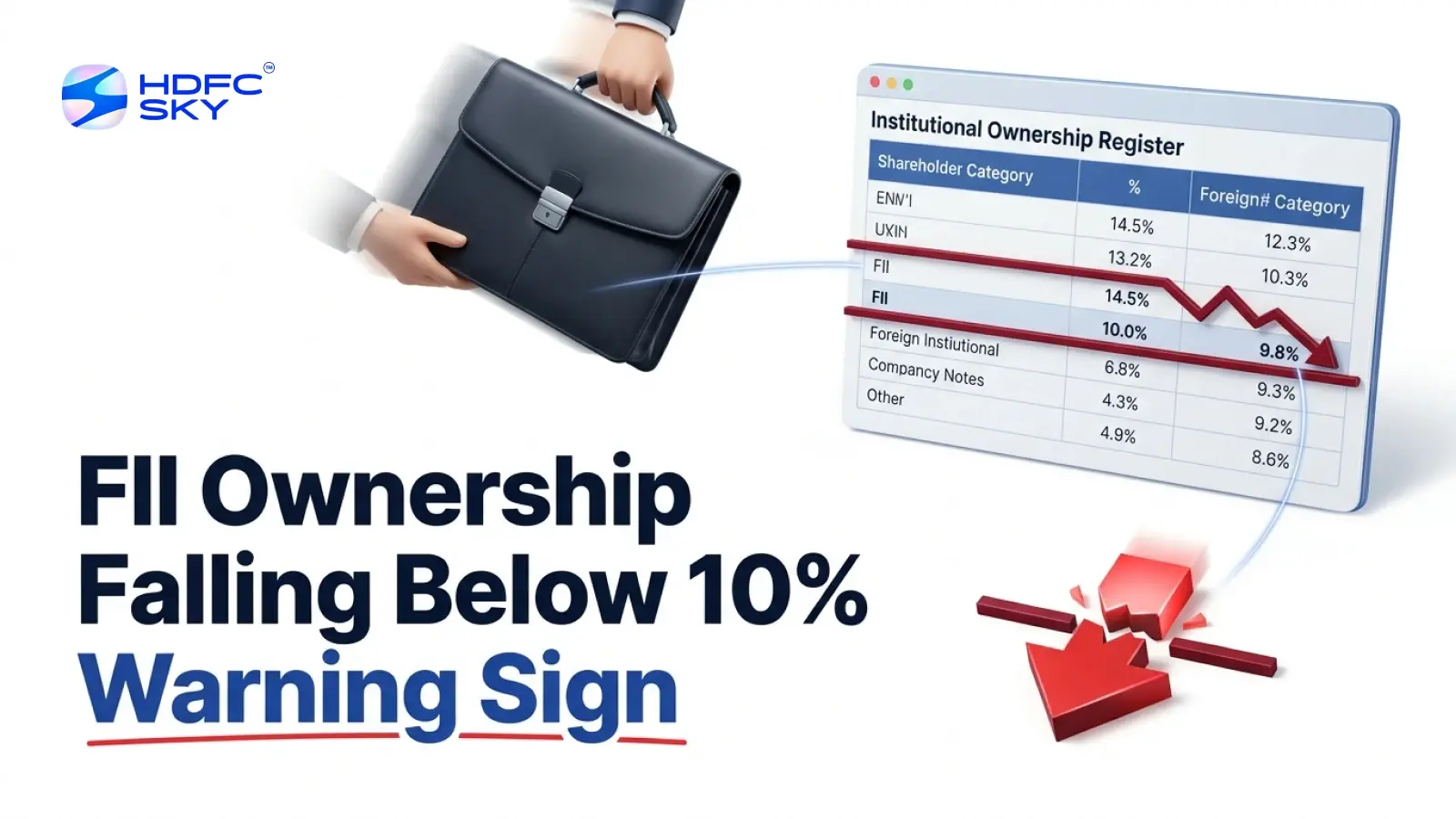
Investors often watch stock prices closely, but ownership changes can reveal risk much earlier. One important signal appears when Foreign Institutional Investor (FII) ownership falls below 10% in a large-cap stock. FIIs usually prefer large companies for their liquidity and governance quality. A sharp decline can signal changing sentiment or company concerns. This blog explains what this shift means and how investors should interpret it.
What Does FII Ownership Mean?
FII ownership shows the percentage of a company’s shares held by foreign institutional investors such as global mutual funds, pension funds, sovereign wealth funds, and hedge funds. These investors often influence liquidity, price discovery, and market sentiment. High FII ownership usually reflects global confidence in a company’s quality and growth prospects. However, falling ownership can sometimes signal reduced conviction—but not always.
Also Read: Why Q4 results “beat estimates” but stocks fell
Why the 10% Threshold Matters
A drop below 10% often changes how markets perceive institutional confidence.
- Loss of Institutional Sponsorship
FIIs often act as anchor investors in large-cap companies and provide confidence to other market participants. When ownership falls below 10%, investors may interpret it as reduced global conviction in the company’s long-term potential. - Lower Liquidity Support
FIIs bring consistent trading activity and liquidity to large-cap stocks. Lower foreign participation can reduce market depth and make the stock more vulnerable to sharper price swings during periods of uncertainty. - Sentiment Signal to Other Investors
Retail investors and domestic institutions closely track FII ownership trends. Falling foreign ownership can influence broader market sentiment and trigger caution, even if the company’s core business performance remains stable.
Common Reasons FII Ownership Falls Below 10%
Not every decline in foreign ownership signals company weakness.
- Global Risk-Off Cycles
FIIs often reduce exposure to emerging markets when the US dollar strengthens or global bond yields rise. This selling can happen even when company fundamentals remain healthy and business performance stays unchanged. - Valuation Concerns
Foreign investors may trim holdings when stock prices rise faster than earnings growth. Even strong companies can face FII selling when valuations become expensive relative to expected future returns. - Sector Rotation
Global funds often shift capital between sectors based on economic cycles. Investors may move from technology to banking, or from growth sectors to defensive industries, causing ownership changes without company-specific concerns. - Company-Specific Concerns
Governance issues, weaker earnings outlook, management uncertainty, or strategic risks can trigger selective foreign exits. In such cases, falling FII ownership may reflect declining confidence in the company itself.
What This Signal Has Meant Historically
History shows that falling FII ownership can mean different things depending on context.
- Sometimes It Precedes Extended Underperformance
Stocks can face prolonged valuation pressure when FIIs continue reducing exposure over multiple quarters. Lower foreign confidence can often create sustained weakness, especially when business performance also starts to slow. - Sometimes DIIs Replace FIIs Successfully
Domestic institutional investors often absorb foreign selling in today’s Indian market. Mutual funds and insurance companies can provide stability and prevent sharp price declines despite falling FII ownership. - Sometimes It Creates a Future Buying Opportunity
Large-cap stocks often recover strongly when foreign selling happens due to global macro factors rather than company weakness. Temporary ownership declines can sometimes create attractive long-term entry points. - Sector Impact Often Matters More Than the Stock
Broad foreign selling across sectors like IT, financials, or FMCG can affect multiple companies at once. Sector-wide exits may reflect global allocation shifts rather than company-specific risks.
How Falling FII Ownership Affects Large-Cap Stocks
The impact usually spreads through multiple market channels.
- Increased Price Volatility
Lower institutional support can increase short-term price swings. Stocks may react more sharply to news, making market movements less stable and more unpredictable. - Valuation Multiple Compression
Stocks may trade at lower valuation multiples when foreign investors reduce holdings. Lower demand can weaken investor confidence and put pressure on stock prices. - Shift in Ownership Power
Domestic investors may gain greater influence over stock direction. Market sentiment may increasingly depend on local investment flows and retail participation. - Reduced Global Attention
Lower foreign ownership can reduce analyst coverage and global investor interest. This may weaken visibility and limit future international capital inflows.
When Falling FII Ownership Is a Serious Warning
Some patterns make this signal more concerning.
- Sharp Multi-Quarter Decline
Continuous FII selling over several quarters often signals deeper concern. It may reflect weakening confidence in growth, business stability, or the company’s future outlook. - Combined with Weak Earnings
Falling FII ownership along with declining profits creates a stronger warning. Weak earnings and foreign selling together can increase the risk of prolonged stock underperformance. - Accompanied by Promoter Selling
If promoters also reduce holdings while FIIs sell, investor confidence can weaken quickly. Multiple shareholder exits often signal rising uncertainty around the business. - Sector-Wide Foreign Exit
Broad foreign selling across an entire sector can create stronger pressure. Large-cap stocks often face valuation declines when global investors reduce exposure together.
When It May Not Be a Negative Signal
Falling FII ownership does not always mean investors should panic.
- Domestic institutional buying fully offsets foreign selling and supports stock stability
- Company fundamentals remain strong despite visible changes in ownership patterns
- Global macro factors, not company-specific issues, drive foreign investor exits
- FIIs may rotate temporarily and return when market conditions improve
- Valuations may become more attractive after sustained foreign selling pressure
Why Retail Investors Often Misread This Signal
Ownership data can be useful, but many investors oversimplify it.
- Focus only on FII selling headlines without deeper ownership analysis
- Ignore domestic institutional buying and ownership replacement trends
- Assume all foreign exits reflect hidden business problems
- Fail to separate global selling from company-specific concerns
- React emotionally to short-term price movements and market narratives
How Investors Should Analyse FII Ownership Trends
Ownership changes matter most when combined with fundamentals.
- Track FII ownership across several quarters instead of one filing
- Compare FII trends with domestic and promoter shareholding changes
- Check whether earnings growth and cash flow remain stable
- Watch sector-wide foreign ownership movement for broader context
- Assess whether valuation improves after the ownership decline
FII Ownership Drop: Risk Signal vs Interpretation
| Signal | Lower Concern | Higher Concern |
| Ownership decline | Gradual reduction during global market volatility or portfolio rebalancing | Sharp multi-quarter drop below 10% with continued selling |
| Company fundamentals | Stable earnings growth and strong operating cash flow | Weak earnings, margin pressure, or slowing business momentum |
| Ownership replacement | Domestic institutions absorb selling and support stability | Limited domestic buying and weak investor demand |
| Sector trend | Broad sector rotation affecting multiple large-cap companies | Company-specific foreign exits without sector-wide pressure |
| Valuation impact | Attractive entry opportunity after temporary foreign selling | Persistent valuation compression and weaker investor confidence |
Conclusion
FII ownership dropping below 10% in a large-cap can be an important risk signal. Its meaning depends on why foreign investors are exiting. Domestic ownership trends now matter more in Indian markets. Investors should treat falling FII ownership as a reason for deeper analysis, not fear.



Open Free Demat Account
Open Free Demat Account
Popular Posts
- 10 Interesting Facts About NSE You Probably Didn’t KnowLast Updated: Sep 30, 2026
- 8-4-3 Rule of SIP - How Does That Work?Last Updated: Jul 30, 2025
- Let's view more exciting Post!
Popular Post from Sky Risk Radar
- When Inventory Piles Up and Sales Stall: The Supply Chain Signal That Precedes Earnings MissesLast Updated: May 29, 2026
- When EBITDA Grows but Cash Flow Doesn’t: The Red Flag That Precedes Most Accounting FraudsLast Updated: May 29, 2026
- The Sudden Auditor Change Signal: What It Means When a Big-4 Firm Walks Away from a Listed CompanyLast Updated: May 29, 2026
- The Insider Selling Cluster: When Three or More Key Executives Sell Shares in the Same QuarterLast Updated: May 29, 2026
- Rising NPAs in a Bank's Quarterly Disclosure: How to Detect Stress Before the Stock ReactsLast Updated: May 29, 2026
- Let's view more exciting Post!
Popular Post from Blogs
- “Bounce Back” Theme Gains Traction in 2026Last Updated: Apr 8, 2026
- 5 Takeaways for Tax Payers from the Budget 2025Last Updated: Jan 29, 2026
- Let’s view more exciting Posts


Invest Anytime, Anywhere


By signing up I certify terms, conditions & privacy policy