Nifty 50
- SBI Life Insurance ₹1,77010.00 (0.57%)
- HDFC Life Insurance ₹524.80-36.70 (-6.54%)
- Cipla₹1,388.605.60 (0.40%)
- Bajaj Finance₹995-48.20 (-4.62%)
- Sun Pharmaceutical₹1,8694.00 (0.21%)
- Axis Bank₹1,198.70-44.50 (-3.58%)
- Tech Mahindra₹1,559.302.30 (0.15%)
- Bajaj Finserv₹1,793-53.50 (-2.90%)
- Eternal₹343.050.40 (0.12%)
- Hindalco Industries₹986-17.80 (-1.77%)
- NTPC₹326.200.20 (0.06%)
- HDFC Bank₹726.35-10.90 (-1.48%)
- Grasim Industries₹3,1890.50 (0.02%)
- Adani Enterprises₹2,952.40-40.80 (-1.36%)
- InterGlobe Aviation₹4,962-66.50 (-1.32%)
- Max Healthcare₹1,046.30-13.60 (-1.28%)
- Kotak Mahindra Bank₹408.15-5.10 (-1.23%)

- Offerings
- Tools & Platforms
Tools & Calculators
- Open API
- Calculators
- SIP Calculator
- CAGR Calculator
- Compound Interest Calculator
- FD Calculator
- RD Calculator
- EPF Calculator
- Retirement Calculator
- HDFC SIP Calculator
- Mutual Fund Return Calculator
- Lumpsum Calculator
- Step Up SIP Calculator
- ETF SIP Calculator
- Brokerage Calculator
- Equity Margin Calculator
- SWP Calculator
- EMI Calculator
- MTF Calculator
- Margin Pledge Calculator
- Algo Strategy
- Markets
Stocks
F&O
Mutual Funds
- More
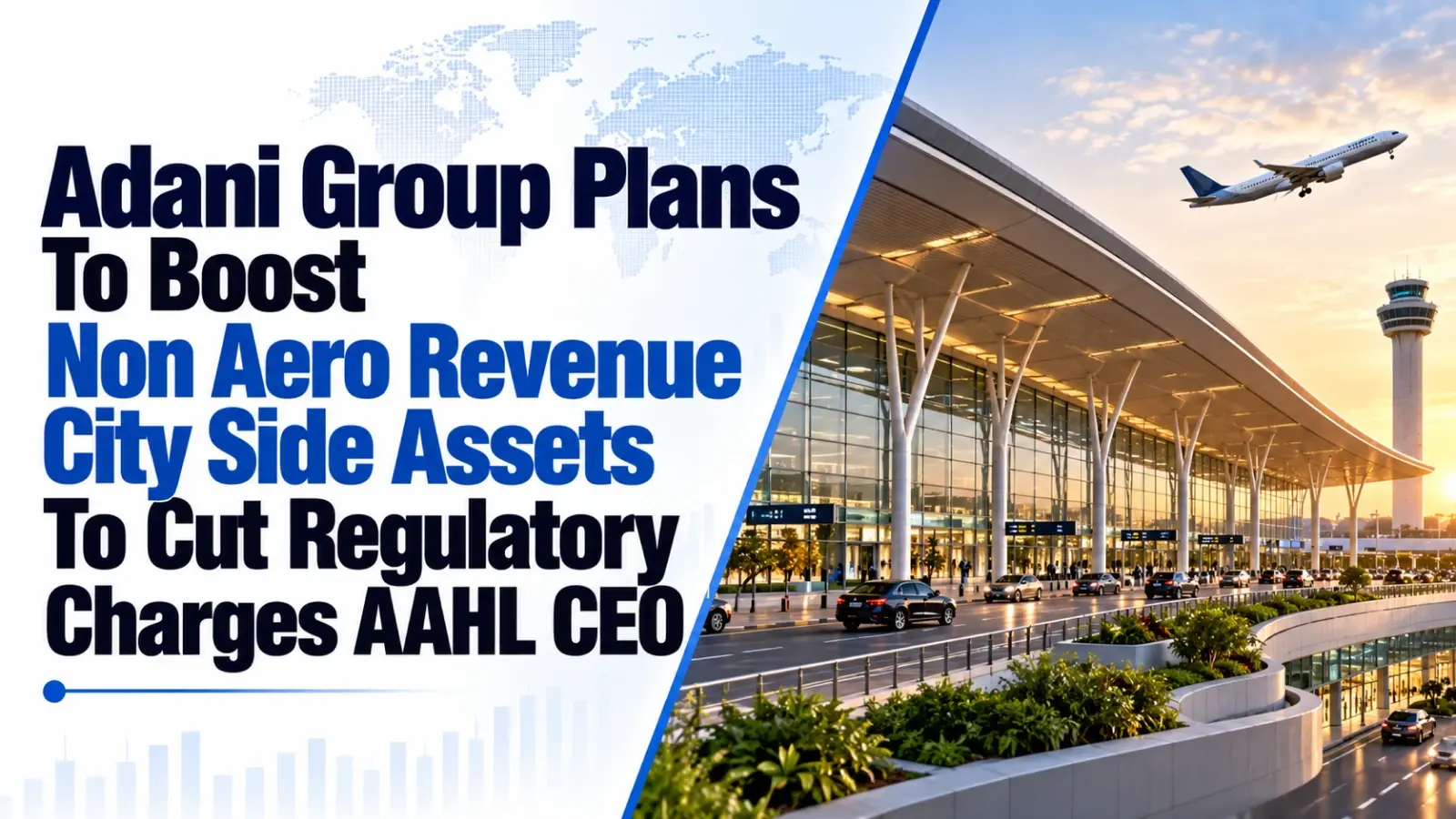
Adani Group Plans To Boost Non-Aero Revenue, City-Side Assets To Cut Regulatory Charges: AAHL CEO
Authored By PTI | Last Modified: Sep 24, 2026 10:48 AM IST
Open Free Demat Account
Open Free Demat Account
Mumbai: Adani Group is working on a strategy to reduce regulatory charges to a bare minimum by enhancing non-aeronautical charges and city-side development, a top company executive said on Wednesday.
The official also said Navi Mumbai International Airport has been planned, dimensioned and constructed with the ambition to make it an international hub when an Indian carrier starts direct flights to the US or Europe from the facility, though other domestic airports also hold potential to become hubs for international traffic.
“Everybody thinks an airport is a regulated business, but that is only one third of our business, and the ambition we have is to make regulator charges by having non-aero and city-side development business so significant that regulated revenue base becomes zero,” Adani Airports Holding Ltd (AAHL) CEO Arun Bansal said during a panel discussion at the 13th SBI Banking and Economics Conclave 2026 here.
“Our ambition is to bring down regulatory charges for passengers. So, we are working on a strategy to reduce regulatory charges to the bare minimum,” he said.
Aeronautical charges are fees levied on airlines and passengers for the direct use of core airport and terminal infrastructure. Non-aeronautical charges are commercial and ancillary fees generated from retail, leasing and services at airports.
Bansal said the ambition is to bring down regulatory revenue profile to almost “single digits” over a period.
Stating that India needs a national carrier first to make the country a global hub for international traffic. Bansal said Singapore, Dubai and Qatar all became global hubs because they have strong international terminals.
“Now, the hope is with IndiGo and Air India having 1,800 aircraft on order; once those aircraft get delivered by 2032, India has potential to become that hub,” Bansal added.
“And that’s why our role as airport operator is to create the infrastructure. Navi Mumbai, which we recently commissioned, is prepared and built with that ambition that it can be one of the international hubs for India,” he said.
While there is room for more such hubs, Bansal said “Navi Mumbai (airport) is planned, dimensioned, constructed with that ambition that it can become an international hub once one of the Indian carriers has direct flights from India to Europe or the US”.
“I think the West Asia crisis has opened the eyes of Indian regulators that our dependence on a transit hub there to travel to Europe or the US is quite significant. So, regulators understand the need to change the regulatory framework to make India the global hub.”
Later, talking to reporters at the event sidelines, Bansal said the airport operators plan to demolish T1 of Mumbai airport. However, the airport operator can’t force any airline to shift operations.
In August this year, Adani Group-operated Mumbai airport informed the civil aviation ministry that it will start demolishing part of Terminal 1 from January 15, 2027, and has started redistributing air traffic to Terminal 2 and Navi Mumbai airport.
“We can never force any airline to operate from Navi Mumbai or Mumbai or Ahmedabad. It’s their choice,” Bansal said.
“T1 demolition cannot be delayed,” he said, adding that airlines have been given time to plan their operations.
He said around five million passenger capacity from T1 will need to be accommodated elsewhere as the redevelopment progresses.
Regarding whether the Adani group is planning to venture into the airline business, Bansal said, “You are asking this question to a guy who is CEO of an airport, and as a man in my position, I would not like to compete with my customers. So I am focusing on airport development and will continue to do that both domestically and internationally.
“My hands are full… I need to build capacity in India from 100 million to 500 million passengers in the next decade and that will take the management bandwidth for the time being,” he added.
(Disclaimer: Except for the headline, this article has not been edited by HDFC Sky editorial team and is auto-generated from PTI feed.)
Disclaimer
At HDFC SKY*, we take utmost care and due diligence in curating and presenting news and market-related content. However, inadvertent errors or omissions may occasionally occur.
If you have any concerns, questions, or wish to point out any discrepancies in our content, please feel free to write to us at content@hdfcsec.com.
Please Note: The information shared is intended solely for informational purposes and does not make any investment recommendations.
HDFC SKY from HDFC Securities, one of most trusted trading platforms in India, has been recognized with the *Next-Gen Digi Content Awards 2025-26.
 Join Us
 Add as preferred source on Google


More Business News








Open Free Demat Account
Open Free Demat Account












Invest Anytime, Anywhere


By signing up I certify terms, conditions & privacy policy