Nifty 50
- Infosys₹1,03540.90 (4.11%)
- Bajaj Auto₹10,045-829.00 (-7.62%)
- HDFC Life Insurance ₹534.2013.00 (2.49%)
- Maruti Suzuki₹11,386-581.00 (-4.86%)
- HDFC Bank₹721.2012.50 (1.76%)
- Shriram Finance₹945-37.70 (-3.84%)
- SBI Life Insurance ₹1,721.6025.20 (1.49%)
- Tata Steel₹178-6.30 (-3.42%)
- Max Healthcare₹940.9511.15 (1.20%)
- Adani Ports₹1,737.80-60.50 (-3.36%)
- TCS₹2,07524.40 (1.19%)
- Grasim Industries₹2,962-99.90 (-3.26%)
- HCL Technologies₹1,243.1013.10 (1.07%)
- Eicher Motors₹6,920-230.00 (-3.22%)
- Tata Consumer ₹9577.50 (0.79%)
- Mahindra & Mahindra₹2,860-90.00 (-3.05%)
- Tech Mahindra₹1,5339.00 (0.59%)
- Adani Enterprises₹2,816.80-86.60 (-2.98%)
- Kotak Mahindra Bank₹418.351.35 (0.32%)
- ITC₹255.90-6.85 (-2.61%)

- Offerings
- Tools & Platforms
Tools & Calculators
- Open API
- Calculators
- SIP Calculator
- CAGR Calculator
- Compound Interest Calculator
- FD Calculator
- RD Calculator
- EPF Calculator
- Retirement Calculator
- HDFC SIP Calculator
- Mutual Fund Return Calculator
- Lumpsum Calculator
- Step Up SIP Calculator
- ETF SIP Calculator
- Brokerage Calculator
- Equity Margin Calculator
- SWP Calculator
- EMI Calculator
- MTF Calculator
- Margin Pledge Calculator
- Algo Strategy
- Markets
Stocks
F&O
Mutual Funds
- More
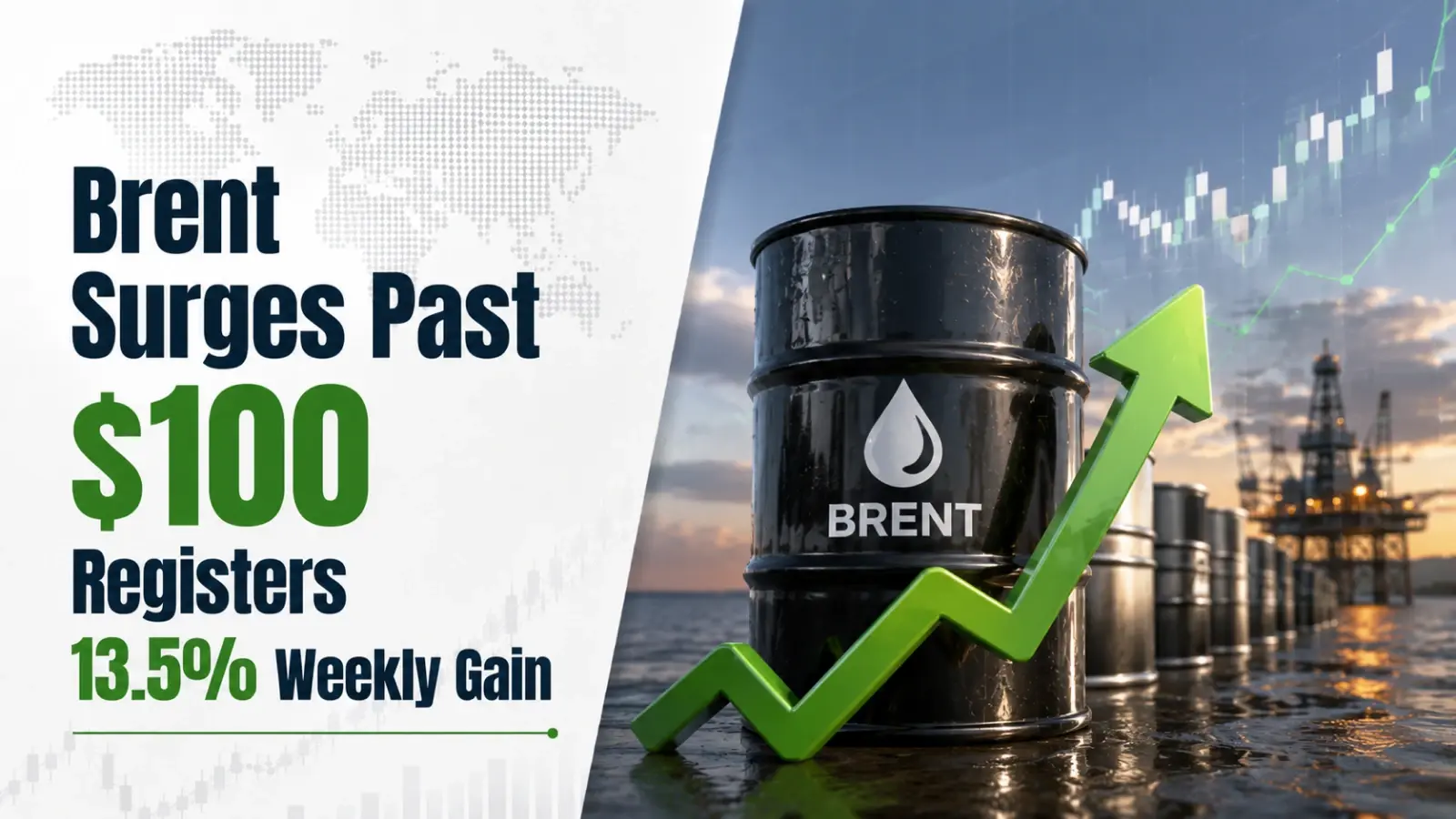
Brent Surges Past $100, Registers 13.5% Weekly Gain as Red Sea Attacks & Iran Conflict Threaten Two Critical Oil Chokepoints
Authored By HDFC SKY | Last Modified: Jul 27, 2026 12:25 PM IST
Open Free Demat Account
Open Free Demat Account
Mumbai, July 25: Global crude oil markets witnessed one of their most volatile weeks since the onset of the US-Israeli war on Iran, as escalating geopolitical tensions in the Middle East propelled Brent crude above the psychologically significant USD 100 per barrel mark for the first time since May. Brent futures surged 7% in a single session on Thursday to settle above $100, before retreating on Friday to trade around $97-99 per barrel.
Despite Friday’s profit-booking, Brent remained on course for a staggering 13.5% weekly advance. West Texas Intermediate (WTI) crude also posted robust weekly gains of approximately 10.9%, trading around $91 per barrel on Friday. Crude oil futures fell 2% to ₹8,876 per barrel on Friday as traders booked profits after the recent rally, even as global benchmark Brent hovered near the $100-a-barrel mark amid geopolitical tensions in West Asia that kept supply concerns alive. On the Multi Commodity Exchange (MCX), crude for the August delivery declined by ₹148, or 1.64%, to ₹8,876 per barrel in a business turnover of 17,232 lots.
Houthi Tanker Attacks & US-Iran Escalation Fuel Supply Fears
The primary catalyst for the oil price surge was a series of attacks on Saudi oil tankers in the Red Sea by Iran-aligned Houthi rebels. The group claimed responsibility for striking two Saudi oil tankers, with one vessel reportedly set ablaze in an overnight attack north of the Bab el-Mandeb Strait.
The Houthis had declared on Monday that they were imposing a naval blockade on Saudi Arabia, which had been diverting its oil via pipeline to bypass Iran’s closure of the Strait of Hormuz. This escalation opened a new front in the conflict, with the threat now spreading from the Strait of Hormuz to the Red Sea.
Also Read: How to invest in crude oil
US President Donald Trump vowed to “hold Iran responsible” for any further attacks and warned of a “massive attack” on Iran “bigger than ever before”. The US military carried out strikes on Iran for the 13th consecutive night, while Iran retaliated with strikes on US-linked military installations in Jordan and Kuwait. The conflict shows no sign of abating, with UN Secretary-General Antonio Guterres cautioning that West Asia was being pushed to the “edge of the unimaginable”.
Two Critical Chokepoints Under Threat
The attacks have raised fears about the potential closure of two of the world’s most critical oil transit routes simultaneously. Daily vessel transits through the Strait of Hormuz fell to just one on Thursday, the lowest since May 7. Meanwhile, the Bab el-Mandeb strait, which controls access from the Red Sea to the Indian Ocean and is the second most important oil channel after Hormuz, now faces similar threats. “The potential supply disruptions facing the market now are larger than at any time during the war,” ING analysts said in a note. “Not only have oil flows through the Strait of Hormuz essentially dried up, but there are clear risks to Saudi oil flows from the Red Sea”.
Oxford Economics fears that if both routes were effectively closed to traffic, the price of oil could eventually pass USD 160 per barrel. Rystad analyst Janiv Shah noted that current disruption in the Strait of Hormuz appears to be nearing peak levels seen in March. Analysts at JPMorgan warned that each additional month of disruption to oil supply would add around $7 to $8 a barrel to Brent, lifting monthly average prices to around $114 a barrel if disruptions extend to three months.
Kazakhstan Output Cuts Add to Supply Tightness
Compounding supply concerns, Kazakhstan’s energy ministry said oil companies temporarily reduced production after suspected Ukrainian drone attacks forced the country’s main Black Sea export terminal to close. The Caspian Pipeline Consortium stopped receiving oil from Kazakhstan after suspending loadings due to attacks on tankers at the terminal.
The route handles about 2% of global daily crude supply. One source said the country’s biggest field had cut output by more than half. Russia also said its forces had struck three Ukrainian ports overnight, targeting infrastructure including loading facilities and fuel reserves.
MCX Crude Hits Six-Week High at Rs 8,554; Profit-Booking Caps Gains
In the domestic market, crude oil futures tracked global benchmarks higher during the week. On the Multi Commodity Exchange (MCX), crude futures for August delivery increased by Rs 144, or 1.71%, to Rs 8,554 per barrel on Thursday, marking the fifth straight session of gains and touching levels last seen on June 10. The September contract also advanced by Rs 92, or 1.13%, to Rs 8,231 per barrel.
However, Friday saw profit-booking as traders locked in gains after the sharp rally. MCX crude for August delivery declined by Rs 148, or 1.64%, to Rs 8,876 per barrel. “Crude prices climbed in the domestic markets on Thursday, posting a six-week high as threats to global oil supplies intensified,” said analysts. They also noted that Brent crude prices were holding near $100 after crossing the level for the first time in two months.
Goldman Sachs Warns of $120 Oil; Prices Up 60% Year-to-Date
Global investment bank Goldman Sachs cautioned that Brent crude could rise to as high as $120 per barrel by the end of the year if exports through the Strait of Hormuz are not restored. Banerjee warned that any significant disruption to shipping through the Red Sea could propel Brent towards $120 per barrel, as global oil inventories have been depleted by months of continuous drawdown.
Oil prices have now rallied more than 30% this month amid intensifying conflict in the Middle East. They are up more than 60% so far this year. The rise in crude has also pushed up fuel prices globally, with the national average price of gasoline in the US rising to $4.09 a gallon on Thursday from $4.06 on Wednesday.
Petrol, Diesel Prices Remain Unchanged in India Despite Crude Rally
Despite the sharp rally in international crude oil prices, retail petrol and diesel prices across India remained largely unchanged during the week. Indian oil marketing companies absorbed rising input costs, providing temporary relief to consumers. On July 24, petrol in Delhi stood at Rs 102.12 per litre, while Mumbai retailed petrol at Rs 111.21 per litre. Diesel prices were also steady at Rs 95.20 per litre in Delhi and Rs 97.83 per litre in Mumbai.
Other major cities saw similar stability. Petrol in Kolkata was priced at Rs 113.51 per litre, Chennai at Rs 107.76, Hyderabad at Rs 115.73, and Bengaluru at Rs 110.89. Diesel in Kolkata stood at Rs 99.82 per litre, Chennai at Rs 99.55, Hyderabad at Rs 103.82, and Bengaluru at Rs 98.80. Some cities saw marginal fluctuations, with Bengaluru recording a decline of Rs 1.24 in petrol prices and Thiruvananthapuram posting the sharpest increase of Rs 1.45.
Government Non-Committal on Fuel Price Cuts Amid Volatility
The government remained non-committal on reducing petrol and diesel prices despite the recent volatility in crude prices. In Parliament, the government noted that Brent crude prices continue to heavily fluctuate, having risen from $68.17 per barrel on July 2 to $92.19 per barrel on July 21. The government also highlighted that Brent had touched $122.86 per barrel on April 30, underscoring the extreme volatility in global oil markets.
Earlier this month, the government had increased windfall taxes on exports of diesel and aviation turbine fuel while lowering the levy on petrol exports, reflecting the recent rebound in global crude oil prices. Brent crude had climbed about 17% in July after recording declines for three consecutive months through June.
OPEC+ Approves August Output Hike Amid Supply Concerns
Amid the supply disruptions, OPEC+ agreed on July 5 to raise production quotas by 188,000 barrels per day starting in August. The decision marked the fifth consecutive month of output increases, with seven member countries – Saudi Arabia, Russia, Iraq, Kuwait, Kazakhstan, Algeria, and Oman – participating in the adjustment. The voluntary production cuts of 1.65 million bpd, first announced in April 2023, remain extended through the end of 2026. However, the effectiveness of these increases has been called into question, as OPEC data shows that total crude oil production of Saudi Arabia, Iraq, and Kuwait decreased by approximately 6 million barrels per day.
IEA Warns of Depleted Reserves; Market Buffers Thinner
The International Energy Agency (IEA) warned in mid-July that world production was below pre-war levels by around 9.4 million barrels a day. The agency also cautioned that renewed fighting in the Middle East was increasing concerns over energy supplies. Oxford Economics noted that much of the world’s spare production capacity has already been used, while strategic and commercial oil inventories are lower than when the war began, leaving the market with fewer buffers against a prolonged supply disruption. However, the IEA also cited cushioning factors, including increased exports from Brazil, Kazakhstan, the United States, and Venezuela, as well as China’s efforts to cut imports.
The past week’s crude oil market reflected the impact of escalating geopolitical tensions, with Brent rising above US$100 amid supply disruption fears. For India, sustained high oil prices threaten inflation, the trade deficit, and the rupee. Markets will closely track geopolitical developments, shipping routes, OPEC+ output, and inventory trends next week.
Source
- https://ppac.gov.in/prices/international-prices-of-crude-oil
- https://www.eia.gov/dnav/pet/pet_pri_spt_s1_d.htm
Disclaimer
If you have any concerns, questions, or wish to point out any discrepancies in our content, please feel free to write to us at content@hdfcsec.com.
Please Note: The information shared is intended solely for informational purposes and does not make any investment recommendations
Disclaimer
At HDFC SKY*, we take utmost care and due diligence in curating and presenting news and market-related content. However, inadvertent errors or omissions may occasionally occur.
If you have any concerns, questions, or wish to point out any discrepancies in our content, please feel free to write to us at content@hdfcsec.com.
Please Note: The information shared is intended solely for informational purposes and does not make any investment recommendations.
HDFC SKY from HDFC Securities, one of most trusted trading platforms in India, has been recognized with the *Next-Gen Digi Content Awards 2025-26.
 Join Us
 Add as preferred source on Google


More BPCL News









Open Free Demat Account
Open Free Demat Account
₹300.60












Invest Anytime, Anywhere


By signing up I certify terms, conditions & privacy policy