Nifty 50
- Sun Pharmaceutical₹1,906.2021.20 (1.12%)
- Shriram Finance₹977.35-26.45 (-2.63%)
- Apollo Hospitals₹8,59782.00 (0.96%)
- SBI Life Insurance ₹1,795.20-24.30 (-1.34%)
- HCL Technologies₹1,393.7012.90 (0.93%)
- Bajaj Finserv₹1,865.50-21.60 (-1.14%)
- Eicher Motors₹7,613.5064.50 (0.85%)
- HDFC Bank₹803.50-8.80 (-1.08%)
- Hindustan Unilever₹1,990.6016.60 (0.84%)
- Jio Financial ₹228.70-2.50 (-1.08%)
- Nestle₹1,270.509.60 (0.76%)
- Titan Company₹4,870.70-51.20 (-1.04%)
- Tech Mahindra₹1,786.5012.50 (0.70%)
- Tata Motors PV₹294.30-2.95 (-0.99%)
- ONGC₹226.071.57 (0.70%)
- Hindalco Industries₹954.75-9.25 (-0.96%)
- Bharti Airtel₹2,109.3013.30 (0.63%)
- InterGlobe Aviation₹5,606.20-53.80 (-0.95%)
- BSE₹3,92515.90 (0.41%)
- Mahindra & Mahindra₹3,367-32.00 (-0.94%)

- Offerings
- Tools & Platforms
Tools & Calculators
- Open API
- Calculators
- SIP Calculator
- CAGR Calculator
- Compound Interest Calculator
- FD Calculator
- RD Calculator
- EPF Calculator
- Retirement Calculator
- HDFC SIP Calculator
- Mutual Fund Return Calculator
- Lumpsum Calculator
- Step Up SIP Calculator
- ETF SIP Calculator
- Brokerage Calculator
- Equity Margin Calculator
- SWP Calculator
- EMI Calculator
- MTF Calculator
- Margin Pledge Calculator
- Algo Strategy
- Markets
Stocks
F&O
Mutual Funds
- More
Dow Falls 189, S&P 500 Drops 26, Nasdaq Slips 100 as Nvidia Exit, Oil Surge Pressure Markets
Authored By HDFC SKY | Published at: Nov 13, 2026 08:31 AM IST
Open Free Demat Account
Mumbai, 12 November 2026: US equities closed lower on Thursday as the sudden resignation of Nvidia chief executive Jensen Huang and a sharp rise in oil prices weighed on the major indices. The Dow Jones Industrial Average fell 188.68 points, or 0.36%, the S&P 500 declined 0.35%, and the Nasdaq Composite slipped 0.39%. Treasury yields climbed, volatility rose, and energy shares outperformed as trading assessed a leadership shake-up at the world’s largest chipmaker alongside renewed geopolitical tensions.

Dow Jones Falls 189 Points as Nvidia Exit and Oil Prices Rise
The Dow Jones Industrial Average opened at 52,427.94 and closed at 52,297.81, losing 188.68 points, or 0.36%. The index touched an intraday high of 52,751.22 and a low of 52,271.16. Nvidia shares fell about 5% after the company announced that Jensen Huang had resigned as president, chief executive and board member, effective immediately, with chief financial officer Colette Kress named interim chief executive. Energy constituents provided some support, with Chevron gaining 1.52% and Exxon Mobil rising 1.82% as crude prices advanced. Financial shares lagged, with Goldman Sachs down 1.43% and American Express falling 1.56%.
Johnson & Johnson added 1.10%, Travelers rose 0.97%, and UnitedHealth gained 0.57%. Honeywell fell 1.84%, Boeing lost 1.72%, and Nike declined 1.46%. The session followed reports that Huang had extramarital affairs, including one with a woman US intelligence officials suspected of being a Chinese spy, and the board’s decision to accept his resignation. Nvidia’s market value remained below $4 trillion after the stock’s decline. The Dow’s fall came as oil prices rose following President Donald Trump’s statement that the US did not need a deal with Iran.
Top gainers in the Dow included Exxon Mobil at 1.82%, Chevron at 1.52%, and Johnson & Johnson at 1.10%. Top losers included Honeywell at 1.84%, Boeing at 1.72%, and American Express at 1.56%.
S&P 500 Falls 26 Points as Nvidia Slump and Yields Pressure Stocks
The S&P 500 opened at 7,550.84 and ended at 7,592.92, losing 26.46 points, or 0.35%. The index reached a high of 7,652.76 and a low of 7,550.84. The benchmark’s decline came as the 10-year Treasury yield climbed 12 basis points to 5.11%, with energy shares leading sector gains. Valero Energy rose 3.08%, Marathon Petroleum added 2.48%, and ConocoPhillips gained 1.60%. Broadcom advanced 5.97% and Advanced Micro Devices surged 5.88% as trading moved into Nvidia’s competitors.
Among other S&P 500 constituents, Super Micro Computer fell 10.71%, Nebius Group dropped 16.41% after its quarterly outlook disappointed, Global Payments declined 12.01%, and Corteva fell 23.56%. The index’s closing performance came as markets assessed the implications of Nvidia’s leadership change and rising oil prices following President Trump’s comments on Iran.
Top gainers in the S&P 500 included Broadcom at 5.97%, AMD at 5.88%, and Arista Networks at 5.70%. Top losers included Corteva at 23.56%, Nebius Group at 16.41%, and Global Payments at 12.01%.
Also Read: What Is the New York Stock Exchange (NYSE)?
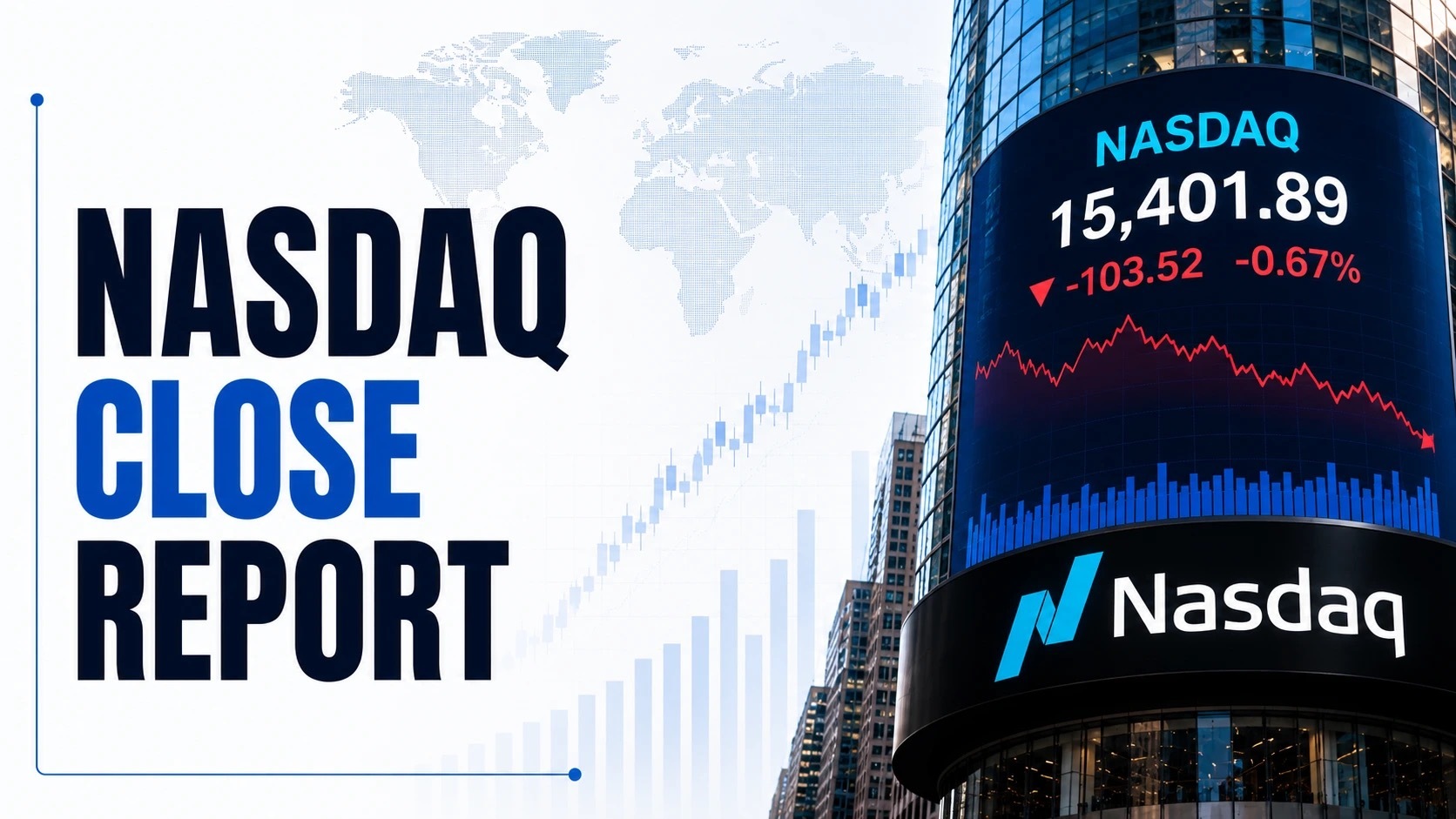
Nasdaq Composite Falls 100 Points as Nvidia Drop Weighs on Tech Stocks
The Nasdaq Composite opened at 25,092.11 and closed at 25,366.09, marking a loss of 100.10 points, or 0.39%. Its intraday high stood at 25,597.22, while the low was 25,068.28. Technology and growth-oriented shares recorded mixed movements, with Nvidia falling about 5% after its leadership announcement, while Alphabet added 1.79% and Tesla gained 1.56%. Meta slipped 0.85%, Netflix declined 2.93%, and Amazon rose 0.42%. AI-linked shares came under pressure, with Nebius Group plunging 16.41% and CoreWeave falling 7%. Intel dropped 2.05%, Micron lost 1.59%, and Marvell Technology fell 2.55%.
The technology-heavy benchmark responded to the Nvidia leadership change and rising Treasury yields. The index had opened lower, falling as much as 1.5% shortly after the opening bell, before paring losses. Top gainers in the Nasdaq included Arista Networks at 5.70%, HubSpot at 6.39%, and Celestica at 4.57%. Top losers included Nebius Group at 16.41%, Super Micro Computer at 10.71%, and Cellebrite at 14.25%.
Russell 2000 Falls 1.55% as Small Caps Slide Amid Rising Treasury Yields
The Russell 2000 opened at 2,827.20 and closed at 2,802.26, losing 44.00 points, or 1.55%. It recorded an intraday high of 2,832.79 and a low of 2,800.62. Smaller-cap companies came under pressure as the 10-year Treasury yield climbed to 5.11%, with the index declining more than the major benchmarks. Among Russell 2000 constituents, Installed Building Products gained 6.79%, while Hancock Whitney fell 10.20% and Veradermics dropped 14.09%. The benchmark’s performance reflected movements across smaller-cap shares as the Nvidia leadership change and rising oil prices influenced broader trading.
Top gainers in the Russell 2000 included Installed Building Products at 6.79%, Heartflow at 6.67%, and Crescent Energy at 3.70%. Top losers included Veradermics at 14.09%, Hancock Whitney at 10.20%, and IonQ at 9.13%.
S&P 100 Falls 8.53 Points as Large Caps Track Broader Market Weakness
The S&P 100 opened at 3,706.40 and finished at 3,737.73, recording a loss of 8.53 points, or 0.23%. The index traded between 3,706.40 and 3,768.22 during the session. Large-cap constituents showed mixed performance, with Nvidia falling about 5%, while Alphabet gained 1.79% and Amazon rose 0.42%. JPMorgan Chase slipped 0.17% and Visa fell 1.22%. The index’s daily performance came as markets responded to the Nvidia leadership change and rising oil prices.
Top gainers in the S&P 100 included Alphabet at 1.79%, Exxon Mobil at 1.82%, and Chevron at 1.52%. Top losers included Nvidia at 5%, Honeywell at 1.84%, and Boeing at 1.72%.
Dow Composite Falls 64 Points as Transport and Utility Indices Both Retreat
The Dow Jones Composite Average opened at 16,554.89 and closed at 16,502.90, losing 64.37 points, or 0.39%, after moving between 16,494.32 and 16,650.84. The Dow Jones Transportation Average ended at 20,538.92, compared with an opening level of 20,651.90, representing a 0.58% decline. The Dow Jones Utility Average closed at 1,113.07, changing 0.13% from its opening level of 1,115.16. Movements in relevant constituents reflected the session’s broad market decline, with transportation shares pressured by rising oil prices and utility shares little changed.
Within the transportation average, Union Pacific added 0.69%, while the utility average’s constituents were little changed. Top losers in the composite included transportation names exposed to fuel costs as crude prices advanced.
Also Read: How to invest in US stocks
SOX Falls 57 Points as Chip Stocks Diverge on Nvidia Leadership Turmoil
The Philadelphia Semiconductor Index (SOX) opened at 10,174.12 and closed at 10,506.67, losing 57.44 points, or 0.54%. Its intraday high was 10,688.24, while the low was 10,174.12. Semiconductor-related constituents showed sharp divergence, with Broadcom gaining 5.97% and AMD rising 5.88%, while Nvidia fell about 5%, Intel dropped 2.05%, and Micron lost 1.59%. The sector benchmark’s daily performance came amid the Nvidia leadership change, which prompted a reassessment of competitive positioning across the chip industry.
Top gainers in the SOX included Broadcom at 5.97%, AMD at 5.88%, and Arista Networks at 5.70%. Top losers included Nvidia at 5%, Intel at 2.05%, and Micron at 1.59%.
NYSE Composite Falls 146 Points as Broader Shares Track Weaker Market Trends
The NYSE Composite Index opened at 24,586.96 and closed at 24,502.49, recording a loss of 146.04 points, or 0.59%. The index traded between 24,499.38 and 24,658.34 during the session. Movements across market segments contributed to its performance, with energy shares advancing while technology and financial shares declined. The index’s decline came as the Nvidia leadership change and rising oil prices shaped broader US equity trading.
Top gainers in the NYSE Composite included energy names as crude prices advanced. Top losers included Global Payments at 12.01% and Super Micro Computer at 10.71%.
S&P MidCap 400 Falls 46 Points as SmallCap 600 Declines 21 Points
The S&P MidCap 400 opened at 3,721.79 and closed at 3,685.94, moving 46.02 points, or 1.23%, with an intraday range of 3,683.00 to 3,727.09. The S&P SmallCap 600 opened at 1,726.51 and ended at 1,709.07, losing 20.93 points, or 1.21%, after trading between 1,707.36 and 1,729.09. The two benchmarks reflected movements among mid- and small-cap shares as the Nvidia leadership change and rising Treasury yields affected the wider market.
Top gainers in the S&P MidCap 400 included Installed Building Products at 6.79% and Crescent Energy at 3.70%. Top losers included Hancock Whitney at 10.20% and Veradermics at 14.09%. Within the S&P SmallCap 600, Heartflow gained 6.67%, while IonQ fell 9.13%.
Oil Surge and Nvidia Exit Drive Session as Treasury Yields Climb Higher
The principal market catalyst was the resignation of Nvidia chief executive Jensen Huang, announced before the opening bell. The company said Huang resigned as president, chief executive and board member, effective immediately, and named chief financial officer Colette Kress as interim chief executive. The announcement followed reports of extramarital affairs, including one with a woman US intelligence officials reportedly suspected of being a Chinese spy. Nvidia shares fell as much as 14% in early trading before paring losses to close down about 5%.
A second catalyst was the rise in oil prices after President Donald Trump said on Truth Social that the US did not need a deal with Iran. West Texas Intermediate (WTI) crude rose 2.55% to settle at $88.74 per barrel, while Brent crude added 3.3% to settle at $95.82 a barrel. The comments raised concerns that the US-Iran conflict would persist, pushing energy shares higher and adding to inflation worries.
Treasury yields rose as trading assessed the implications of higher oil prices and comments from Federal Reserve officials. The 10-year Treasury yield climbed 12 basis points to 5.11%, while the 30-year yield rose 9 basis points to 5.44%. Trading remained focused on the path of inflation and interest rates, with movements across sectors reflecting the day’s broader market conditions.
VIX Jumps 7.89% as Nvidia Exit and Oil Surge Lift Market Volatility
The CBOE Volatility Index (VIX) changed 7.89% to 18.87, compared with its previous close of 17.49. The index measures expected volatility in the S&P 500 over the coming 30 days. Its intraday high stood at 19.34, while the low was 17.38. The VIX’s movement coincided with the Nvidia leadership announcement and the rise in oil prices, which prompted a reassessment of near-term uncertainty.
Also Read: US Stock Market Timings
Energy Gains 2% as Broader S&P 500 Sectors Post Mixed Daily Declines
Performance across the 11 S&P 500 sectors was mixed, with energy recording the strongest move at about 2%. The energy sector advanced as crude prices rose following President Trump’s comments on Iran. Information technology was mixed, with Nvidia’s decline offset by gains in Broadcom and AMD. Financials moved lower, with Goldman Sachs down 1.43% and American Express falling 1.56%. Health care was mixed, with Johnson & Johnson gaining 1.10% while Pfizer fell 2.11%. Industrials declined, with General Electric down 2.84% and Honeywell falling 1.84%. Consumer discretionary was mixed, with Amazon gaining 0.42% and Nike declining 1.46%. Communication services was mixed, with Alphabet adding 1.79% and Netflix falling 2.93%. Consumer staples, utilities, real estate and materials recorded mixed to slightly lower movements. The sector moves followed the Nvidia leadership change and the rise in oil prices.
Alphabet Gains 1.8% as Nvidia Falls 5% Across All Magnificent Seven Shares
Among the Magnificent Seven, Alphabet gained 1.79%, Amazon rose 0.42%, Microsoft added 0.41%, and Tesla advanced 1.56%. Nvidia fell about 5%, Meta slipped 0.85%, and Apple traded roughly flat after touching an all-time high of $359.37. Their daily movements contributed to the performance of major US equity benchmarks, with the divergence between Nvidia and its mega-cap peers reflecting the session’s leadership shake-up.
AMD Gains 5.9% as Nvidia Falls 5% While Energy Shares Advance Strongly
Semiconductor stocks were mixed, with the Philadelphia Semiconductor Index falling 0.54%. AMD gained 5.88% and Broadcom rose 5.97%, while Nvidia fell about 5%, Intel dropped 2.05%, and Micron lost 1.59%. Financial stocks moved lower, with Goldman Sachs down 1.43%, American Express falling 1.56%, and Visa slipping 1.22%. Energy stocks advanced alongside crude oil prices, with Valero Energy gaining 3.08%, Marathon Petroleum rising 2.48%, and ConocoPhillips adding 1.60%. AI and growth stocks were mixed, with Nebius Group plunging 16.41% and CoreWeave falling 7%, while Alphabet gained 1.79%. Movements among these constituents contributed to the technology-heavy indices.
Jobless Claims Rise to 200,000 While Existing Home Sales Fall 5.5% Sharply
The latest economic data showed initial jobless claims at 200,000 for the week ending 7 November, an increase of 9,000 from the prior period and above the consensus estimate of 195,000. The four-week average remained unchanged at 195,250. Continuing claims fell 20,000 to just below 1.7 million. Existing home sales fell 5.5% in October to a seasonally adjusted annualised rate of 3.75 million, the lowest since August 2010, and below expectations of 3.86 million. Sales were down 8.8% compared with October last year.
The releases provided the latest information on the labour market and housing activity during the session. The housing data reflected the impact of mortgage rates that have climbed to their highest levels since 2000, aside from a single month in 2023.
10-Year Treasury Yield Hits 5.11% as Fed Officials Signal Further Rate Hikes
The Federal Reserve (Fed) remained a key focus as markets assessed comments from officials and the outlook for interest rates. Cleveland Fed President Beth Hammack said she supports gradual rate increases and does not see the need for a half-point move. San Francisco Fed President Mary Daly said her bias is that further tightening will be needed. Chicago Fed President Austan Goolsbee said the inflation data placed the central bank in a “precarious moment.” Fed Governor Christopher Waller earlier raised the possibility of a half-point hike in December if inflation data comes in worse than anticipated.
The 2-year US Treasury yield stood at 4.87%, up 14 basis points. The 10-year Treasury yield stood at 5.11%, up 12 basis points, and the 30-year yield was 5.44%, up 9 basis points. The yield curve changed as rising oil prices and hawkish Fed comments affected Treasury trading.
Also Read: What Are Fractional Shares?
Brent Crude Rises 3.3% as Gold Falls 2.7% While Dollar Index Strengthens
Brent crude traded at $95.82 a barrel, changing 3.3%, while West Texas Intermediate (WTI) crude stood at $88.74, moving 2.55%. The advance followed President Donald Trump’s statement on Truth Social that the US did not need a deal with Iran, a remark that raised concerns about prolonged supply disruption. Separate data showing a surprise rise in US crude stocks last week tempered the move only marginally. Energy shares tracked the price gain, with the S&P 500 energy index rising about 2% as the best-performing of the 11 major sectors.
Gold traded at $3,880.93 per ounce, changing -2.7%, having touched its lowest level since October 2025 earlier in the session. US gold futures for December delivery fell 3.2% to $3,872.00. The metal has tumbled roughly 30% from record highs above $5,500 early last year, with the decline extending for a third straight session. Copper dropped to a four-month low as trading weighed weak demand and expectations of US rate hikes. Bitcoin traded at $71,300, down from a high of $74,700 the previous day.
The US Dollar Index (DXY) moved to 103.23, its highest level since early April last year, just before President Trump announced reciprocal tariffs on US trading partners. Currency movements followed expectations of further Federal Reserve rate hikes and the rise in Treasury yields, with the 10-year yield at 5.11%, up from 4.84% a week earlier.
The closing session was shaped by Nvidia’s leadership change and rising oil prices, alongside higher Treasury yields and mixed economic data. The Dow fell 0.36%, the S&P 500 lost 0.35%, and the Nasdaq slipped 0.39%, while energy shares outperformed and volatility rose. These figures provide a factual summary of the session’s key market developments.
Disclaimer
The information shared here is intended solely for informational and educational purposes and does not constitute investment recommendations. While we practice strict due diligence in curating daily market data, readers must perform independent research before trading. To flag any real-time data discrepancies or content concerns, please write to us at content@hdfcsec.com.
 Join Us
 Add as preferred source on Google


More International News







Open Free Demat Account










Invest Anytime, Anywhere


By signing up I certify terms, conditions & privacy policy