Nifty 50
- Tech Mahindra₹1,790140.00 (8.48%)
- InterGlobe Aviation₹4,686.90-91.40 (-1.91%)
- TCS₹2,465115.00 (4.89%)
- BSE₹3,363-65.00 (-1.90%)
- Infosys₹1,161.2051.20 (4.61%)
- Max Healthcare₹846-12.00 (-1.40%)
- Bharti Airtel₹1,90551.00 (2.75%)
- Tata Consumer ₹978.90-12.55 (-1.27%)
- Mahindra & Mahindra₹2,920.9059.20 (2.07%)
- Jio Financial ₹216.25-2.76 (-1.26%)
- Bajaj Finance₹98115.75 (1.63%)
- ONGC₹222-2.64 (-1.18%)
- Hindalco Industries₹90814.15 (1.58%)
- Bharat Electronics₹376.85-3.55 (-0.93%)
- HCL Technologies₹1,38020.00 (1.47%)
- Nestle₹1,265.50-10.30 (-0.81%)
- JSW Steel₹1,216.4016.00 (1.33%)
- Adani Enterprises₹2,680.90-19.10 (-0.71%)
- Grasim Industries₹2,92034.10 (1.18%)
- Bajaj Finserv₹1,720-12.00 (-0.69%)

- Offerings
- Tools & Platforms
Tools & Calculators
- Open API
- Calculators
- SIP Calculator
- CAGR Calculator
- Compound Interest Calculator
- FD Calculator
- RD Calculator
- EPF Calculator
- Retirement Calculator
- HDFC SIP Calculator
- Mutual Fund Return Calculator
- Lumpsum Calculator
- Step Up SIP Calculator
- ETF SIP Calculator
- Brokerage Calculator
- Equity Margin Calculator
- SWP Calculator
- EMI Calculator
- MTF Calculator
- Margin Pledge Calculator
- Algo Strategy
- Markets
Stocks
F&O
Mutual Funds
- More
Dow Rallies 295 Points, Nasdaq Adds 0.45% as Treasury Yields Ease
Authored By HDFC SKY | Last Modified: Sep 3, 2026 09:03 AM IST
Open Free Demat Account
Open Free Demat Account
Mumbai, Sept 3: US stock markets closed higher on Wednesday, snapping a three-session losing streak as Treasury yields retreated from multi-year highs and oil prices steadied near $95 a barrel. The Dow Jones Industrial Average advanced 295.07 points, or 0.56%, to settle at 53,061.95, recovering from Tuesday’s sharp decline.
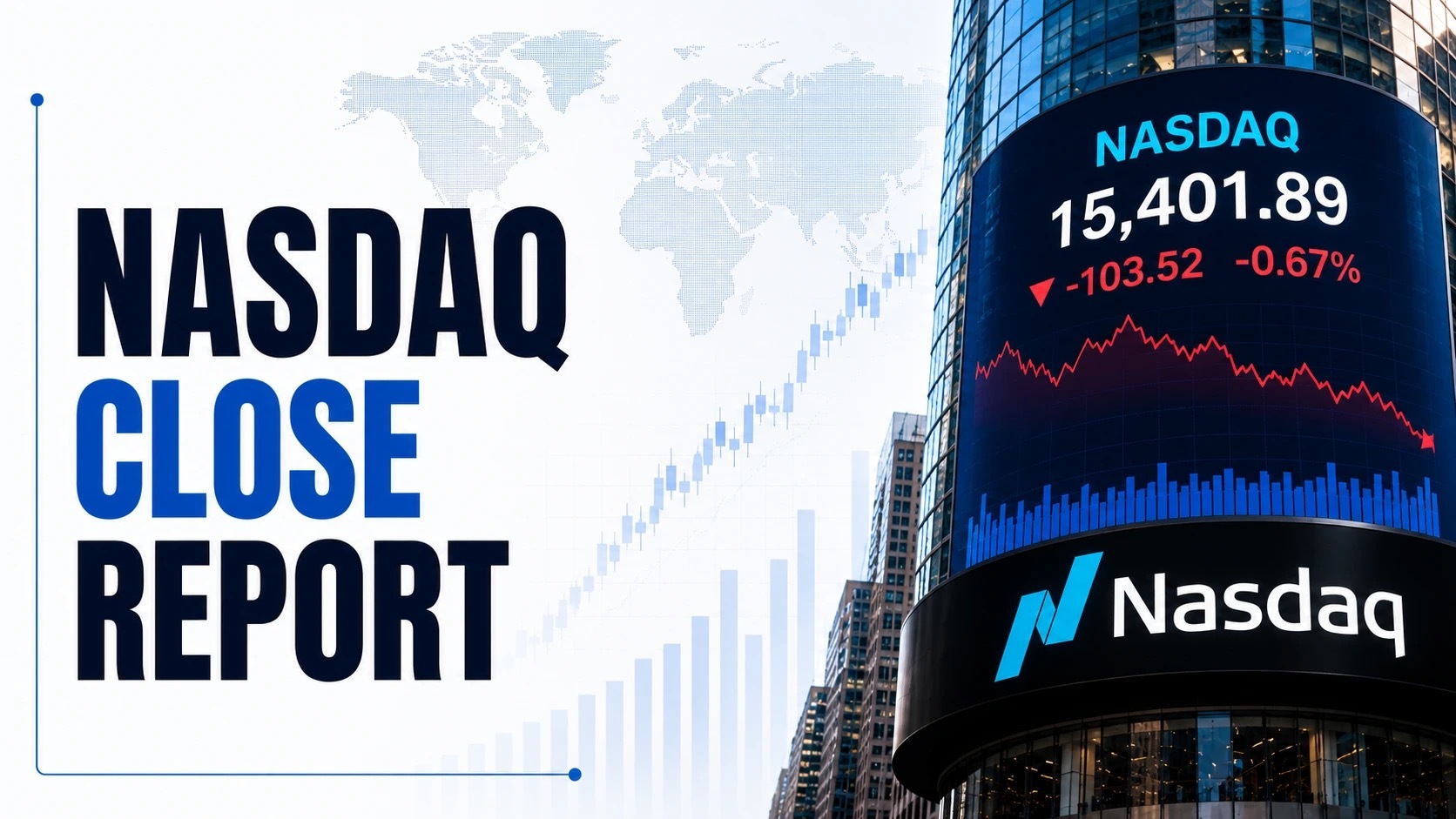
The S&P 500 gained 35.12 points, or 0.46%, ending at 7,666.59, while the Nasdaq Composite rose 118.05 points, or 0.45%, to finish at 26,217.83. The rebound followed a modest pullback in the 10-year yield after it touched 4.818% – its highest intraday level since November 2023 – and came despite weaker-than-expected private-sector jobs data and escalating US-Iran military clashes that kept crude prices elevated.

Dow Adds 295 Points as Nvidia and J&J Lead Blue-Chip Rally
The blue-chip index opened at 52,829.58 and traded within a daily range of 52,829.58 to 53,227.50 before closing at 53,061.95. Technology and healthcare stocks powered the advance, with Nvidia (NVDA) emerging as the top performer, rising 3.20%, while Johnson & Johnson (JNJ) added 1.49%.
American Express (AXP) gained 1.78% and Caterpillar (CAT) advanced 1.68%, further supporting the index. On the downside, Honeywell (HON) declined 1.86%, 3M (MMM) fell 0.97%, and Microsoft (MSFT) lost 0.85%, tempering the overall gain. The recovery followed Tuesday’s roughly 420-point decline, as investors rotated into beaten-down value stocks amid easing concerns over the trajectory of bond yields.
S&P 500 Rises 0.46% as Materials and Financials Lead Advance
The broad-market index opened at 7,634.58 and traded between 7,633.62 and 7,681.19 before closing at 7,666.59. Nine of the 11 S&P sectors ended in positive territory, with Materials leading the charge, rising approximately 1.6%, followed by Communication Services and Financials, which also posted solid gains. Real Estate was the sole sector in the red, declining 0.7%, while the Energy sector underperformed despite elevated crude prices, reflecting profit-taking after a strong quarterly run.
Among top performers, Dell Technologies (DELL) surged 15.84% after raising its annual revenue forecast, while Nvidia (NVDA) added 3.20% and Oracle (ORCL) gained 3.10%. The worst laggards included Palo Alto Networks (PANW) , which plunged 9.29% despite beating earnings estimates, while CrowdStrike (CRWD) fell 5.43% and Datadog (DDOG) declined 6.56%.
Nasdaq Snaps Three-Day Losing Streak with 0.45% Tech Rebound
The technology-heavy index opened at 26,094.00 and traded within a range of 26,062.68 to 26,245.04 before closing at 26,217.83. The Nasdaq’s recovery was led by semiconductor and artificial intelligence names, with Nvidia (NVDA) rising 3.20% and Micron Technology (MU) gaining 2.44%. Intel (INTC) advanced 1.25%, while ASML Holding (ASML) added 1.04% and Texas Instruments (TXN) rose 0.57%, providing broad-based support.
However, cybersecurity stocks weighed heavily on the index, with Palo Alto Networks (PANW) tumbling 9.29% and CrowdStrike (CRWD) falling 5.43%. Datadog (DDOG) declined 6.56% and Palantir Technologies (PLTR) dropped 5.80%, offsetting some of the gains from semiconductor names. Despite the mixed performance within the technology sector, the index managed to snap a three-day losing streak, helped by the pullback in the 10-year Treasury yield from its intraday peak.
Russell 2000 Outperforms Peers with 1.25% Surge in Small Caps
The small-cap Russell 2000 led the broader market advance, rising 36.42 points, or 1.25%, to close at 2,956.55. The index opened at 2,926.51 and traded between 2,926.51 and 2,959.52 throughout the session. The Russell’s outperformance reflected renewed risk appetite among investors, with smaller companies typically benefiting more from improving sentiment and easing concerns over interest rates.
The index’s gain was nearly three times that of the large-cap S&P 500, indicating a broad-based rotation into cyclical and domestically-focused names. The advance was supported by strength in industrials, financials, and healthcare stocks within the small-cap universe, as investors looked past geopolitical tensions and focused on the modest pullback in Treasury yields.
S&P 100 Gains 0.61% as Large-Cap Stocks Join Broader Recovery
The S&P 100 Index (OEX) advanced 23.08 points, or 0.61%, to close at 3,802.32. The index opened at 3,782.67 and traded within a range of 3,782.67 to 3,812.01. The move mirrored the broader market recovery, with large-cap stocks participating fully in the rebound. The index’s performance was supported by strength in technology, healthcare, and financial mega-caps, which together account for a significant weighting. The advance came despite mixed performance among the Magnificent Seven stocks, as investors balanced geopolitical risks against the pullback in bond yields and stabilising oil prices.
Also Read: How to Invest in the US Stocks From India
Dow Composite, Transport, Utility Averages Show Mixed Performance
The Dow Jones Composite Average (DJC) rose 55.16 points, or 0.33%, to close at 16,633.20. The index opened at 16,592.13 and traded between 16,569.69 and 16,690.97. The Dow Jones Transportation Average (DJT) bucked the broader trend, declining 53.88 points, or 0.26%, to finish at 20,713.48. The transport index opened at 20,791.21 and traded within a range of 20,629.09 to 20,932.69.
The weakness in transports reflected ongoing concerns over elevated energy costs and potential supply chain disruptions amid escalating US-Iran military tensions. The Dow Jones Utility Average (DJU) advanced 2.97 points, or 0.28%, to close at 1,075.48. The utility index opened at 1,070.40 and traded between 1,059.52 and 1,076.62, benefiting from the pullback in yields as defensive plays attracted buyers.
Philadelphia Semiconductor Index Rises 0.45% as Chip Stocks Recover
The Philadelphia Semiconductor Index (SOX) gained 50.64 points, or 0.45%, to close at 11,339.25. The index opened at 11,243.55 and traded between 11,154.67 and 11,388.99 throughout the session. The semiconductor sector’s advance was led by Nvidia (NVDA) , which rose 3.20%, while Micron Technology (MU) added 2.44% and Intel (INTC) gained 1.25%.
ASML Holding (ASML) advanced 1.04% and Texas Instruments (TXN) rose 0.57%, providing additional support. The recovery in chip stocks followed Tuesday’s sell-off, with AI-related demand continuing to provide a strong underlying tailwind for the sector. However, not all semiconductor names participated, as Broadcom (AVGO) declined 0.60% and Advanced Micro Devices (AMD) fell 0.52%, reflecting ongoing rotation within the group.
NYSE Composite Adds 0.62% as Market Breadth Improves Notably
The NYSE Composite Index (NYA) advanced 150.28 points, or 0.62%, to close at 24,499.56. The index opened at 24,349.28 and traded between 24,349.28 and 24,543.70. The broad-based advance reflected improving market breadth, with advancing stocks significantly outnumbering decliners on the New York Stock Exchange.
The index’s gain was driven by strength in financials, materials, and healthcare names, while energy stocks provided a modest contribution despite mixed performance. The NYSE Composite’s outperformance relative to the Nasdaq indicated a rotation into value and cyclical names, as investors responded to the pullback in Treasury yields and stabilising oil prices.
S&P MidCap 400 and SmallCap 600 Both Advance as Risk Appetite Grows
The S&P 400 MidCap Index (SP400) gained 24.30 points, or 0.65%, to close at 3,745.09. The index opened at 3,720.79 and traded between 3,720.79 and 3,752.56. The S&P 600 SmallCap Index (SP600) rose 16.85 points, or 0.97%, to finish at 1,751.50. The small-cap index opened at 1,736.28 and traded within a range of 1,736.28 to 1,756.87.
The outperformance of both mid-cap and small-cap indices reflected improving risk appetite among investors, with smaller companies typically benefiting more from a favourable economic outlook and easing interest rate concerns. The gains were broad-based across sectors, with industrials, financials, and healthcare leading the advance.
10-Year Yield Drops to 4.79% from 4.82% Intraday Peak
The benchmark 10-year US Treasury yield hit an intraday high of 4.818% on Wednesday, its highest level since November 2023, before pulling back to trade around 4.79% by the close. The yield had climbed sharply in recent sessions amid concerns over persistent inflation, rising oil prices, and heavy government debt issuance. The 30-year Treasury yield held near 5.27%, while shorter-dated yields also remained elevated, with the 2-year yield trading around 4.95%.
The pullback in yields provided a catalyst for the equity market rebound, as lower borrowing costs eased pressure on growth and technology stocks. New York Federal Reserve President John Williams attributed the rise in long-term bond yields to a strong economic outlook and large AI-driven technology investments, rather than inflation fears or market dysfunction.
Brent Crude Holds Near $95 as US-Iran Military Clashes Escalate
Brent crude futures advanced approximately 1% to trade near $95.63 per barrel, while West Texas Intermediate crude rose nearly 1% to settle around $91.01 per barrel. The gains came as the United States launched additional military strikes on Iran, targeting air defence sites, radar systems, and maritime assets, raising concerns over potential disruptions to energy supplies through the Strait of Hormuz.
US Energy Secretary Chris Wright told CNBC that more than 17 million barrels of oil transited the strait on Monday, the highest level since the Iran war broke out in February. Despite the elevated prices, oil’s stabilisation after touching multi-month highs provided some relief to equity markets, which had been pressured by concerns over energy-driven inflation and its implications for Federal Reserve policy.
Also Read: How to Invest in S&P 500 Stocks Through Index Funds
Gold Rebounds 1% to $4,373 as Dollar and Yields Pull Back
Spot gold rose approximately 1% to $4,373.01 per ounce, rebounding from its lowest level since early August. The recovery came as the US dollar and Treasury yields retreated from recent highs, reducing the opportunity cost of holding non-yielding bullion. Gold futures for December delivery rose 0.5% to $4,419.50.
The precious metal had declined sharply in recent sessions amid rising bond yields and a stronger dollar, but the modest pullback in both provided a catalyst for the rebound. Gold’s recovery was also supported by safe-haven demand amid escalating US-Iran tensions, as investors sought protection against geopolitical uncertainty and potential inflationary pressures from higher energy costs.
Dollar Index Holds Near 99.70 Amid Middle East Geopolitical Tensions
The US Dollar Index (DXY), which measures the greenback against a basket of six major currencies, held firm near 99.70, reflecting sustained safe-haven demand amid escalating Middle East hostilities. The index had earlier touched a two-week high of 99.85 amid surging Treasury yields and heightened geopolitical uncertainty. The dollar’s strength weighed on commodity prices and emerging market currencies, though the modest pullback in yields provided some relief for risk-sensitive assets.
The Japanese yen rose sharply against the dollar, gaining approximately 1% to trade at 158.56 per dollar, in a move that market participants could not immediately explain, though it followed the currency’s retracement from its 40-year low reached before the joint US-Japan intervention in late July.
US Private Jobs Rise Just 38,000 as Fed Rate Hike Bets Climb to 66%
US private-sector employment increased by just 38,000 jobs in August, below economists’ expectations of 47,000 and marking the smallest gain since January. Education and health services led job creation with 45,000 positions, while manufacturing recorded the largest losses. Annual pay for job-stayers rose 3% year-over-year, while pay growth for job-changers eased to 4.7% from 4.8% in July. Despite the weak ADP data, expectations of a 25-basis-point Federal Reserve rate hike in September rose to approximately 66%, from 37% a week earlier, amid hawkish comments from Fed officials. New York Fed President John Williams said there were no clear signs that monetary policy was sufficient to bring inflation back to target. Markets now await the August nonfarm payrolls and inflation data ahead of the September 15–16 policy meeting.
Materials Lead S&P 500 Sectors as Real Estate Falls 0.7% on Rising Yields
Nine of the 11 S&P 500 sectors closed higher on Wednesday, led by Materials, which gained approximately 1.6%. Communication Services and Financials also posted solid gains, while Health Care rose 0.8% and Industrials added 0.6%, supporting the broad-based recovery. Information Technology underperformed, gaining just 0.2%, as mixed performance among mega-cap technology stocks limited the sector’s advance. Real Estate was the sole sector to decline, falling 0.7% as higher borrowing costs weighed on property-related stocks. Utilities gained just 0.1%, reflecting their sensitivity to rising bond yields, while Energy edged up 0.3% despite higher oil prices.
Financial stocks outperformed the broader market as expectations for higher interest rates and a steeper yield curve supported the sector. The Invesco KBW Bank ETF (KBWB) rose approximately 1% and has reached a series of record highs in recent sessions. JPMorgan Chase (JPM) gained 0.36%, Wells Fargo (WFC) surged 2.56%, and Citigroup (C) advanced 1.32%. Goldman Sachs (GS) rose 0.20%, American Express (AXP) gained 1.78%, Bank of America (BAC) added 0.98%, and Morgan Stanley (MS) rose 0.36%.
Energy stocks were mixed as oil prices steadied after touching multi-month highs. Chevron (CVX) gained 0.33%, while Exxon Mobil (XOM) fell 0.23%. ConocoPhillips (COP), Marathon Petroleum (MPC) and Valero Energy (VLO) gained 0.5%, 0.4% and 0.3%, respectively. The sector is up approximately 22% quarter-to-date, although concerns over additional non-OPEC supply and potential geopolitical de-escalation have raised questions about the sustainability of the crude rally.
Magnificent Seven Mixed as Nvidia and Meta Post Strong Gains
The Magnificent Seven mega-cap technology stocks finished mostly higher, with Nvidia (NVDA) and Meta Platforms (META) leading the advance. Nvidia rose 3.20%, while Meta gained 2.48% and Netflix (NFLX) added 2.36%. Alphabet (GOOGL) advanced 0.63%, while Amazon (AMZN) finished flat and Tesla (TSLA) edged up 0.27%. Microsoft (MSFT) was the laggard among the group, declining 0.85%, while Apple (AAPL) slipped 0.05%.
The mixed performance reflected ongoing rotation within the technology sector, with AI-related names continuing to attract investor interest while traditional software stocks faced pressure from higher yields. The Roundhill Magnificent Seven ETF (MAGS) closed up 0.7%, indicating overall strength in the group despite the divergent moves.
Also Read : US Stock Market Timings
Semiconductor Stocks Rebound as AI Demand Remains Strong Tailwind
The semiconductor sector rebounded after Tuesday’s sell-off, with Nvidia (NVDA) rising 3.20% and Micron Technology (MU) gaining 2.44%. Intel (INTC) added 1.25%, while ASML Holding (ASML) advanced 1.04% and Texas Instruments (TXN) rose 0.57%. KLA Corporation (KLAC) gained 0.80% and Qorvo (QRVO) rose 0.34%, providing additional support.
However, not all chip stocks participated in the rally. Broadcom (AVGO) declined 0.60%, while Advanced Micro Devices (AMD) fell 0.52% and Lam Research (LRCX) lost 0.63%. Applied Materials (AMAT) declined 0.76% and Marvell Technology (MRVL) fell 1.81%. The mixed performance reflected ongoing rotation within the sector, with investors favouring AI-exposed names over those with greater exposure to traditional end markets such as PCs and smartphones.
CBOE Volatility Index Falls 6.37% to 15.30 as Market Calm Returns
The CBOE Volatility Index (VIX) fell 1.04 points, or 6.37%, to settle at 15.30. The index, often referred to as Wall Street’s “fear gauge,” had ticked up to 16.7 in early trading before declining as the session progressed. The VIX’s retreat reflected easing concerns over market volatility, with the S&P 500 recovering from Tuesday’s losses and posting a solid gain. Despite the decline, the VIX remains above its recent lows, indicating that traders continue to expect elevated daily swings in the S&P 500.
The index has been meandering around the 15 level for much of the past two years, which has been the low end of its trading range. The VIX’s decline suggested that investors were growing more comfortable with the current macroeconomic and geopolitical backdrop, at least for the time being.
The US equity market’s rebound on Wednesday was driven by a modest pullback in Treasury yields from multi-year highs and stabilising oil prices, despite weaker-than-expected private-sector employment data. The 10-year yield’s retreat to 4.79% provided relief to growth stocks, while the Russell 2000’s 1.25% advance indicated broad-based participation across market capitalisations. However, elevated rate-hike expectations at 66% and ongoing US-Iran tensions suggest that volatility may persist in the near term. Market participants now turn their attention to Friday’s nonfarm payrolls report for further clues on the Federal Reserve’s policy path, with the September FOMC meeting looming as the next major catalyst.
Source
- https://www.nasdaq.com/
- spglobal.com/spdji/en/indices/equity/sp-500/
- https://www.dowjones.com/
- https://www.spglobal.com/spdji/en/indices/equity/dow-jones-industrial-average/
- https://www.spglobal.com/spdji/en/indices/equity/sp-500/
- https://www.nasdaq.com/market-activity/index/comp
- https://www.nasdaq.com/market-activity/quotes/nasdaq-ndx-index
- https://www.spglobal.com/spdji/en/indices/equity/sp-100/
- https://www.lseg.com/en/ftse-russell/indices/russell-us
- https://www.nyse.com/index
- https://www.nyse.com/index
- https://www.spglobal.com/spdji/en/indices/equity/dow-jones-transportation-average/
- https://www.spglobal.com/spdji/en/indices/equity/dow-jones-utility-average/
- https://www.spglobal.com/spdji/en/indices/equity/dow-jones-composite-average/
- https://www.nasdaq.com/market-activity/index/sox
- https://www.cboe.com/tradable_products/vix/
Disclaimer
If you have any concerns, questions, or wish to point out any discrepancies in our content, please feel free to write to us at content@hdfcsec.com.
Please Note: The information shared is intended solely for informational purposes and does not make any investment recommendations
HDFC SKY, one of India’s most trusted trading platforms, has been recognized with the Next-Gen Digi Content Awards 2025–26.
Disclaimer
At HDFC SKY*, we take utmost care and due diligence in curating and presenting news and market-related content. However, inadvertent errors or omissions may occasionally occur.
If you have any concerns, questions, or wish to point out any discrepancies in our content, please feel free to write to us at content@hdfcsec.com.
Please Note: The information shared is intended solely for informational purposes and does not make any investment recommendations.
HDFC SKY from HDFC Securities, one of most trusted trading platforms in India, has been recognized with the *Next-Gen Digi Content Awards 2025-26.
 Join Us
 Add as preferred source on Google


More International News







Open Free Demat Account
Open Free Demat Account










Invest Anytime, Anywhere


By signing up I certify terms, conditions & privacy policy