Nifty 50
- Bajaj Auto₹10,102324.00 (3.31%)
- Tech Mahindra₹1,465.30-48.80 (-3.22%)
- Dr. Reddy's Labs₹1,223.8026.80 (2.24%)
- Bharti Airtel₹1,768.80-36.30 (-2.01%)
- Bharat Electronics₹374.956.80 (1.85%)
- ITC₹261.15-4.85 (-1.82%)
- Mahindra & Mahindra₹2,835.7039.50 (1.41%)
- SBI₹943.25-15.85 (-1.65%)
- BSE₹3,329.5042.30 (1.29%)
- NTPC₹308.45-3.55 (-1.14%)
- JSW Steel₹1,181.9013.90 (1.19%)
- ICICI Bank₹1,342.70-12.30 (-0.91%)
- Eicher Motors₹7,12878.00 (1.11%)
- Hindustan Unilever₹1,842.10-14.60 (-0.79%)
- Tata Steel₹175.131.33 (0.77%)
- Axis Bank₹1,250.10-9.00 (-0.71%)
- Trent₹2,940.5022.30 (0.76%)
- L&T₹3,682.60-20.70 (-0.56%)
- InterGlobe Aviation₹4,860.6027.60 (0.57%)
- Reliance Industries₹1,164-6.30 (-0.54%)

- Offerings
- Tools & Platforms
Tools & Calculators
- Open API
- Calculators
- SIP Calculator
- CAGR Calculator
- Compound Interest Calculator
- FD Calculator
- RD Calculator
- EPF Calculator
- Retirement Calculator
- HDFC SIP Calculator
- Mutual Fund Return Calculator
- Lumpsum Calculator
- Step Up SIP Calculator
- ETF SIP Calculator
- Brokerage Calculator
- Equity Margin Calculator
- SWP Calculator
- EMI Calculator
- MTF Calculator
- Margin Pledge Calculator
- Algo Strategy
- Markets
Stocks
F&O
Mutual Funds
- More
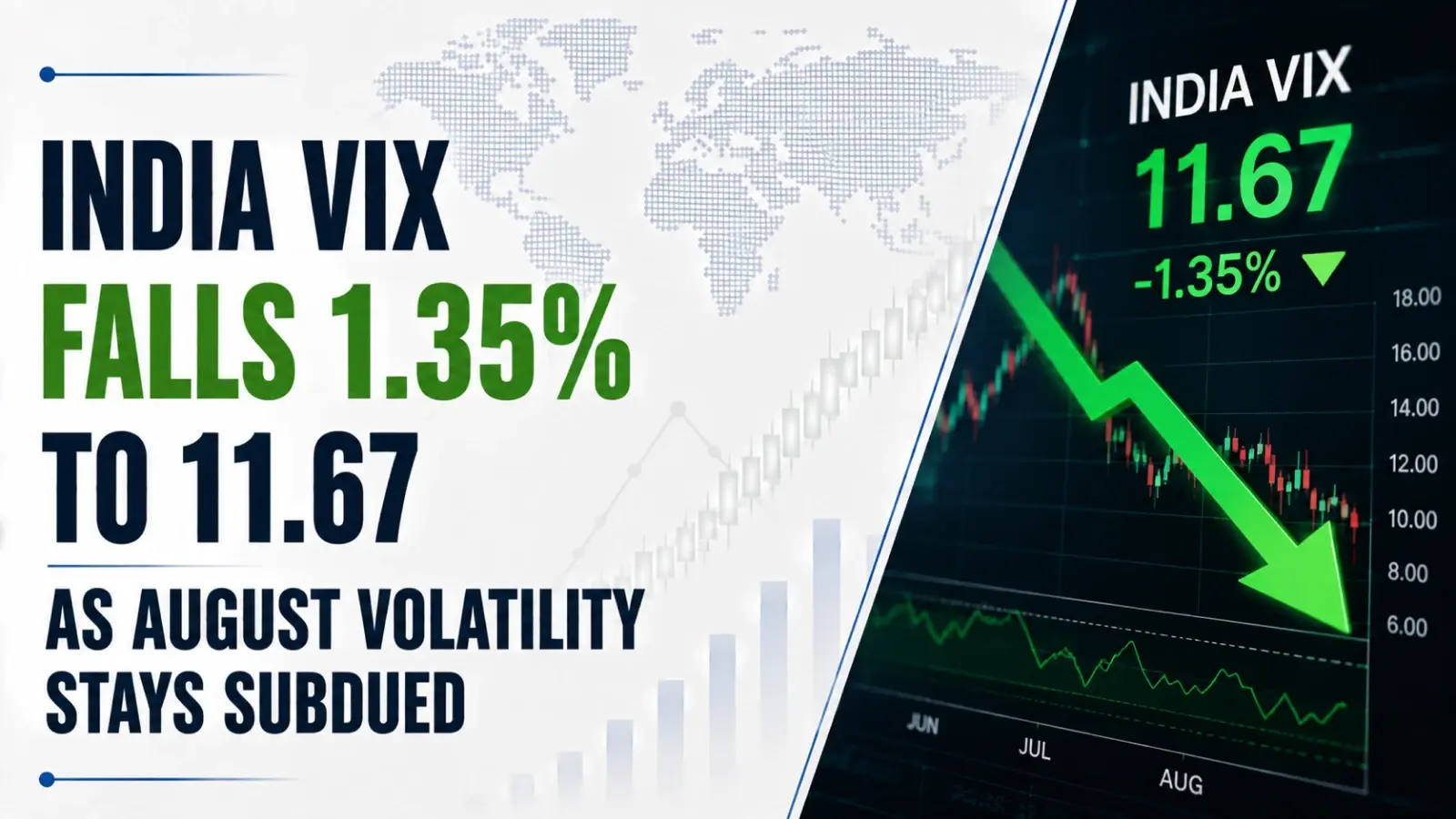
India VIX Falls 1.35% to 11.67 as August Volatility Stays Subdued
Authored By HDFC SKY | Last Modified: Aug 12, 2026 04:20 PM IST
Open Free Demat Account
Open Free Demat Account
Mumbai, Aug 12: India VIX closed at 11.67 on Wednesday, down 0.16 points or 1.35% from the previous close of 11.86, as market volatility remained contained despite continuing crude oil and geopolitical risks. During the session, the volatility index moved between 11.25 and 12.09, with an open of 11.85. The latest reading remains well below the 52-week high of 28.90, while the index is up 23.10% year-to-date.

India VIX At 11.67 Signals Continued Volatility Cooling
The latest reading extends the subdued volatility trend seen through August. India VIX has remained close to the 12 level after the sharp volatility episode in July, when the index climbed to 15.15 intraday on 8 July.
The current reading is also only marginally above the 52-week low of 8.72, showing that the index is well away from the elevated levels recorded during periods of heightened market stress. Its technical rating remains NEUTRAL, while the classic daily pivot levels stand at 11.83, with resistance at 12.48, 13.09 and 13.74 and support at 11.22, 10.57 and 9.96.
The latest decline follows the approximately 4% fall in India VIX on 11 August, when it closed at 11.86 against the previous close of 12.25. The index opened at 12.24, touched a low of 11.19 and a high of 12.45 before ending lower.
July’s 15.15 Spike Has Given Way to 12
The sharp contrast between July and August remains central to the India VIX story. On 8 July, India VIX surged nearly 30% intraday to 15.15, while at around 2:25 pm it stood at 14.77, up 26.78%. The move accompanied a sharp decline in the Nifty and Sensex and reflected concerns over geopolitical developments, crude oil prices, benchmark weakness, increased hedging activity, earnings and derivatives-market adjustments.
Volatility subsequently eased. India VIX rose to 14.03 on 24 July, gaining 4.12%, before declining to around 12.66 on 27 July and 12.46 on 28 July. By 31 July, it had fallen to 11.75, down 3.37% for the day.
The August readings have therefore remained substantially below July’s elevated levels, with India VIX around 12.00–12.01 on 5 August, 12.06 on 6 August, 12.15 on 7 August, 11.86 on 11 August and 11.67 on 12 August.
RBI Rate Decision Passed Without A VIX Shock
The Reserve Bank of India (RBI) monetary policy decision was one of the key scheduled events influencing volatility during the first week of August. The RBI retained the repo rate at 5.25%, while raising its FY27 gross domestic product growth forecast to 6.7% and maintaining a neutral policy stance.
India VIX remained around the 12 level following the decision. On 6 August, the index recorded a relatively wide intraday range of 10.09–12.43, but closed at 12.06. This kept the broader volatility measure contained even as the market absorbed the policy announcement.
The 7 August close of 12.15 also reflected moderate volatility, with crude oil, RBI policy and the ongoing earnings season among the factors highlighted for market movements.
Crude Near $90 Keeps External Risks in Focus
The decline in India VIX has occurred even as crude oil and geopolitical risks remain important market factors. On 12 August, Brent crude was reported at around $89.7 per barrel, with prices moving higher as expectations of a US-Iran agreement weakened and concerns over potential disruptions around the Strait of Hormuz persisted.
Other market reports placed Brent near $90 and West Texas Intermediate (WTI) around $84, keeping developments in West Asia relevant for Indian markets.
The continuing oil-market pressure provides an important contrast with the subdued India VIX reading. Geopolitical tensions involving the US, Iran and the wider Middle East remain linked to concerns over crude supply and shipping disruptions, but these developments have not produced a July-style surge in implied volatility.
August Volatility Stays Near 12 Despite Equity Weakness
The movement in India VIX on 11 August was particularly notable because Indian equities came under pressure while volatility declined. The Nifty slipped below 24,500 amid higher crude prices and profit-taking, yet India VIX fell approximately 4% to 11.86.
This differed significantly from the 8 July episode, when a sharp equity-market decline coincided with an approximately 30% intraday rise in India VIX. The latest movement therefore shows that recent equity weakness has not been accompanied by a comparable increase in the volatility index.
India VIX measures expected near-term volatility using Nifty option prices. Its current level consequently reflects the volatility being priced through the options market rather than simply measuring the magnitude of previous Nifty movements.
Earnings Season Adds Another Source of Market Volatility
The Q1 FY27 earnings season is continuing and remains another factor influencing market volatility. Corporate results can create stock-specific price movements, while results from major index constituents can affect broader Nifty volatility.
However, the current India VIX readings around 11–12 show that the earnings season has not produced an index-wide volatility spike comparable with the July episode. Recent market commentary has continued to identify Q1 earnings, crude oil, RBI policy and global cues among the factors shaping volatility.
NSE Explores New Volatility Index Beyond India VIX
A separate structural development is the National Stock Exchange of India’s (NSE) reported exploration of a new volatility index. The proposed measure is understood to be at the pilot-testing stage and would use a revised methodology.
The development does not mean India VIX is being discontinued. Instead, NSE is examining whether another measure could capture different aspects of market volatility and potentially support additional derivatives products. Several methodologies are reportedly being considered before consultation with market participants and academics.
NSE previously launched India VIX futures in 2014, but discontinued them in 2017 because of insufficient liquidity and market participation. Any future derivatives based on a new volatility index would also require regulatory approval from the Securities and Exchange Board of India (SEBI).
India VIX Remains Far Below Its 28.90 High
At 11.67, India VIX remains substantially below its 52-week high of 28.90 and only moderately above its 52-week low of 8.72. The index’s 23.10% year-to-date return also places the current reading within a much calmer range than the extreme levels seen during periods of market stress.
Seasonality data show that 12 out of 18 years have recorded positive India VIX returns in August. For the month, the maximum positive change is 68.84% in 2015, the average positive change is 18.10%, the maximum negative change is -11.26% in 2016, the average negative change is -5.24%, and the average change is 10.32%.
July Spike Fades as August Holds Near 12
The sequence from July into August shows a clear moderation in volatility. India VIX moved from 14.03 on 24 July to 12.66 on 27 July, 12.46 on 28 July and 11.75 on 31 July. It then remained close to 12 through the first half of August, despite fluctuations during individual sessions.
The current reading of 11.67 therefore marks a continued cooling in implied volatility compared with July’s 15.15 intraday peak. At the same time, crude prices, West Asia tensions and the Q1 FY27 earnings season remain active market developments.
India VIX closed at 11.67 on 12 August, extending the subdued volatility pattern seen through August. The index remains below July’s 15.15 intraday peak, while crude prices, geopolitical developments, earnings and the proposed new NSE volatility index remain key developments shaping the broader volatility landscape.
Source
- https://www.nseindia.com/reports-indices-historical-vix
Disclaimer
If you have any concerns, questions, or wish to point out any discrepancies in our content, please feel free to write to us at content@hdfcsec.com.
Please Note: The information shared is intended solely for informational purposes and does not make any investment recommendations
Disclaimer
At HDFC SKY*, we take utmost care and due diligence in curating and presenting news and market-related content. However, inadvertent errors or omissions may occasionally occur.
If you have any concerns, questions, or wish to point out any discrepancies in our content, please feel free to write to us at content@hdfcsec.com.
Please Note: The information shared is intended solely for informational purposes and does not make any investment recommendations.
HDFC SKY from HDFC Securities, one of most trusted trading platforms in India, has been recognized with the *Next-Gen Digi Content Awards 2025-26.
 Join Us
 Add as preferred source on Google


More Business News








Open Free Demat Account
Open Free Demat Account











Invest Anytime, Anywhere


By signing up I certify terms, conditions & privacy policy