Nifty 50
- Dr. Reddy's Labs₹1,268.2038.70 (3.15%)
- Shriram Finance₹825.25-39.75 (-4.60%)
- Kotak Mahindra Bank₹440.409.90 (2.30%)
- Tata Consumer ₹924-39.90 (-4.14%)
- JSW Steel₹1,205.5020.00 (1.69%)
- Asian Paints₹2,249.80-57.20 (-2.48%)
- Sun Pharmaceutical₹1,761.3013.30 (0.76%)
- HDFC Life Insurance ₹514-9.75 (-1.86%)
- Adani Ports₹1,71310.30 (0.60%)
- Bajaj Finance₹912-16.95 (-1.82%)
- Cipla₹1,345.507.50 (0.56%)
- Tata Motors PV₹260-4.60 (-1.74%)
- Max Healthcare₹818.753.75 (0.46%)
- Eicher Motors₹6,945-121.00 (-1.71%)
- BSE₹3,24413.20 (0.41%)
- Infosys₹1,137-16.80 (-1.46%)
- Coal India₹397.800.35 (0.09%)
- Hindustan Unilever₹1,789.40-25.30 (-1.39%)
- SBI Life Insurance ₹1,618.80-21.20 (-1.29%)

- Offerings
- Tools & Platforms
Tools & Calculators
- Open API
- Calculators
- SIP Calculator
- CAGR Calculator
- Compound Interest Calculator
- FD Calculator
- RD Calculator
- EPF Calculator
- Retirement Calculator
- HDFC SIP Calculator
- Mutual Fund Return Calculator
- Lumpsum Calculator
- Step Up SIP Calculator
- ETF SIP Calculator
- Brokerage Calculator
- Equity Margin Calculator
- SWP Calculator
- EMI Calculator
- MTF Calculator
- Margin Pledge Calculator
- Algo Strategy
- Markets
Stocks
F&O
Mutual Funds
- More
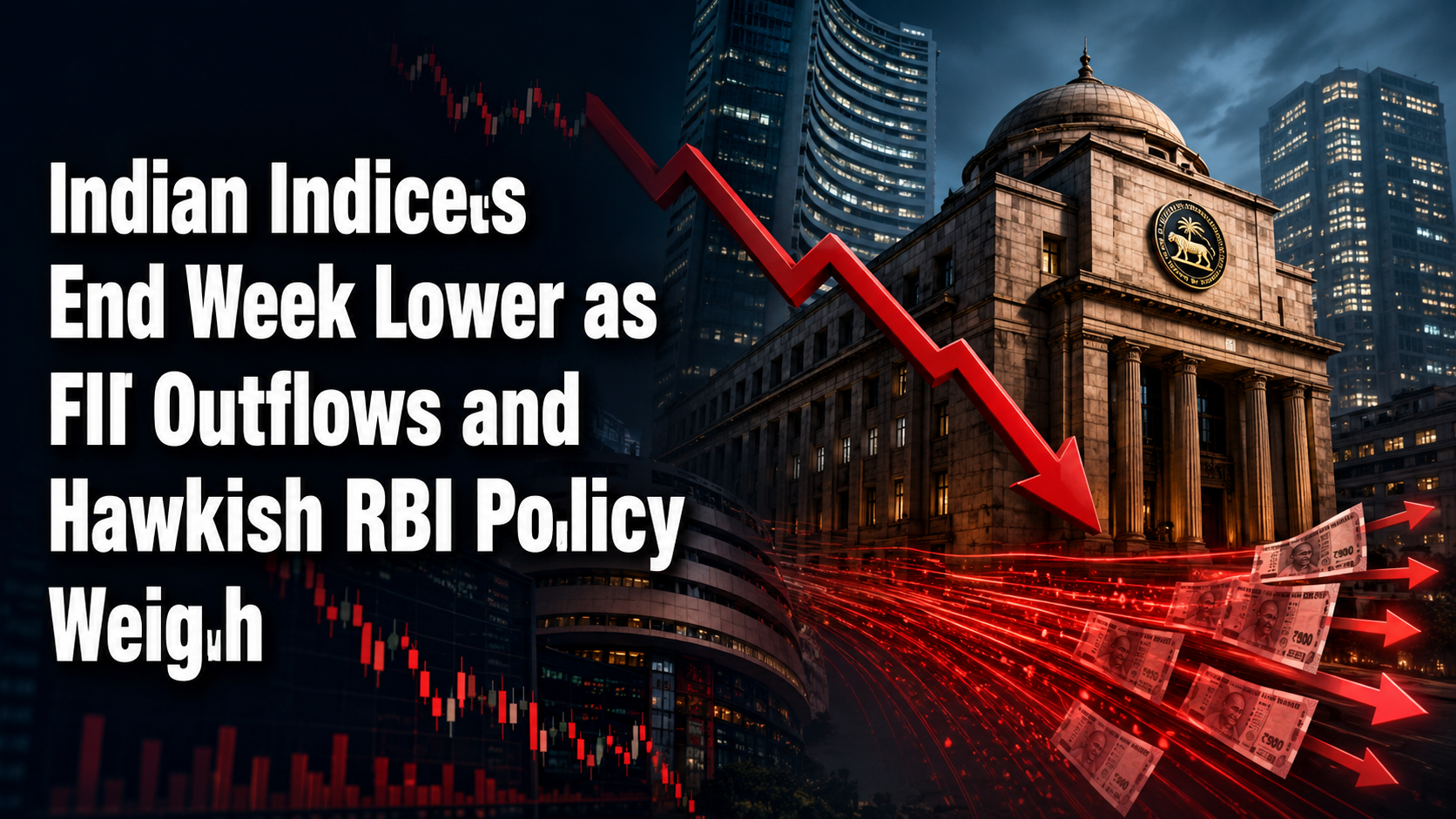
Indian Indices End Week Lower as FII Outflows and Hawkish RBI Policy Weigh
Authored By HDFC SKY | Last Modified: Jun 8, 2026 09:56 AM IST
Open Free Demat Account
Open Free Demat Account
Mumbai, June 7: India’s major equity market indexes ended lower amid a week that was defined by critical policy changes and major economic data announcements. Foreign Institutional Investors offloaded shares totalling ₹31,114 crores against the backdrop of RBI initiatives and healthy GDP numbers. While the Nifty 50 declined by 0.8% to close at 23,366.70, the Sensex fell by 0.16% to end the session at 74,243.34, resulting in year-to-date declines of 10.6% and 12.9%, respectively. It was reported that FII outflows during secondary market operations in 2026 have been around ₹400 crores an hour, compared to double that amount last year.
Week at a Glance: Performance of Benchmark Indices
The Nifty 50 ended the week at 23,366.70 on 5 June 2026, down 181.05 points (0.77%) from the previous week’s close of 23,547.75. The index remained volatile as investors reacted to continued FII outflows, global market cues, and the RBI’s monetary policy decision. After falling sharply on 1 June, the market attempted a mid-week recovery, but gains were short-lived. On Friday, profit-booking and cautious sentiment pushed the Nifty down 49.85 points (0.21%), with the index trading between 23,282.65 and 23,516.35 during the session.
Also Read: How to Earn Money from Share Market
Among the week’s top performers were Adani Enterprises, Hindustan Unilever, Adani Ports, Bajaj Finance, and Axis Bank, while healthcare stocks such as Dr. Reddy’s Laboratories, Cipla, and Max Healthcare also posted gains. On the downside, Wipro, TCS, Hindalco Industries, Tata Steel, Trent, Coal India, NTPC, ONGC, and Bharti Airtel were among the biggest losers, reflecting weakness in the IT, metals, and telecom sectors. Overall, strength in financials and defensive sectors was unable to offset broader market pressure, resulting in a weekly decline for the benchmark index.
The BSE Sensex ended the week at 74,243.34 on 5 June 2026, down 116.67 points (0.16%) for the day and extending its weekly decline as investors remained cautious amid persistent FII outflows, global market uncertainty, and the RBI’s policy outlook. The index witnessed volatility throughout the week, with Friday’s session seeing a high of 74,717.57 and a low of 73,988.75 before settling near the day’s lower range.
Also Read: Difference between NSE and BSE
Among the week’s stronger performers were Hindustan Unilever, Adani Ports, Bajaj Finance, Axis Bank, Asian Paints, Mahindra & Mahindra, Eternal, ICICI Bank, Titan, and Larsen & Toubro, which benefited from buying interest in financial, consumer, and infrastructure stocks. On the downside, Trent, TCS, Tata Steel, NTPC, HCL Technologies, Bharti Airtel, Kotak Mahindra Bank, Reliance Industries, HDFC Bank, and UltraTech Cement were among the major drags on the index. Weakness in IT, metals, telecom, and select heavyweight stocks outweighed gains in financials and consumer shares, leaving the Sensex lower for the week.
IT Sector Rallies 4% on Bargain Hunting as Broader Market Weakens
The Nifty IT index was the standout performer of the week, surging over 4% on 2 June alone, led by heavyweights Tata Consultancy Services (TCS), Infosys, and HCL Technologies. TCS shares jumped over 6%, Infosys advanced nearly 6%, and HCL Technologies gained more than 4% on the day. In early trade on 1 June, the Nifty IT index gained nearly 3%, with Infosys rising nearly 5% and MphasiS climbing over 4%.
The rally extended for three consecutive sessions, pushing the Nifty IT index up around 6-7% even as the broader Nifty index slipped over 3% to trade below 23,250. Infosys gained nearly 9% in just three sessions, while TCS and other IT majors recorded strong gains, adding approximately ₹3 lakh crore in market capitalisation to the sector. Market participants saw the sharp rebound as bargain‑hunting after an AI‑driven selloff earlier in the year, with analysts arguing that “we see no existential threat from Gen‑AI,” noting that enterprises would still need system integrators to customise AI and software tools.
RBI Holds Repo Rate At 5.25%; Maintains Neutral Stance
On 5 June, the RBI’s Monetary Policy Committee (MPC) unanimously voted to keep the benchmark repo rate unchanged at 5.25% for the second consecutive meeting, maintaining a “neutral” stance. The Standing Deposit Facility (SDF) rate was kept at 5%, while the Marginal Standing Facility (MSF) rate and Bank Rate were retained at 5.50%. The decision was largely in line with market expectations, with 11 out of 15 economists surveyed in a PTI poll anticipating a pause, while four expected a 25‑basis‑point hike.
Also Read: The Repo Rate Transmission Lag: Why RBI Rate Cuts Take 6–12 Months to Show Up in Your EMI
However, the central bank sharply revised its macroeconomic projections for FY27, cutting the real GDP growth forecast to 6.6% from 6.9% estimated in April, while raising the inflation forecast to 5.1% from 4.6% earlier. Price pressures are expected to peak at 5.9% in the third quarter before easing, and core inflation for FY27 is now projected at 4.7%, up from a previous estimate of 4.4%. RBI Governor Sanjay Malhotra warned that escalating geopolitical tensions, elevated commodity prices, and supply disruptions were clouding the economic outlook.
India’s Q4 GDP Surprises At 7.8%; FY26 Full‑Year Growth At 7.7%
Earlier on 5 June, the government released robust GDP data for the January‑March quarter, showing the economy grew at an unexpectedly strong 7.8% year‑on‑year, well above the 7.2% forecast in a Reuters poll of economists. The better‑than‑expected performance was driven by resilient farm output and brisker construction activity, which helped offset weakening external demand emanating from the Middle East conflict.
Gross Value Added (GVA) grew 7.9% during the quarter. The government revised up growth for the previous quarter to 8.0% from an earlier 7.8%. For the full fiscal year ending March 2026, GDP growth was estimated at 7.7%, compared with a forecast of 7.6% from February. Manufacturing output rose 7.3% year‑on‑year, construction activity grew 8.4%, and farm output, a sector employing over 40% of India’s workforce, expanded by 3.6%.
Finance Minister Nirmala Sitharaman said the government remains committed to driving the “Reform Express” through decisive policy measures to sustain economic momentum. Prime Minister Narendra Modi added that the 7.7% GDP growth reflected “the inherent strength of our economy, the success of reforms and the hard work of 140 crore Indians.”
Relentless FII Selling Continues; DIIs Absorb Outflow in One Week
Foreign institutional investors remained net sellers on all five trading sessions of the week, with cumulative net outflows from Indian equities totalling ₹31,114.47 crore, according to exchange data. The sharpest selling was recorded on 5 June (₹8,776 crore) and 2 June (₹8,363 crore), as overseas investors continued to rotate capital towards AI‑linked markets such as South Korea and Taiwan.
Domestic institutional investors (DIIs) provided significant support, emerging as net buyers each day of the week. DIIs purchased shares worth a net ₹5,109 crore on 1 June, ₹9,589 crore on 2 June, ₹5,741 crore on 3 June, ₹4,360 crore on June 4, and ₹9,134 crore on June 5.
Aggregate net FPI investments in Indian equities have now fallen to their lowest level since 2016. Global funds’ ownership in listed companies has shrunk to 15% from almost 20% a decade ago, while domestic mutual funds, buoyed by steady retail flows, now control nearly 20% of the market. For the year so far, FIIs have been net sellers of nearly ₹3.26 lakh crore worth of shares, while DIIs have net purchased shares worth ₹4.09 lakh crore.
NRI & OCI Investment Limits Relaxed: Individual Ceiling Doubled To 10%
A key market‑supportive announcement from the RBI on 5 June was the relaxation of equity investment limits for non‑resident individuals (NRIs), overseas citizens of India (OCIs), and persons resident outside India (PROIs) without requiring registration with the Securities and Exchange Board of India (SEBI).
Under the revised framework, the investment limit for a single overseas individual investor has been increased to 10% of a company’s paid‑up capital from 5% earlier. The aggregate NRI investment cap has been raised to 24%. The RBI’s June 5 press release said, “The limits for investment by NRIs and OCIs in equity instruments traded on the stock market without SEBI registration are being increased.” The central bank also removed restrictions on short‑term investments by FPIs and introduced a simplified, registration‑free route for overseas individuals investing in Indian equities.
While the move is seen as positive for long‑term capital inflows and market liquidity, analysts noted it may not immediately reverse the outflow trend, as sustained FII selling and global headwinds remain dominant.
Cotton Import Duty Exemption Lifts Textile Stocks; Sector Sees Strong Gains
On June 1, the Finance Ministry announced a temporary exemption of customs duties on cotton imports for a five‑month period, effective from 1 June to 31 October 2026. The measure, implemented during the cotton off‑season, was aimed at augmenting the availability of cotton for India’s textile and apparel industry, helping manufacturers manage input costs amid supply concerns and rising raw material prices. The exemption covers customs duties and associated agricultural cesses on cotton imports.
Textile stocks surged sharply on the announcement as investors anticipated lower raw material costs and improved margins. Domestic cotton prices had jumped by 25% in two months prior to the duty waiver. The Nifty Textile index recorded strong gains on 1 June and continued to outperform early in the week, making it one of the week’s strongest sectoral themes. Leading textile and apparel companies saw their share prices rise as the duty relief was expected to ease cost pressures.
Among the major beneficiaries, Vardhman Textiles recorded the sharpest rise, while stocks such as Gokaldas Exports, KPR Mill, Trident, Welspun Living and Raymond Lifestyle also traded higher following the announcement.
India‑US Trade Talks Advance: Four‑Day Negotiations Move Toward Interim Deal
A delegation from the United States Trade Representative (USTR) visited India from 1 June to 4 June 2026 for the latest round of discussions on the India‑US trade deal. The negotiations covered trade in goods, customs procedures, trade facilitation measures, non‑tariff barriers, economic security cooperation, and other matters of mutual interest. Both countries reaffirmed their commitment to concluding a mutually beneficial trade agreement aimed at strengthening bilateral trade and economic ties, following a Joint Statement issued on 7 February 2026.
On 3 June, US Ambassador to India Sergio Gor said the proposed interim trade agreement was ”99 per cent” complete, expressing confidence that the pact would be finalised soon. On 5 June, Commerce and Industry Minister Piyush Goyal indicated that the first tranche of the trade deal could be finalised by mid‑July 2026. The positive sentiment from the talks supported export‑oriented sectors such as IT, pharmaceuticals, and engineering stocks, which remained sensitive to developments throughout the week.
Three IPOs Hit Primary Market; CMR Green Draws $6 Bn Bids, Subscribed 270 Times
The primary market saw significant activity during the week, with three companies launching initial public offerings despite volatile secondary market conditions.
CMR Green Technologies, India’s largest non‑ferrous metal recycler specialising in aluminium and zinc die‑casting alloys, opened its IPO on 3 June with a price band of ₹182–₹192 per share and closed on 5 June. Headquartered in Hyderabad, the company serves the automotive and industrial sectors and aimed to raise ₹630.9 crore through a complete offer for sale (OFS) of 3.28 crore equity shares. The IPO witnessed massive investor interest, receiving total bids worth over ₹56,397 crore ($5.94 billion), representing a subscription of 270.5 times for qualified institutional buyers (QIBs) , 172.4 times for non‑institutional investors, and 27 times for retail investors. The grey market premium (GMP) hovered around 40% , implying a likely listing price of about ₹269 against the upper price band of ₹192. The IPO is set to list on the NSE and BSE on 10 June 2026.
Also Read: What is an IPO
Hexagon Nutrition, a nutrition‑focused company engaged in developing micronutrient premixes, wellness, and clinical nutrition products, opened its IPO on 5 June with a price band of ₹42–₹45 per share. The company, which owns brands such as Pentasure, Obesigo, PediaGold, and Nutrone, exports products to over 75 countries and has manufacturing facilities in India and Uzbekistan. It aimed to raise up to ₹138.87 crore. On the opening day, the issue was subscribed 1.65 times. Ahead of the IPO, the company raised ₹41.65 crore from five anchor investors on 4 June.
GenXAI Analytics, an artificial intelligence analytics firm, also opened its IPO on 5 June, aiming to raise up to ₹55 crore, with shares to be listed on the NSE Emerge platform. The company raised ₹15 crore from anchor investors ahead of the IPO.
AirTrunk Announces ₹3 Lakh Crore Data Centre Investment; Banking Reform Panel Formed
In the real estate and digital infrastructure sector, AirTrunk, a Blackstone‑backed hyperscale data centre operator, announced on 5 June a landmark investment of over ₹3 lakh crore ($30 billion) to develop 5 GW of data centre capacity in India by 2030. Prime Minister Narendra Modi welcomed the announcement, stating that “India’s digital infrastructure journey is gathering remarkable momentum” and calling it “among the largest proposed investments in the country’s digital infrastructure ecosystem.” AirTrunk CEO Robin Khuda called India a top destination for digital infrastructure investment, driven by the global race for AI capabilities. The investment is expected to benefit sectors such as real estate, construction, power, and technology services.
Meanwhile, the government formed a banking reform panel during the week, expected to chart a roadmap for the next phase of sector overhaul, including bank consolidation and foreign direct investment (FDI) norms. As of March 2026, public sector banks’ total assets reached ₹283 lakh crore. On 1 June, RBI Deputy Governor Swaminathan J had cautioned lenders about managing uncertainties beyond balance sheets, citing risks from geopolitics, AI, and climate change, and underscored the need for stronger underwriting standards amid the expansion of retail credit and digital lending.
Market Volatility, Rising Crude Oil Prices, And El Nino Fears Weigh On Sentiment
Throughout the week, investors remained cautious due to multiple overhangs. The Middle East conflict kept crude oil prices elevated above $95/barrel, raising fears of inflation, fiscal stress, and pressure on the rupee. The RBI’s downward revision of the FY27 GDP forecast to 6.6% and upward revision of inflation to 5.1% added to concerns.
El Nino fears also weighed on market sentiment, as a weaker monsoon could hurt agricultural output, rural demand, and overall economic growth. The combination of elevated crude prices, persistent FII outflows, and weather‑related uncertainties contributed to reduced risk‑taking and increased sector rotation throughout the week.
Over the week, the Indian stock market was driven primarily by persistent foreign institutional investor (FII) outflows totalling ₹31,114 crore, a hawkish RBI policy stance that cut the FY27 GDP forecast to 6.6% while raising inflation projections, and the release of robust Q4 GDP data at 7.8%. Three IPOs—CMR Green Technologies, Hexagon Nutrition, and GenXAI Analytics—opened during the week, with CMR Green receiving a record 270 times subscription. Domestic institutional investors (DIIs) absorbed the entire FII selling, with net purchases exceeding ₹9,000 crore on two separate trading sessions.
Source
Disclaimer
If you have any concerns, questions, or wish to point out any discrepancies in our content, please feel free to write to us at content@hdfcsec.com.
Please Note: The information shared is intended solely for informational purposes and does not make any investment recommendations
Disclaimer
At HDFC SKY*, we take utmost care and due diligence in curating and presenting news and market-related content. However, inadvertent errors or omissions may occasionally occur.
If you have any concerns, questions, or wish to point out any discrepancies in our content, please feel free to write to us at content@hdfcsec.com.
Please Note: The information shared is intended solely for informational purposes and does not make any investment recommendations.
HDFC SKY from HDFC Securities, one of most trusted trading platforms in India, has been recognized with the *Next-Gen Digi Content Awards 2025-26.
 Join Us
 Add as preferred source on Google


More Business News









Open Free Demat Account
Open Free Demat Account










Invest Anytime, Anywhere


By signing up I certify terms, conditions & privacy policy