Nifty 50
- Eternal₹317.4012.95 (4.25%)
- Shriram Finance₹865-35.90 (-3.98%)
- Apollo Hospitals₹7,730125.50 (1.65%)
- Adani Enterprises₹2,477-73.00 (-2.86%)
- ONGC₹227.502.50 (1.11%)
- JSW Steel₹1,185.50-34.50 (-2.83%)
- Asian Paints₹2,30722.20 (0.97%)
- Jio Financial ₹205.03-5.77 (-2.74%)
- TCS₹2,53023.10 (0.92%)
- Tata Steel₹167.67-4.66 (-2.70%)
- UltraTech Cement₹11,05092.00 (0.84%)
- Adani Ports₹1,702.70-47.30 (-2.70%)
- Maruti Suzuki₹11,23060.00 (0.54%)
- Tech Mahindra₹1,790-39.10 (-2.14%)
- Cipla₹1,3387.10 (0.53%)
- Tata Motors PV₹264.60-5.40 (-2.00%)
- Reliance Industries₹1,1905.50 (0.46%)
- Hindalco Industries₹869.85-15.75 (-1.78%)
- Axis Bank₹1,217.505.50 (0.45%)
- Trent₹2,727.50-48.30 (-1.74%)

- Offerings
- Tools & Platforms
Tools & Calculators
- Open API
- Calculators
- SIP Calculator
- CAGR Calculator
- Compound Interest Calculator
- FD Calculator
- RD Calculator
- EPF Calculator
- Retirement Calculator
- HDFC SIP Calculator
- Mutual Fund Return Calculator
- Lumpsum Calculator
- Step Up SIP Calculator
- ETF SIP Calculator
- Brokerage Calculator
- Equity Margin Calculator
- SWP Calculator
- EMI Calculator
- MTF Calculator
- Margin Pledge Calculator
- Algo Strategy
- Markets
Stocks
F&O
Mutual Funds
- More
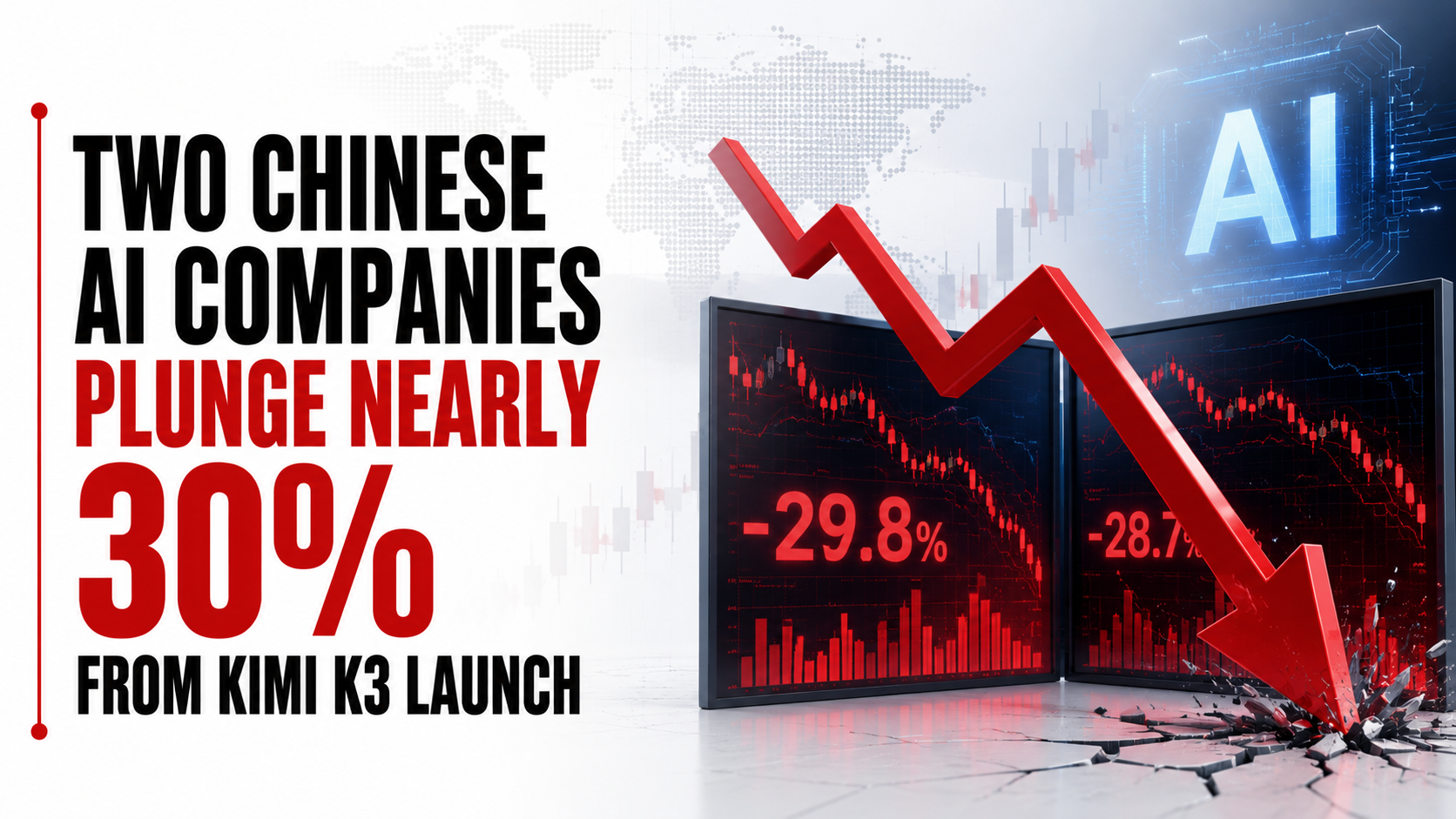
Two Chinese AI Companies Plunge Nearly 30% From Kimi K3 Launch: What’s Special About This New One?
Authored By HDFC SKY | Last Modified: Jul 20, 2026 10:29 AM IST
Open Free Demat Account
Open Free Demat Account
Beijing, July 19: Chinese AI startup Moonshot released Kimi K3 on Thursday, a 2.8 trillion-parameter model that the company describes as the world’s largest open-weight AI system to date. Backed by Alibaba and Tencent, Moonshot built K3 for advanced reasoning, long-horizon coding and knowledge-intensive work, and gave it a 1 million-token context window, letting it hold far more information in a single prompt than earlier models.
Unlike closed systems from OpenAI and Anthropic, whose weights and infrastructure stay private behind paid APIs, Kimi K3’s trained weights are freely downloadable, letting developers run, customise and deploy it on their own hardware. Moonshot said the model performs competitively with Anthropic’s Fable 5 and clearly outperforms Anthropic’s Opus 4.8, and OpenAI’s GPT-5.5 and GPT-5.6 Sol, on GPU kernel optimisation, a measure of how efficiently AI-generated code uses available hardware.
Independent evaluators broadly, though not fully, back that positioning: Arena AI ranked K3 first for building web interfaces, Artificial Analysis scored it in the same tier as Opus 4.8 and GPT-5.5, while Fable 5 and GPT-5.6 Sol still edge ahead on overall intelligence rankings.
The release lands a month after Fable and Mythos, Anthropic’s own frontier models, were briefly pulled from the market by the US government over security concerns, and it triggered a sharp selloff in shares of rival Chinese AI firms Zhipu and Minimax in Hong Kong trading, down 27.7 per cent and 16.5 per cent, respectively.

Why the Industry Taking Notice
1. Unprecedented scale: At 2.8 trillion parameters, K3 is the first open-weight model to approach the 3-trillion mark, and Moonshot calls it the largest open-weight system released anywhere to date.
2. Beats, not just matches, US rivals on key tasks: Moonshot says K3 substantially outperforms Opus 4.8, GPT-5.5 and GPT-5.6 Sol on GPU kernel optimisation, and independent testers at Arena AI placed it first for front-end web development.
3. It’s free to download and modify: As an open-weight release, businesses and researchers can run and customise K3 on their own systems, unlike the closed, subscription-gated models from Anthropic and OpenAI.
4. It undercuts the West’s cost structure: Analysts note Chinese models can run at a fraction of what US labs charge; Moonshot’s own K2.6 model reportedly costs about a third of Anthropic’s Opus 4.8, and Anthropic itself is raising Opus 4.8 prices 50 per cent in September.
5. Timing amplifies the signal: K3 arrives just a month after Fable and Mythos were briefly withdrawn in the US, and follows Z.ai’s GLM-5.2, which prominent Silicon Valley investors said was the first Chinese model to match top US labs without compromise.
6. It targets the areas Western labs guarded most: K3 was built specifically for advanced reasoning and long-horizon coding, exactly the frontier-task categories where proprietary US models had held a clearer edge over open alternatives.
7. It’s rattling markets and funding rounds alike: The launch immediately hit rival Chinese AI stocks, and comes as Moonshot reportedly seeks fresh funding near a $30-31.5 billion valuation, and DeepSeek near $71 billion, even as Anthropic and OpenAI sit at roughly $965 billion and $852 billion.
Disclaimer
If you have any concerns, questions, or wish to point out any discrepancies in our content, please feel free to write to us at content@hdfcsec.com.
Please Note: The information shared is intended solely for informational purposes and does not make any investment recommendations
Disclaimer
At HDFC SKY*, we take utmost care and due diligence in curating and presenting news and market-related content. However, inadvertent errors or omissions may occasionally occur.
If you have any concerns, questions, or wish to point out any discrepancies in our content, please feel free to write to us at content@hdfcsec.com.
Please Note: The information shared is intended solely for informational purposes and does not make any investment recommendations.
HDFC SKY from HDFC Securities, one of most trusted trading platforms in India, has been recognized with the *Next-Gen Digi Content Awards 2025-26.
 Join Us
 Add as preferred source on Google


More Business News








Open Free Demat Account
Open Free Demat Account








Invest Anytime, Anywhere


By signing up I certify terms, conditions & privacy policy