Nifty 50
- Nestle₹1,383.2049.20 (3.69%)
- Shriram Finance₹950-38.00 (-3.85%)
- Tata Consumer ₹987.9027.90 (2.91%)
- HDFC Life Insurance ₹544.05-15.95 (-2.85%)
- Infosys₹1,08825.90 (2.44%)
- Bajaj Finance₹957-25.75 (-2.62%)
- Coal India₹416.958.45 (2.07%)
- Bajaj Finserv₹1,710.30-45.40 (-2.59%)
- Tech Mahindra₹1,575.2031.70 (2.05%)
- Mahindra & Mahindra₹2,793.70-70.70 (-2.47%)
- TCS₹2,304.9035.60 (1.57%)
- SBI Life Insurance ₹1,650-37.20 (-2.20%)
- ONGC₹225.502.85 (1.28%)
- Hindalco Industries₹882.50-19.75 (-2.19%)
- Hindustan Unilever₹1,895.5020.00 (1.07%)
- Dr. Reddy's Labs₹1,216-24.00 (-1.94%)
- NTPC₹313.702.70 (0.87%)
- InterGlobe Aviation₹4,718.50-81.90 (-1.71%)
- Adani Enterprises₹2,71722.00 (0.82%)
- Cipla₹1,307.80-21.80 (-1.64%)

- Offerings
- Tools & Platforms
Tools & Calculators
- Open API
- Calculators
- SIP Calculator
- CAGR Calculator
- Compound Interest Calculator
- FD Calculator
- RD Calculator
- EPF Calculator
- Retirement Calculator
- HDFC SIP Calculator
- Mutual Fund Return Calculator
- Lumpsum Calculator
- Step Up SIP Calculator
- ETF SIP Calculator
- Brokerage Calculator
- Equity Margin Calculator
- SWP Calculator
- EMI Calculator
- MTF Calculator
- Margin Pledge Calculator
- Algo Strategy
- Markets
Stocks
F&O
Mutual Funds
- More
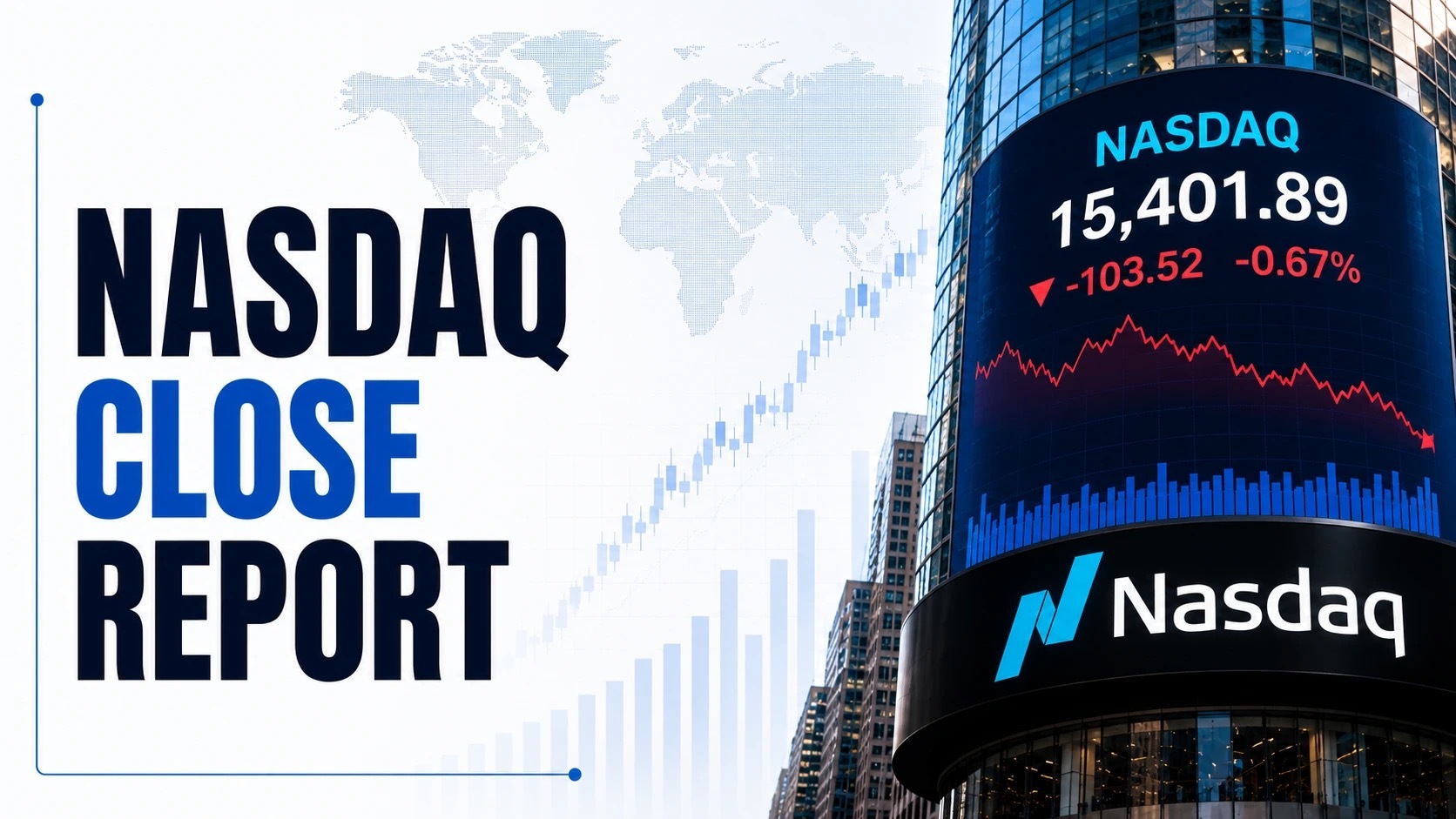
Nasdaq Plunges 0.76% as Chip Stock Rout Deepens, Dow Rises 140 Points on Rotation to Defensives
Authored By HDFC SKY | Last Modified: Aug 25, 2026 08:40 AM IST
Open Free Demat Account
Open Free Demat Account
Mumbai, Aug 25: US stock markets closed mixed on Monday as a sharp sell-off in semiconductor stocks dragged the technology-heavy Nasdaq Composite lower, while the Dow Jones Industrial Average advanced on rotation into defensive and financial names. The S&P 500 also finished in the red, pressured by weakness in the information technology sector, even as broader market breadth remained positive.
The Nasdaq Composite (^IXIC) fell 200.26 points, or 0.76%, to settle at 25,980.19. The index opened at 26,065.32 and traded within a day’s range of 25,910.82 to 26,109.96, marking its fourth consecutive session of decline. The S&P 500 (^GSPC) declined 21.51 points, or 0.28%, closing at 7,652.86, after opening at 7,663.38 and touching an intraday low of 7,638.17. Bucking the broader trend, the Dow Jones Industrial Average (^DJI) gained 140.15 points, or 0.26%, to end at 53,417.16, with the index opening at 53,261.95 and reaching an intraday high of 53,508.18.
The market action reflected a significant rotation out of growth and technology stocks into more defensive sectors, driven by escalating geopolitical tensions, rising Treasury yields, and caution ahead of key inflation data and Federal Reserve commentary later this week.

Dow Jones Gains 140 Points as Visa Surges 3.07%, Defensives Lead
The Dow Jones Industrial Average outperformed the broader market, rising 0.26% to close at 53,417.16, marking its second consecutive daily gain. The index opened at 53,261.95 and touched an intraday high of 53,508.18, supported by strength in financial and consumer defensive stocks.
Leading the Dow’s advance was Visa (V), which surged 3.07%, contributing significantly to the index’s upside. UnitedHealth Group (UNH) rose 2.27%, while Walmart (WMT) gained 2.72% and Disney (DIS) advanced 2.62%. Procter & Gamble (PG) added 1.35%, and JPMorgan Chase (JPM) climbed 1.35%, providing further support to the blue-chip index.
On the downside, Caterpillar (CAT) declined 1.96%, weighing on the industrial sector, while Boeing (BA) fell 1.75% and IBM dropped 1.94%. Nvidia (NVDA), which is also a Dow component, fell 2.94%, reflecting the broader weakness in semiconductor stocks. Despite the declines in these components, the Dow’s breadth remained positive, with 20 of the 30 stocks in the index closing in the green.
The rotation into defensive sectors was evident as investors sought safety amid rising geopolitical uncertainty. The Dow’s advance was also supported by a decline in oil prices, which eased concerns about inflationary pressures, and a modest pullback in Treasury yields following reports that the Treasury Department may utilise its General Account to fund bond buyback operations.
S&P 500 Drops 0.28% as Tech Sector Weakness Offsets Broad Gains
The S&P 500 ended the session lower by 0.28%, closing at 7,652.86, as weakness in the technology and energy sectors offset gains in consumer staples, financials, and healthcare. The index opened at 7,663.38 and traded between an intraday low of 7,638.17 and a high of 7,670.30, reflecting a narrow trading range amid cautious sentiment.
Information technology was the worst-performing sector, falling 1.3%, dragged down by semiconductor stocks. Nvidia (NVDA) dropped 2.94%, while Broadcom (AVGO) declined 2.63% and Advanced Micro Devices (AMD) fell 3.48%. Memory chip makers were hit hardest, with Seagate Technology (STX) plunging 6.54% and Western Digital (WDC) shedding 5.24%. The weakness in tech was partly offset by gains in consumer staples, which rose 1.4% as investors rotated into defensive names. Walmart (WMT) gained 2.72%, Costco (COST) advanced 2.50%, and Procter & Gamble (PG) added 1.35%.
Financials also provided support, with Visa (V) surging 3.07% and Mastercard (MA) climbing 3.24%. The healthcare sector rose 0.8%, led by UnitedHealth (UNH) up 2.27% and Amgen (AMGN) gaining 1.03%. Despite the overall decline, six of the 11 S&P 500 sectors finished higher, indicating broad-based buying outside of technology and energy.
Nasdaq Composite Falls 0.76% as Semiconductor Rout Deepens Ahead of Nvidia Earnings
The Nasdaq Composite suffered the steepest decline among the major indices, falling 0.76% to close at 25,980.19, marking its fourth consecutive losing session. The index opened at 26,065.32 and hit an intraday low of 25,910.82, its lowest level since early August, before recovering slightly.
The sell-off was concentrated in semiconductor and memory stocks, with the PHLX Semiconductor Sector (SOX) dropping 2.70% to 11,423.17. Micron Technology (MU) tumbled 5.83%, Seagate Technology (STX) plunged 6.54%, and Western Digital (WDC) fell 5.24%. The weakness followed reports that Nvidia (NVDA) plans to raise prices for AI servers by more than 15% in early 2027 due to soaring memory costs, raising concerns about potential demand destruction. Nvidia itself fell 2.94%, extending its losing streak to seven consecutive sessions—its longest since October 2022.
Other tech giants also weighed on the index, with Tesla (TSLA) dropping 3.83% and Alphabet (GOOGL) gaining only 0.95% to provide limited offset. The broader weakness in growth stocks was exacerbated by rising Treasury yields, with the 10-year yield hovering near 4.70%, pressuring high-valuation tech names. The Nasdaq’s decline was also influenced by geopolitical jitters as the US announced expanded sanctions on Iran, adding to uncertainty over global trade and energy prices.
Also Read: How to Invest in the US Stocks From India
Russell 2000 Slides 0.76%, Small-Caps Mirror Nasdaq Decline
The Russell 2000 Index (^RUT) fell 22.79 points, or 0.76%, to close at 2,995.08, mirroring the Nasdaq’s percentage decline. The index opened at 3,015.06 and traded between a high of 3,015.06 and a low of 2,991.24, reflecting broad-based weakness among smaller companies.
Small-cap stocks were pressured by the same factors affecting the broader market: rising geopolitical tensions, uncertainty over trade policy, and higher borrowing costs. The energy sector within the Russell 2000 was a notable drag, with oil services and exploration companies declining as crude prices fell. KTOS dropped 7.17%, AVAV lost 7.50%, and IESC fell 5.37%, weighing on the industrials-heavy index.
Healthcare stocks within the Russell 2000 also declined, with HIMS plunging 8.01% and GH dropping 4.40%, though some biotechnology names like TGTX gained 3.21% and SRRK rose 3.01% to provide modest support. The index remains 2.3% below its 52-week high of 3,069.71, reflecting the recent underperformance of small-caps relative to large-caps.
S&P 100 Gains 0.28% as Defensives Outperform, Dow Jones Composite Rises
The S&P 100 Index (OEX) rose 0.28%, closing at 3,769.63, outperforming the broader S&P 500. The index opened at 3,775.88 and traded between a high of 3,782.67 and a low of 3,761.64, supported by strength in financials and consumer staples. Gains in Visa (V), Walmart (WMT), and UnitedHealth (UNH) offset declines in technology heavyweights like Nvidia (NVDA) and Tesla (TSLA).
The Dow Jones Composite Average (DJC) advanced 0.15%, or 24.47 points, to close at 16,866.43. The index opened at 16,848.09 and touched a high of 16,897.36, reflecting broad-based gains across the Dow’s equity components. The Dow Jones Transportation Average (DJT) declined 0.64%, or 139.10 points, to 21,431.16, pressured by weakness in trucking and railroad stocks after President Trump threatened to raise tariffs on Canadian autos and auto parts, which could disrupt cross-border supply chains. J.B. Hunt Transport fell over 5%, while Old Dominion Freight Line slid 2%.
The Dow Jones Utility Average (DJU) climbed 1.29%, or 13.85 points, to 1,089.29, as investors rotated into defensive, yield-oriented sectors. The index opened at 1,076.58 and hit a high of 1,090.40, supported by a decline in Treasury yields, which made utility dividends more attractive.
PHLX Semiconductor Index Plunges 2.70% as Memory Stocks Lead Decline
The PHLX Semiconductor Sector (SOX) dropped 317.21 points, or 2.70%, to close at 11,423.17, reflecting the steepest decline among major sector indices. The index opened at 11,513.88 and touched an intraday low of 11,263.34, its lowest level since mid-August.
The sell-off was broad-based, with memory chip makers bearing the brunt. Sandisk (SNDK), the worst-performing stock in the S&P 500, plunged 6.45%, while Seagate Technology (STX) fell 6.54% and Western Digital (WDC) dropped 5.24%. Micron Technology (MU) shed 5.83%, and SK Hynix declined nearly 9% in South Korean trading, dragging the Roundhill Memory ETF (DRAM) down by nearly 6%.
The weakness was triggered by reports that Nvidia (NVDA) had informed customers of price hikes of more than 15% for AI servers in early 2027 due to rising memory costs, raising concerns about potential demand softening. Additionally, reports that Apple (AAPL) may source DRAM and NAND flash from Chinese suppliers CXMT and YMTC further weighed on memory stocks. The semiconductor index is now 21.8% below its 52-week high of 14,655.29, underscoring the sector’s recent volatility.
NYSE Composite Flat as Energy Drags, S&P 400 and 600 Decline
The NYSE Composite (NYA) ended nearly flat, declining just 2.03 points, or 0.0082%, to close at 24,726.64. The index opened at 24,728.67 and traded within a narrow range of 24,662.87 to 24,749.89, reflecting mixed performance across listed stocks. Energy stocks weighed on the index as crude prices fell, while financials and consumer staples provided support.
The S&P 400 MidCap Index (SP400) fell 29.10 points, or 0.76%, to close at 3,801.30, mirroring the Russell 2000’s decline. The index opened at 3,830.40 and hit a low of 3,791.81, pressured by weakness in energy and industrials. The S&P 600 SmallCap Index (SP600) declined 7.37 points, or 0.41%, to close at 1,782.01, as smaller companies faced headwinds from rising borrowing costs and trade uncertainty. Both indices remain below their 52-week highs, with the SP400 3.3% below its peak and the SP600 2.7% below its high.
VIX Rises 4.69% as Geopolitical Tensions and Rate Uncertainty Fuel Volatility
The CBOE Volatility Index (VIX) jumped 4.69%, or 0.71 points, to close at 15.84, reflecting increased market anxiety. The index opened at 15.90 and touched an intraday high of 16.06, its highest level since early August. The rise in the VIX was driven by escalating geopolitical tensions, including the US threat of secondary sanctions on Iran and a breakdown in US-Canada trade talks, which heightened uncertainty over global trade and energy supplies.
The VIX’s move above 15 indicates a modest increase in investor nervousness, though it remains well below its 52-week high of 35.30. The index’s rise also reflects caution ahead of key events later this week: the July Personal Consumption Expenditures (PCE) inflation report on Wednesday and Federal Reserve Chair Kevin Warsh’s speech at the Jackson Hole symposium on Friday. Both events could provide clues on the future path of interest rates, adding to market volatility.
Also Read: How to Invest in S&P 500 Stocks Through Index Funds
Tech Leads Sector Losses as Consumer Staples Shine on Rotation
Among the 11 S&P 500 sectors, information technology was the worst performer, falling 1.3%, as semiconductor and memory stocks weighed heavily. Nvidia (NVDA) dropped 2.94%, Broadcom (AVGO) fell 2.63%, and Advanced Micro Devices (AMD) declined 3.48%, contributing to the sector’s underperformance. The technology sector’s decline was exacerbated by rising Treasury yields, which make future earnings of growth stocks less attractive.
Energy was the second-worst performer, declining 1.5%, as crude oil prices fell on profit-taking and ahead of the US sanctions announcement on Iran. Diamondback Energy (FANG) fell 3%, APA dropped 3%, and Halliburton (HAL) declined 3%, dragging the sector lower.
On the upside, consumer staples led the gains, rising 1.4%, as investors rotated into defensive names. Walmart (WMT) gained 2.72%, Costco (COST) advanced 2.50%, and Procter & Gamble (PG) added 1.35%. Financials rose 1.2%, supported by Visa (V) surging 3.07% and Mastercard (MA) gaining 3.24%. Healthcare advanced 0.8%, with UnitedHealth (UNH) up 2.27% and Amgen (AMGN) gaining 1.03%. The rotation into defensives reflects investor caution amid geopolitical uncertainty and elevated bond yields.
Oil Falls 2.5% as Iran Sanctions Announcement Triggers Profit-Taking
Crude oil prices declined on Monday despite the US unveiling its toughest-ever sanctions campaign against Iran. West Texas Intermediate (WTI) crude futures fell 2.5% to settle at $84.89 per barrel, while Brent crude dropped 2.5% to $92.06 per barrel. The decline was attributed to profit-taking after last week’s strong gains, as well as expectations that the sanctions may have limited immediate impact on global supply.
The US Treasury announced “Operation Economic Outcast,” targeting Iran’s oil revenue and any nation economically tied to the regime. Treasury Secretary Scott Bessent warned that countries continuing to engage with Iran could be removed from the US dollar system. While the sanctions could tighten Iranian crude exports, the market appeared to price in the possibility that China, the dominant buyer of Iranian oil, might find workarounds.
Gold rose 0.62% to $4,709.80 per troy ounce, near its highest level since May, as investors sought haven assets amid geopolitical tensions and the Treasury’s bond market intervention. The US dollar index (DXY) edged up 0.2% to 99.04, recovering from three-month lows, as the euro and Canadian dollar weakened. Natural gas futures gained 1.3% to $2.81 per mmBtu on strong summer cooling demand.
Treasury Yields Pull Back as Treasury May Use General Account for Buybacks
Treasury yields declined modestly on Monday after CNBC reported that the Treasury Department may use its nearly $1 trillion General Account to fund bond buyback operations. The 10-year Treasury yield fell 3 basis points to 4.698%, while the 30-year yield dropped 4 basis points to 5.234%, easing from last week’s 19-year high above 5.3%.
The report followed Treasury Secretary Scott Bessent’s comments last week that the department plans to double buyback operations for 10- to 30-year securities starting September 9, with up to $14 billion scheduled through November. The intervention aims to cap long-term borrowing costs, which have surged amid concerns over government debt and persistent inflation.
However, some analysts view the Treasury’s intervention as a troubling strategy that undermines investor confidence. Mohamed El-Erian, chief economic adviser at Allianz, noted that the move does not address the fundamental issue of significant demand for bond financing by the government and tech sector, while traditional foreign buyers like China and Japan are less dependable. Markets are now awaiting Federal Reserve Chair Kevin Warsh’s Jackson Hole speech on Friday for signals on the Fed’s reaction function to rising yields.
The divergence between the Dow and the Nasdaq highlights a clear rotation toward defensive and financial stocks, driven by geopolitical risks and elevated bond yields. Investors are positioning for the PCE inflation data on Wednesday and Fed Chair Warsh’s Jackson Hole speech on Friday, which could influence Treasury yields and market direction. The semiconductor sector remains under pressure ahead of Nvidia’s earnings, with the SOX now 21.8% below its high, suggesting caution is warranted in tech-heavy portfolios. Meanwhile, falling oil prices and gold’s rise indicate a flight to safety, while the VIX’s increase signals near-term volatility.
Source
- https://www.nasdaq.com/
- spglobal.com/spdji/en/indices/equity/sp-500/
- https://www.dowjones.com/
- https://www.spglobal.com/spdji/en/indices/equity/dow-jones-industrial-average/
- https://www.spglobal.com/spdji/en/indices/equity/sp-500/
- https://www.nasdaq.com/market-activity/index/comp
- https://www.nasdaq.com/market-activity/quotes/nasdaq-ndx-index
- https://www.spglobal.com/spdji/en/indices/equity/sp-100/
- https://www.lseg.com/en/ftse-russell/indices/russell-us
- https://www.nyse.com/index
- https://www.nyse.com/index
- https://www.spglobal.com/spdji/en/indices/equity/dow-jones-transportation-average/
- https://www.spglobal.com/spdji/en/indices/equity/dow-jones-utility-average/
- https://www.spglobal.com/spdji/en/indices/equity/dow-jones-composite-average/
- https://www.nasdaq.com/market-activity/index/sox
- https://www.cboe.com/tradable_products/vix/
Disclaimer
If you have any concerns, questions, or wish to point out any discrepancies in our content, please feel free to write to us at content@hdfcsec.com.
Please Note: The information shared is intended solely for informational purposes and does not make any investment recommendations
HDFC SKY, one of India’s most trusted trading platforms, has been recognized with the Next-Gen Digi Content Awards 2025–26.
Disclaimer
At HDFC SKY*, we take utmost care and due diligence in curating and presenting news and market-related content. However, inadvertent errors or omissions may occasionally occur.
If you have any concerns, questions, or wish to point out any discrepancies in our content, please feel free to write to us at content@hdfcsec.com.
Please Note: The information shared is intended solely for informational purposes and does not make any investment recommendations.
HDFC SKY from HDFC Securities, one of most trusted trading platforms in India, has been recognized with the *Next-Gen Digi Content Awards 2025-26.
 Join Us
 Add as preferred source on Google


More International News




Open Free Demat Account
Open Free Demat Account









Invest Anytime, Anywhere


By signing up I certify terms, conditions & privacy policy