Nifty 50
- Tech Mahindra₹1,790140.00 (8.48%)
- InterGlobe Aviation₹4,686.90-91.40 (-1.91%)
- TCS₹2,465115.00 (4.89%)
- BSE₹3,363-65.00 (-1.90%)
- Infosys₹1,161.2051.20 (4.61%)
- Max Healthcare₹846-12.00 (-1.40%)
- Bharti Airtel₹1,90551.00 (2.75%)
- Tata Consumer ₹978.90-12.55 (-1.27%)
- Mahindra & Mahindra₹2,920.9059.20 (2.07%)
- Jio Financial ₹216.25-2.76 (-1.26%)
- Bajaj Finance₹98115.75 (1.63%)
- ONGC₹222-2.64 (-1.18%)
- Hindalco Industries₹90814.15 (1.58%)
- Bharat Electronics₹376.85-3.55 (-0.93%)
- HCL Technologies₹1,38020.00 (1.47%)
- Nestle₹1,265.50-10.30 (-0.81%)
- JSW Steel₹1,216.4016.00 (1.33%)
- Adani Enterprises₹2,680.90-19.10 (-0.71%)
- Grasim Industries₹2,92034.10 (1.18%)
- Bajaj Finserv₹1,720-12.00 (-0.69%)

- Offerings
- Tools & Platforms
Tools & Calculators
- Open API
- Calculators
- SIP Calculator
- CAGR Calculator
- Compound Interest Calculator
- FD Calculator
- RD Calculator
- EPF Calculator
- Retirement Calculator
- HDFC SIP Calculator
- Mutual Fund Return Calculator
- Lumpsum Calculator
- Step Up SIP Calculator
- ETF SIP Calculator
- Brokerage Calculator
- Equity Margin Calculator
- SWP Calculator
- EMI Calculator
- MTF Calculator
- Margin Pledge Calculator
- Algo Strategy
- Markets
Stocks
F&O
Mutual Funds
- More
- Understanding The Yield Curve
- What Is Yield Curve Inversion?
- Why Do Economists Take Yield Curve Inversion Seriously?
- Has India Experienced Yield Curve Inversion?
- Why Does Yield Curve Inversion Raise Concerns About India’s Growth?
- Factors That Make India’s Situation Unique
- Should Investors Be Worried?
- Conclusion
- Understanding The Yield Curve
- What Is Yield Curve Inversion?
- Why Do Economists Take Yield Curve Inversion Seriously?
- Has India Experienced Yield Curve Inversion?
- Why Does Yield Curve Inversion Raise Concerns About India’s Growth?
- Factors That Make India’s Situation Unique
- Should Investors Be Worried?
- Conclusion
What Is “Yield Curve Inversion” and Why Does It Make Economists Nervous About India’s Growth?
By Aseem Shrivastava | Published at: Jun 3, 2026 12:33 PM IST
Open Free Demat Account
Open Free Demat Account
Economic growth often depends on signals that most people never notice. One of those signals is the yield curve. Economists, investors, and policymakers watch it closely because sudden changes can hint at future trouble. When the yield curve inverts, concerns about slowing growth begin to rise. In India, where economic momentum matters deeply, this unusual financial pattern has started attracting serious attention.
Understanding The Yield Curve
A yield curve shows the relationship between interest rates on government bonds with different maturity periods. Short-term bonds usually offer lower returns, while long-term bonds offer higher returns because investors expect better compensation for locking in their money for longer. This creates an upward-sloping curve. The yield curve also reflects investor expectations about inflation, interest rates, and future economic growth.
What Is Yield Curve Inversion?
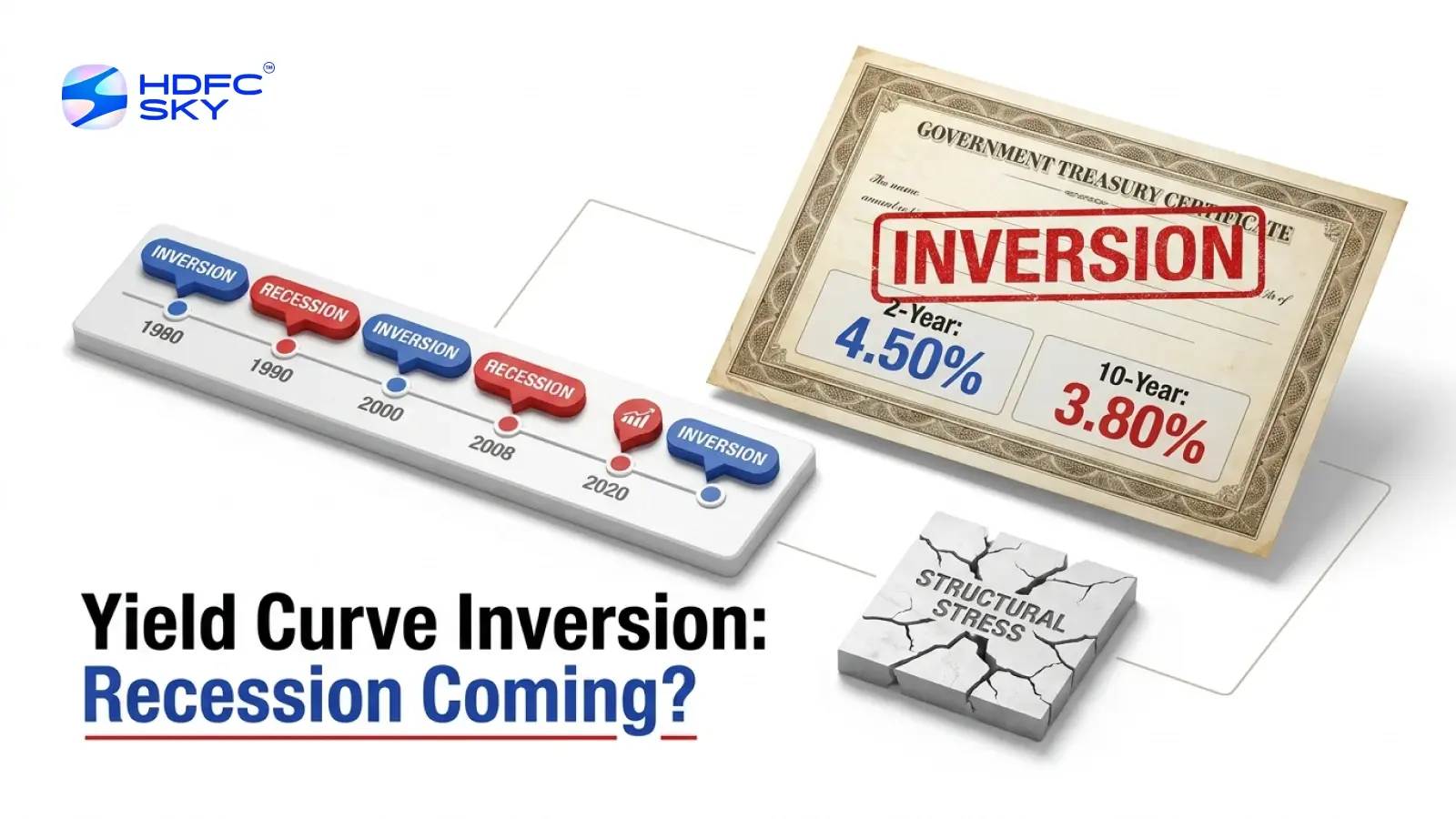
Yield curve inversion occurs when short-term government bonds give higher returns than long-term bonds. This is unusual because investors normally expect higher returns for longer investments.
It happens when investors expect slower economic growth ahead and shift money into long-term bonds for safety. This raises demand and lowers long-term yields, while short-term rates stay high due to central bank policies.
As a result, the usual bond pattern reverses, creating an inverted yield curve that often signals economic caution.
Also Read: Understanding India VIX: What 15 vs 25 means for your portfolio risk in plain language
Why Do Economists Take Yield Curve Inversion Seriously?
Economists watch yield curve inversion closely because it often reveals how investors feel about the future. It helps them understand whether confidence in economic growth is rising or falling.
- It Has a Strong Historical Track Record
Yield curve inversion has gained attention because it has appeared before several major economic slowdowns in countries like the United States.
While it does not guarantee a recession, it has often acted as an early warning sign. This pattern makes economists treat it with caution whenever it appears. - It Reflects Investor Expectations
Bond markets respond quickly to changing economic outlooks. When investors expect weaker growth ahead, they often prefer the safety of long-term government bonds.
Their actions can push long-term yields lower than short-term yields, causing the yield curve to invert. Economists read this shift as a sign that market confidence may be weakening. - It Helps Measure Economic Confidence
The yield curve offers a simple way to assess how markets view the economy’s future. A normal yield curve often suggests optimism. An inverted one can suggest uncertainty.
Economists use this signal alongside inflation, employment, and spending data to understand where the economy may be heading. - It Supports Early Policy Decisions
Institutions such as the Reserve Bank of India and government policy makers monitor these signs carefully.
An inverted yield curve can encourage early action, such as adjusting interest rates or introducing measures to support economic stability before larger problems develop.
Has India Experienced Yield Curve Inversion?
India has seen periods where parts of its bond market showed signs of yield curve inversion. These events may not always attract public attention, but economists and financial experts closely monitor them.
India’s bond market behaves differently from many developed economies. It reacts strongly to government borrowing, inflation trends, and policy decisions by the Reserve Bank of India.
For example, when inflation rises, the Reserve Bank of India may increase short-term interest rates. This can push short-term yields higher. If long-term growth expectations stay weak, long-term yields may remain lower, leading to inversion.
However, India’s strong domestic demand and steady economic growth can sometimes reduce or soften these signals.
Why Does Yield Curve Inversion Raise Concerns About India’s Growth?
When yield curve inversion appears in India, it raises concerns about its impact on businesses, banks, and financial markets.
- It Can Slow Economic Expansion
Businesses may become more cautious during uncertain times. Many may delay new investments, hiring plans, or expansion projects.
In India, slower business activity can affect major sectors such as manufacturing, real estate, and retail. This can weaken overall economic momentum and reduce job creation. - It Can Affect Borrowing and Lending
Banks play a central role in India’s financial system. Yield curve inversion can reduce the profit they earn from lending, which may make them more careful about giving loans.
As a result, home loans, business loans, and personal credit may become more expensive or harder to secure. This can slow spending and investment across the economy. - It Can Increase Market Uncertainty
Financial markets often react quickly to warning signs. Investors may move money away from stocks and toward safer assets when confidence weakens.
In India, foreign investors also shape market movements. If they reduce investments, market volatility can increase and public confidence may decline, especially among first-time investors. - It Can Create Policy Challenges
A changing yield curve can make decision-making more difficult for policymakers. The Reserve Bank of India must balance inflation control with the need to support growth.
The government may also need to strengthen spending or speed up reforms to keep economic activity steady.
Factors That Make India’s Situation Unique
India’s economy has several strong internal drivers that help it respond differently to global financial signals like yield curve inversion.
- Strong Domestic Consumption
India’s large population and growing middle class keep demand steady across essential and non-essential goods, which supports overall economic growth. - Government Infrastructure Push
Public investment in roads, railways, and digital systems strengthens economic activity. These projects also create jobs and improve long-term productivity. - Growing Digital Economy
India’s expanding digital sector, including online services and financial technology, adds strength and supports new business opportunities. - Influence of Global Factors
Oil prices, foreign investment flows, and global economic trends still affect India’s performance. However, strong domestic demand often provides stability during global uncertainty.
Should Investors Be Worried?
Investors often feel anxious when they hear about yield curve inversion, but it is important to understand it in the right context.
- Yield curve inversion is a warning signal, not a guarantee of trouble
- Investors should avoid emotional reactions to market signals
- Focus on long-term investment planning instead of short-term changes
- Stay informed about economic trends before making decisions
- Citizens should manage savings and borrowing carefully
- Economic conditions can change quickly, so stay balanced and aware
Conclusion
Yield curve inversion may sound technical, but its message can affect everyone. It reflects concerns about future economic strength and often signals caution ahead. In India, unique economic strengths may soften its impact. Even so, economists watch it closely because understanding early warning signs helps the country prepare for future challenges.



Open Free Demat Account
Open Free Demat Account
Popular Posts
- 10 Interesting Facts About NSE You Probably Didn’t KnowLast Updated: Sep 30, 2026
- 8-4-3 Rule of SIP - How Does That Work?Last Updated: Jul 30, 2025
- Let's view more exciting Post!
Popular Post from Market Decoded by Sky
- What the Buffett Indicator Says About Indian Market Valuations Right Now and Its LimitationsLast Updated: Jun 3, 2026
- What Happens to Indian Stocks When the US Fed Changes Rates: The Historical Correlation DecodedLast Updated: Jun 3, 2026
- Understanding India VIX: What 15 vs 25 Means for Your Portfolio Risk in Plain LanguageLast Updated: Jun 3, 2026
- The Repo Rate Transmission Lag: Why RBI Rate Cuts Take 6–12 Months to Show Up in Your EMILast Updated: Jun 3, 2026
- The Difference Between SEBI’s SAST Regulations and an Open Offer: Explained for Everyday InvestorsLast Updated: Jun 1, 2026
- Let's view more exciting Post!
Popular Post from Blogs
- “Bounce Back” Theme Gains Traction in 2026Last Updated: Apr 8, 2026
- 5 Takeaways for Tax Payers from the Budget 2025Last Updated: Jan 29, 2026
- Let’s view more exciting Posts


Invest Anytime, Anywhere


By signing up I certify terms, conditions & privacy policy