Nifty 50
- Tech Mahindra₹1,790140.00 (8.48%)
- InterGlobe Aviation₹4,686.90-91.40 (-1.91%)
- TCS₹2,465115.00 (4.89%)
- BSE₹3,363-65.00 (-1.90%)
- Infosys₹1,161.2051.20 (4.61%)
- Max Healthcare₹846-12.00 (-1.40%)
- Bharti Airtel₹1,90551.00 (2.75%)
- Tata Consumer ₹978.90-12.55 (-1.27%)
- Mahindra & Mahindra₹2,920.9059.20 (2.07%)
- Jio Financial ₹216.25-2.76 (-1.26%)
- Bajaj Finance₹98115.75 (1.63%)
- ONGC₹222-2.64 (-1.18%)
- Hindalco Industries₹90814.15 (1.58%)
- Bharat Electronics₹376.85-3.55 (-0.93%)
- HCL Technologies₹1,38020.00 (1.47%)
- Nestle₹1,265.50-10.30 (-0.81%)
- JSW Steel₹1,216.4016.00 (1.33%)
- Adani Enterprises₹2,680.90-19.10 (-0.71%)
- Grasim Industries₹2,92034.10 (1.18%)
- Bajaj Finserv₹1,720-12.00 (-0.69%)

- Offerings
- Tools & Platforms
Tools & Calculators
- Open API
- Calculators
- SIP Calculator
- CAGR Calculator
- Compound Interest Calculator
- FD Calculator
- RD Calculator
- EPF Calculator
- Retirement Calculator
- HDFC SIP Calculator
- Mutual Fund Return Calculator
- Lumpsum Calculator
- Step Up SIP Calculator
- ETF SIP Calculator
- Brokerage Calculator
- Equity Margin Calculator
- SWP Calculator
- EMI Calculator
- MTF Calculator
- Margin Pledge Calculator
- Algo Strategy
- Markets
Stocks
F&O
Mutual Funds
- More
- What Is the US Fed Rate, and Why Does India Care?
- Why Indian Stocks React When the Fed Changes Rates
- The Historical Correlation: What Past Fed Cycles Tell Us
- Which Indian Sectors Feel Fed Rate Changes the Most?
- Why the Correlation Is Not Always Predictable
- What Indian Investors Should Watch After Every Fed Meeting
- Conclusion
- What Is the US Fed Rate, and Why Does India Care?
- Why Indian Stocks React When the Fed Changes Rates
- The Historical Correlation: What Past Fed Cycles Tell Us
- Which Indian Sectors Feel Fed Rate Changes the Most?
- Why the Correlation Is Not Always Predictable
- What Indian Investors Should Watch After Every Fed Meeting
- Conclusion
What Happens to Indian Stocks When the US Fed Changes Rates: The Historical Correlation Decoded
By Aseem Shrivastava | Published at: Jun 3, 2026 11:37 AM IST
Open Free Demat Account
Open Free Demat Account
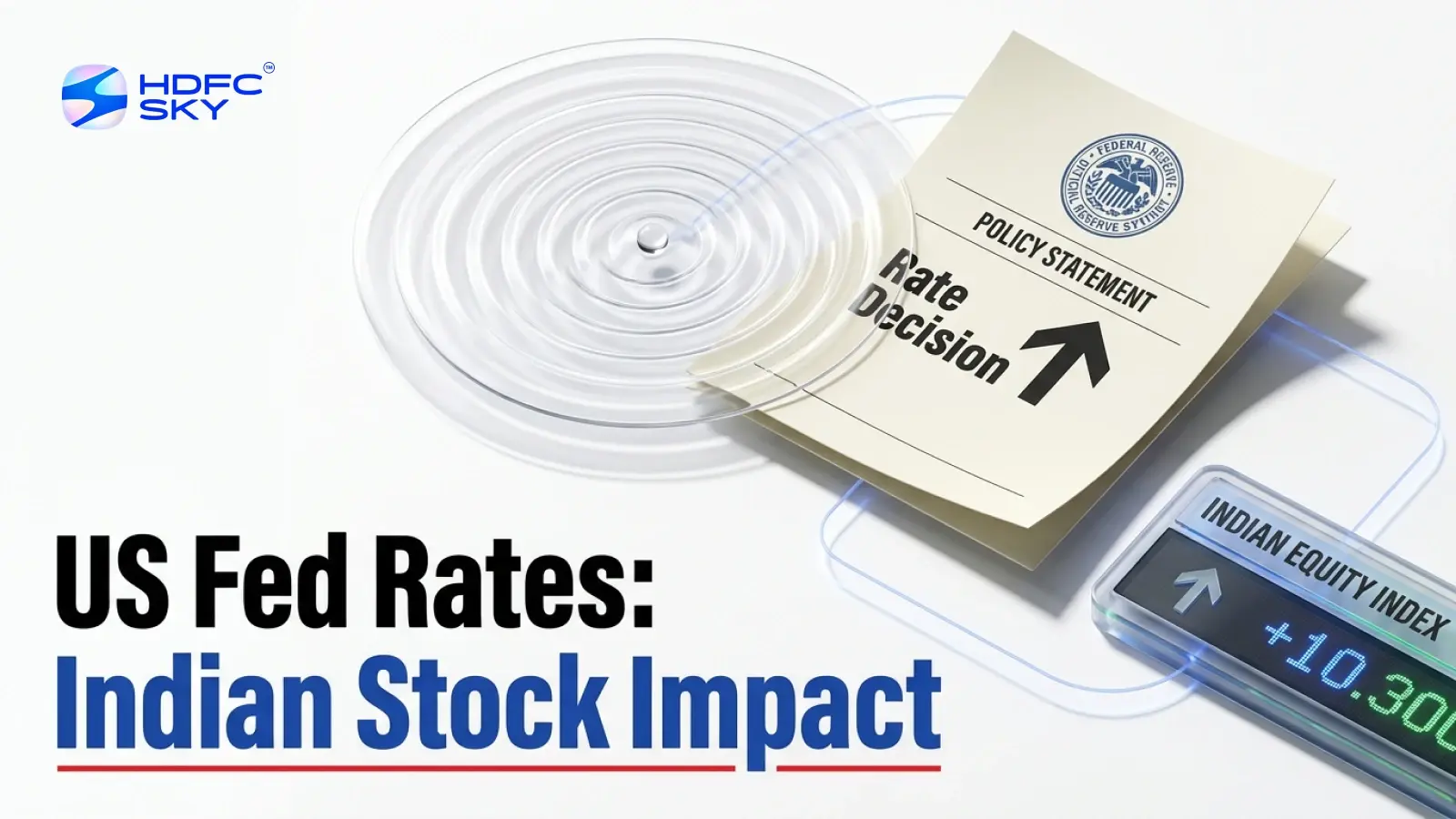
The US Federal Reserve announces a rate hike or cut, and Indian stock markets react within hours. Why does a policy decision made in Washington affect Dalal Street so quickly? The answer lies in global money flows, currency movements, and investor sentiment. Even though the decision happens far from India, its impact often reaches Indian investors almost immediately. Understanding this connection helps investors read market movements better and separate short-term reactions from long-term opportunities.
What Is the US Fed Rate, and Why Does India Care?
The US Federal Reserve, often called the Fed, controls interest rates in the United States. These rates influence global borrowing costs and shape investor decisions across financial markets.
When the Fed raises rates, investors often move money toward safer US assets like Treasury bonds. When it cuts rates, they may seek better returns in emerging markets such as India.
This movement of capital can affect Indian stocks, the rupee, and market sentiment.
The Fed does not control Indian markets directly, but it often changes the mood of global investors.
Also Read: How RBI’s policy pause sent rate-sensitive stocks in two opposite directions on the same day
Why Indian Stocks React When the Fed Changes Rates
Indian markets often react quickly because Fed decisions affect the financial conditions that global investors watch closely.
- Foreign Institutional Investors Shift Capital
When US interest rates rise, American bonds often become more attractive to global investors. Foreign institutional investors may pull money from Indian equities and redirect it to safer US assets, which can create selling pressure on Indian stock markets. - The Rupee Often Feels Immediate Pressure
Fed tightening can strengthen the US dollar and weaken the Indian rupee. A weaker rupee increases import costs for Indian companies and can affect profit margins, especially in sectors that rely heavily on imported raw materials. - Global Risk Appetite Changes
Higher US rates can reduce investor interest in riskier assets across emerging markets. Even strong Indian companies may experience short-term price declines when investors become more cautious and prefer safety over growth opportunities. - Borrowing Costs Can Rise Indirectly
Fed decisions often influence global bond yields. As borrowing costs rise worldwide, Indian companies with large debt obligations may face higher financing expenses, which can affect profitability and reduce investor confidence.
The Historical Correlation: What Past Fed Cycles Tell Us
History shows that Indian stocks respond differently to each Fed cycle. Looking at past trends helps investors understand patterns, even though no two market phases behave exactly the same.
- Fed Tightening Cycle (2013: The Taper Tantrum)
In 2013, the Fed signalled that it would reduce economic stimulus. Even before actual rate hikes began, global investors reacted sharply. India saw heavy foreign investor outflows, the rupee weakened significantly, and both the Sensex and Nifty faced strong volatility.
The key lesson was clear: Indian stocks can react even before actual US rate hikes begin. - Fed Hiking Cycle (2015–2018)
During this period, the Fed raised rates gradually. Indian markets showed resilience despite global concerns. Strong domestic reforms, improving corporate earnings, and steady economic growth helped offset much of the pressure created by global capital shifts.
This period showed that Fed impact weakens when India’s internal fundamentals stay strong. - Emergency Rate Cuts (2020 Pandemic)
The Fed cut rates aggressively during the pandemic to support the US economy. Global liquidity increased rapidly, and investors searched for higher returns in emerging markets. After an initial crash, Indian equities rallied strongly as foreign capital returned.
Lower US rates often support risk assets globally. - Aggressive Rate Hikes (2022–2023)
The Fed delivered its fastest rate hikes in decades to fight inflation. Foreign investors became cautious, and growth-focused sectors such as technology faced pressure. Yet Indian markets remained more resilient than many other emerging markets because of stronger domestic growth and investor confidence.
Which Indian Sectors Feel Fed Rate Changes the Most?
Some sectors respond more directly than others when global interest rates shift. Understanding these patterns can help investors manage expectations.
- IT Stocks
Indian IT companies depend heavily on US clients and economic conditions. Fed-driven slowdowns in the US can affect technology spending and investor sentiment toward these stocks. - Banking and Financials
Banks and financial firms react to liquidity changes and bond yield movements, which can influence lending conditions and profitability across the sector. - Pharma
Pharma companies earn significant export revenue and often remain more defensive, making them relatively stable during periods of global financial uncertainty. - Consumer and Domestic Sectors
These businesses depend more on Indian demand, but broader market sentiment can still influence their stock performance during global policy shifts. - High-Growth and Valuation-Heavy Stocks
Stocks with high valuations often face the greatest pressure when global rates rise, as investors become less willing to pay premium prices.
Why the Correlation Is Not Always Predictable
Fed decisions influence Indian markets, but they do not determine them alone. Several domestic factors can change the outcome.
- RBI Policy Can Offset Global Pressure
The Reserve Bank of India can use its own policy tools to support liquidity and calm markets when global uncertainty increases. - Domestic Economic Growth Can Dominate
Strong GDP growth, healthy consumption, and rising investments can help Indian stocks remain stable despite negative global signals. - Political Stability Matters
Investor confidence often improves when policy direction remains stable, even during periods of external market stress. - Corporate Earnings Can Outweigh Outflows
Strong company performance can attract investors back, even when foreign capital temporarily moves elsewhere. - Markets React to Expectations Too
Sometimes markets move more on what investors expect the Fed to say than on the actual announcement itself.
What Indian Investors Should Watch After Every Fed Meeting
After every Fed announcement, investors should watch a few important signals to understand market direction.
- Watch whether the Fed sounds hawkish or dovish in its policy statement.
- Track foreign institutional investor inflows and outflows over the following days.
- Monitor USD/INR movement for signs of currency pressure or strength.
- Check Indian bond yields for shifts in borrowing cost expectations.
- Observe how the RBI responds in its own policy commentary.
- Notice whether market leadership shifts between defensive and growth sectors.
Conclusion
US Fed decisions matter because global capital moves quickly across borders. Indian stocks often react immediately, but the impact does not always follow the same pattern. Historical trends help investors understand market behaviour, though they cannot predict every outcome. Smart investors look beyond headlines and balance global signals with India’s domestic economic strength before making investment decisions.



Open Free Demat Account
Open Free Demat Account
Popular Posts
- 10 Interesting Facts About NSE You Probably Didn’t KnowLast Updated: Sep 30, 2026
- 8-4-3 Rule of SIP - How Does That Work?Last Updated: Jul 30, 2025
- Let's view more exciting Post!
Popular Post from Market Decoded by Sky
- What the Buffett Indicator Says About Indian Market Valuations Right Now and Its LimitationsLast Updated: Jun 3, 2026
- What Is “Yield Curve Inversion” and Why Does It Make Economists Nervous About India’s Growth?Last Updated: Jun 3, 2026
- Understanding India VIX: What 15 vs 25 Means for Your Portfolio Risk in Plain LanguageLast Updated: Jun 3, 2026
- The Repo Rate Transmission Lag: Why RBI Rate Cuts Take 6–12 Months to Show Up in Your EMILast Updated: Jun 3, 2026
- The Difference Between SEBI’s SAST Regulations and an Open Offer: Explained for Everyday InvestorsLast Updated: Jun 1, 2026
- Let's view more exciting Post!
Popular Post from Blogs
- “Bounce Back” Theme Gains Traction in 2026Last Updated: Apr 8, 2026
- 5 Takeaways for Tax Payers from the Budget 2025Last Updated: Jan 29, 2026
- Let’s view more exciting Posts


Invest Anytime, Anywhere


By signing up I certify terms, conditions & privacy policy