Nifty 50
- Tech Mahindra₹1,790140.00 (8.48%)
- InterGlobe Aviation₹4,686.90-91.40 (-1.91%)
- TCS₹2,465115.00 (4.89%)
- BSE₹3,363-65.00 (-1.90%)
- Infosys₹1,161.2051.20 (4.61%)
- Max Healthcare₹846-12.00 (-1.40%)
- Bharti Airtel₹1,90551.00 (2.75%)
- Tata Consumer ₹978.90-12.55 (-1.27%)
- Mahindra & Mahindra₹2,920.9059.20 (2.07%)
- Jio Financial ₹216.25-2.76 (-1.26%)
- Bajaj Finance₹98115.75 (1.63%)
- ONGC₹222-2.64 (-1.18%)
- Hindalco Industries₹90814.15 (1.58%)
- Bharat Electronics₹376.85-3.55 (-0.93%)
- HCL Technologies₹1,38020.00 (1.47%)
- Nestle₹1,265.50-10.30 (-0.81%)
- JSW Steel₹1,216.4016.00 (1.33%)
- Adani Enterprises₹2,680.90-19.10 (-0.71%)
- Grasim Industries₹2,92034.10 (1.18%)
- Bajaj Finserv₹1,720-12.00 (-0.69%)

- Offerings
- Tools & Platforms
Tools & Calculators
- Open API
- Calculators
- SIP Calculator
- CAGR Calculator
- Compound Interest Calculator
- FD Calculator
- RD Calculator
- EPF Calculator
- Retirement Calculator
- HDFC SIP Calculator
- Mutual Fund Return Calculator
- Lumpsum Calculator
- Step Up SIP Calculator
- ETF SIP Calculator
- Brokerage Calculator
- Equity Margin Calculator
- SWP Calculator
- EMI Calculator
- MTF Calculator
- Margin Pledge Calculator
- Algo Strategy
- Markets
Stocks
F&O
Mutual Funds
- More
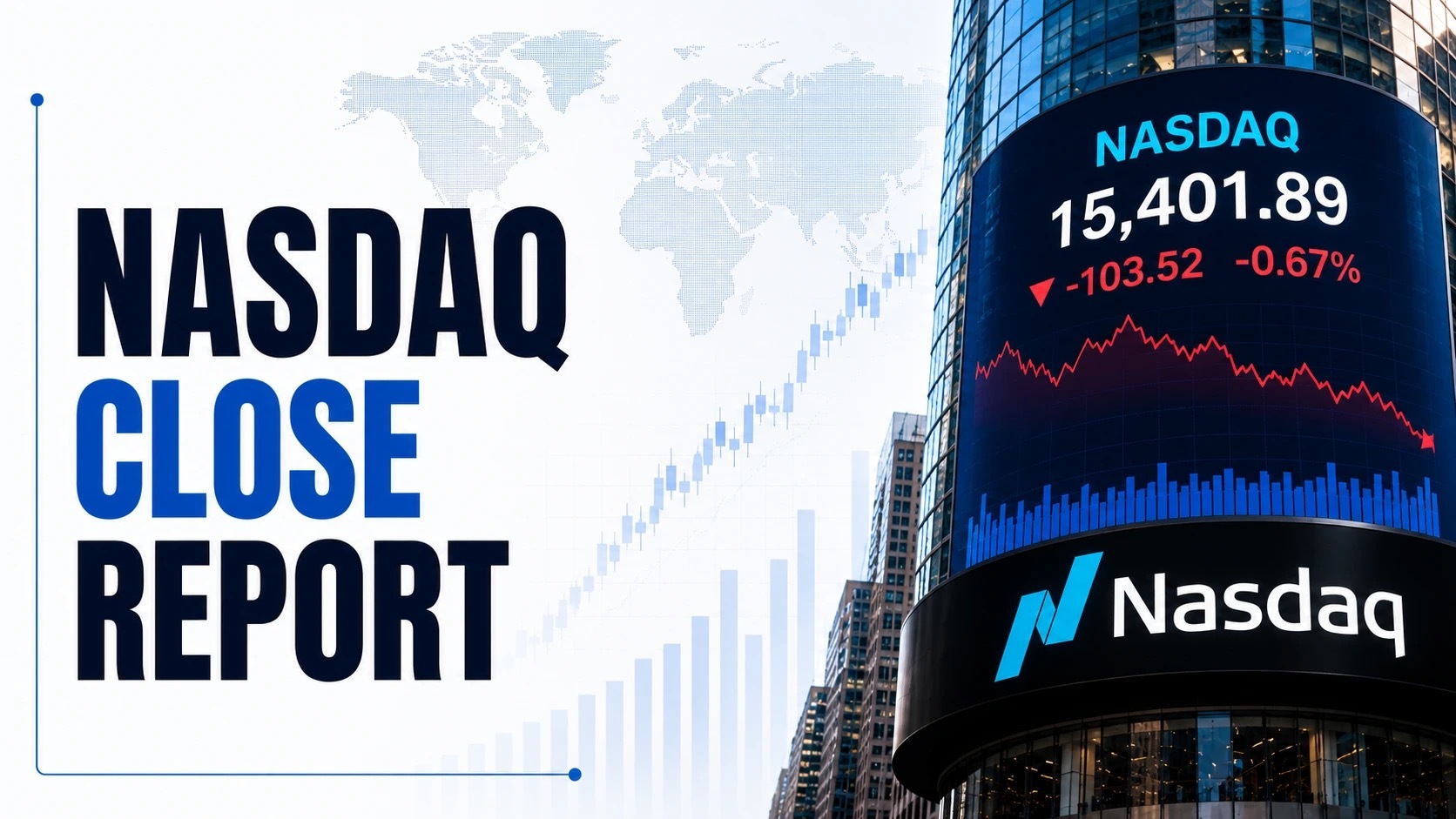
Dow Slips 374 Points, Nasdaq Flat as US-Iran Strikes Send Oil Above $90 and Rate-Hike Bets Surge
Authored By HDFC SKY | Last Modified: Sep 1, 2026 09:01 AM IST
Open Free Demat Account
Open Free Demat Account
Mumbai, Sept 1: US stocks closed lower on the final trading day of August, as renewed military strikes between the United States and Iran pushed crude oil prices above $90 per barrel, reigniting inflation fears and strengthening expectations of a Federal Reserve interest rate hike in September.
The Dow Jones Industrial Average fell 374.09 points (0.70%) to 53,185.90, while the S&P 500 declined 25.62 points (0.33%) to 7,686.14 and the Nasdaq Composite slipped 31.54 points (0.12%) to 26,370.89. Despite the session’s losses, all three major indexes recorded solid gains for August, with the S&P 500 rising 2.6%, the Nasdaq advancing 3.9%, and the Dow gaining 1.3% for the month.

Dow Jones Industrial Average Sheds 374 Points on Rate-Hike Jitters
The Dow Jones Industrial Average (^DJI) closed at 53,185.90, down 374.09 points or 0.70% from the previous session’s close of 53,559.99. The index opened at 53,462.60 and traded within a daily range of 53,123.62 to 53,462.60. The 30-stock index remained well above its 52-week low of 44,948.16 and below its 52-week high of 54,744.33.
Alphabet Inc. (GOOGL) was the heaviest drag on the Dow, falling 2.07% to $337.56, followed by Amazon.com Inc. (AMZN) which declined 2.44% to $259.97. Boeing Co. (BA) dropped 0.83%, while Goldman Sachs Group Inc. (GS) fell 0.72% and American Express Co. (AXP) declined 0.86%. On the upside, Chevron Corp. (CVX) surged 2.14% to lead Dow gainers, benefiting from the sharp rise in oil prices. Walmart Inc. (WMT) added 1.73%, and Cisco Systems Inc. (CSCO) rose 0.51%. The Dow’s decline was broad-based, with 24 of 30 components finishing in negative territory.
S&P 500 Drops 0.33% as Energy Gains Offset Broad Weakness
The S&P 500 (^GSPC) closed at 7,686.14, down 25.62 points or 0.33% from Friday’s close of 7,711.76. The index opened at 7,697.52 and traded between an intraday low of 7,665.06 and a high of 7,697.52. The benchmark index remains within its 52-week range of 6,316.91 to 7,816.70.
Energy was the sole sector in positive territory, gaining 2.11% as oil prices surged on geopolitical tensions. SLB (SLB) rose 2.20%, Exxon Mobil Corp. (XOM) advanced 2.74%, and Chevron (CVX) gained 2.14%. Halliburton Co. (HAL) climbed over 2%, while Williams Companies (WMB) and Kinder Morgan (KMI) also posted solid gains.
Communication services was the worst-performing sector, declining 1.63%, weighed down by Alphabet (GOOGL) which fell 2.18% and Meta Platforms (META) which dropped 0.99%. Take-Two Interactive (TTWO) plunged following leaks about its upcoming GTA 6 release.
Information technology declined 0.2% as rising Treasury yields pressured growth stocks. Microsoft Corp. (MSFT) fell 1.19% to $509.20, while Apple Inc. (AAPL) slipped 0.89% to $315.65 on Tim Cook’s final day as CEO. Utilities were among the biggest laggards, falling sharply after California lawmakers blocked a proposal limiting utility exposure to wildfire claims.
Nasdaq Composite Flat as Tech Giants Weigh on Index
The Nasdaq Composite (^IXIC) closed at 26,370.89, down 31.54 points or 0.12% from Friday’s close of 26,402.42. The index opened at 26,358.56 and traded within a daily range of 26,249.77 to 26,398.33. The tech-heavy index remains 2.5% below its record high set in early June but posted a 3.9% gain for August.
Tesla Inc. (TSLA) was the standout performer among mega-cap tech stocks, surging 5.53% to lead Nasdaq gainers. Nvidia Corp. (NVDA) rose 1.63% following the announcement of a $3.5 billion investment in Taiwanese chipmaker MediaTek. CrowdStrike Holdings (CRWD) jumped 5.77%, and Palo Alto Networks (PANW) gained 2.81%.
However, the broader technology sector faced headwinds from rising bond yields. Amazon (AMZN) fell 2.44% after the Federal Trade Commission and 22 states sued the e-commerce giant over alleged advertising auction manipulation. Alphabet (GOOGL) declined 2.07%, while Microsoft (MSFT) dropped 1.19% and Apple (AAPL) slipped 0.89%. Booking Holdings (BKNG) tumbled 3.18%, and Airbnb Inc. (ABNB) lost 3.25% among consumer discretionary names.
Russell 2000 Drops 0.54% as Small-Caps Underperform
The Russell 2000 (^RUT) closed at 2,956.45, down 15.93 points or 0.54% from Friday’s close of 2,972.37. The small-cap index opened at 2,967.43 and traded between a low of 2,944.34 and a high of 2,967.43. The Russell 2000 remains within its 52-week range of 2,303.46 to 3,069.71, though it underperformed large-cap indexes on Monday.
Small-cap stocks were pressured by rising interest rate expectations, as smaller companies tend to have higher debt burdens and are more sensitive to borrowing costs. Energy-related small-caps provided some support, while technology and consumer discretionary names weighed on the index.
Also Read: How to Invest in the US Stocks From India
S&P 100 Falls 0.29% as Mega-Cap Tech Stocks Drag
The S&P 100 (^OEX) closed at 3,801.26, down 10.95 points or 0.29% from Friday’s close of 3,812.21. The index opened at 3,805.34 and traded between an intraday low of 3,789.00 and a high of 3,806.37. The S&P 100 remains below its 52-week high of 3,853.17 and above its 52-week low of 3,074.00.
The index, which comprises the largest companies in the S&P 500, was dragged lower by mega-cap technology stocks including Alphabet, Amazon, and Microsoft. Energy giants Chevron and Exxon Mobil provided some offsetting gains.
Dow Jones Composite, Transportation and Utility Averages Show Mixed Performance
The Dow Jones Composite Average (^DJC) closed at 16,751.89, down 116.12 points or 0.69% from Friday’s close of 16,868.01. The index opened at 16,816.03 and traded within a range of 16,698.66 to 16,816.03.
The Dow Jones Transportation Average (^DJT) closed at 21,302.01, down 76.74 points or 0.36% from 21,378.75. The index opened at 21,350.67 and traded between 21,153.78 and 21,358.92. Transportation stocks faced pressure from rising oil prices, which increase fuel costs for airlines and trucking companies.
The Dow Jones Utility Average (^DJU) closed at 1,063.16, down 15.12 points or 1.40% from 1,078.28. The index opened at 1,061.83 and traded between 1,054.71 and 1,066.27. Utilities were the worst-performing major sector group, plunging on concerns over California wildfire liability legislation that weighed heavily on PG&E Corp. (PCG) and Edison International (EIX) .
Philadelphia Semiconductor Index Gains 0.57% on Chip Stock Strength
The PHLX Semiconductor Sector Index (^SOX) closed at 11,535.05, up 65.39 points or 0.57% from Friday’s close of 11,469.66. The index opened at 11,529.16 and traded within a range of 11,444.20 to 11,587.26, marking a new 52-week high of 11,587.26.
Semiconductor stocks showed resilience despite broader market weakness. Micron Technology (MU) surged 2.83%, Qualcomm (QCOM) jumped 3.83%, and Advanced Micro Devices (AMD) gained 1.20% . Nvidia (NVDA) rose 1.63% following its $3.5 billion investment in MediaTek. The SOX posted strong gains for August, reflecting continued demand for AI-related chip stocks.
NYSE Composite Falls 0.50% as Breadth Turns Negative
The NYSE Composite (^NYA) closed at 24,463.04, down 122.14 points or 0.50% from Friday’s close of 24,585.18. The index opened at 24,585.18 and traded within a range of 24,449.46 to 24,585.18. The NYSE Composite remains within its 52-week range of 20,894.59 to 24,866.75.
Declining issues outpaced advancing issues on the New York Stock Exchange by a margin of approximately 2-to-1, reflecting broad-based selling pressure. Energy stocks provided some support, but weakness in financials, utilities, and consumer discretionary names weighed on the index.
S&P MidCap 400 and SmallCap 600 Decline on Rate Sensitivity
The S&P MidCap 400 (^SP400) closed at 3,760.23, down 19.24 points or 0.51% from Friday’s close of 3,779.47. The index opened at 3,779.47 and traded between 3,752.76 and 3,779.47. Mid-cap stocks, which are often more sensitive to interest rate changes, underperformed large caps.
The S&P SmallCap 600 (^SP600) closed at 1,755.70, down 11.87 points or 0.67% from 1,767.57. The index opened at 1,766.80 and traded between 1,750.98 and 1,766.94. Small-cap stocks underperformed all other major indices, reflecting heightened sensitivity to rising yields and the potential for a September rate hike.
Also Read: How to Invest in S&P 500 Stocks Through Index Funds
Strait of Hormuz Tensions Lift Brent to $90.49, Reviving Inflation and Rate-Hike Fears
The primary catalyst for Monday’s decline was the renewal of military hostilities between the United States and Iran. On Sunday, US Central Command confirmed strikes on Iranian rocket launchers on Larak Island in the Strait of Hormuz, which were allegedly preparing to deploy sea mines. Iran retaliated with missile attacks on US bases in Jordan, marking the first exchange of fire in nearly a month.
Brent crude futures surged to $90.49 per barrel, up 2.71%, while WTI crude jumped 2.83% to $85.76 per barrel. The spike in oil prices reignited inflation concerns, as higher energy costs could keep consumer prices elevated and force the Federal Reserve to maintain restrictive monetary policy.
Federal Reserve rate-hike expectations intensified following Chairman Kevin Warsh’s hawkish speech at the Jackson Hole symposium on Friday. Warsh warned that inflation remained “too hot” and that the central bank has “work to do.” The probability of a 25-basis-point rate hike at the September meeting surged from approximately 35-40% before Warsh’s speech to nearly 60% by Monday’s close.
Volatility Index Jumps 6.65% as Market Anxiety Rises
The CBOE Volatility Index (^VIX) surged 6.65% to 15.39, reflecting increased market anxiety following the escalation in US-Iran tensions and rising rate-hike expectations. The VIX had previously fallen to a 2026 low of 14.13 in late August, but Monday’s geopolitical shock prompted a sharp reversal.
The rise in the VIX indicates that options traders are pricing in greater uncertainty over the next 30 days. The index remains below its long-term average of around 19-20, suggesting that while volatility has increased, markets have not yet entered a panic phase.
Tesla Surges 5.53% as Amazon Falls 2.44% on FTC Lawsuit
The Magnificent Seven mega-cap technology stocks showed sharp divergence on Monday. Tesla (TSLA) was the standout performer, surging 5.53% as investors shrugged off broader market weakness.
Nvidia (NVDA) rose 1.63% following its $3.5 billion investment in MediaTek, expanding its AI ecosystem footprint.
However, the remaining five Magnificent Seven stocks declined. Amazon (AMZN) fell 2.44% after the FTC and 22 states sued the e-commerce giant over alleged advertising auction manipulation. Alphabet (GOOGL) dropped 2.07%, while Microsoft (MSFT) declined 1.19%. Apple (AAPL) slipped 0.89% on Tim Cook’s final day as CEO before John Ternus takes over, while Meta Platforms (META) fell 0.99%.
Quiet US Data Calendar Shifts Focus to Friday’s Jobs Report
Monday’s economic calendar was relatively quiet, with no major US economic data releases. Investors are now looking ahead to Friday’s August jobs report, which could provide important signals on the strength of the labour market and influence expectations for the Federal Reserve’s September rate decision.
A stronger-than-expected jobs report could reinforce expectations for tighter monetary policy, while signs of labour-market deterioration could reduce the probability of further tightening.
The ISM Manufacturing PMI and ISM Services PMI are also scheduled for release later this week, providing additional indicators of US economic activity.
Hawkish Fed Signals Push September Rate-Hike Odds Towards 60%
Federal Reserve Chairman Kevin Warsh’s hawkish comments at the Jackson Hole symposium on Friday continued to influence markets on Monday. Warsh warned that inflation remained above the Fed’s 2% target and that the central bank still had work to do. The probability of a 25-basis-point rate hike at the September 16 FOMC meeting rose to approximately 60%, up from around 35–40% before Warsh’s speech.
Speaking at the G20 finance ministers meeting in Asheville, North Carolina, on Monday, Warsh described the current economic environment as one of a global investment surge and expressed confidence in the US economy while maintaining a hawkish stance on inflation.
Rising Oil and Fed Hike Bets Push 10-Year Treasury Yield to 4.76%
US Treasury yields climbed on Monday as rising oil prices intensified inflation concerns and strengthened expectations of a Federal Reserve rate hike.
The 10-year Treasury yield rose approximately 4 basis points to 4.76%, its highest level since January 2025. The yield opened at 4.733% and reached an intraday high of 4.754% before settling near its session highs.
The 2-year Treasury yield, which closely tracks expectations for Fed policy, held near 4.34%, while the 30-year Treasury yield climbed to 5.26%, its highest level since mid-August.
The yield curve remained inverted, with the 2-year yield trading below the 10-year yield, reflecting continued uncertainty over the economic and monetary-policy outlook.
Also Read : US Stock Market Timings
US-Iran Escalation Sends Brent Crude Above $90 on Supply Fears
Brent crude futures settled at $90.49 per barrel, up 2.71%, while WTI crude rose 2.83% to $85.76 per barrel as renewed US-Iran military tensions heightened concerns over oil supplies through the strategic Strait of Hormuz.
The US strike on Iranian rocket launchers and Iran’s retaliatory attacks on US bases in Jordan raised fears of a broader conflict that could disrupt a critical route for global oil shipments, increasing supply-risk concerns.
Natural gas futures climbed approximately 1.6% to $2.935 per million British thermal units, reaching a seven-week high amid expectations of warmer weather and stronger LNG export demand.
Gold futures declined approximately 0.8% to $4,495 per ounce as rising Treasury yields and a stronger dollar weighed on the precious metal. However, gold remained on track for its best monthly performance since January, with prices up nearly 10% in August.
Dollar Falls 0.28% to 99.428 Despite Hawkish Fed Repricing
The US Dollar Index (DXY) fell 0.28% to 99.428 despite rising expectations for a Federal Reserve rate hike and escalating geopolitical tensions. The dollar briefly traded above its 200-day moving average but failed to sustain the gain.
EUR/USD rose to 1.1616 from 1.1580, supported by expectations of tighter European Central Bank policy. The ECB is scheduled to meet on September 9–10, a week before the Fed.
USD/JPY fell to 159.80 from 160.14 as the yen strengthened following comments from US Treasury Secretary Scott Bessent suggesting that Japan could take action to support a stronger currency. GBP/USD rose to 1.3550 from 1.3531, supported by broad dollar weakness.
Renewed US-Iran military hostilities have pushed crude oil above $90 per barrel, reigniting inflation fears and driving September Fed rate-hike odds to nearly 60%. Rising Treasury yields, with the 10-year at 4.76% (a 19-month high), continue to pressure growth stocks and interest-rate-sensitive sectors. Energy stocks outperformed as the sole positive sector, while utilities and communication services lagged. Friday’s August jobs report will be critical in shaping the Fed’s September decision, with market participants closely monitoring labour market data for signs of softening that could reduce tightening pressure.
Source
- https://www.nasdaq.com/
- spglobal.com/spdji/en/indices/equity/sp-500/
- https://www.dowjones.com/
- https://www.spglobal.com/spdji/en/indices/equity/dow-jones-industrial-average/
- https://www.spglobal.com/spdji/en/indices/equity/sp-500/
- https://www.nasdaq.com/market-activity/index/comp
- https://www.nasdaq.com/market-activity/quotes/nasdaq-ndx-index
- https://www.spglobal.com/spdji/en/indices/equity/sp-100/
- https://www.lseg.com/en/ftse-russell/indices/russell-us
- https://www.nyse.com/index
- https://www.nyse.com/index
- https://www.spglobal.com/spdji/en/indices/equity/dow-jones-transportation-average/
- https://www.spglobal.com/spdji/en/indices/equity/dow-jones-utility-average/
- https://www.spglobal.com/spdji/en/indices/equity/dow-jones-composite-average/
- https://www.nasdaq.com/market-activity/index/sox
- https://www.cboe.com/tradable_products/vix/
Disclaimer
If you have any concerns, questions, or wish to point out any discrepancies in our content, please feel free to write to us at content@hdfcsec.com.
Please Note: The information shared is intended solely for informational purposes and does not make any investment recommendations
HDFC SKY, one of India’s most trusted trading platforms, has been recognized with the Next-Gen Digi Content Awards 2025–26.
Disclaimer
At HDFC SKY*, we take utmost care and due diligence in curating and presenting news and market-related content. However, inadvertent errors or omissions may occasionally occur.
If you have any concerns, questions, or wish to point out any discrepancies in our content, please feel free to write to us at content@hdfcsec.com.
Please Note: The information shared is intended solely for informational purposes and does not make any investment recommendations.
HDFC SKY from HDFC Securities, one of most trusted trading platforms in India, has been recognized with the *Next-Gen Digi Content Awards 2025-26.
 Join Us
 Add as preferred source on Google


More International News






Open Free Demat Account
Open Free Demat Account





Invest Anytime, Anywhere


By signing up I certify terms, conditions & privacy policy