Nifty 50
- Dr. Reddy's Labs₹1,229.4032.40 (2.71%)
- Apollo Hospitals₹7,775-252.50 (-3.15%)
- Bajaj Auto₹10,034256.00 (2.62%)
- ITC₹257.90-8.10 (-3.05%)
- Tata Motors PV₹284.454.55 (1.63%)
- Tech Mahindra₹1,471-43.10 (-2.85%)
- Bharat Electronics₹373.905.75 (1.56%)
- L&T₹3,627.50-75.80 (-2.05%)
- BSE₹3,330.2043.00 (1.31%)
- Max Healthcare₹865.95-17.85 (-2.02%)
- Cipla₹1,317.4016.40 (1.26%)
- Hindalco Industries₹882.50-17.85 (-1.98%)
- Eicher Motors₹7,11969.00 (0.98%)
- Hindustan Unilever₹1,820.70-36.00 (-1.94%)
- Mahindra & Mahindra₹2,81316.80 (0.60%)
- SBI₹941-18.10 (-1.89%)
- Kotak Mahindra Bank₹443.402.40 (0.54%)
- Coal India₹404.80-6.75 (-1.64%)
- HCL Technologies₹1,2236.30 (0.52%)
- Bharti Airtel₹1,778.70-26.40 (-1.46%)

- Offerings
- Tools & Platforms
Tools & Calculators
- Open API
- Calculators
- SIP Calculator
- CAGR Calculator
- Compound Interest Calculator
- FD Calculator
- RD Calculator
- EPF Calculator
- Retirement Calculator
- HDFC SIP Calculator
- Mutual Fund Return Calculator
- Lumpsum Calculator
- Step Up SIP Calculator
- ETF SIP Calculator
- Brokerage Calculator
- Equity Margin Calculator
- SWP Calculator
- EMI Calculator
- MTF Calculator
- Margin Pledge Calculator
- Algo Strategy
- Markets
Stocks
F&O
Mutual Funds
- More
Reopening of Strait of Hormuz To Lower Tail Risk, but Supply Normalisation To Be Costly: S&P
Authored By PTI | Published at: Jun 25, 2026 03:20 PM IST
Open Free Demat Account
Open Free Demat Account
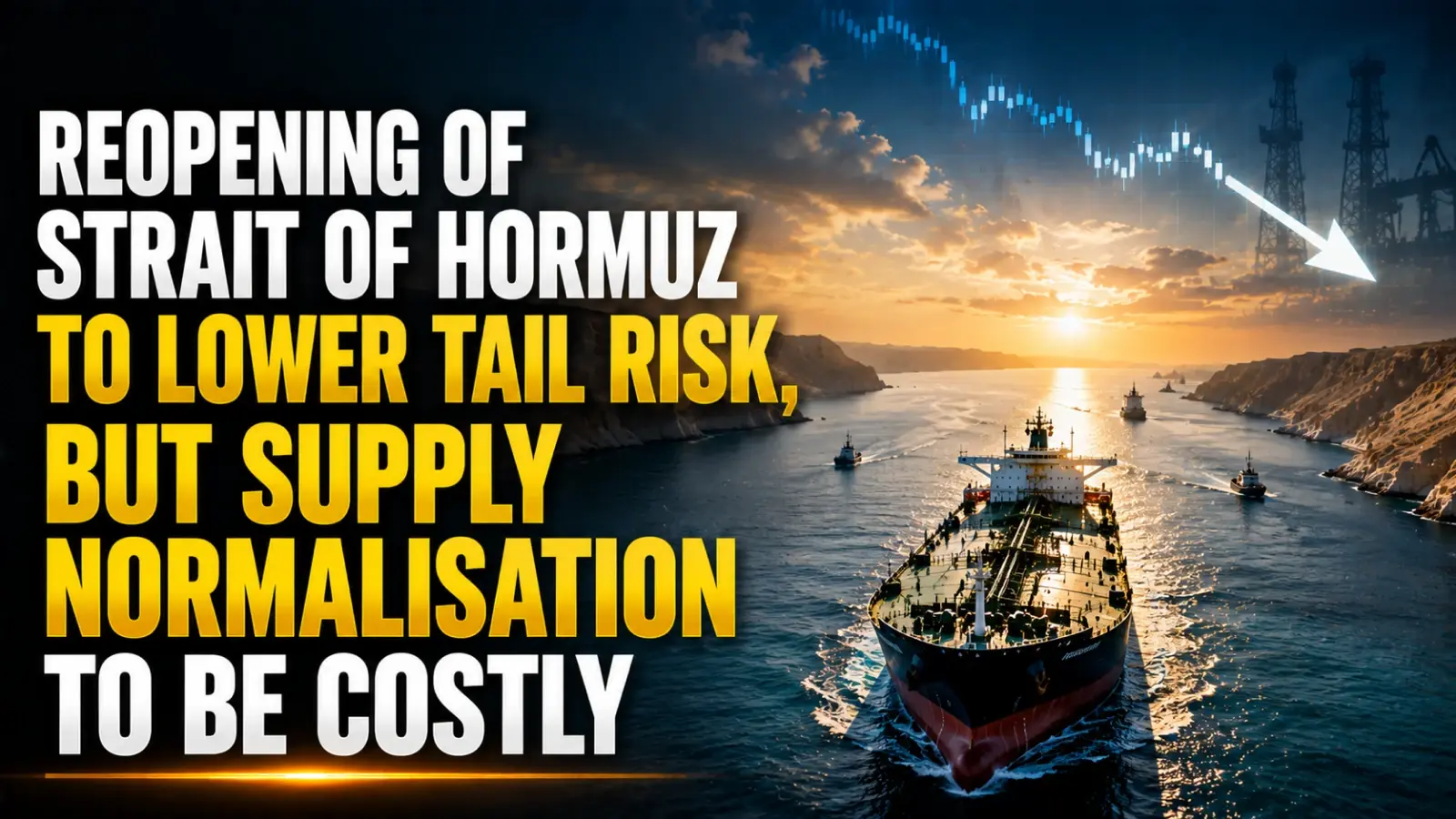
New Delhi: S&P Global Ratings on Thursday said the reopening of the Strait of Hormuz would lower tail risk for the Asia-Pacific region, but supply normalisation will be uneven and costly.
On June 17, the United States and Iran reached a memorandum of understanding (MoU) that included a commitment to reach a final agreement within 60 days. The MoU also refers to reopening the Strait of Hormuz and allowing the passage of commercial ships without any charge.
In its report, S&P said the US-Iran MoU is constructive, but hard issues such as Iran’s nuclear programme, sanctions relief, regional security, and Israel’s security concerns remain unresolved. “Shipping, insurance, port, and operational constraints could also delay a return to pre-conflict flows,” S&P said in its report titled ‘Hormuz Reopens, Fragility Remains’.
S&P has maintained its Brent crude assumption at USD 110 per barrel on average for the rest of 2026, before lowering it to USD 80 per barrel in 2027 and USD 65 per barrel from 2028. “A Hormuz reopening reduces immediate tail risk, but Asia-Pacific still faces slower, costlier, and more fragmented operating conditions,” said Eunice Tan, head of Asia-Pacific credit research at S&P Global Ratings.
Brent crude prices have retreated to below USD 80 per barrel, while the liquefied natural gas Japan Korea Marker (LNG JKM) is near USD 15 per million British thermal units (MMBtu) following the MoU. S&P said these developments have eased the headline shock, but do not mean physical markets have fully healed.
The ratings agency cautioned that a slow resumption of flows could keep energy, freight and input-cost pressures elevated across petrochemicals, agriculture, transportation and logistics. According to S&P, the sectors most exposed are energy and downstream industries, along with emerging markets that have thin external and fiscal buffers.
The Strait of Hormuz also carries refined fuels, naphtha, fertilizers and industrial feedstocks, meaning slower flows can have repercussions beyond the energy sector. S&P said South Asia is especially exposed to the second-order risks arising from the West Asia conflict.
India, the world’s largest urea importer, relies heavily on Gulf suppliers, while Bangladesh and other countries depend on imported fertilisers and gas-linked nitrogen production. “Alternative supply from North Africa, Russia, China, or higher-cost Europe could help but would be slower and costlier. If fertiliser tightness overlaps with weather stress, it could rapidly affect crop yields, food prices, household purchasing power, and subsidy burdens,” S&P said.
“Central banks face a tough trade-off: Tightening policy could help contain inflation and currency depreciation but would weigh on growth; whereas staying put could leave currencies and capital flows more exposed,” Tan said.
(Disclaimer: Except for the headline, this article has not been edited by HDFC Sky editorial team and is auto-generated from PTI feed.)
Disclaimer
If you have any concerns, questions, or wish to point out any discrepancies in our content, please feel free to write to us at content@hdfcsec.com.
Please Note: The information shared is intended solely for informational purposes and does not make any investment recommendations
Disclaimer
At HDFC SKY*, we take utmost care and due diligence in curating and presenting news and market-related content. However, inadvertent errors or omissions may occasionally occur.
If you have any concerns, questions, or wish to point out any discrepancies in our content, please feel free to write to us at content@hdfcsec.com.
Please Note: The information shared is intended solely for informational purposes and does not make any investment recommendations.
HDFC SKY from HDFC Securities, one of most trusted trading platforms in India, has been recognized with the *Next-Gen Digi Content Awards 2025-26.
 Join Us
 Add as preferred source on Google


More Business News






Open Free Demat Account
Open Free Demat Account











Invest Anytime, Anywhere


By signing up I certify terms, conditions & privacy policy