Nifty 50
- JSW Steel₹1,241.3025.00 (2.06%)
- Axis Bank₹1,236-54.00 (-4.19%)
- ONGC₹2253.00 (1.35%)
- Tata Motors PV₹278-8.85 (-3.09%)
- SBI₹973.7011.10 (1.15%)
- Infosys₹1,130.70-30.50 (-2.63%)
- L&T₹3,661.9034.80 (0.96%)
- Bajaj Finance₹957.35-24.75 (-2.52%)
- Eicher Motors₹7,34964.50 (0.89%)
- Apollo Hospitals₹7,700-190.00 (-2.41%)
- Adani Ports₹1,76615.20 (0.87%)
- UltraTech Cement₹10,650-257.00 (-2.36%)
- Dr. Reddy's Labs₹1,242.509.50 (0.77%)
- HDFC Bank₹712-16.85 (-2.31%)
- InterGlobe Aviation₹4,70013.10 (0.28%)
- Trent₹2,891.60-67.10 (-2.27%)
- Bharat Electronics₹377.200.35 (0.09%)
- Hindustan Unilever₹1,853.20-40.60 (-2.14%)
- NTPC₹309-6.15 (-1.95%)

- Offerings
- Tools & Platforms
Tools & Calculators
- Open API
- Calculators
- SIP Calculator
- CAGR Calculator
- Compound Interest Calculator
- FD Calculator
- RD Calculator
- EPF Calculator
- Retirement Calculator
- HDFC SIP Calculator
- Mutual Fund Return Calculator
- Lumpsum Calculator
- Step Up SIP Calculator
- ETF SIP Calculator
- Brokerage Calculator
- Equity Margin Calculator
- SWP Calculator
- EMI Calculator
- MTF Calculator
- Margin Pledge Calculator
- Algo Strategy
- Markets
Stocks
F&O
Mutual Funds
- More
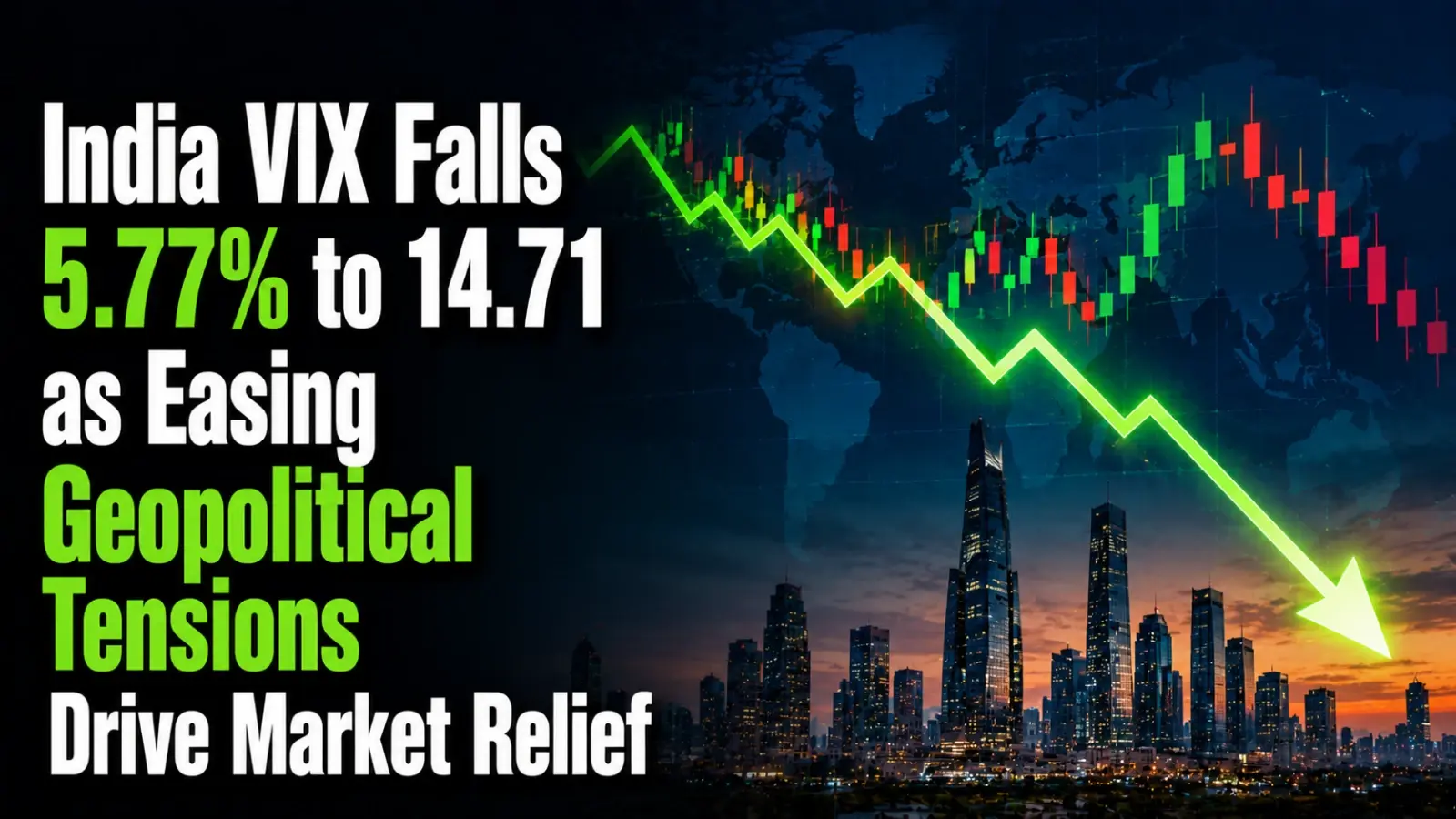
India VIX Falls 5.77% to 14.71 as Easing Geopolitical Tensions Drive Market Relief
Authored By HDFC SKY | Last Modified: Jun 12, 2026 05:24 PM IST
Open Free Demat Account
Open Free Demat Account
Mumbai, June 12: India VIX declined sharply on Friday, falling 0.90 points or 5.77% to close at 14.71. The fall came amid easing political concerns in addition to a broad-based recovery across domestic markets, bringing to a close a volatile week characterised by volatility in risk sentiment over developments in West Asia and global markets
During the day, the volatility index traded within a day’s range of 14.39 to 15.61, while remaining considerably higher than the 52-week low of 8.72 but lower than the 52-week high of 28.90. Even after Friday’s decline, India VIX continues to remain up 55.17% year-to-date, indicating higher uncertainty compared to the start of 202

INDIA VIX Decline 5.77% as Volatility Drops to 14.71%
India VIX opened at 15.61, which was also the previous session’s closing, but throughout the day experienced declines, touching an intraday low of 14.39. The index ultimately closed near the lower boundary of its trading range, suggesting a reduction in expected market volatility.
The movement followed a week in which volatility fluctuated sharply in response to geopolitical headlines. Market participants monitored developments surrounding negotiations involving the United States and Iran, with changing expectations around a potential agreement influencing risk assessments across global and domestic markets.
The decline on Friday marked one of the steepest single-session falls in India VIX during the week, reversing part of the volatility surge witnessed earlier as geopolitical concerns intensified.
Five-Day Swing From 17.03 To 14.71 Highlights Rapid Reversal
India VIX experienced significant fluctuations between 8 June and 12 June 2026, reflecting changing market expectations during a period dominated by geopolitical developments.
On 8 June, the volatility index rose 7.85% to 17.03, reaching its highest level of the week as renewed hostilities in West Asia heightened uncertainty. Concerns over potential disruptions to global energy supplies and rising crude oil prices contributed to increased volatility expectations.
By 9 June, the index had fallen 8.53% to 15.58, marking a sharp reversal as reports suggested a temporary easing of tensions. The decline continued on 10 June, when India VIX increased marginally by 1.63% to 15.61, reflecting cautious trading conditions despite signs of reduced hostility.
On 11 June, the index remained largely unchanged, slipping 0.13% to 15.61, as markets awaited greater clarity regarding reports of a proposed United States-Iran framework agreement. Friday’s decline to 14.71 completed the week’s downward move, bringing the index back towards levels seen before the latest volatility spike.
Peace Deal Expectations Push Volatility to Day Low Of 14.39
Friday’s decline in India VIX coincided with reports indicating progress towards a potential diplomatic resolution involving the United States and Iran. Market attention focused on comments suggesting that a peace agreement could be finalised in the near term, reducing immediate concerns about further escalation in the region.
The easing of geopolitical uncertainty contributed to stronger performance across domestic financial markets during the session. India VIX touched a low of 14.39, its weakest level of the day, reflecting a reduction in expectations of sharp market swings.
The movement also represented a significant contrast to conditions seen earlier in the week, when concerns surrounding geopolitical developments had driven the index towards levels above 17.
Year-To-Date Gain Of 55.17% Shows Elevated 2026 Volatility
Although India VIX recorded a notable decline on 12 June, the broader trend for 2026 remains one of elevated volatility. The index has gained 55.17% year-to-date, highlighting the extent of market uncertainty experienced during the first half of the year.
Current levels remain substantially above the 52-week low of 8.72, indicating that volatility expectations continue to exceed those recorded during calmer market conditions. At the same time, the index remains well below the 52-week high of 28.90, suggesting that current conditions are considerably less volatile than the most turbulent periods observed over the past year.
The wide gap between the annual high and low also illustrates the significant fluctuations in risk perception that have characterised markets during the past twelve months.
June History Shows Average Decline Of 6.92% Across 18 Years
Historical data indicates that June has often been a challenging month for India VIX. According to seasonality analysis, the index has delivered negative returns in 11 out of the past 18 years during June.
The month recorded a maximum positive change of 9.45% in 2011, while the largest decline was 43.90% in 2024. Average positive movement during June stands at 5.58%, compared with an average negative movement of 14.86%.
Overall, the average change for June is -6.92%, suggesting that volatility has historically tended to ease during the month more frequently than it has increased.
Technical Levels Place Key Support At 14.35
Technical indicators currently classify the trend in India VIX as Neutral, with no decisive directional signal emerging from moving averages, technical indicators or crossover metrics.
According to classic pivot calculations, immediate resistance levels are positioned at 15.99, 16.38, and 16.81, while support levels are identified at 15.17, 14.74, and 14.35.
Fibonacci-based calculations place resistance at 15.87, 16.06, and 16.38, with support levels at 15.24, 15.05, and 14.74. Camarilla levels indicate resistance at 15.69, 15.76, and 15.84, while support levels stand at 15.53, 15.46, and 15.38.
These levels are derived from the previous trading day’s price range and are used to monitor potential support and resistance zones during the trading session.
Market Reports Keep India VIX in Focus Throughout Week
Several market reports published during the week highlighted India VIX as a key indicator of market conditions. Coverage from financial publications including Economic Times, Moneycontrol, 5paisa and DealPlexus tracked volatility movements alongside developments in equities, commodities and global geopolitical events.
Reports noted that despite weakness in benchmark indices during parts of the week, India VIX generally remained within the 15–16 range, indicating that markets were not pricing in extreme levels of uncertainty. At the same time, analysts continued to monitor the index closely as developments in global markets and geopolitical negotiations influenced short-term volatility expectations.
India VIX closed at 14.71, down 5.77% on 12 June 2026, following a week marked by significant volatility driven by geopolitical developments. While easing tensions contributed to a decline in expected market fluctuations, the index remains 55.17% higher year-to-date, reflecting elevated volatility levels compared with the start of 2026. Historical June trends, technical levels and ongoing global developments continue to keep the volatility index under close observation.
Source
- https://www.nseindia.com/products-services/indices-india-vix-index
- https://www.nseindia.com/market-data/live-equity-market
- https://www.nseindia.com/reports-indices-historical-vix
Disclaimer
If you have any concerns, questions, or wish to point out any discrepancies in our content, please feel free to write to us at content@hdfcsec.com.
Please Note: The information shared is intended solely for informational purposes and does not make any investment recommendations
Disclaimer
At HDFC SKY*, we take utmost care and due diligence in curating and presenting news and market-related content. However, inadvertent errors or omissions may occasionally occur.
If you have any concerns, questions, or wish to point out any discrepancies in our content, please feel free to write to us at content@hdfcsec.com.
Please Note: The information shared is intended solely for informational purposes and does not make any investment recommendations.
HDFC SKY from HDFC Securities, one of most trusted trading platforms in India, has been recognized with the *Next-Gen Digi Content Awards 2025-26.
 Join Us
 Add as preferred source on Google


More Markets News









Open Free Demat Account
Open Free Demat Account












Invest Anytime, Anywhere


By signing up I certify terms, conditions & privacy policy