Nifty 50
- Bajaj Finance₹1,07076.00 (7.65%)
- Apollo Hospitals₹8,371-228.50 (-2.66%)
- Shriram Finance₹96455.25 (6.08%)
- ONGC₹230-5.00 (-2.13%)
- Mahindra & Mahindra₹3,127.50165.60 (5.59%)
- NTPC₹316.70-5.25 (-1.63%)
- Maruti Suzuki₹12,652657.00 (5.48%)
- Coal India₹394.30-5.35 (-1.34%)
- Tata Motors PV₹293.7015.20 (5.46%)
- Adani Ports₹1,884.60-25.40 (-1.33%)
- InterGlobe Aviation₹5,420279.20 (5.43%)
- Bharat Electronics₹395.10-2.90 (-0.73%)
- ICICI Bank₹1,50075.90 (5.33%)
- Dr. Reddy's Labs₹1,366-8.00 (-0.58%)
- BSE₹3,790188.50 (5.23%)
- Bharti Airtel₹2,056.90-10.70 (-0.52%)
- Bajaj Finserv₹1,83578.50 (4.47%)
- ITC₹278.85-1.15 (-0.41%)
- Asian Paints₹2,523.80105.50 (4.36%)
- Power Grid Corp₹261.15-0.90 (-0.34%)

- Offerings
- Tools & Platforms
Tools & Calculators
- Open API
- Calculators
- SIP Calculator
- CAGR Calculator
- Compound Interest Calculator
- FD Calculator
- RD Calculator
- EPF Calculator
- Retirement Calculator
- HDFC SIP Calculator
- Mutual Fund Return Calculator
- Lumpsum Calculator
- Step Up SIP Calculator
- ETF SIP Calculator
- Brokerage Calculator
- Equity Margin Calculator
- SWP Calculator
- EMI Calculator
- MTF Calculator
- Margin Pledge Calculator
- Algo Strategy
- Markets
Stocks
F&O
Mutual Funds
- More
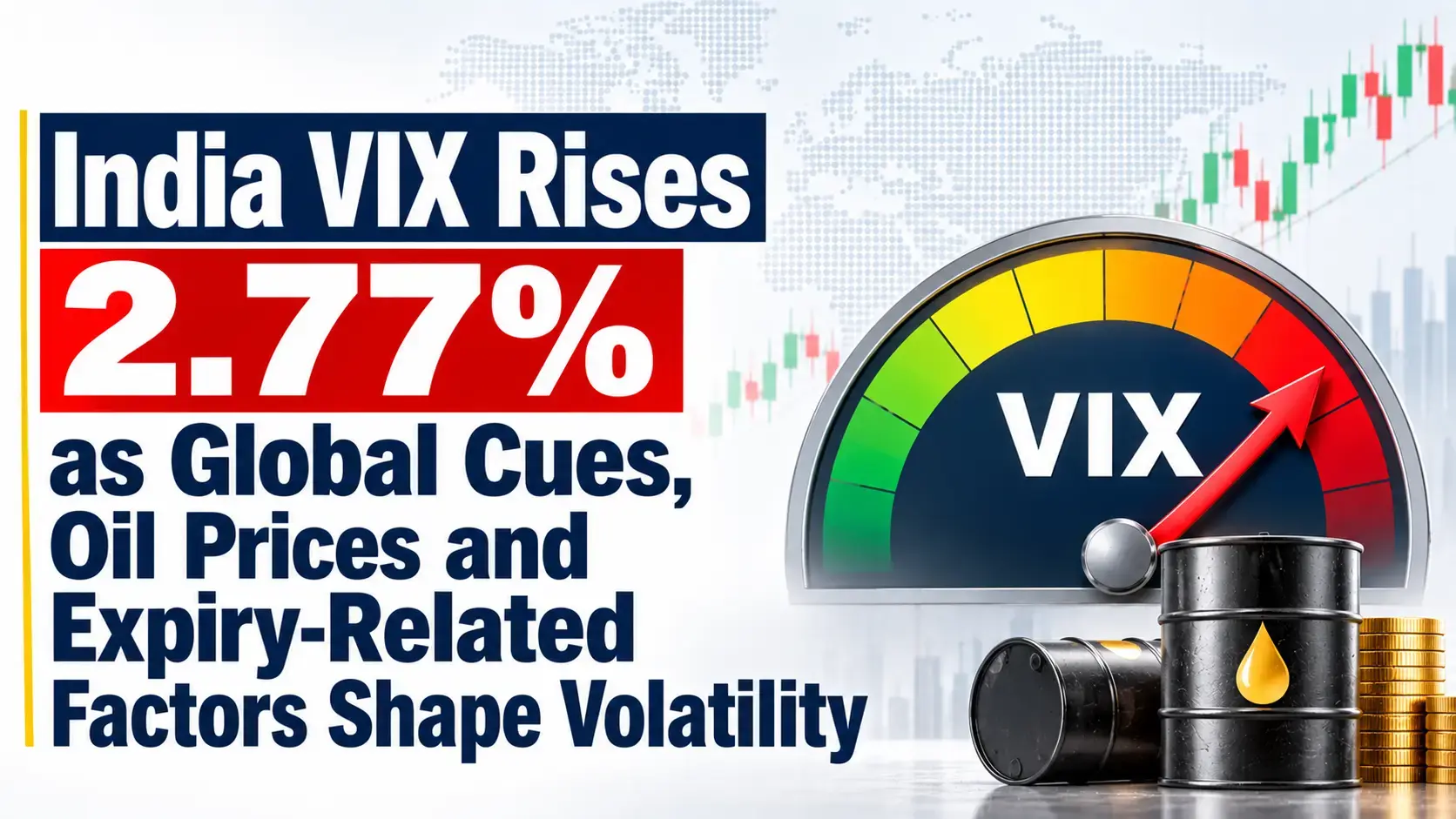
India VIX Rises 2.77% as Global Cues, Oil Prices and Expiry-Related Factors Shape Volatility
Authored By HDFC SKY | Published at: Nov 5, 2026 04:15 PM IST
Open Free Demat Account
Mumbai, 5 November 2026: India VIX rose 0.42 points, or 2.77%, to 15.61 as of 3:42 PM IST on Thursday, compared with its previous close of 15.19. The index opened at 15.18, touched an intraday high of 15.95 and recorded a low of 11.62 during the session. The movement came alongside a sharp rally in domestic equities, declining international crude oil prices, a strong rally on Wall Street and changing geopolitical expectations following the US midterm election results.

India VIX Rises 2.77% to 15.61 Despite Strong Equity Market Opening
Indian benchmark indices opened sharply higher on Thursday, with the Sensex starting at 78,910.94, up 1,609.54 points, while the Nifty 50 opened at 24,378.05, gaining 417.45 points. The rally extended across several sectors, with financial, automobile and realty stocks contributing to the early gains. The Nifty moved above 24,300, while the Sensex crossed 78,500 during the session.
Despite the positive opening, India VIX recorded an increase compared with its previous close of 15.19. An early-session reading at 10:22 AM IST placed the index at 15.25, representing a rise of 0.26%. The reported intraday high in that update was 15.42, while the later market snapshot recorded a high of 15.95.
India VIX measures the market’s expectation of annualised volatility in the Nifty 50 over the next 30 calendar days. It is calculated using Nifty options prices and reflects expected future market fluctuations rather than volatility already experienced during the trading session.
Banking and Auto Gains of Up to 2.99% Shape Domestic Market Activity
Financial and automobile stocks recorded substantial gains during early trading on Thursday. The Nifty Auto index advanced approximately 2.99%, while the Nifty Private Bank index gained around 2.07%. The Nifty Bank rose approximately 1.99%, and the Nifty PSU Bank index increased by 1.59%. Meanwhile, the Nifty Midcap 100 advanced approximately 1.50%.
The movement in banking stocks was significant because financial companies account for a substantial portion of the Nifty 50. Gains across heavyweight banking constituents supported the benchmark’s upward movement, while automobile and realty stocks also contributed to the broader market advance.
The sectoral performance coincided with the increase in India VIX, indicating that the movement in the volatility index did not mirror the direction of the broader equity benchmarks during the early trading period.
FII Buying of ₹7,284.03 Crore Provides a Positive Domestic Market Cue
Foreign institutional investor (FII) activity remained an important domestic market development entering Thursday’s session. The latest available figures for 4 November showed foreign institutional investors as net buyers of ₹7,284.03 crore, while domestic institutional investors (DIIs) recorded net selling of ₹3,712.23 crore.
Foreign investors had purchased approximately ₹20,834 crore over the four sessions ending 4 November, marking their strongest reported buying activity since 2023. These figures relate to the preceding trading sessions and do not represent confirmed institutional transactions for 5 November.
The institutional activity formed part of the domestic market backdrop as benchmark indices recorded substantial opening gains. The distinction between the previous session’s transactions and Thursday’s actual flows remains important when assessing the day’s market developments.
Sensex Weekly Expiry and Earnings Activity Add To Intraday Market Factors
Thursday’s trading session also coincided with the weekly expiry of Sensex derivatives contracts. Expiry-related activity included the possibility of position unwinding, short covering, adjustments by option writers and changes in hedging positions around important strike prices.
These developments can contribute to intraday fluctuations even when benchmark indices move higher. However, the available information does not establish the extent to which expiry-related positioning contributed to India VIX’s movement.
Stock-specific developments also featured in domestic trading. Ashok Leyland recorded strong gains, while Asian Paints was among the prominent advancing stocks. PI Industries faced sharp selling pressure, and Titan’s September-quarter results remained a focus during the session. These individual stock movements formed part of the broader earnings and price-discovery activity on 5 November.
US Election Outcome and Iran Conflict Expectations Change Global Risk Conditions
Developments surrounding the US midterm election results influenced international market conditions on Thursday. The Democratic Party’s reported victories changed expectations surrounding the US administration’s approach to the Iran conflict.
Market developments reflected expectations that the election outcome could increase political pressure on President Donald Trump to pursue diplomatic engagement and reduce the possibility of further military escalation. These expectations also affected concerns about potential disruption to energy supplies and geopolitical risks across the Middle East.
However, the developments did not establish that the Iran conflict had ended or that a diplomatic agreement had been reached. The possibility of further military action and disruption to regional energy supplies remained unresolved.
For India, developments involving Iran and the Gulf region are particularly relevant because of the country’s dependence on imported crude oil. Changes in crude prices can influence the import bill, inflation expectations, currency movements and corporate input costs.
Brent Crude Trades Near $94 After Previous Session’s 9% Decline
International crude oil prices recorded a substantial decline following the developments surrounding the US election and expectations of reduced geopolitical escalation. Brent crude traded around $93–94 per barrel during the Indian morning session, extending the weakness after falling approximately 9% in the previous trading session.
Brent was reported near $94.21 following the overnight decline. Lower crude prices formed an important part of the international economic developments influencing Indian market conditions on Thursday.
The movement was relevant to India’s external balance and inflation outlook. Lower oil prices can reduce the country’s crude import expenditure and ease imported inflation pressures. They can also influence the rupee, government finances and operating costs across oil-sensitive industries, including aviation, automobiles, paints and chemicals.
Wall Street Gains 3.03% As US VIX Falls 20.26% To 16.61
US equity markets recorded substantial gains in the previous trading session on Wednesday, 4 November. The Dow Jones Industrial Average advanced 3.03%, while the S&P 500 gained 1.58% and the Nasdaq Composite increased 1.44%. The Dow added approximately 1,569 points.
The US Volatility Index (VIX) also declined approximately 20.26% to 16.61. The movement reflected changing volatility conditions in the US equity market and accompanied the broader advance in American benchmarks.
The US 10-year Treasury yield moved towards approximately 4.85%, reaching a reported two-month low. Meanwhile, the US dollar weakened against major currencies, with the dollar index declining, while the euro strengthened and several Asian currencies advanced.
These developments provided the international backdrop for Thursday’s Indian trading session, alongside the changes in crude oil prices and geopolitical expectations.
Asian Semiconductor Weakness Contrasts With Broader Global Market Gains
Asian technology markets recorded selling pressure on Thursday despite the strength in US equities. South Korea’s KOSPI declined sharply, while Taiwan’s benchmark also fell. Japanese technology shares faced pressure, with semiconductor companies including Samsung Electronics and SK Hynix among the stocks affected.
Concerns included elevated artificial intelligence valuations, the sustainability of infrastructure spending, future semiconductor demand, possible restrictions on data-centre expansion and regulatory uncertainty surrounding artificial intelligence infrastructure.
The weakness in Asian technology shares contrasted with the broader improvement in global equity conditions. Meanwhile, unresolved geopolitical developments, including potential disruption to shipping through the Strait of Hormuz and the possibility of renewed military escalation involving Iran, continued to form part of the international market environment.
India VIX November Seasonality Shows Negative Returns In 10 Of 18 Years
Historical seasonality data showed that India VIX recorded negative returns in 10 out of 18 years during November. The month registered an average change of 0.49% across the historical period presented.
The maximum positive monthly change was 21.46% in November 2021, while the average positive change stood at 10.87%. The maximum negative change was 19.92% in November 2020, with an average negative change of 7.82%.
India VIX’s reported year-to-date return stood at 64.66% on 5 November. Its 52-week range was 8.72–28.90, compared with the session’s recorded range of 11.62–15.95. The daily technical rating was classified as Neutral.
India VIX closed the reported session with a gain of 2.77% to 15.61, despite the sharp opening advance in domestic benchmarks. The day’s developments included international crude weakness, changing geopolitical expectations, movements in US equities and volatility, domestic sectoral activity and weekly derivatives expiry. The index’s reported daily range remained 11.62–15.95.
Disclaimer
The information shared here is intended solely for informational and educational purposes and does not constitute investment recommendations. While we practice strict due diligence in curating daily market data, readers must perform independent research before trading. To flag any real-time data discrepancies or content concerns, please write to us at content@hdfcsec.com.
 Join Us
 Add as preferred source on Google


More Markets News







Open Free Demat Account












Invest Anytime, Anywhere


By signing up I certify terms, conditions & privacy policy