Nifty 50
- Dr. Reddy's Labs₹1,229.4032.40 (2.71%)
- Apollo Hospitals₹7,775-252.50 (-3.15%)
- Bajaj Auto₹10,034256.00 (2.62%)
- ITC₹257.90-8.10 (-3.05%)
- Tata Motors PV₹284.454.55 (1.63%)
- Tech Mahindra₹1,471-43.10 (-2.85%)
- Bharat Electronics₹373.905.75 (1.56%)
- L&T₹3,627.50-75.80 (-2.05%)
- BSE₹3,330.2043.00 (1.31%)
- Max Healthcare₹865.95-17.85 (-2.02%)
- Cipla₹1,317.4016.40 (1.26%)
- Hindalco Industries₹882.50-17.85 (-1.98%)
- Eicher Motors₹7,11969.00 (0.98%)
- Hindustan Unilever₹1,820.70-36.00 (-1.94%)
- Mahindra & Mahindra₹2,81316.80 (0.60%)
- SBI₹941-18.10 (-1.89%)
- Kotak Mahindra Bank₹443.402.40 (0.54%)
- Coal India₹404.80-6.75 (-1.64%)
- HCL Technologies₹1,2236.30 (0.52%)
- Bharti Airtel₹1,778.70-26.40 (-1.46%)

- Offerings
- Tools & Platforms
Tools & Calculators
- Open API
- Calculators
- SIP Calculator
- CAGR Calculator
- Compound Interest Calculator
- FD Calculator
- RD Calculator
- EPF Calculator
- Retirement Calculator
- HDFC SIP Calculator
- Mutual Fund Return Calculator
- Lumpsum Calculator
- Step Up SIP Calculator
- ETF SIP Calculator
- Brokerage Calculator
- Equity Margin Calculator
- SWP Calculator
- EMI Calculator
- MTF Calculator
- Margin Pledge Calculator
- Algo Strategy
- Markets
Stocks
F&O
Mutual Funds
- More
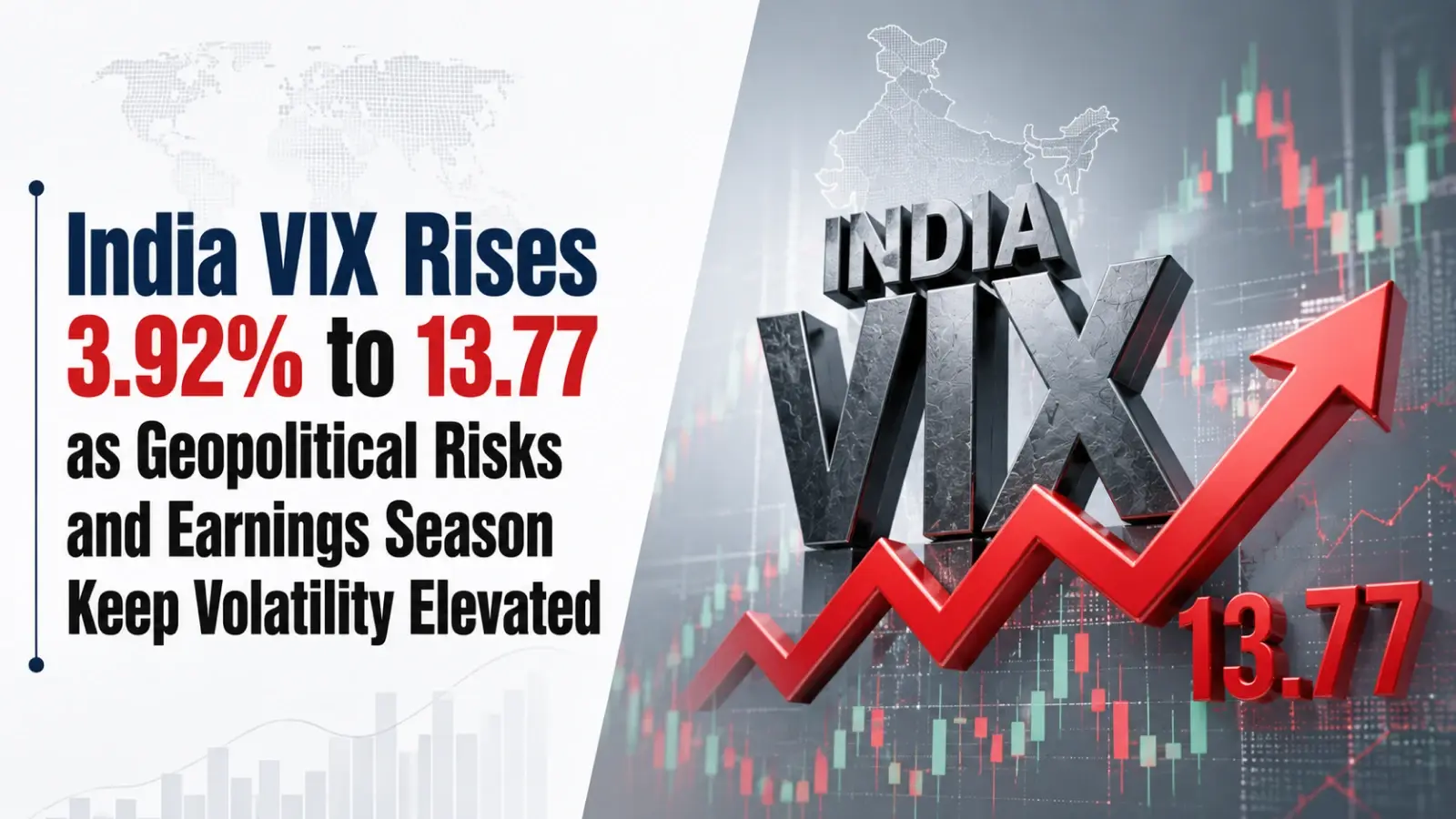
India VIX Rises 3.92% to 13.77 as Geopolitical Risks and Earnings Season Keep Volatility Elevated
Authored By HDFC SKY | Last Modified: Jul 14, 2026 11:23 AM IST
Open Free Demat Account
Open Free Demat Account
Mumbai, July 14: India VIX, the National Stock Exchange’s (NSE) volatility index, extended its upward movement during the opening session on Tuesday, rising 3.92% or 0.52 points to 13.77 as of 09:54 IST.
The index traded between a day low of 11.65 and a day high of 13.82, indicating that market participants continued to price in higher near-term uncertainty following last week’s sharp volatility spike.
Although the index remains well below its 52-week high of 28.90, it has stayed considerably above the sub-12 levels seen earlier this month, reflecting sustained caution amid geopolitical developments, higher crude oil prices and the ongoing Q1 FY27 earnings season.

India VIX Trades at 13.77 After Last Week’s 30% Surge
The latest move comes after India VIX witnessed one of its sharpest single-day gains in recent months on 8 July, when it climbed more than 26-30% to 14.68 after remaining below 12 on 3 July. Volatility moderated to around 12.5 by 10 July, but returned higher during Monday’s session, with the index closing at 13.28, up approximately 8% from the previous session.
During early trade on 14 July, India VIX continued to strengthen, reaching 13.77, suggesting that volatility has remained above the relatively calm levels recorded before last week’s spike.
The index opened at 13.28, matching the previous close, before touching an intraday high of 13.82. For 2026 so far, India VIX has generated year-to-date returns of 45.25%, while its 52-week range stands between 8.72 and 28.90. Technical indicators currently classify the broader trend as Neutral.
US-Iran Tensions and Oil Rally Lift Volatility
The latest rise in India VIX follows renewed geopolitical tensions involving the United States and Iran, which have heightened concerns over energy supplies and global trade routes.
According to the developments referenced, US President Donald Trump announced the re-imposition of a blockade on Iranian ports, while Iran threatened to close the Strait of Hormuz and reportedly launched attacks on US facilities in the Persian Gulf. The United States Central Command subsequently carried out fresh airstrikes on Iranian positions, and Washington also announced a 20% levy on cargo passing through the Strait of Hormuz.
These developments pushed global energy prices higher, with Brent crude rising 1.7% to USD 84.72 per barrel on 14 July, after touching an intraday high of USD 85.64, its highest level since mid-June. As India imports nearly 85-90% of its crude oil requirements, higher oil prices have remained an important factor influencing overall market volatility.
Earnings Season Adds Another Layer of Market Uncertainty
Alongside geopolitical developments, the beginning of the Q1 FY27 corporate earnings season has added to market uncertainty.
The earnings calendar is expected to bring increased stock-specific movements as companies release quarterly financial results and management commentary. This has contributed to higher activity in the derivatives market, with participants increasing hedging positions ahead of major earnings announcements. The resulting rise in implied volatility has continued to support India VIX above the subdued levels seen in early July.
The combination of earnings-related positioning and external macroeconomic developments has kept volatility elevated even after the sharp spike recorded last week moderated from its peak.
Benchmark Indices Open Lower as Financial Stocks Lag
The rise in India VIX coincided with a weaker start for domestic equity markets on 14 July.
The BSE Sensex opened at 77,277.57, down 338.83 points (0.44%), while the Nifty 50 started the session at 24,113.45, lower by 97.55 points (0.40%). Meanwhile, GIFT Nifty futures declined 165.5 points (0.68%) to 24,052, indicating a subdued opening for Indian equities.
Sector-wise, Financial Services (-1.14%), Auto (-0.87%), PSU Banks (-0.86%) and Realty (-0.84%) recorded the largest intraday declines. In contrast, defensive sectors remained comparatively resilient, with Information Technology (+0.61%), Pharma (+0.50%), Metals (+0.40%) and Fast-Moving Consumer Goods (FMCG) (+0.19%) trading in positive territory during the session.
Among Sensex constituents, TCS, Infosys, Tech Mahindra and Tata Steel traded higher, while IndusInd Bank, Bajaj Finance and several financial stocks witnessed declines during early trading.
Technical Levels Show Moderate Volatility Despite Gains
Despite recent increases, India VIX remains significantly below the highs recorded earlier this year.
As of the opening session on 14 July, the index traded at 13.77, compared with its 52-week high of 28.90 and 52-week low of 8.72. The day’s Classic Pivot Levels indicate Resistance 1 at 14.71, Resistance 2 at 16.14, Resistance 3 at 18.76, while Support 1 stands at 10.66, followed by 8.04 and 6.61.
The exchange’s technical assessment currently categorises the overall trend as Neutral, with no active directional signal from moving averages or technical indicators.
July Seasonality Continues to Favour Higher Volatility
Historical trading data also highlights July as a comparatively weaker month for India VIX performance.
According to the seasonality analysis, India VIX has delivered negative monthly returns in 14 out of the past 18 years during July. The month has recorded an average decline of 8.04%, with the maximum positive change of 7.39% registered in 2011, while the largest decline of 24.22% occurred in 2022. The average positive monthly gain stands at 3.67%, whereas the average negative monthly move is 11.39%.
Although the current year’s movement differs from historical averages, the latest trading session indicates that volatility has remained above the unusually subdued levels recorded at the beginning of July.
Global Factors Remain Central to Market Developments
Alongside developments in energy markets, other global indicators continued to influence domestic market conditions.
The Indian rupee weakened by 30 paise to 95.68 per US dollar, while the MSCI Asia Pacific Index declined 1.7%, led by losses in Taiwan and South Korea. S&P 500 futures also traded 0.2% lower. Market commentary also highlighted that the US 10-year Treasury yield had risen to 4.61%, while India’s June Consumer Price Index (CPI) inflation stood at 4.38%.
These developments occurred alongside the continued monitoring of geopolitical events and corporate earnings releases, both of which remained central themes influencing market volatility.
India VIX opened 3.92% higher at 13.77 on 14 July 2026, extending last week’s volatility after geopolitical developments, higher crude oil prices and the ongoing Q1 FY27 earnings season. The index remains above early July levels while staying below its 52-week high, with market movements continuing to reflect evolving global and domestic developments.
Source
- https://www.nseindia.com/reports-indices-historical-vix
Disclaimer
If you have any concerns, questions, or wish to point out any discrepancies in our content, please feel free to write to us at content@hdfcsec.com.
Please Note: The information shared is intended solely for informational purposes and does not make any investment recommendations
Disclaimer
At HDFC SKY*, we take utmost care and due diligence in curating and presenting news and market-related content. However, inadvertent errors or omissions may occasionally occur.
If you have any concerns, questions, or wish to point out any discrepancies in our content, please feel free to write to us at content@hdfcsec.com.
Please Note: The information shared is intended solely for informational purposes and does not make any investment recommendations.
HDFC SKY from HDFC Securities, one of most trusted trading platforms in India, has been recognized with the *Next-Gen Digi Content Awards 2025-26.
 Join Us
 Add as preferred source on Google


More Business News










Open Free Demat Account
Open Free Demat Account












Invest Anytime, Anywhere


By signing up I certify terms, conditions & privacy policy