Nifty 50
- Asian Paints₹2,438.1093.80 (4.00%)
- Infosys₹1,140.50-20.50 (-1.77%)
- HDFC Bank₹72020.00 (2.86%)
- ONGC₹230.85-3.98 (-1.69%)
- BSE₹3,583.6093.60 (2.68%)
- Power Grid Corp₹263.55-4.15 (-1.55%)
- InterGlobe Aviation₹5,041.50121.60 (2.47%)
- Reliance Industries₹1,287-13.00 (-1.00%)
- Tata Consumer ₹1,053.8024.90 (2.42%)
- NTPC₹319.95-3.05 (-0.94%)
- Nestle₹1,223.7028.70 (2.40%)
- Apollo Hospitals₹8,391-68.00 (-0.80%)
- Hindustan Unilever₹1,940.4042.10 (2.22%)
- Adani Enterprises₹2,595.30-20.10 (-0.77%)
- ICICI Bank₹1,417.1029.70 (2.14%)
- Tata Steel₹176.45-0.92 (-0.52%)
- Axis Bank₹1,231.3022.30 (1.84%)
- TCS₹2,488.90-12.80 (-0.51%)
- Bharat Electronics₹382.105.60 (1.49%)
- Tech Mahindra₹1,778-8.90 (-0.50%)

- Offerings
- Tools & Platforms
Tools & Calculators
- Open API
- Calculators
- SIP Calculator
- CAGR Calculator
- Compound Interest Calculator
- FD Calculator
- RD Calculator
- EPF Calculator
- Retirement Calculator
- HDFC SIP Calculator
- Mutual Fund Return Calculator
- Lumpsum Calculator
- Step Up SIP Calculator
- ETF SIP Calculator
- Brokerage Calculator
- Equity Margin Calculator
- SWP Calculator
- EMI Calculator
- MTF Calculator
- Margin Pledge Calculator
- Algo Strategy
- Markets
Stocks
F&O
Mutual Funds
- More
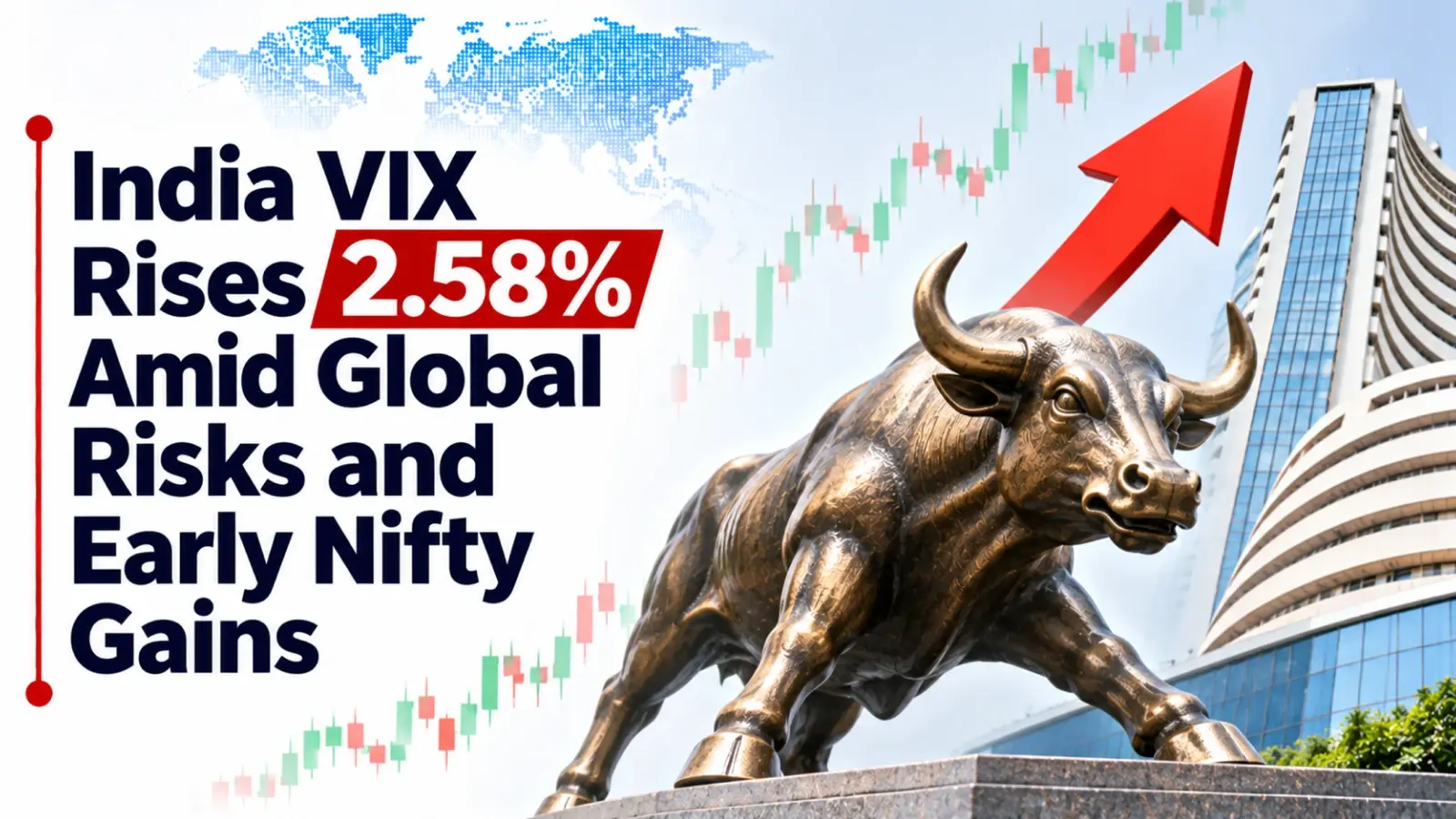
India VIX Rises 2.58% Amid Global Risks and Early Nifty Gains
Authored By HDFC SKY | Published at: Nov 3, 2026 10:21 AM IST
Open Free Demat Account
Open Free Demat Account
Mumbai, 3 November 2026: The India VIX, a key gauge of expected near-term volatility in the Nifty 50 index, rose 0.40 points or 2.58% to trade at 15.87 as of 10:01 IST on Tuesday, 3 November 2026. This increase occurred even as the domestic equity benchmarks opened on a positive note, with the Nifty 50 gaining 0.76% to 23,622.25 and the Sensex rising 0.92% to 76,385.48 in early trade.
The divergence highlights a complex market setup where domestic optimism, driven by falling crude oil prices and strong institutional buying, was countered by persistent global uncertainties, including geopolitical tensions in the Middle East and the US midterm elections.

GIFT Nifty Signals 1.18% Gain at 23,513 While FII Buying of ₹3,115 Crore Supports Sentiment
The domestic market entered the session with a bullish setup. The GIFT Nifty indicated a positive start, rising as much as 1.18% to 23,513 in early pre-market trade. This optimism was underpinned by strong institutional flows from the previous session, where Foreign Institutional Investors (FIIs) were net buyers of Indian equities to the tune of ₹3,115 crore, while Domestic Institutional Investors (DIIs) sold shares worth ₹392 crore.
Further supporting the positive sentiment was a sharp decline in crude oil prices, which fell over 7% in the prior session to trade around $104.72–$105 per barrel. As India is a major importer of crude, lower prices are seen as a positive for the economy and corporate earnings. Additionally, the Indian Rupee was expected to open stronger against the US dollar, in the range of ₹94.75–₹94.78, compared to the previous close of ₹94.90, adding to the favourable domestic narrative.
US-Iran Peace Hopes Lower Crude but Qeshm Island Strike Keeps Geopolitical Risk Premium Elevated
A significant factor influencing market volatility was the ongoing geopolitical situation between the US and Iran. Hopes of diplomatic progress, with officials from Iran and Qatar involved in discussions to end the conflict, had contributed to the sharp fall in crude oil prices. However, reports of a US strike on Iran’s Qeshm Island kept uncertainty alive, preventing a complete removal of the geopolitical risk premium from the market.
This mixed scenario created a pull-and-push effect on the India VIX. While the possibility of peace and lower crude prices exerted downward pressure on volatility, the lingering threat of military escalation and its potential impact on energy supply routes, particularly the Strait of Hormuz, prevented a significant drop in the VIX.
US Midterm Elections and Nasdaq’s 1.07% Decline Weigh on Asian Tech Stocks, Sparking Volatility Fears
Global factors were a major source of upward pressure on the India VIX. The US midterm elections, held on 3 November, introduced fresh uncertainty regarding potential changes in control of the House and Senate, with implications for fiscal and trade policies. This event risk was compounded by a sell-off in US technology stocks in the previous session, with the Nasdaq Composite falling 1.07%.
Major tech firms like Oracle and AMD saw significant declines of nearly 9% and 7.5%, respectively. This negative sentiment transmitted to Asian markets, with South Korea’s KOSPI index dropping approximately 2.72% and technology heavyweights Samsung Electronics and SK Hynix falling 3.17% and 4.14%. The weakness in global tech stocks posed a direct risk to the Indian IT sector and broader market sentiment, sustaining demand for protective options and keeping the VIX elevated.
Rupee Expected to Open Stronger at ₹94.75–₹94.78 Against the Dollar on Softer Crude Oil Prices
On the domestic front, the earnings season remained a key trigger for stock-specific and index-level volatility. Several major companies, including State Bank of India, Bajaj Finserv, and Lupin, were scheduled to announce their quarterly results on 3 November. In early trade, Marico gained 4.5% following better-than-expected earnings, while VRL Logistics surged 13%.
However, KEC International declined 4.2% after reporting a sharp profit drop. In the currency market, the Rupee was expected to open stronger, which could improve foreign investor sentiment. These domestic developments, while positive on balance, were insufficient to fully offset the global risk factors that were pushing the VIX higher.
Asian Markets Fall as South Korean Technology Stocks Decline
Asian market weakness provided another global development ahead of the Indian trading session. South Korea’s KOSPI declined approximately 2.72%, while Samsung Electronics and SK Hynix fell 3.17% and 4.14%, respectively. The MSCI Asia-Pacific index excluding Japan declined approximately 0.9%, whereas Australia’s ASX 200 advanced around 0.2%. Japan’s financial markets remained closed for Culture Day.
The weakness in South Korean technology stocks coincided with selling pressure across global semiconductor and technology companies. The developments were relevant to Indian markets amid concerns surrounding technology-sector valuations and artificial intelligence-related expenditure.
India VIX Technical Rating Remains Neutral With Pivot Levels
India VIX carried a Neutral technical rating on the daily timeframe. The available technical dashboard did not provide readings for moving averages, technical indicators or moving-average crossovers.
Based on the previous trading day’s price range, the Classic pivot point stood at 15.32, with resistance levels at 16.10, 16.70 and 17.48, and support levels at 14.72, 13.94 and 13.34.
Under the Fibonacci calculation, the pivot point was 15.32, with resistance levels at 15.85, 16.17 and 16.70, and support levels at 14.79, 14.47 and 13.94. The Camarilla calculation placed the pivot at 15.32, with resistance at 15.63, 15.75 and 15.88, and support at 15.37, 15.25 and 15.12.
November Seasonality Shows Negative Returns In 10 Of 18 Years
Historical seasonality data indicated that India VIX recorded negative returns in 10 out of 18 years during November. The maximum positive monthly change was 21.46% in November 2021, while the average positive change stood at 11.10%.
On the negative side, the maximum decline was 19.92% in November 2020, with the average negative change reported at 7.82%. The overall average change for November stood at 0.59%. These figures provide historical monthly context rather than describing the index’s movement during the current trading session.
In the preceding US trading session, the Dow Jones Industrial Average gained 0.41%, while the S&P 500 and Nasdaq Composite declined 0.51% and 1.07%, respectively. Oracle fell nearly 9%, while Advanced Micro Devices (AMD) declined approximately 7.5%. Concerns surrounding artificial intelligence expenditure, technology valuations and the returns expected from these investments remained among the factors influencing the sector.
The India VIX reading of 15.87 on 3 November 2026 reflects a confluence of factors. Traders should monitor the sustainability of the Nifty’s gap-up opening, given the conflicting signals from global markets. Key events to watch include the outcome of the US midterm elections, developments in US-Iran negotiations, and crude oil price movements. The divergence between a rising Nifty and a rising VIX suggests a market pricing in both domestic optimism and significant external risks. Observing the VIX’s trajectory in relation to the Nifty’s performance and global cues will be crucial for assessing near-term market stability.
Disclaimer
The information shared here is intended solely for informational and educational purposes and does not constitute investment recommendations. While we practice strict due diligence in curating daily market data, readers must perform independent research before trading. To flag any real-time data discrepancies or content concerns, please write to us at content@hdfcsec.com.
 Join Us
 Add as preferred source on Google


More SBIN News







Open Free Demat Account
Open Free Demat Account
₹996.20












Invest Anytime, Anywhere


By signing up I certify terms, conditions & privacy policy