Nifty 50
- Adani Ports₹1,872110.70 (6.29%)
- Trent₹2,861.70-52.20 (-1.79%)
- Adani Enterprises₹2,607.90128.10 (5.17%)
- Maruti Suzuki₹11,426-153.00 (-1.32%)
- Kotak Mahindra Bank₹45919.00 (4.32%)
- Bajaj Auto₹10,383-102.00 (-0.97%)
- Eternal₹337.8511.85 (3.63%)
- SBI Life Insurance ₹1,652-14.70 (-0.88%)
- Power Grid Corp₹2608.60 (3.42%)
- Eicher Motors₹7,238-62.00 (-0.85%)
- Bajaj Finance₹938.9021.65 (2.36%)
- Hindalco Industries₹886.30-7.45 (-0.83%)
- Hindustan Unilever₹1,858.2042.40 (2.34%)
- Cipla₹1,358-7.60 (-0.56%)
- NTPC₹310.506.75 (2.22%)
- Tech Mahindra₹1,769.60-7.00 (-0.39%)
- Titan Company₹4,43496.10 (2.22%)
- InterGlobe Aviation₹4,675-15.00 (-0.32%)
- ITC₹2655.50 (2.12%)
- HDFC Bank₹683.30-2.00 (-0.29%)

- Offerings
- Tools & Platforms
Tools & Calculators
- Open API
- Calculators
- SIP Calculator
- CAGR Calculator
- Compound Interest Calculator
- FD Calculator
- RD Calculator
- EPF Calculator
- Retirement Calculator
- HDFC SIP Calculator
- Mutual Fund Return Calculator
- Lumpsum Calculator
- Step Up SIP Calculator
- ETF SIP Calculator
- Brokerage Calculator
- Equity Margin Calculator
- SWP Calculator
- EMI Calculator
- MTF Calculator
- Margin Pledge Calculator
- Algo Strategy
- Markets
Stocks
F&O
Mutual Funds
- More
Manual F&O Trading vs Algo Strategies on HDFC SKY: Which Suits Your Trading Style?
By HDFC SKY | Published at: Oct 29, 2026 04:05 PM IST
Open Free Demat Account
Open Free Demat Account
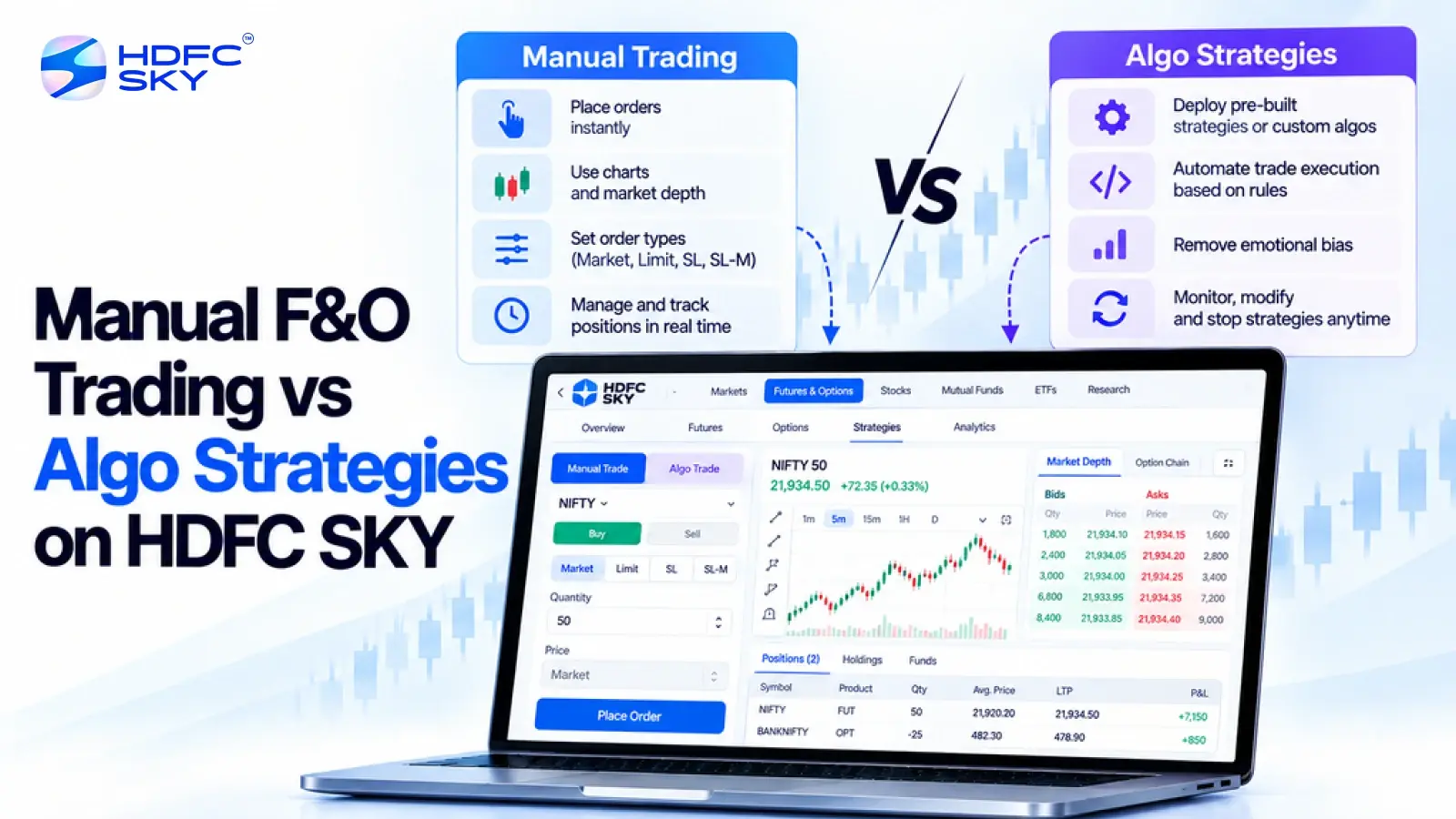
Futures and options trading demands timely decisions, disciplined execution, and careful risk management. HDFC SKY gives traders tools for both active F&O trading and strategy-based trading. You can analyse markets, build strategies, and place trades manually. You can also explore algorithmic trading through HDFC SKY’s API-based setup. The right choice depends on how you make decisions, how much time you have, and how comfortable you feel with automation and technology.
What is Manual F&O Trading?
Manual F&O trading means you make and execute trading decisions yourself. You study the market, select a futures or options contract, and decide when to enter or exit a position.
HDFC SKY provides several tools that can support this process. Its F&O platform includes an advanced futures and options chain, open interest analysis, market scanners, heatmaps, a payoff analyser, and an auto order slicer. These tools can help you study contracts and manage trades from the platform.
The final decision, however, stays with you. You decide what to trade, when to place the order, and how to manage the position.
What are Algo Strategies on HDFC SKY?
Algorithmic trading uses predefined rules to generate or execute trades. Instead of making every decision manually, you create a set of conditions that a system can follow.
HDFC SKY provides Open APIs that can connect trading applications with its brokerage, market data, and order services. Traders can use these APIs to build or connect algorithmic trading systems. HDFC SKY provides current guidance for connecting its platform with OpenAlgo for self-hosted trading setups.
HDFC SKY also lists a strategy builder that allows users to create and backtest custom trading strategies using historical data.
The key difference is simple. Manual trading keeps the decision and execution with you. Algo trading uses predefined rules and technology to automate parts of that process. This difference becomes clearer when we look at how each approach works in practice.
How Manual F&O Trading Works on HDFC SKY
Manual trading gives you direct control over each stage of the trade. Your process can generally follow four steps.
1. Analyse the Market
You first study the underlying asset and the relevant futures or options contracts. You may look at price movements, charts, the option chain, and open interest before making a decision.
HDFC SKY’s option chain provides live data on available strikes and open interest for stocks and indices. Its F&O platform also provides tools such as market scanners and heatmaps.
2. Select the Contract and Strategy
Once you form a market view, you choose the relevant contract and trading approach. For example, you may decide to trade a futures contract or use an options strategy based on your view of the market. HDFC SKY also provides strategy-related tools, including its strategy builder and payoff analyser.
3. Place the Order
You then place the trade through the HDFC SKY platform. You remain responsible for choosing the order and deciding how much to trade. You also need to monitor the position after execution. Market conditions can change quickly in F&O trading, so your original plan may need an adjustment.
4. Manage and Exit the Position
Manual trading does not end after placing an order. You need to track the position and follow your exit plan. HDFC SKY’s payoff analyser can help you understand potential profit and loss across different scenarios. Its F&O platform also includes tools for position and order management.
This hands-on approach suits traders who want to stay closely involved with their trades. But traders who prefer predefined rules and less manual intervention may look at automation instead.
How Algo Strategies Work with HDFC SKY
Algo trading changes the process by moving some trading decisions from manual action to predefined rules.
1. Define the Trading Rules
You first decide what conditions should trigger a trade. These rules may cover when to enter, when to exit, and how to manage the position. The rules need to be clear enough for a system to follow.
HDFC SKY’s strategy builder allows traders to create and backtest custom strategies using historical data. This can help traders review how a strategy would have behaved under past market conditions.
A backtest, however, does not guarantee future results. Past performance cannot ensure that a strategy will work in live markets.
2. Connect the Strategy to HDFC SKY
HDFC SKY Open API allows applications to connect with its trading and market-data services. This creates a link between the trading strategy and the brokerage platform. For example, HDFC SKY’s current OpenAlgo guide describes a setup where traders create API credentials, install OpenAlgo, and connect their trading strategies so orders can flow through HDFC SKY.
3. Automate Order Execution
Once the setup works, the system can act when the predefined conditions occur. The basic process starts with defining the trading rules, followed by generating trading signals.
The strategy then connects to HDFC SKY to place and execute orders. After execution, the positions are monitored based on the defined trading rules. This can reduce the need to manually place every order. However, automation does not remove the need to monitor the system or manage risk.
4. Follow the applicable trading framework
Retail algo trading also operates under an exchange and regulatory framework. SEBI introduced a framework for safer participation of retail investors in algorithmic trading. NSE has since published implementation standards for API-based retail algo trading.
HDFC SKY’s current API guidance also highlights requirements such as API credentials and static IP details where applicable. So, algo trading offers automation, but it also requires a suitable setup and compliance with the applicable rules. With both approaches established, the next question is how they differ in everyday trading.
Also Read: Automated F&O Market Nudges on HDFC SKY: Daily Signals Delivered to You
Manual F&O Trading vs Algo Strategies: Key Differences
The main differences come down to control, execution, time, and the way you make decisions.
| Aspect | Manual F&O Trading | Algo Strategies |
| Decision-making | You study the market and decide what to do. You can change your decision when market conditions change. | You define the rules in advance. The system follows those rules when the required conditions occur. |
| Order execution | You place and manage orders yourself. | An automated setup can send orders based on predefined conditions through the connected trading system. This can make execution more consistent, but it does not guarantee better prices or better trading results. |
| Emotional discipline | You have greater flexibility, but emotions can affect your decisions. You may hesitate after a loss or exit too early after a gain. | An algo follows its programmed rules instead of reacting to fear or excitement. However, poor rules can still produce poor trades. Automation does not make an unsuitable strategy effective. |
| Screen time | Manual F&O trading usually requires more active attention. You need to watch the market and decide when to act. | Algo strategies can reduce the need for constant manual order placement. The amount of monitoring still depends on the strategy and how you build the system. |
| Flexibility | You can respond to new information immediately and change your decisions when market conditions shift. | An algo follows its programmed conditions. If those conditions no longer suit the market, you need to review or change the strategy. |
| Technical requirements | Manual trading mainly requires market knowledge and familiarity with the HDFC SKY platform. | Algo trading adds another layer. You need to understand the strategy, automation setup, and relevant API requirements. Some setups may also require technical knowledge or external tools. HDFC SKY’s current OpenAlgo guide, for example, describes a self-hosted setup. |
Which Approach Fits Your Trading Style?
Your trading habits can help you decide between manual F&O trading and algo strategies. The right approach depends on how you make decisions, how actively you want to monitor the market, and how comfortable you are with automation.
1. Manual F&O trading may suit you if you:
- Prefer making trading decisions yourself.
- Like studying charts and market information.
- Want direct control over entries and exits.
- Feel comfortable monitoring positions.
- Prefer flexibility when market conditions change.
- Do not want to manage an automated trading setup.
Manual trading works best when you enjoy staying involved in the decision-making process and want to respond directly to changing market conditions.
2. Algo strategies may suit you if you:
- Prefer clearly defined trading rules.
- Want to reduce manual order placement.
- Value consistent execution.
- Have a strategy that you can express through specific conditions.
- Want to spend less time watching the screen for every trading signal.
- Feel comfortable with the technical side of automation.
Algo trading does not mean you can ignore your strategy after setting it up. You still need to test it, monitor its behaviour and review whether it remains suitable.
3. A hybrid approach can also work
You do not always have to treat manual and algo trading as completely separate choices. A trader may use HDFC SKY’s F&O tools for market analysis while using automation for a strategy with clearly defined rules.
HDFC SKY’s platform combines F&O analysis tools with strategy-building and API capabilities, giving traders different ways to approach their trading workflow. The important point is to choose the approach that matches your own process rather than choosing automation simply because it sounds more advanced.
Once you know which style feels closer to your trading habits, a few practical factors can help you make the final decision.
Conclusion
Manual F&O trading and algo strategies offer different ways to trade on HDFC SKY. Manual trading gives you direct control, while algo strategies can automate rule-based execution. Your choice should depend on your time, trading approach, technical comfort, and ability to manage risk. Neither approach guarantees returns. Choose the method that fits your trading process and discipline best.



Open Free Demat Account
Open Free Demat Account
Popular Posts
- 10 Interesting Facts About NSE You Probably Didn’t KnowLast Updated: Sep 30, 2026
- 8-4-3 Rule of SIP - How Does That Work?Last Updated: Jul 30, 2025
- Let's view more exciting Post!
Popular Post from Derivatives
- How to Build a 10-Minute Pre-Market F&O Routine Using HDFC SKY NudgesLast Updated: Oct 29, 2026
- Curated Algo Strategies on HDFC SKY: How to Read Strategy Performance Before You SubscribeLast Updated: Oct 29, 2026
- How to Deploy Your First Algo Strategy on HDFC SKY via AlgoBulls: A Step-by-Step GuideLast Updated: Oct 29, 2026
- Options Tab Walkthrough on HDFC SKY: IV, OI, and Max Pain at a GlanceLast Updated: Oct 29, 2026
- Futures Tab Walkthrough on HDFC SKY: Where to Find Basis, Rollover, and OI DataLast Updated: Oct 29, 2026
- Let's view more exciting Post!
Popular Post from Blogs
- “Bounce Back” Theme Gains Traction in 2026Last Updated: Apr 8, 2026
- 5 Takeaways for Tax Payers from the Budget 2025Last Updated: Jan 29, 2026
- Let’s view more exciting Posts
Invest Anytime, Anywhere


By signing up I certify terms, conditions & privacy policy