Nifty 50
- TCS₹2,102.7022.40 (1.08%)
- Adani Enterprises₹2,555.70-187.30 (-6.83%)
- Axis Bank₹1,252.109.60 (0.77%)
- ITC₹254.80-10.90 (-4.10%)
- Infosys₹999.257.25 (0.73%)
- Adani Ports₹1,679.80-70.30 (-4.02%)
- HCL Technologies₹1,193.208.20 (0.69%)
- Max Healthcare₹872.25-35.75 (-3.94%)
- Tech Mahindra₹1,500.609.50 (0.64%)
- JSW Steel₹1,182.60-47.40 (-3.85%)
- Titan Company₹4,404.1027.10 (0.62%)
- SBI Life Insurance ₹1,661-65.10 (-3.77%)
- Nestle₹1,330.906.90 (0.52%)
- Apollo Hospitals₹7,626.50-290.50 (-3.67%)
- Trent₹2,896.406.10 (0.21%)
- InterGlobe Aviation₹4,812.20-177.80 (-3.56%)
- HDFC Life Insurance ₹546.500.45 (0.08%)
- Dr. Reddy's Labs₹1,170.30-33.50 (-2.78%)
- Reliance Industries₹1,175.60-32.10 (-2.66%)

- Offerings
- Tools & Platforms
Tools & Calculators
- Open API
- Calculators
- SIP Calculator
- CAGR Calculator
- Compound Interest Calculator
- FD Calculator
- RD Calculator
- EPF Calculator
- Retirement Calculator
- HDFC SIP Calculator
- Mutual Fund Return Calculator
- Lumpsum Calculator
- Step Up SIP Calculator
- ETF SIP Calculator
- Brokerage Calculator
- Equity Margin Calculator
- SWP Calculator
- EMI Calculator
- MTF Calculator
- Margin Pledge Calculator
- Algo Strategy
- Markets
Stocks
F&O
Mutual Funds
- More
- Union Budget 2026: Historic Sunday Timing
- Budget Session 2026: Key Dates to Remember
- Where to Watch Budget 2026 Live
- Understanding the Union Budget 2026
- Economic Survey 2026: A Day Before the Budget
- The Halwa Ceremony: A Time-Honoured Budget Tradition
- The ‘Blue Sheet’ and Budget Secrecy
- When Did Budget-Making for 2026 Begin?
- Finance Minister Nirmala Sitharaman: Ninth Consecutive Budget
- Historical Facts About the Union Budget
- Union Budget 2026: Historic Sunday Timing
- Budget Session 2026: Key Dates to Remember
- Where to Watch Budget 2026 Live
- Understanding the Union Budget 2026
- Economic Survey 2026: A Day Before the Budget
- The Halwa Ceremony: A Time-Honoured Budget Tradition
- The ‘Blue Sheet’ and Budget Secrecy
- When Did Budget-Making for 2026 Begin?
- Finance Minister Nirmala Sitharaman: Ninth Consecutive Budget
- Historical Facts About the Union Budget
When and Where to Watch Union Budget 2026
By Shishta Dutta | Updated at: Jan 31, 2026 03:39 PM IST
Open Free Demat Account
Open Free Demat Account
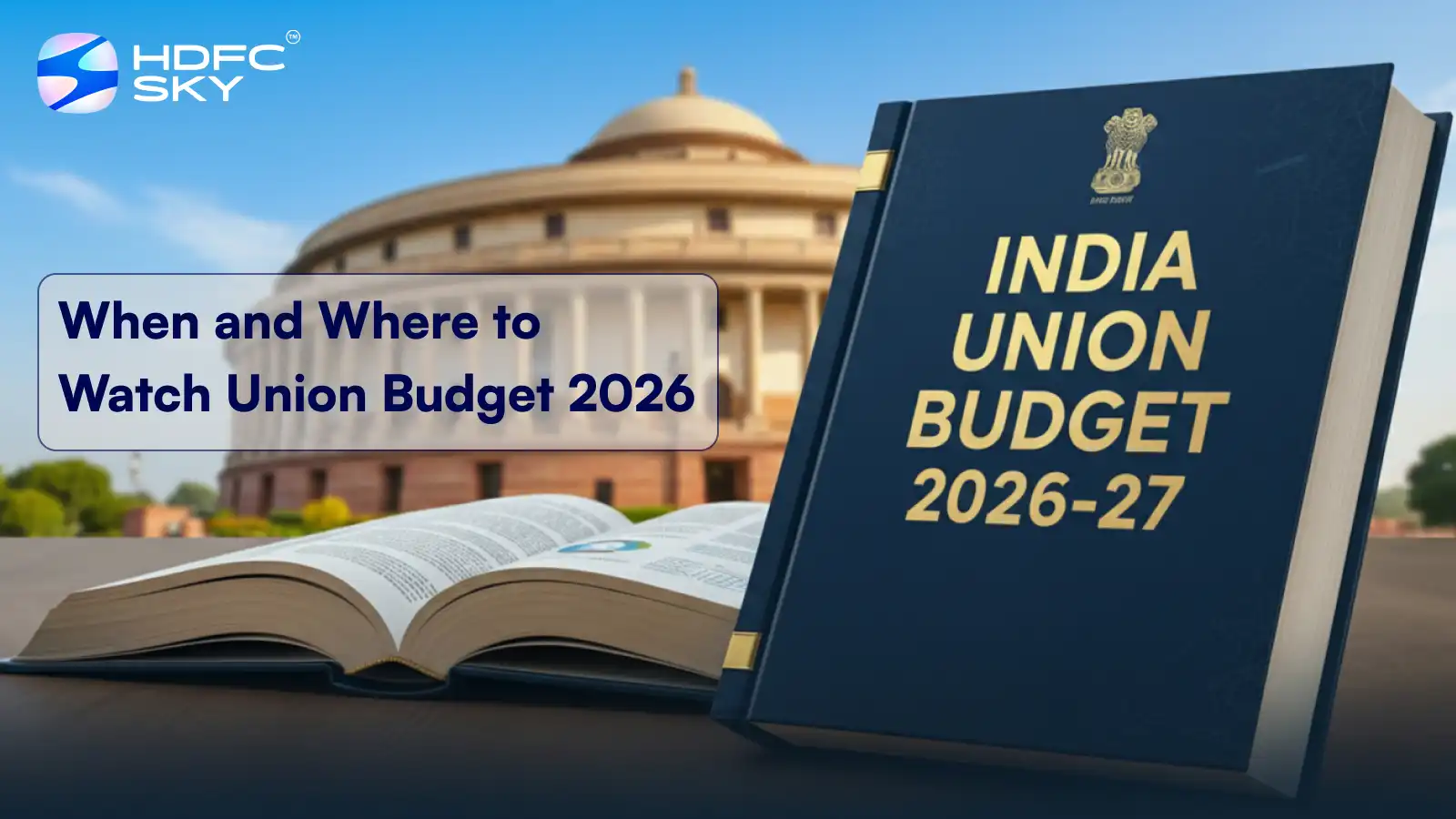
The Union Budget 2026 is set to be presented on Sunday, 1st February 2026, at 11 AM, marking a historic first as India witnesses a budget presentation on a Sunday. Finance Minister Nirmala Sitharaman will table the budget in Parliament, continuing her record of consecutive budget presentations. This budget carries extra significance as it is the second full-fledged budget of the government’s third term, following the interim budget of 2024 and the annual budget of 2025.
Union Budget 2026: Historic Sunday Timing
Since 2017, the practice of presenting the Union Budget on 1st February has been followed, irrespective of the day of the week. This year is unique because 1st February 2026 falls on a Sunday, making it the first-ever Sunday budget presentation in India’s history. The timing of 11 AM continues the tradition set in 1999, shifting from the previous 5 PM schedule. This change allows greater accessibility and ensures that the nation can follow the proceedings closely.
Budget Session 2026: Key Dates to Remember
The Budget Session 2026 has been summoned by the President of India and will be held in two parts:
First Session: January 28 – February 13, 2026
- January 28: Commencement of the Budget Session
- January 29: Presentation of the Economic Survey 2026
- February 1: Union Budget 2026 presentation
- February 13: Conclusion of the first half
Second Session: March 9 – April 2, 2026
- March 9: Commencement of the second half
- April 2: Conclusion of the second half
These dates allow Parliament to review, debate, and approve the proposals laid out in the budget efficiently.
Where to Watch Budget 2026 Live
For those wanting to follow the Union Budget 2026 live, the proceedings will be available across multiple platforms:
- Official Parliamentary Telecast: Watch on government broadcasting channels
- National News Channels: Televised nationwide
- News Websites: Live streams on major platforms
- YouTube: Official streams via government and news channels
This ensures that citizens, investors, and businesses can access the budget updates in real-time.
Understanding the Union Budget 2026
The Union Budget 2026 is India’s annual financial statement presented under Article 112 of the Constitution. It outlines the government’s revenue and expenditure plans for the upcoming fiscal year. Key components of the budget include:
- Revenue and Expenditure Estimates: Expected receipts and planned spending
- Tax Proposals: Adjustments or introduction of new taxes
- Policy and Reforms: Strategic initiatives across sectors
- Sectoral Allocations: Special emphasis on infrastructure, healthcare, education, and social programs
Essentially, the budget serves as the government’s roadmap for economic growth and fiscal management for 2026-27.
Economic Survey 2026: A Day Before the Budget
The Economic Survey 2026 is presented on January 29, 2026, a day before the budget. This report reviews the nation’s economic performance in the ongoing fiscal year and provides valuable insights for policymakers, investors, and the public. Key highlights include:
- Sector-wise growth performance
- Regional economic trends
- Impacts of current policies on revenue and expenditure
- Forecasts for the upcoming financial year
- The Economic Survey essentially sets the stage for the Union Budget 2026, offering context to the government’s financial proposals.
The Halwa Ceremony: A Time-Honoured Budget Tradition
The Halwa Ceremony is a long-standing pre-budget ritual conducted at North Block just before the printing of the budget. It marks the final stage of preparation, where the Finance Minister distributes halwa to key officials as a gesture of gratitude for their efforts. This ceremony also signals the start of a strict lock-in period, during which officials involved in budget preparation cannot leave the premises or communicate externally.
Dating back to the 1980s, the tradition ensures the confidentiality of sensitive budget information while fostering a sense of teamwork and dedication among those responsible for compiling the budget. Financial experts and policymakers watch this event closely, as it indicates that the Union Budget 2026 is ready for presentation.
The ‘Blue Sheet’ and Budget Secrecy
Another critical element of the budget process is the Blue Sheet, a coded document containing all the essential calculations and allocations that form the core of the budget. This master sheet guides the final financial proposals, including tax revisions, sectoral allocations, and spending plans.
Its preparation also marks the beginning of the lock-in period, ensuring that no details are leaked before the official presentation. Together with the Halwa Ceremony, the Blue Sheet highlights the careful planning and secrecy measures that make the Union Budget 2026 a meticulously crafted financial statement.
When Did Budget-Making for 2026 Begin?
The preparation for the Union Budget 2026-27 started in August 2025. The process begins with a budget circular sent to all ministries and departments, instructing them to estimate revenue and expenditure for their respective areas. This is followed by pre-budget consultations with experts, stakeholders, and the public.
The compilation, review, and finalisation of proposals take several months, ensuring that every sector, from infrastructure to social welfare, receives appropriate attention. The Halwa Ceremony and Blue Sheet preparation mark the conclusion of this meticulous process, readying the budget for parliamentary presentation.
Finance Minister Nirmala Sitharaman: Ninth Consecutive Budget
Finance Minister Nirmala Sitharaman will present the Union Budget 2026 for the ninth consecutive time, highlighting her experience and continuity in fiscal management. This will also be the second full annual budget of the government’s third term, reinforcing stability while introducing policies aimed at economic growth, social development, and investment promotion.
Historical Facts About the Union Budget
The Union Budget carries a rich history with several interesting milestones:
- The budget timing moved from 5 PM to 11 AM in 1999
- The document carrier changed from a red briefcase to a traditional bahi khata in 2019
- The secretive Blue Sheet holds the calculations for final allocations
- The Halwa Ceremony, initiated in the 1980s, ensures confidentiality and marks the final stage of preparation
These traditions combine ceremonial significance with practical measures, making the budget both a cultural and financial event.
Final Thoughts
The Union Budget 2026 is more than a financial statement. It lays the roadmap for India’s economic growth, revenue generation, and policy initiatives for the coming year. With historic Sunday timing, live streaming options, the ceremonial Halwa distribution, and the meticulous preparation of the Blue Sheet, this budget reflects careful planning, tradition, and transparency. For citizens, investors, and policymakers alike, the Union Budget 2026 provides insights into the government’s priorities and the nation’s financial direction for 2026-27.


About Author

Shishta Dutta
Open Free Demat Account
Open Free Demat Account
Popular Posts
- 10 Interesting Facts About NSE You Probably Didn’t KnowLast Updated: Sep 30, 2026
- 8-4-3 Rule of SIP - How Does That Work?Last Updated: Jul 30, 2025
- Let's view more exciting Post!
Popular Post from Union Budget
- How to Plan Savings Allocation in 2026: Stock Market Outlook with HDFC Securities Research TeamLast Updated: Feb 4, 2026
- Union Budget 2026: How Will the Move to Increase STT Affect the Market?Last Updated: Feb 3, 2026
- Union Budget 2026: Economic Challenges, Policy Choices and Possible Road AheadLast Updated: Jan 31, 2026
- Union Budget 2026: How the Budget Impacts Banking and Financial ServicesLast Updated: Jan 30, 2026
- Union Budget 2026: Key Expectations Across Major͏ SectorsLast Updated: Jan 28, 2026
- Let's view more exciting Post!
Popular Post from Blogs
- “Bounce Back” Theme Gains Traction in 2026Last Updated: Apr 8, 2026
- 5 Takeaways for Tax Payers from the Budget 2025Last Updated: Jan 29, 2026
- Let’s view more exciting Posts


Invest Anytime, Anywhere


By signing up I certify terms, conditions & privacy policy