Nifty 50
- TCS₹2,34293.60 (4.16%)
- ICICI Bank₹1,422.80-20.20 (-1.40%)
- Tech Mahindra₹1,640.9055.90 (3.53%)
- Shriram Finance₹1,086.90-14.10 (-1.28%)
- Infosys₹1,14433.20 (2.99%)
- ITC₹266-3.00 (-1.12%)
- HCL Technologies₹1,316.1034.10 (2.66%)
- UltraTech Cement₹11,589-128.00 (-1.09%)
- Wipro₹180.954.55 (2.58%)
- Asian Paints₹2,608.70-22.30 (-0.85%)
- Bajaj Auto₹11,910190.00 (1.62%)
- SBI Life Insurance ₹1,761.10-12.10 (-0.68%)
- Hindalco Industries₹1,037.4013.40 (1.31%)
- Eicher Motors₹8,059-41.00 (-0.51%)
- HDFC Bank₹720.309.30 (1.31%)
- Maruti Suzuki₹13,376-64.00 (-0.48%)
- Tata Motors PV₹319.403.40 (1.08%)
- Bajaj Finserv₹2,002-9.00 (-0.45%)
- Grasim Industries₹3,29032.00 (0.98%)
- InterGlobe Aviation₹5,166-23.00 (-0.44%)

- Offerings
- Tools & Platforms
Tools & Calculators
- Open API
- Calculators
- SIP Calculator
- CAGR Calculator
- Compound Interest Calculator
- FD Calculator
- RD Calculator
- EPF Calculator
- Retirement Calculator
- HDFC SIP Calculator
- Mutual Fund Return Calculator
- Lumpsum Calculator
- Step Up SIP Calculator
- ETF SIP Calculator
- Brokerage Calculator
- Equity Margin Calculator
- SWP Calculator
- EMI Calculator
- MTF Calculator
- Margin Pledge Calculator
- Markets
Stocks
F&O
Mutual Funds
- More
GST 2.0: Why India’s New Tax Regime is Being Called “Consumer-Centric”
Authored By Shishta Dutta | Published at: Sep 1, 2025 01:39 PM IST
Open Free Demat Account
Open Free Demat Account
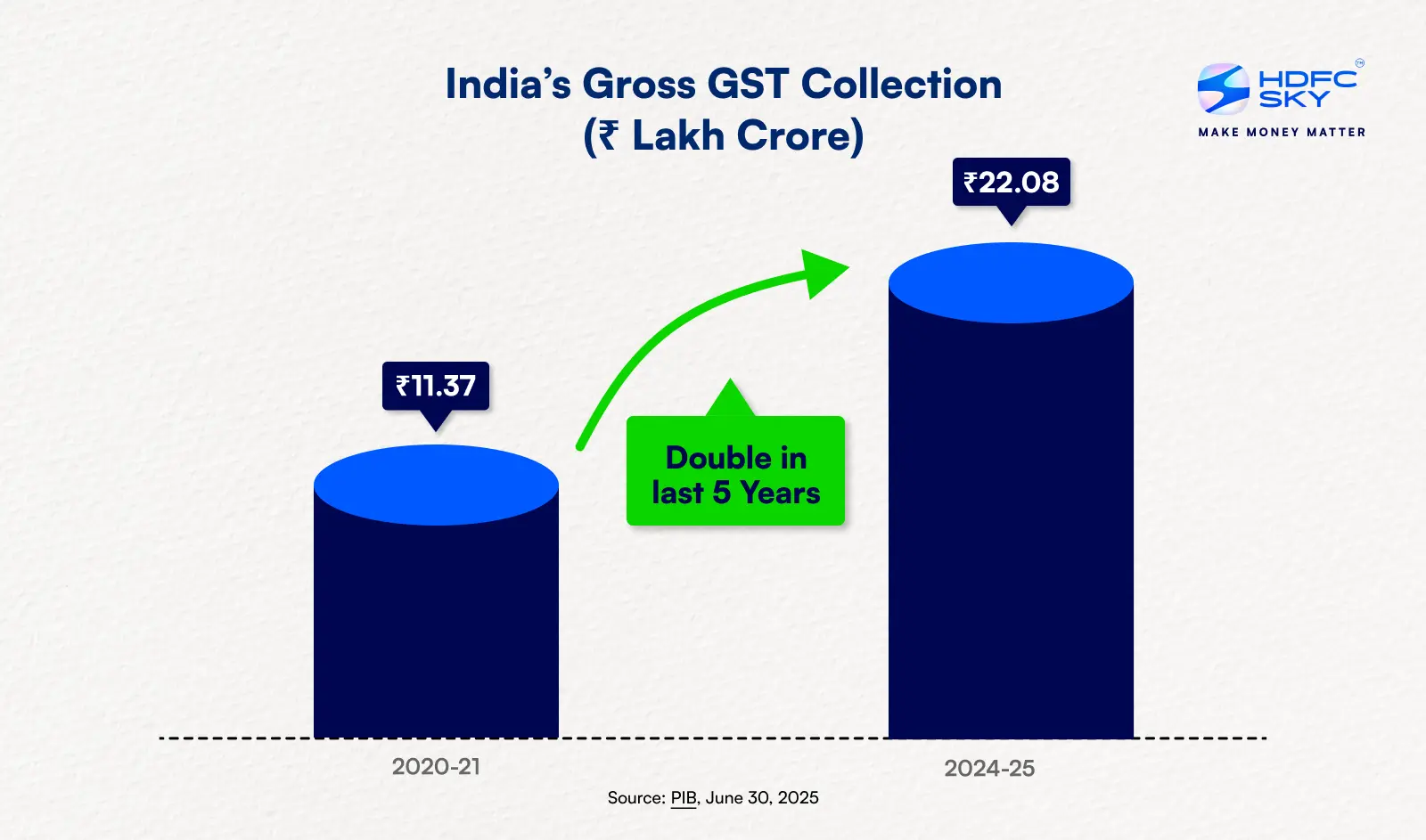
On the landmark night of July 1, 2017 , India ushered in a new era of taxation with the launch of the Goods and Services Tax (GST). Described by Prime Minister Narendra Modi as “a path-breaking legislation for New India,” GST marked a fundamental shift from a fragmented, multi-layered indirect tax structure to a unified national system.
Until then, businesses and consumers were weighed down by a web of taxes: excise duty, service tax, value-added tax (VAT), and others , each carrying its own compliance burdens. This not only inflated the cost of doing business but also created bottlenecks in interstate trade due to varied tax regimes across states.
GST brought all these under one umbrella , effectively turning India into a single common market. It eliminated tax cascading by enabling seamless input tax credit across the value chain, lowered the overall tax burden, and streamlined compliance.
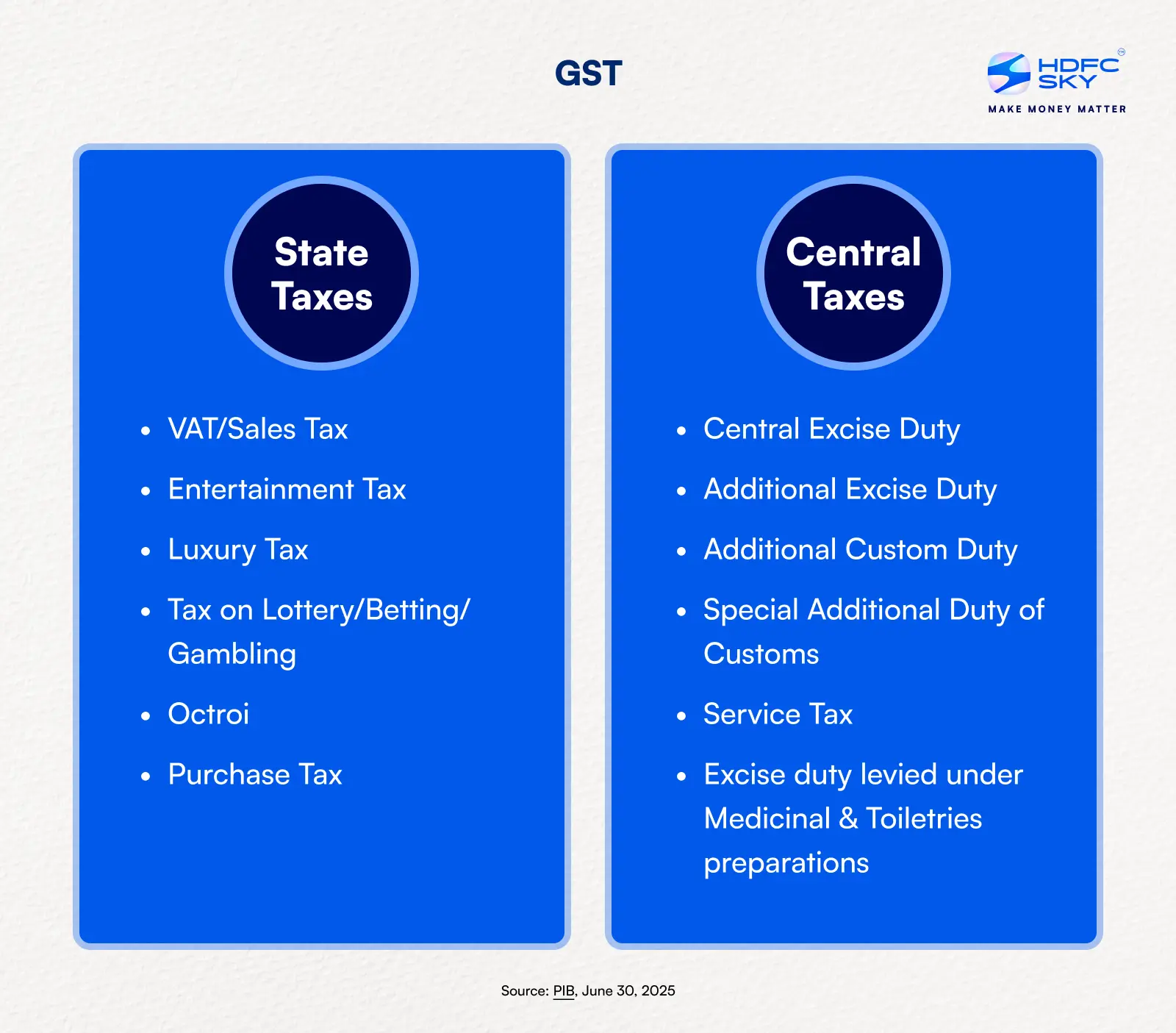
In FY 2024-25, GST posted its highest-ever gross collection at ₹22.08 lakh crore, marking a year-on-year growth of 9.4%. The average monthly collection during the year stood at ₹1.84 lakh crore, a strong indicator of both economic activity and improved compliance.
This revenue performance has been complemented by a steady broadening of the tax base.
As of April 30, 2025, the number of active GST registrations has crossed 1.51 crore, reflecting a sharp rise in the taxpayer base and growing formalisation of the economy.
Yet, despite these gains, challenges remain.

What’s New in GST 2.0?
Eight years since its rollout, GST remains a work in progress, despite the concerted efforts of the GST Council and the active participation of state representatives.
One of the most debated among them is the complex rate structure. The current system features multiple tax brackets: 0%, 5%, 12%, 18%, and 28%, along with a separate sin tax on demerit goods and a patchwork of cesses.
This intricate framework has not only made compliance harder but also diluted the original promise of simplicity and uniformity.
It is in response to these ongoing challenges that the government has now set its sights on GST 2.0. Prime Minister Narendra Modi, in his address on the 79th Independence Day, pledged next-generation GST reforms (GST 2.0) aimed at easing the tax burden on ordinary citizens, with a clear focus on the middle class and micro, small, and medium enterprises (MSMEs). At the heart of the government’s proposal lie three core pillars.
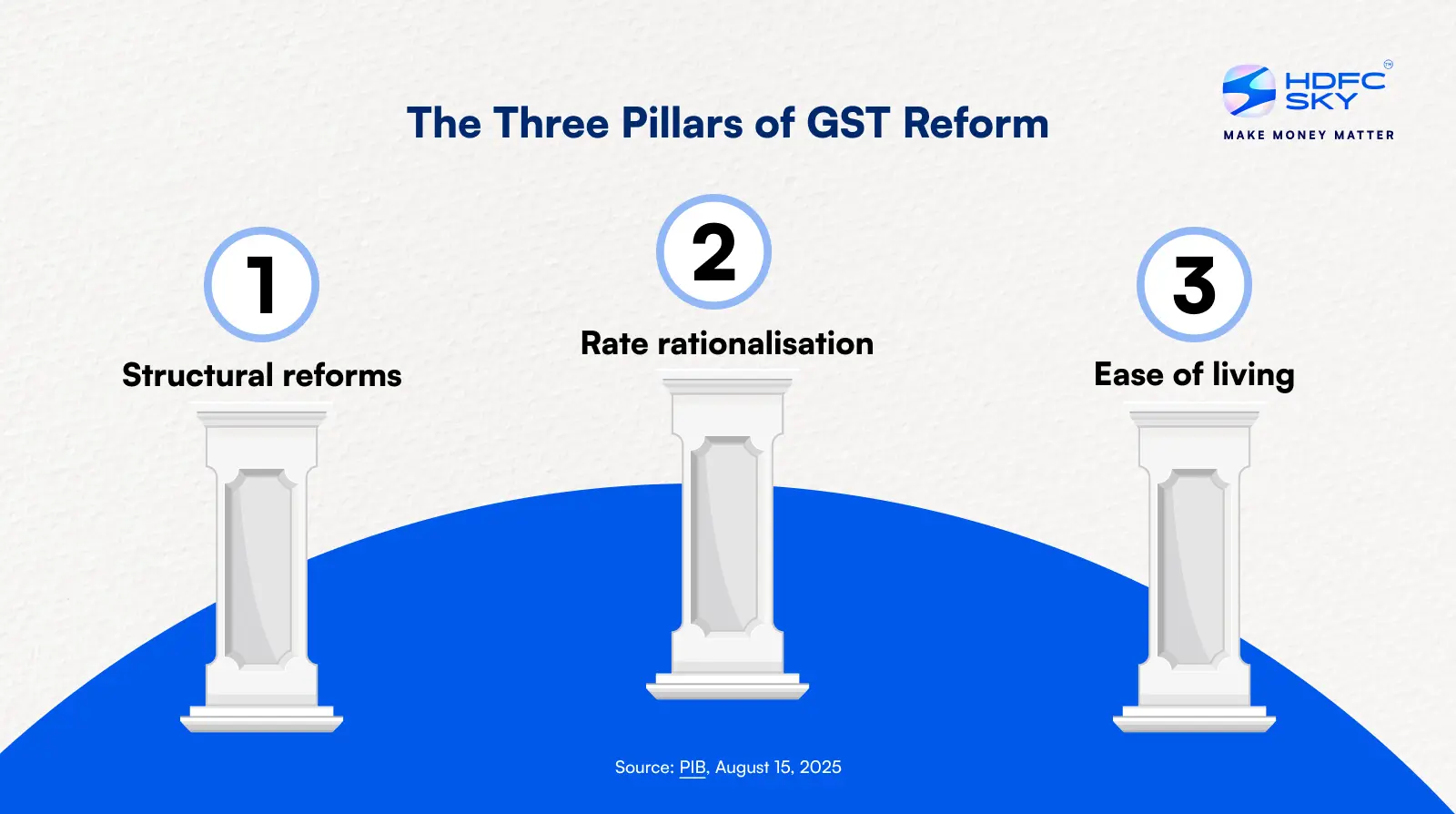
Let’s break these down:
Structural reforms
- Correction of Inverted Duty Structures: Match input and output tax rates to avoid unused input tax credit. This will encourage more domestic value addition and lower costs for producers, while also making Indian goods more competitive in both domestic and global markets.
- Resolving Classification Issues: Address ambiguities in the classification of goods and services to streamline rate structures, reduce litigation, simplify compliance, and ensure greater fairness and consistency across sectors. This would not only cut down disputes but also build greater trust between taxpayers and authorities.
- Stability and Predictability: Ensure long-term clarity and consistency in GST rates and policy direction. This will help businesses plan better, boost investor confidence, and create a more stable tax environment. In the long run, such stability will also encourage greater investment and support sustained economic growth.
Rate Rationalisation
- Lower Taxes on Essential and Aspirational Goods: Reducing GST on commonly used items and aspirational goods will improve affordability, boost consumption, and make both essential and lifestyle products more accessible to a broader segment of the population.
- Reduction of Slabs: The reform aims to streamline the rate structure by moving towards a simplified two-rate system, a standard rate and a merit rate, with special rates reserved only for a limited set of goods and services.

- Phase-out of Compensation Cess: The withdrawal of the compensation cess has opened up fiscal space, allowing the GST Council more room to rationalise rates and align them sustainably within the broader GST framework for long-term stability. This marks a shift towards a self-reliant GST system that no longer depends on temporary revenue buffers.
Ease of Living
- Simplified Registration: Ensure a seamless, technology-driven, and time-bound registration process, particularly aimed at supporting small businesses and startups in entering the formal economy with minimal friction.
- Pre-filled Returns: Introduce pre-filled GST returns to reduce manual data entry, minimise errors, and eliminate input-output mismatches, thereby easing the compliance burden on taxpayers. This would save time, cut costs, and make compliance simpler, especially for small businesses.
- Faster Refunds: Enable automated and time-bound refund processing, especially for exporters and businesses facing inverted duty structures, to improve cash flow and reduce delays in working capital availability. Faster refunds will enhance liquidity, strengthen competitiveness, and support growth in export-oriented sectors.
Why the Term “Consumer-Centric”?
Earlier, GST was mainly seen as a tool for collecting revenue and ensuring businesses followed rules. But with GST 2.0, the focus has shifted to making the system better for consumers.
The government wants to make GST simpler, more stable, and more transparent, helping businesses grow, supporting the formal economy, and making it easier to do business across India.
A simplified and consumer-friendly tax system is especially important now, as it can boost demand and support economic recovery in today’s price-sensitive environment.
If cleared, the new GST framework could be rolled out ahead of Diwali, delivering what Prime Minister Narendra Modi described as a “double Diwali” for Indian consumers.
The success of GST 2.0 will ultimately depend on how well these promises are implemented.
Conclusion
By aligning tax policy with the needs of everyday consumers, the government is hoping to transform GST from a compliance headache into a tool for inclusive economic growth.
As reforms move from file to field, the real test will lie in execution. But the intention is clear: putting the Indian consumer at the centre of India’s tax story.
Disclaimer: At HDFC SKY, we take utmost care and due diligence in curating and presenting news and market-related content. However, inadvertent errors or omissions may occasionally occur.
If you have any concerns, questions, or wish to point out any discrepancies in our content, please feel free to write to us at content@hdfcsec.com.
Please note that the information shared is intended solely for informational purposes and does not make any investment recommendations
 Join Us
 Add as preferred source on Google


More Business News









Open Free Demat Account
Open Free Demat Account







Invest Anytime, Anywhere


By signing up I certify terms, conditions & privacy policy