Nifty 50
- TCS₹2,34293.60 (4.16%)
- ICICI Bank₹1,422.80-20.20 (-1.40%)
- Tech Mahindra₹1,640.9055.90 (3.53%)
- Shriram Finance₹1,086.90-14.10 (-1.28%)
- Infosys₹1,14433.20 (2.99%)
- ITC₹266-3.00 (-1.12%)
- HCL Technologies₹1,316.1034.10 (2.66%)
- UltraTech Cement₹11,589-128.00 (-1.09%)
- Wipro₹180.954.55 (2.58%)
- Asian Paints₹2,608.70-22.30 (-0.85%)
- Bajaj Auto₹11,910190.00 (1.62%)
- SBI Life Insurance ₹1,761.10-12.10 (-0.68%)
- Hindalco Industries₹1,037.4013.40 (1.31%)
- Eicher Motors₹8,059-41.00 (-0.51%)
- HDFC Bank₹720.309.30 (1.31%)
- Maruti Suzuki₹13,376-64.00 (-0.48%)
- Tata Motors PV₹319.403.40 (1.08%)
- Bajaj Finserv₹2,002-9.00 (-0.45%)
- Grasim Industries₹3,29032.00 (0.98%)
- InterGlobe Aviation₹5,166-23.00 (-0.44%)

- Offerings
- Tools & Platforms
Tools & Calculators
- Open API
- Calculators
- SIP Calculator
- CAGR Calculator
- Compound Interest Calculator
- FD Calculator
- RD Calculator
- EPF Calculator
- Retirement Calculator
- HDFC SIP Calculator
- Mutual Fund Return Calculator
- Lumpsum Calculator
- Step Up SIP Calculator
- ETF SIP Calculator
- Brokerage Calculator
- Equity Margin Calculator
- SWP Calculator
- EMI Calculator
- MTF Calculator
- Margin Pledge Calculator
- Markets
Stocks
F&O
Mutual Funds
- More
India’s Push for High-Grade Steel in the Auto Sector
Authored By Shishta Dutta | Last Modified: Oct 15, 2025 12:22 PM IST
Open Free Demat Account
Open Free Demat Account
India’s big push to make more high-grade steel for cars isn’t just about better materials but also about strategy. On the face of it, this looks like a simple industrial upgrade. But dig a little deeper, and it’s really about industrial policy, trade security, and even the green transition.
Why the fuss over steel? Because right now, India still depends on imports for the kind of high-quality steel modern cars need. Cutting that dependence means stronger supply chains, lower costs, and a more competitive auto industry.
The government has promised “all necessary support,” which shows intent. But the bigger question is: can India actually pull it off? Making advanced steel demands technology, skilled talent, and institutions that can deliver at scale and to global standards.
Without that ecosystem, ambition may not fructify.

Why High-Grade Steel Matters
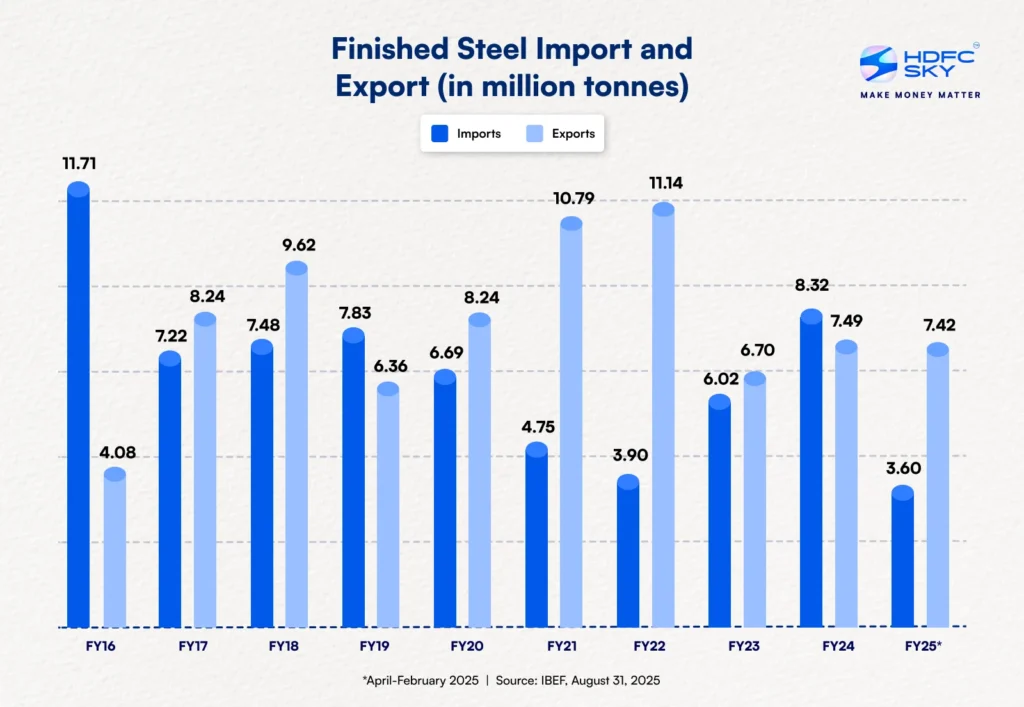
To see why this push is important, let’s start with the bigger picture. India has already shown it can compete in finished steel which is the everyday backbone of construction, infrastructure, railways, appliances, and machinery. Exports have steadily climbed over the last decade and now actually outpace imports. That’s proof we can scale up when the right policies and incentives are in place.
The next step is high-grade steel. This isn’t just “better” steel; it’s the material that goes into the critical parts of cars; lightweight yet strong panels, crash-resistant structures, advanced engines, even electric vehicle components that demand both performance and durability. Beyond autos, it underpins defence, aerospace, and high-tech industries, all sectors where India seeks greater self-reliance
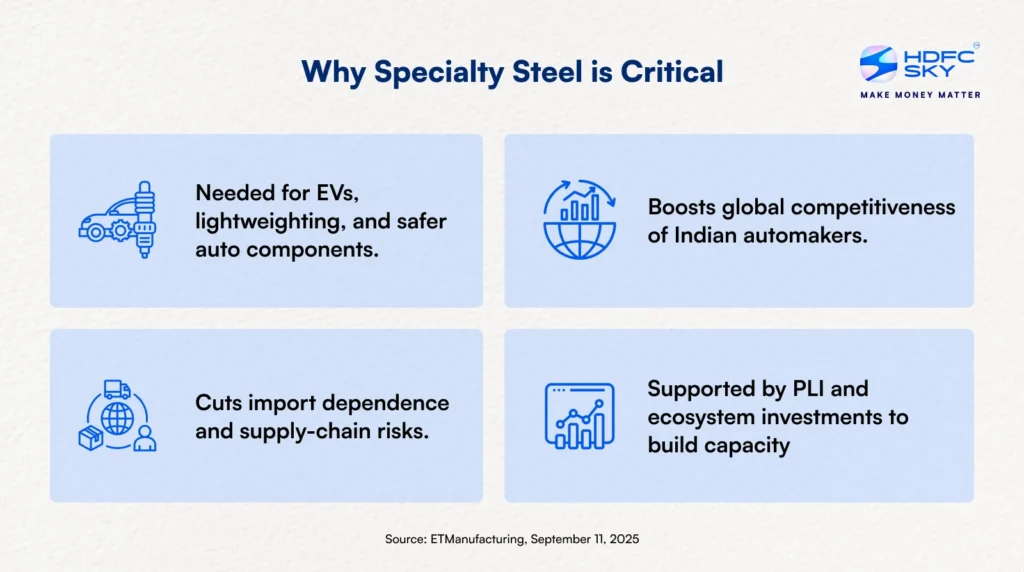
So the logic is simple: if India could achieve self-reliance in finished steel, there’s no reason we can’t extend that success into high-grade steel. What’s needed is the right mix of technology, skills, and policy support to close the gap.
The Policy Logic Behind Self-Reliance
The National Steel Policy (NSP) 2017 set the tone early, aiming to build a technologically advanced and globally competitive steel industry. And the government’s push on specialty steel ties neatly into the Atmanirbhar Bharat goal of cutting reliance on imports.
The Production Linked Incentive (PLI) Scheme for Specialty Steel was launched to draw fresh investment and expand India’s capacity in value-added grades. Since steel is a deregulated sector, most investment and production decisions rest on the industry’s techno-commercial calculations. Even so, the scheme has gained traction. Companies participating in the PLI had so far committed about ₹27,106 crore, of which ₹18,848 crore had already been invested by December 2024. In the same period, India produced around 1.26 million tonnes of specialty steel under this programme.
Going forward, specialty steel projects are expected to attract investments of ₹29,500 crores and to add nearly 25 million tonnes of new capacity and create employment for around 17,000 people by FY 2027-28.
And this isn’t happening in isolation. Alongside the PLI, there are proposals worth a staggering ₹24.8 lakh crore across the wider steel ecosystem from mills to suppliers, testing agencies, and certification bodies. Put together, it’s not just about making more steel, but about building the whole value chain that high-grade production depends on.
There’s also a useful precedent. The PLI for Auto & Auto Components has already shown how targeted incentives can transform an industry, spurring new investments and technology adoption.
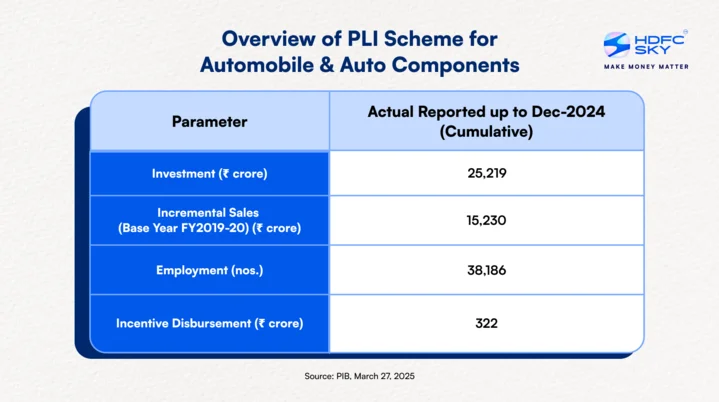
The challenge now is to bring the same momentum into specialty steel, where India still lags. If done well, the two PLIs can reinforce each other, that is auto makers creating demand, and steel makers meeting it with world-class domestic supply.
Key Policy Challenges
- Technological Catch-Up: Making advanced auto-grade steels requires cutting-edge metallurgy, precision process control, and ultra-clean raw materials. Right now, many of India’s public and private steelmakers aren’t fully equipped to handle this challenge. That’s why policy support can’t stop at subsidies; it also has to enable technology acquisition, whether through global partnerships, licensing deals, or joint R&D programs with universities and research institutes. Without this, India risks falling behind in the quality game.
- Industrial Upgradation Costs: Upgrading a steel mill to produce automotive-grade steel is expensive and risky. That’s where coordinated demand aggregation (from Original Equipment Manufacturer (OEMs)) and targeted government support like tax breaks, concessional finance, and risk-sharing models become critical. Otherwise, producers will hesitate to commit capital, and the gap in specialty steel will persist.
- Green Imperatives: There’s another layer to this story. As carmakers shift to EVs, global steelmakers are moving toward low-carbon production using green hydrogen, electric arc furnaces, and large-scale scrap recycling. If India’s specialty steel strategy doesn’t build sustainability into the process from day one, domestic output could find itself locked out of global supply chains that increasingly demand “green steel.” The launch of the Green Steel Taxonomy marks a transformative step for India’s steel industry establishing clear definitions for green steel, driving innovation, and creating a robust market for low-carbon products.
Strategic Opportunities
- Industrial Deepening: By moving into advanced materials, India cuts its dependence on imports and builds stronger supply chains at home.
- Export Potential: Once we have the capabilities in place, India could also become a competitive exporter of auto-grade steel, especially to emerging markets in ASEAN, Africa, and the Middle East.
- Innovation Ecosystem: Collaboration between steelmakers, automakers, and research institutes won’t just boost auto steel, it could spark innovations that spill over into defence and infrastructure too.
- Policy Alignment: If the steel strategy is tied closely to the EV mission, the PLI for auto components, and the green hydrogen roadmap, it can create powerful cross-sector synergies.
Conclusion
India’s effort to build domestic capacity in high-grade steel isn’t just about shielding one sector from imports. It’s really about creating strategic depth in the country’s broader industrial base. High-grade steel is critical for automobiles, especially as the industry shifts towards electric vehicles, and it is also essential for sectors like defence, infrastructure, and clean energy.
But making this work will take more than subsidies or incentives. The real challenge for the government is to bring three things together at once: upgrading India’s industrial capabilities, making production more sustainable, and ensuring that the steel we make can compete in global markets. That’s a tall order, but it’s also what will decide whether the policy succeeds.
If India can get this balance right, the initiative could serve as a test case for a much bigger question: how can India pursue self-reliance in manufacturing while still staying integrated with global supply chains? Success here would not just strengthen the steel sector, it would send a strong signal about India’s ability to climb the value chain across industries.
Disclaimer: At HDFC SKY, we take utmost care and due diligence in curating and presenting news and market-related content. However, inadvertent errors or omissions may occasionally occur.
If you have any concerns, questions, or wish to point out any discrepancies in our content, please feel free to write to us at content@hdfcsec.com.
Please note that the information shared is intended solely for informational purposes and does not make any investment recommendations
 Join Us
 Add as preferred source on Google


More Business News





Open Free Demat Account
Open Free Demat Account




Invest Anytime, Anywhere


By signing up I certify terms, conditions & privacy policy