Nifty 50
- TCS₹2,34293.60 (4.16%)
- ICICI Bank₹1,422.80-20.20 (-1.40%)
- Tech Mahindra₹1,640.9055.90 (3.53%)
- Shriram Finance₹1,086.90-14.10 (-1.28%)
- Infosys₹1,14433.20 (2.99%)
- ITC₹266-3.00 (-1.12%)
- HCL Technologies₹1,316.1034.10 (2.66%)
- UltraTech Cement₹11,589-128.00 (-1.09%)
- Wipro₹180.954.55 (2.58%)
- Asian Paints₹2,608.70-22.30 (-0.85%)
- Bajaj Auto₹11,910190.00 (1.62%)
- SBI Life Insurance ₹1,761.10-12.10 (-0.68%)
- Hindalco Industries₹1,037.4013.40 (1.31%)
- Eicher Motors₹8,059-41.00 (-0.51%)
- HDFC Bank₹720.309.30 (1.31%)
- Maruti Suzuki₹13,376-64.00 (-0.48%)
- Tata Motors PV₹319.403.40 (1.08%)
- Bajaj Finserv₹2,002-9.00 (-0.45%)
- Grasim Industries₹3,29032.00 (0.98%)
- InterGlobe Aviation₹5,166-23.00 (-0.44%)

- Offerings
- Tools & Platforms
Tools & Calculators
- Open API
- Calculators
- SIP Calculator
- CAGR Calculator
- Compound Interest Calculator
- FD Calculator
- RD Calculator
- EPF Calculator
- Retirement Calculator
- HDFC SIP Calculator
- Mutual Fund Return Calculator
- Lumpsum Calculator
- Step Up SIP Calculator
- ETF SIP Calculator
- Brokerage Calculator
- Equity Margin Calculator
- SWP Calculator
- EMI Calculator
- MTF Calculator
- Margin Pledge Calculator
- Markets
Stocks
F&O
Mutual Funds
- More
PLI Push: Smartphone Exports Cross ₹1 Trillion in Just 5 Months
Authored By Shishta Dutta | Published at: Oct 7, 2025 10:11 AM IST
Open Free Demat Account
Open Free Demat Account
In India’s long tryst with industrial transformation, there are moments that stand out as inflection points. The last five months have given us one such moment: smartphone exports from India have crossed the ₹1 trillion mark between April and August 2025.
To put that in perspective, this figure is 55% up from what we managed (₹64,500 crore) in the same period last year.
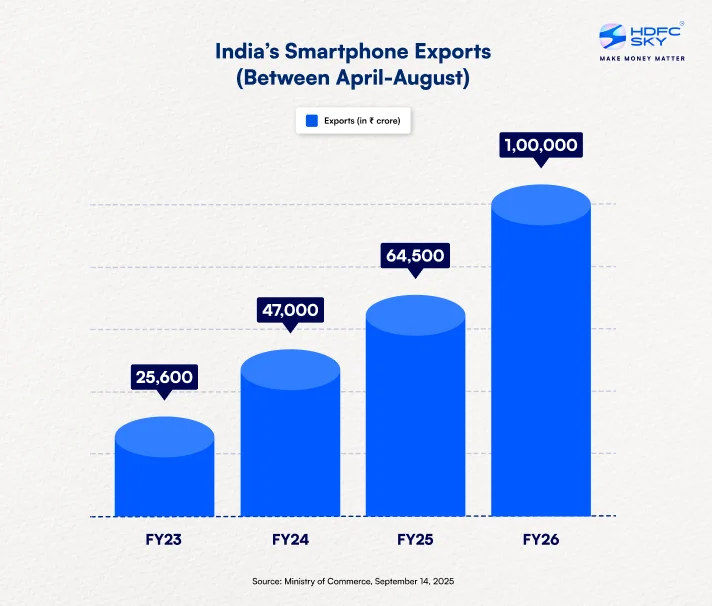
Zooming out to full-year data makes the scale of this surge even sharper. India’s smartphone exports have surged from ₹1.29 lakh crore in FY24 to ₹2 lakh crore in FY25, with FY26 already touching ₹1 lakh crore in just five months.
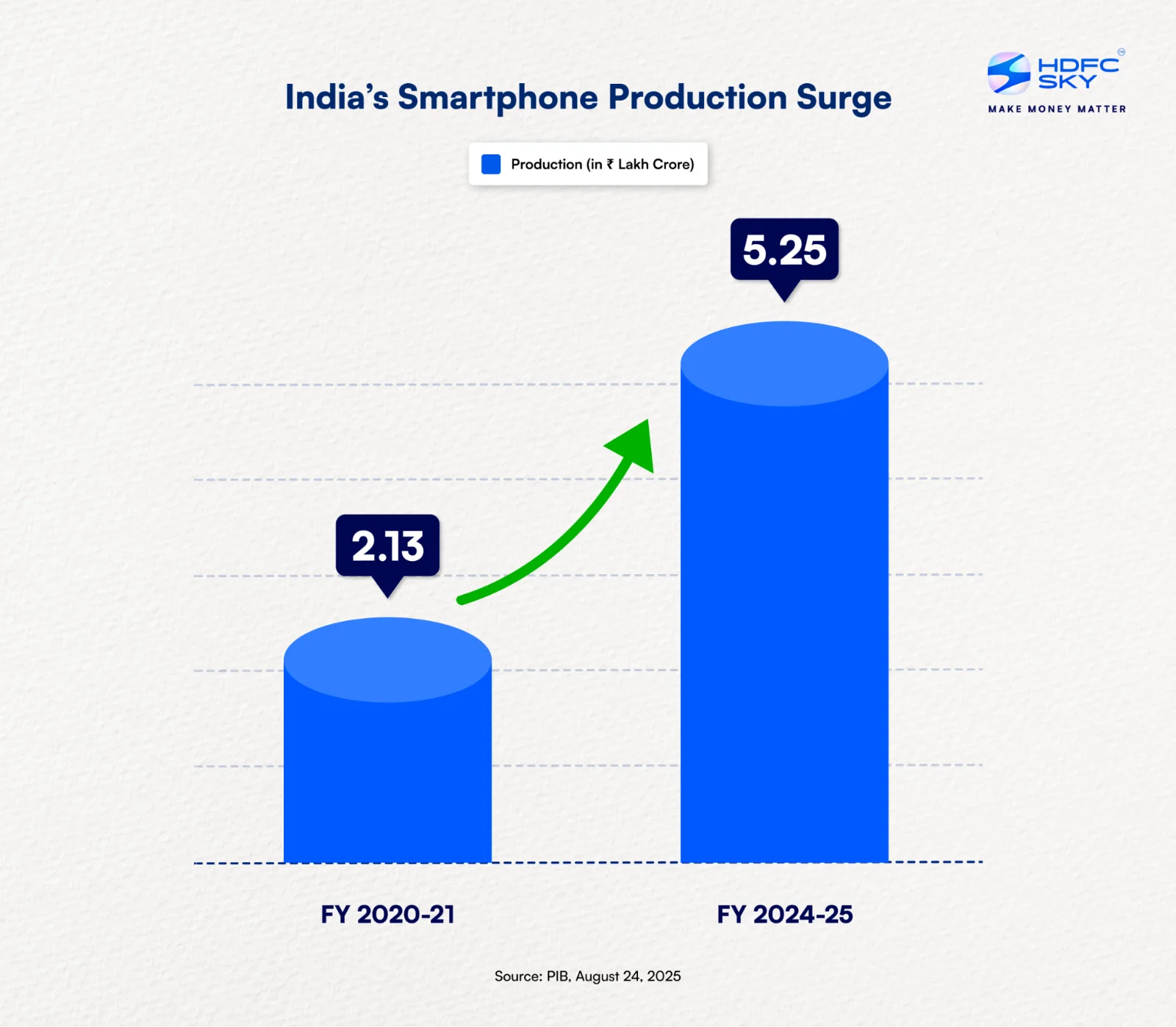
Clearly, India’s smartphone export engine has shifted gears. But what’s fueling this rise?

PLI: The Policy That Changed the Game
For years, India’s growth story has been powered by the services sector, which contributes more than half of the GDP . But to make growth more balanced and resilient, the government turned its attention to manufacturing, a crucial source of jobs, exports, and self-reliance.
In 2020 , it launched the Production Linked Incentive (PLI) Scheme to encourage domestic manufacturing through performance-based incentives. The scheme started with mobiles, electronic components, medical devices, and key pharma ingredients.
After its early success, it was gradually extended to 13 sectors , including automobiles, textiles, white goods, and specialty steel.
By November 2024, committed investments under PLI had reached ₹1.61 lakh crore . The momentum carried into 2025, with realized investments rising to about ₹1.76 lakh crore across 806 approved projects as they moved from approval to active implementation
The government has set an ambitious target of $30-35 billion in smartphone exports for FY26, up from around $24 billion in FY25 . PLI is expected to remain the backbone of this drive.
Apple and Samsung: The Twin Engines
If there are two companies driving this turnaround, it’s Apple and Samsung. Apple’s ecosystem of iPhone contract manufacturers, Tata Electronics, and Foxconn, has become the face of India’s smartphone export story. In just five months of FY26, Tata Electronics and Foxconn alone shipped over ₹75,000 crore worth of iPhones, accounting for nearly 75% of India’s smartphone exports in this period.
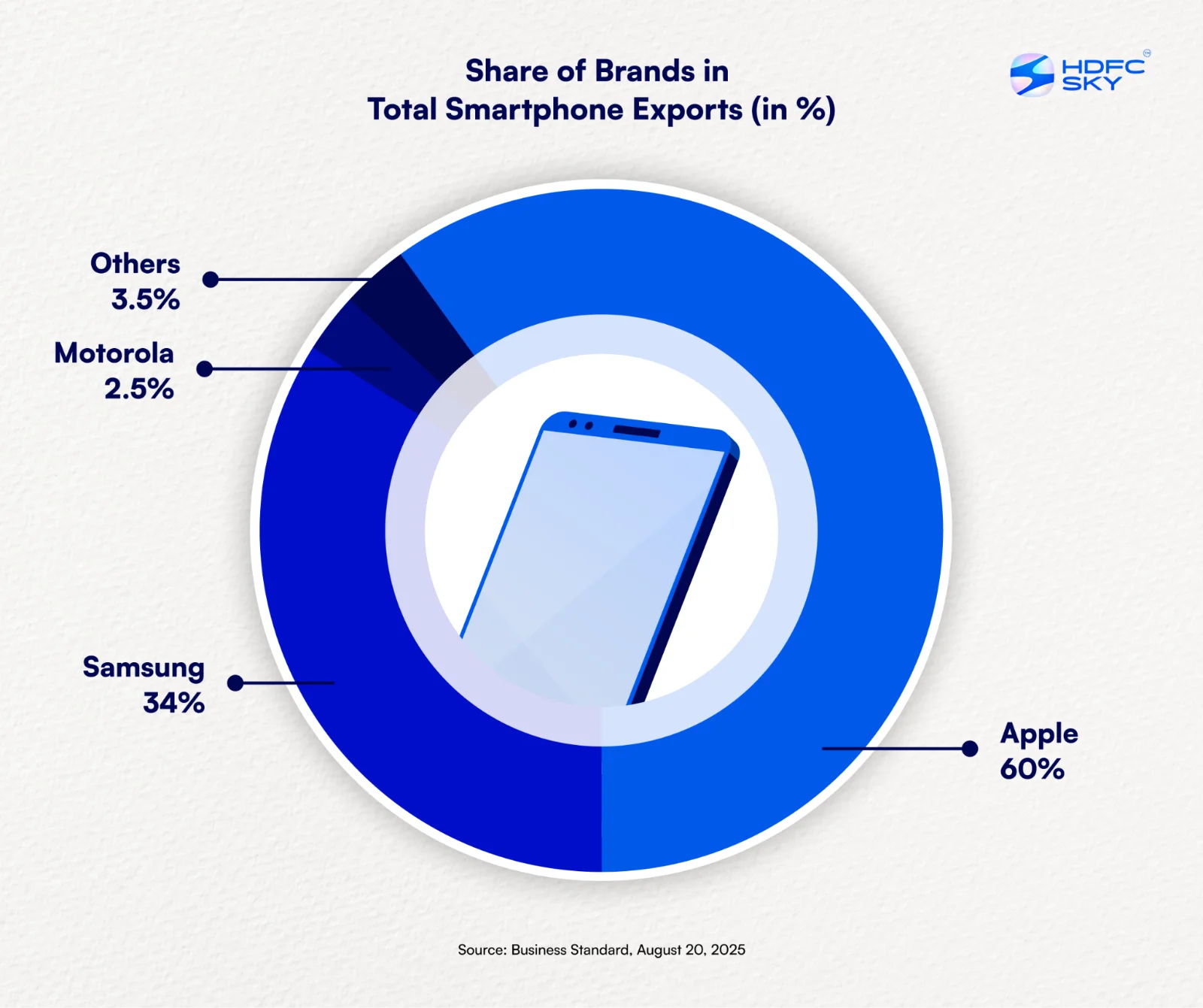
In H1 CY2025, Apple and Samsung together made up nearly 94% of India’s smartphone exports; Apple led with 60%, Samsung followed at 34%. Motorola surprised by taking the third spot with a 2.5% share, crossing 1 million units and edging past Chinese rivals like Xiaomi and Vivo.
On the demand side, the US has emerged as the biggest market, now taking 54% of India’s smartphone shipments despite tariffs concerns.
Apple sent over three-fourths of its exports to the US, while Samsung focused on Europe, with over 60% of its shipments headed to markets like Austria, Germany, France, and Spain.
Together, Apple and Samsung have set the pace for India’s smartphone export boom. Their success shows how global majors, backed by policy support, can turn India into a serious player in the global electronics supply chain.
Why Now? The Global Backdrop
India’s smartphone export story isn’t unfolding in isolation. Global shifts are playing a big role. Global smartphone makers are diversifying production to reduce reliance on a single country and strengthen supply chains. With its vast domestic market, cost advantages, and supportive government schemes, India has emerged as a prime manufacturing destination.
- China+1 strategy: With rising costs and growing geopolitical risks in China, companies are actively diversifying supply chains. Vietnam benefited first, but India, with its vast labor pool and policy push, is now emerging as the next big hub.
- US-China tech war: As Washington clamps down on Beijing’s tech rise, companies like Apple are doubling down on India to reduce overdependence on China.
- Domestic demand: India is already the world’s second-largest smartphone market after China. Building for local demand provides the scale that makes exports viable.
The Ripple Effect
The smartphone export boom has ripple effects across the economy.
- Jobs: Large factories employ tens of thousands of workers, many of them first-time industrial employees. The smartphone assembly line is often their entry into formal manufacturing.
- Ancillary industries: Packaging, logistics, repair, and maintenance services are expanding alongside. Component suppliers are beginning to see India as a market worth investing in.
- Balance of trade: Smartphones, once a big import burden, are now contributing to exports. That’s a dramatic turnaround in just a few years.
India’s export surge is remarkable, but the next step is building a stronger ecosystem. High-value parts like chips, displays, and batteries are still mostly imported. Developing local capacity, better logistics, and skilled talent will be key. If India delivers on these, it can move from assembly hub to global electronics powerhouse.
Conclusion
Crossing ₹1 trillion in smartphone exports in just five months is a tremendous achievement. It shows that with the right mix of policy, global shifts, and private participation, India can rewrite its place in the global supply chain.
This milestone is a step towards India’s $500 billion electronics vision for 2030 , cementing the country’s rise as a global hub for production and innovation.
Smartphones may just be the beginning. If India plays its cards right, the next trillion could come not just from shipping iPhones and Galaxy devices, but from an entire ecosystem of electronics, chips, and hardware proudly stamped “Made in India.”
 Join Us
 Add as preferred source on Google


More Business News








Open Free Demat Account
Open Free Demat Account







Invest Anytime, Anywhere


By signing up I certify terms, conditions & privacy policy