Nifty 50
- TCS₹2,34293.60 (4.16%)
- ICICI Bank₹1,422.80-20.20 (-1.40%)
- Tech Mahindra₹1,640.9055.90 (3.53%)
- Shriram Finance₹1,086.90-14.10 (-1.28%)
- Infosys₹1,14433.20 (2.99%)
- ITC₹266-3.00 (-1.12%)
- HCL Technologies₹1,316.1034.10 (2.66%)
- UltraTech Cement₹11,589-128.00 (-1.09%)
- Wipro₹180.954.55 (2.58%)
- Asian Paints₹2,608.70-22.30 (-0.85%)
- Bajaj Auto₹11,910190.00 (1.62%)
- SBI Life Insurance ₹1,761.10-12.10 (-0.68%)
- Hindalco Industries₹1,037.4013.40 (1.31%)
- Eicher Motors₹8,059-41.00 (-0.51%)
- HDFC Bank₹720.309.30 (1.31%)
- Maruti Suzuki₹13,376-64.00 (-0.48%)
- Tata Motors PV₹319.403.40 (1.08%)
- Bajaj Finserv₹2,002-9.00 (-0.45%)
- Grasim Industries₹3,29032.00 (0.98%)
- InterGlobe Aviation₹5,166-23.00 (-0.44%)

- Offerings
- Tools & Platforms
Tools & Calculators
- Open API
- Calculators
- SIP Calculator
- CAGR Calculator
- Compound Interest Calculator
- FD Calculator
- RD Calculator
- EPF Calculator
- Retirement Calculator
- HDFC SIP Calculator
- Mutual Fund Return Calculator
- Lumpsum Calculator
- Step Up SIP Calculator
- ETF SIP Calculator
- Brokerage Calculator
- Equity Margin Calculator
- SWP Calculator
- EMI Calculator
- MTF Calculator
- Margin Pledge Calculator
- Markets
Stocks
F&O
Mutual Funds
- More
₹25,000 Crore Export Push: Can India’s New Promotion Mission Deliver?
Authored By Shishta Dutta | Published at: Sep 5, 2025 12:03 PM IST
Open Free Demat Account
Open Free Demat Account
India’s ambition to scale its exports to $2 trillion by 2030 is no secret. But that journey just became significantly more complex.
On August 27, the United States imposed sweeping 50% tariffs on a broad range of Indian exports, doubling the previous rate of 25% . The move was triggered by India’s continued oil trade with Russia. Given that the United States accounts for 20% of India’s merchandise exports and contributes nearly 2% to the country’s GDP , the tariffs are likely to have a wide-ranging economic impact
It is against this backdrop that the Government of India is finalising an ambitious ₹25,000 crore Export Promotion Mission (EPM), spread over six financial years (2025-31) , aimed at rebuilding momentum and reorienting India’s trade strategy.
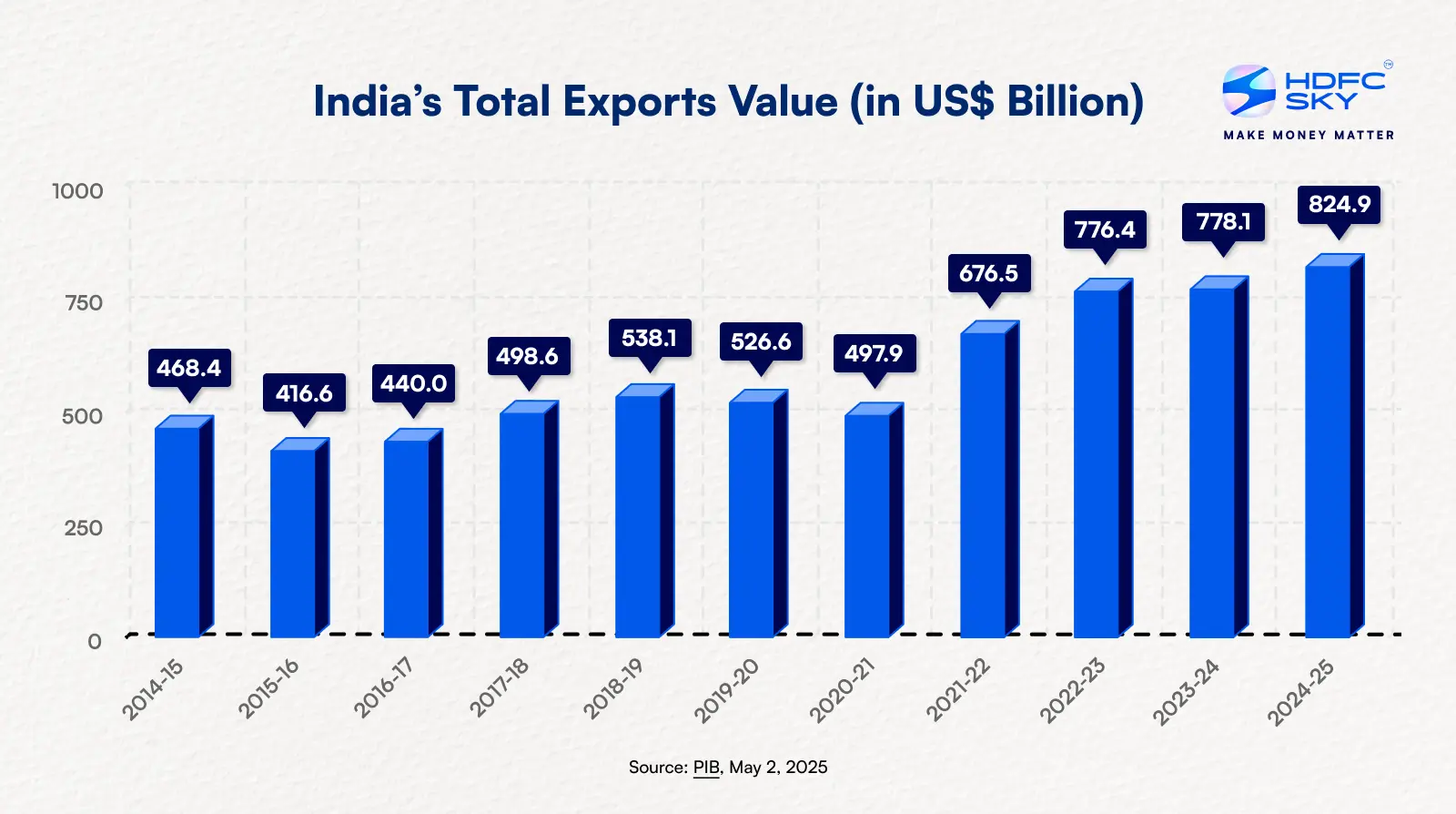
Let’s have a look at India’s total exports value over a decade.

A Shock and a Response
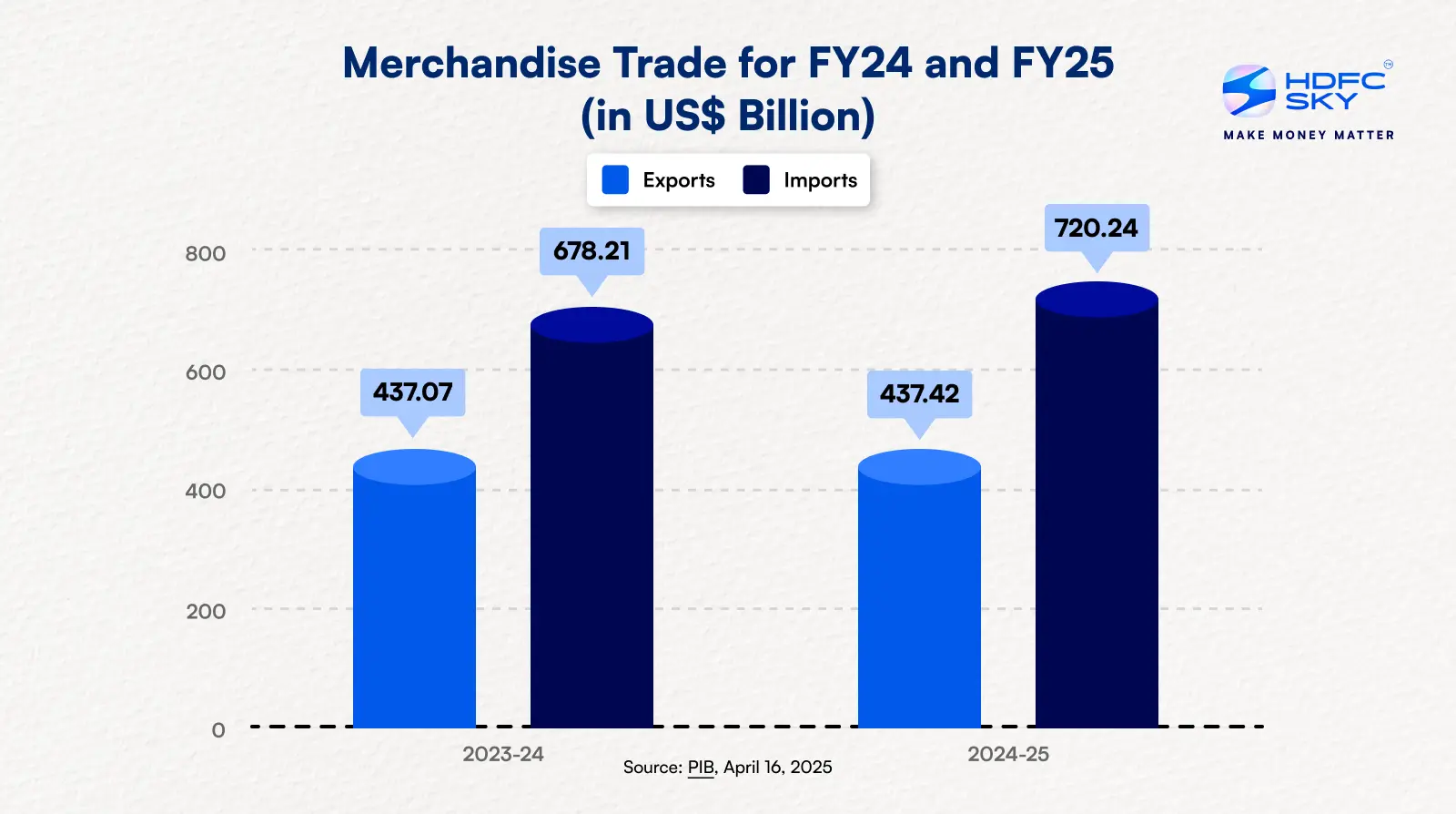
India’s merchandise export performance over the past two years has been a mix bag, while imports have continued to rise, leading to a widening trade deficit. India’s merchandise trade deficit widened to US$ 282.83 billion in FY 2024–25, up from US$ 241.14 billion recorded in FY 2023-24.
Now, with U.S. tariffs threatening to reduce India’s merchandise exports to the US by as much as 40-45% in 2025-26 compared to the previous year, the government’s previously announced goal of reaching $2 trillion in exports by 2030 may seem distant. The affected sectors, textiles, gems and jewelry, furniture, seafood, and machinery , are among India’s largest employers and exporters to the U.S.
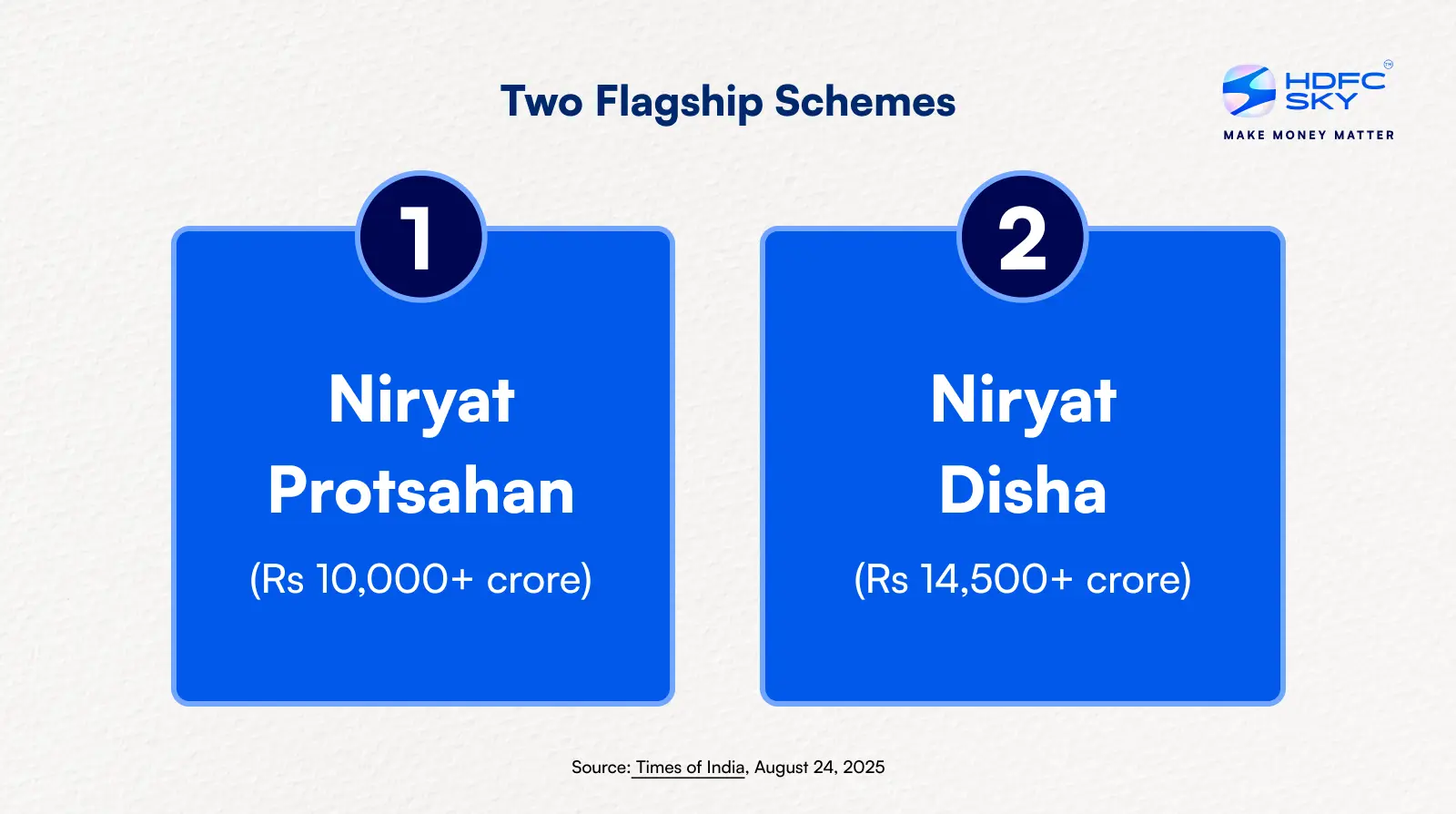
The Export Promotion Mission seeks to address this challenge head-on. It is anchored by two new flagship schemes: Niryat Protsahan, with an allocation exceeding ₹10,000 crore, and Niryat Disha, set to receive more than ₹14,500 crore. They represent a recalibration of India’s export engine in the face of both global protectionism and domestic constraints. The Export Promotion Mission will be driven by a collaborative framework involving key ministries, export bodies, and industry stakeholders.
What Do the Schemes Aim to Solve?
The two schemes operate in tandem, each tackling a different facet of the export pipeline.
Niryat Protsahan is built to energise the soft infrastructure of trade, supporting marketing efforts, brand positioning, skill development, and capacity building. Its design acknowledges that many Indian exporters, especially Micro, Small & Medium Enterprises (MSMEs), lack the institutional backing to penetrate new markets or adapt to rapidly changing global standards. This scheme is expected to offer tailored support to high-potential sectors and geographies, while also bridging the knowledge and incentive gaps that persist outside India’s established export hubs.
Under the Niryat Protsahan scheme, the government is expected to introduce a range of supportive measures including interest equalisation to make credit more affordable for exporters, market development assistance to help Indian products gain visibility in new and existing global markets, and improved access to trade finance, especially for MSMEs that often face funding constraints at the pre- and post-shipment stages.
Niryat Disha , on the other hand, is about hard logistics. It focuses on upgrading ports, warehousing, digital customs infrastructure, and intermodal freight corridors, longstanding pain points that reduce India’s export competitiveness. By addressing turnaround delays, warehousing bottlenecks, and inconsistent documentation standards across states, Disha intends to provide the kind of seamless backend support that can reduce transaction costs and improve delivery timelines across borders.
Under the Niryat Disha scheme, the focus will be on strengthening the export ecosystem through targeted support for quality compliance, trade infrastructure upgrades, logistics efficiency, and the digitalisation of customs and documentation processes, critical enablers for reducing export bottlenecks and aligning with global standards.
Combined, the two schemes offer a comprehensive push to make Indian exports.
But Will It Be Enough?
Before the new ₹25,000 crore Export Promotion Mission, India had introduced earlier schemes like MEIS and RoDTEP to support exporters. Both were well-intentioned but faced challenges that eventually hurt exporter trust.
Merchandise Exports from India Scheme (MEIS), launched in 2015 , aimed at compensating exporters for infrastructural bottlenecks and related costs, through Duty Credit Scrips that could be used for imports or domestic procurement and were fully transferable. But it ran into trouble at the global level. The World Trade Organization (WTO) ruled that MEIS was an illegal export subsidy , forcing India to phase it out.
To replace it, the government launched Remission of Duties and Taxes on Exported Products (RoDTEP) in 2021 . This scheme had a different goal: instead of offering rewards, it aimed to refund hidden taxes, duties and levies . On paper, RoDTEP was more structured and WTO-compliant.
But in practice, RoDTEP too faced serious issues . Refunds were often delayed and smaller businesses, in particular, struggled with paperwork and long wait times. As a result, confidence in government export support began to fade.
The new schemes, Niryat Protsahan and Niryat Disha, must do more than offer funding. They need to be fast, transparent, and predictable. If exporters don’t know when or how much they’ll receive, even a ₹25,000 crore package won’t go far.
Conclusion
The convergence of an aggressive trade shock and a domestic policy pivot marks a turning point in India’s export narrative. The ₹25,000 crore Export Promotion Mission could be a long-overdue recalibration of how India views its place in global trade.
If crafted and delivered with foresight, these schemes could help India not only absorb the Trump tariff blow but also chart a more resilient, diversified, and globally competitive export future. The challenge lies not in the size of the fund, but in the precision of its impact.
In a post-tariff world, intent alone will not suffice. Execution will be everything.
Disclaimer: At HDFC SKY, we take utmost care and due diligence in curating and presenting news and market-related content. However, inadvertent errors or omissions may occasionally occur.
If you have any concerns, questions, or wish to point out any discrepancies in our content, please feel free to write to us at content@hdfcsec.com.
Please note that the information shared is intended solely for informational purposes and does not make any investment recommendations
 Join Us
 Add as preferred source on Google


More Business News





Open Free Demat Account
Open Free Demat Account







Invest Anytime, Anywhere


By signing up I certify terms, conditions & privacy policy