Nifty 50
- Kotak Mahindra Bank₹4408.10 (1.88%)
- Titan Company₹4,377-173.00 (-3.80%)
- BSE₹3,35651.00 (1.54%)
- Adani Enterprises₹2,743-106.90 (-3.75%)
- Bharti Airtel₹1,833.9023.40 (1.29%)
- Hindalco Industries₹910.85-29.65 (-3.15%)
- ICICI Bank₹1,357.5014.70 (1.09%)
- JSW Steel₹1,230-29.60 (-2.35%)
- Coal India₹414.502.85 (0.69%)
- Bharat Electronics₹378.30-9.10 (-2.35%)
- Max Healthcare₹9085.50 (0.61%)
- Infosys₹992-21.85 (-2.16%)
- HDFC Life Insurance ₹546.052.10 (0.39%)
- Asian Paints₹2,372.10-52.10 (-2.15%)
- Bajaj Finance₹963.850.75 (0.08%)
- Mahindra & Mahindra₹2,800-55.00 (-1.93%)
- Apollo Hospitals₹7,9172.50 (0.03%)
- Adani Ports₹1,750.10-33.30 (-1.87%)
- L&T₹3,701.50-68.50 (-1.82%)

- Offerings
- Tools & Platforms
Tools & Calculators
- Open API
- Calculators
- SIP Calculator
- CAGR Calculator
- Compound Interest Calculator
- FD Calculator
- RD Calculator
- EPF Calculator
- Retirement Calculator
- HDFC SIP Calculator
- Mutual Fund Return Calculator
- Lumpsum Calculator
- Step Up SIP Calculator
- ETF SIP Calculator
- Brokerage Calculator
- Equity Margin Calculator
- SWP Calculator
- EMI Calculator
- MTF Calculator
- Margin Pledge Calculator
- Algo Strategy
- Markets
Stocks
F&O
Mutual Funds
- More
- Swiggy IPO Timeline
- About Swiggy IPO
- Peer Comparison of Swiggy
- SWOT Analysis of Swiggy
- More about Swiggy
- Swiggy’s Business Model
- Industry Outlook
- How will Swiggy Benefit?
- Swiggy IPO Overview
- Why is Swiggy Going Public?
- Swiggy IPO Details
- Important Dates of Swiggy IPO
- Lead Managers of Swiggy IPO
- Swiggy IPO Valuation Overview
- Peer Group Comparison
- Key Insights of Swiggy IPO:
- Swiggy IPO Strengths
- Swiggy’s Funding and Valuation
- Objectives of the Swiggy IPO Proceeds
- Utilisation of Proceeds
- Swiggy Financial Performance (Restated Consolidated) (in crores)
- Key Insights from Financial Performance
- Quick Commerce Business
- Key Strategies of Swiggy
- Competitor Analysis for Swiggy
- Swiggy Instamart Competitor Analysis
- FAQs
- Swiggy IPO Timeline
- About Swiggy IPO
- Peer Comparison of Swiggy
- SWOT Analysis of Swiggy
- More about Swiggy
- Swiggy’s Business Model
- Industry Outlook
- How will Swiggy Benefit?
- Swiggy IPO Overview
- Why is Swiggy Going Public?
- Swiggy IPO Details
- Important Dates of Swiggy IPO
- Lead Managers of Swiggy IPO
- Swiggy IPO Valuation Overview
- Peer Group Comparison
- Key Insights of Swiggy IPO:
- Swiggy IPO Strengths
- Swiggy’s Funding and Valuation
- Objectives of the Swiggy IPO Proceeds
- Utilisation of Proceeds
- Swiggy Financial Performance (Restated Consolidated) (in crores)
- Key Insights from Financial Performance
- Quick Commerce Business
- Key Strategies of Swiggy
- Competitor Analysis for Swiggy
- Swiggy Instamart Competitor Analysis
- FAQs
Swiggy IPO 2024 - Check Date, Price, Lot Size & Complete Details
By Sonali Palande | Updated at: May 13, 2025 02:59 PM IST
Open Free Demat Account
Open Free Demat Account
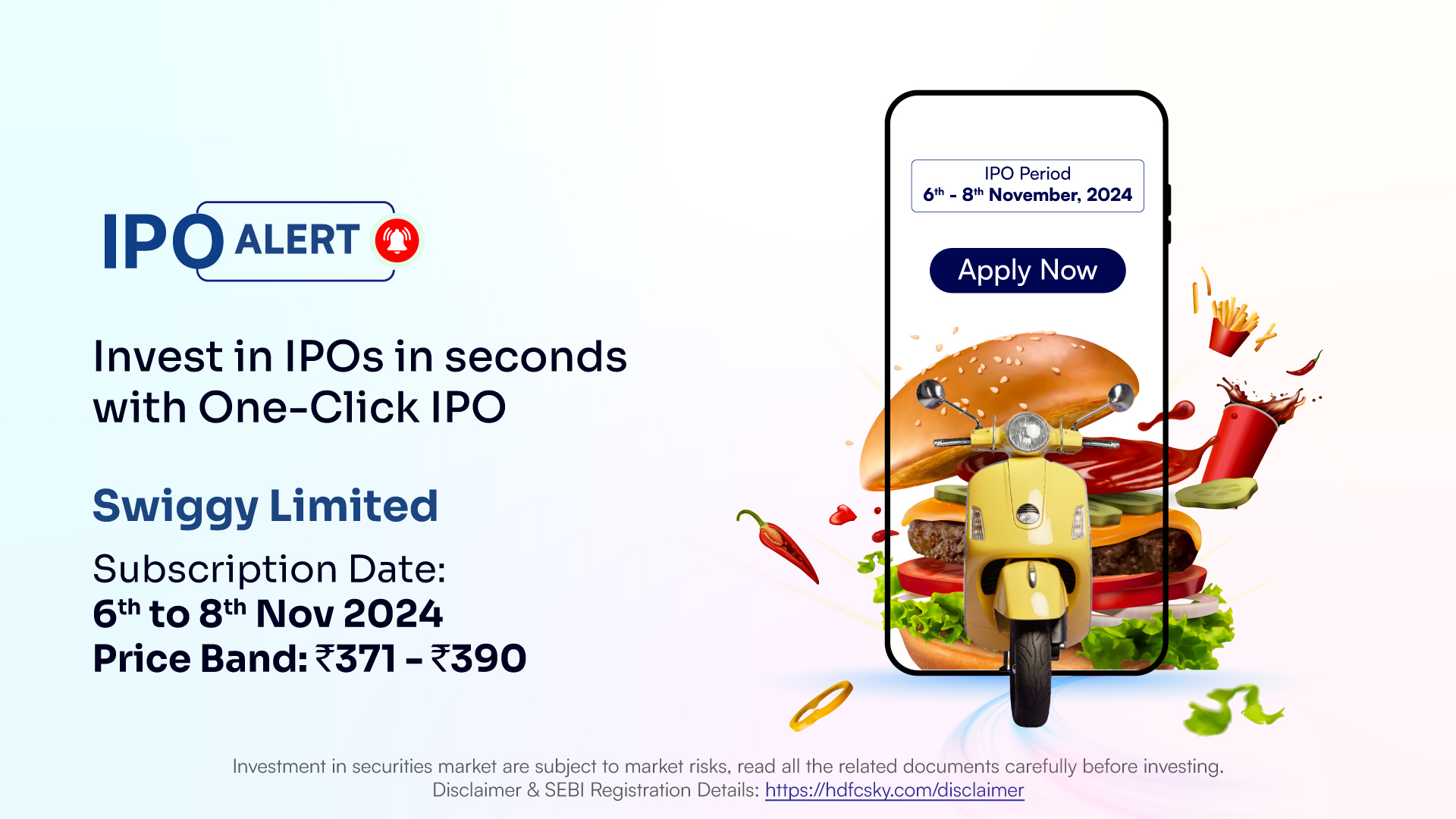
- Open date: 6th November, 2024
- Close Date: 8th November, 2024
- Minimum Investment: Rs 14,820
- Lot Size: 38 shares
- Price Range: Rs 371 – 390 per share
- Listing: BSE, NSE
- Issue Size: ₹11,327.43 crore
Swiggy IPO Timeline
- Bidding Starts: 6th November, 2024
- Bidding Ends: 8th November, 2024
- Allotment Finalisation: 11th November, 2024
- Refund Initiation: 12th November, 2024
- Crediting of allotted shares to demat account: 12th November, 2024
- Listingdate: 13th November, 2024
About Swiggy IPO
Founded in 2014, Swiggy Limited offers users a user-friendly platform accessible through a single app for searching, selecting, ordering, and paying for food (Food Delivery) and grocery and household items (Instamart), with deliveries facilitated by an on-demand network of delivery partners.
The company operates five business units:
- Food Delivery
- Out-of-home Consumption: Includes dining at restaurants and attending events
- Quick Commerce: On-demand delivery of grocery and household products
- Supply Chain and Distribution: Business-to-business (B2B) deliveries, warehousing, logistics, and distribution for wholesalers and retailers
- Platform Innovation: Development of new initiatives and offerings like Swiggy Genie and Swiggy Minis
Peer Comparison of Swiggy
- Zomato
SWOT Analysis of Swiggy
| Strengths and Opportunities | Weaknesses and Threats |
| Swiggy’s operating revenue increased by 36% YoY in FY24, reaching ₹11,247 crore, with losses reduced by 44% to ₹2,350 crore. | Ongoing net losses and negative cash flows persist despite revenue growth. High advertising and delivery costs are significant challenges. |
| Over 5,000 employees and more than 200,000 delivery executives ensure efficient operations nationwide. | Swiggy must acquire and retain users cost-effectively; shifts in preferences could harm its user base and revenue. |
| The introduction of services like Instamart and Swiggy Genie allows entry into non-food verticals. | Strong relationships with restaurant partners are essential; increased prices or competitor partnerships could decrease order volumes. |
| Operating in over 500 cities, Swiggy caters to a wide consumer range, establishing itself as a market leader. | Efficient management of Dark Stores is crucial; inadequate oversight may disrupt services and user satisfaction. |
| Machine learning algorithms improve user experience, while Swiggy One and various payment options enhance customer loyalty. | Potential government regulations affecting e-commerce and food delivery could pose risks to demand and business models. |
| Acquiring Dineout strengthens offline restaurant experiences and relationships with partners. | Swiggy faces competition from Zomato, Uber Eats, Foodpanda, and Dineout, each vying for market share. |
| With 112.73 million users, Swiggy tests new services using its extensive network before scaling them. | |
| Technology-driven recommendations and targeted advertising drive customer engagement. | |
| Revenue rose steadily from ₹5,704.90 crore in FY22 to ₹11,247.39 crore in FY24, showing a solid market trajectory. | |
| Swiggy has the potential to venture into new business areas, such as grocery delivery and online medicine delivery, enabling access to emerging markets and capturing a larger portion of the online delivery landscape. |
More about Swiggy
Diverse Offerings on the Swiggy Platform
Swiggy’s platform extends beyond food delivery, encompassing a variety of services that cater to different consumer needs.
Restaurant Reservations and Event Bookings
- Dineout Integration: Users can easily make restaurant reservations through Swiggy, allowing for a seamless dining experience.
- Event Bookings with SteppinOut: The platform also facilitates event bookings, making it a go-to solution for social activities and outings.
Product Pickups and Deliveries
- Genie Service: Swiggy offers a product pickup and delivery service called Genie, enhancing its hyperlocal commerce capabilities.
- Swiggy Minis: This feature allows for quick and convenient access to a range of local services and products.
Membership and Payment Options
Swiggy enhances the customer experience through its membership and payment options.
Swiggy One Membership Program
- Exclusive Discounts and Offers: The “Swiggy One” program provides members with special discounts and offers, encouraging customer loyalty and repeat usage.
Flexible Payment Solutions
- Swiggy Money: A prepaid digital wallet that allows for easy in-app transactions.
- Swiggy UPI: Users can make quick payments using the Unified Payments Interface (UPI) for added convenience.
- Swiggy-HDFC Bank Credit Card: This collaboration provides users with additional benefits, making the payment process more rewarding.
Comprehensive Business Enablement Solutions
Swiggy provides restaurant partners, merchant partners (selling grocery and household items on its platform), and brand partners, including alliance partners, with comprehensive business enablement solutions. These include analytics-driven tools to enhance their online presence and customer base, along with fulfillment services to streamline the supply chain and last-mile delivery.
Extensive Product Range and Infrastructure
As of June 30, 2024, Swiggy offered around 19,000 SKUs of grocery and household items, which comprised:
- Everyday essentials like eggs, bread, fruits, and vegetables
- Impulse purchases such as snacks and quick meals
- Regularly recurring items typically bought monthly or weekly, like shampoo and soap
- Ad hoc purchases, including feminine hygiene products, basic pharmaceuticals, personal care items, and stationery
- Occasion and festival-related purchases, such as sweets, festive supplies, and sports event items
As of June 30, 2024, Swiggy’s Instamart operated a vast network of 557 Active Dark Stores across 32 cities in India. By September 10, 2024, this network expanded to 605 Active Dark Stores across 43 cities. As of June 30, 2024, the company employed 5,401 people.
Swiggy’s Business Model
Swiggy employs a multi-sided business model that connects three main stakeholders: customers, restaurant partners, and delivery personnel. Here’s a breakdown of how this model operates:
- Revenue from Customers: Swiggy charges delivery fees to customers based on the distance from the restaurant and the size of the order. These fees can fluctuate due to promotional offers or subscription services like Swiggy One, which provides free deliveries and discounts.
- Commissions from Restaurant Partners: The company earns a commission from restaurant partners for each order made through its platform. This commission varies according to individual agreements with each restaurant and the service location.
- Advertising and Promotions: Swiggy generates additional income by allowing restaurants to advertise and promote their listings within the app, enhancing visibility and attracting more customers.
- Instamart and Swiggy Genie: By offering grocery delivery and personal services, Swiggy has diversified its revenue sources, reducing reliance on the food delivery segment alone.
Industry Outlook
- India’s food services market is projected to nearly double, reaching ₹9 trillion by 2030.
- Growth was driven by:
- An expanding customer base.
- Increased dining occasions as consumers seek diverse culinary experiences.
- Furthermore, online food delivery is anticipated to grow at a higher rate of 18% CAGR, increasing its contribution to the overall food services market from the current 8% to 20% by 2030.
- Contributing factors include:
- The growing popularity of convenience-focused services.
- Advancements in technology facilitate easier access to food delivery.
- Changing consumer preferences towards online ordering.
- Urbanisation and busier lifestyles are likely to increase demand for online food delivery services.
- Overall, the sector is positioned for substantial growth in the coming years.
How will Swiggy Benefit?
This creates a significant opportunity for Swiggy to increase its market share. Swiggy’s Instamart is also strategically positioned to capitalise on the growing demand for online grocery delivery services.
The trend toward online shopping, accelerated by the COVID-19 pandemic, suggests that quick-commerce grocery services will continue to expand. With its emphasis on technology, enhancing customer experience, and diversifying services, Swiggy is a formidable contender in both the food delivery and grocery delivery sectors.
Swiggy IPO Overview
Swiggy IPO is projected to raise around $1.25 billion. The primary objective is to raise funds for business expansion, which includes diversifying services to incorporate grocery deliveries through Instamart and parcel delivery through Swiggy Genie.
The food delivery market is intensely competitive, featuring major players like Zomato and Uber Eats. By securing this capital, Swiggy aims to bolster its technology infrastructure and improve customer experience, which is essential for maintaining its competitive advantage in the industry.
Why is Swiggy Going Public?
Swiggy’s IPO is a key component of its long-term strategy to raise capital, scale operations, and solidify its position in the competitive Indian market. Here are several reasons for the company’s decision to go public:
- Expansion Plans: Swiggy aims to enhance its presence in smaller cities and boost its delivery capacity. The funds raised from the IPO will enable the company to invest in infrastructure, technology, and operations to penetrate new markets.
- Debt Repayment: Like many startups, Swiggy has accumulated substantial debt and venture capital funding to fuel its growth. The IPO will assist in reducing its debt burden and improving overall financial stability.
- Product Diversification: Swiggy is committed to diversifying its offerings beyond food delivery. The proceeds from the IPO will be allocated to developing and expanding these new avenues, such as grocery delivery and cloud kitchens.
- Brand Recognition: Going public will enhance Swiggy’s brand visibility and credibility. Being a listed company instils a greater level of trust among customers, partners, and investors.
Swiggy IPO Details
| Category | Details |
| Issue Type | Book Built Issue IPO |
| Total Issue Size | ₹11,327.43 crore |
| IPO Dates | IPO Opens : 6th November, 2024
IPO Closes : 8th November, 2024 |
| Price Bands | Rs 371 – 390 per share |
| Lot Size | 38 shares |
| Face Value | ₹1 per share |
| Listing Exchange | BSE, NSE |
Important Dates of Swiggy IPO
| IPO Activity | Date |
| Allotment Date | November 11th, 2024 |
| Refunds Initiation | November 12th, 2024 |
| Crediting of Shares to Demat | November 12th, 2024 |
| IPO Listing Date | November 13th, 2024 |
Lead Managers of Swiggy IPO
| Kotak Mahindra Capital Company Limited |
| Citigroup Global Markets India Private Limited |
| Jefferies India Private Limited |
| Avendus Capital Pvt Ltd |
| J.P. Morgan India Private Limited |
| BofA Securities India Limited |
| ICICI Securities Limited |
Swiggy IPO Valuation Overview
| KPI | Value |
| Earning Per Share (EPS) | ₹10.70 (Basic) |
| Price/Earning (P/E) Ratio | N/A |
| Return on Net Worth (RoNW) | -30.16% |
| Net Asset Value (NAV) | ₹35.48 |
| ROE | – |
| ROCE | – |
| EBITDA Margin | -16.52% |
| PAT Margin | – |
| Debt to Equity Ratio | N/A |
Peer Group Comparison
| Company | EPS | PE Ratio | RoNW % | NAV | Income |
| Swiggy | 10.70 | N/A | (30.16) | 35.48 | ₹11,634.35 Cr |
| Zomato Limited | 0.41 | 742.50 | 1.72 | 23.14 | ₹12,114 Cr. |
Key Insights of Swiggy IPO:
- Earnings Per Share (EPS): Swiggy’s EPS of ₹10.70 indicates its earnings performance on a per-share basis, but the negative RoNW reflects challenges in generating returns on shareholders’ equity.
- Price/Earnings (P/E) Ratio: The P/E ratio is not applicable (N/A) for Swiggy, indicating that either the company is not currently profitable or the valuation has not been established in the IPO context.
- Return on Net Worth (RoNW): The RoNW of -30.16% suggests that Swiggy is currently experiencing losses, which could raise concerns for potential investors regarding the company’s financial health.
- Net Asset Value (NAV): At ₹35.48, the NAV represents the intrinsic value of the company’s assets per share, giving a baseline for valuation against the market price during the IPO.
- Comparison with Peers: In comparison, Zomato’s metrics highlight a vastly higher P/E ratio and a positive RoNW, indicating better market valuation and profitability relative to Swiggy.
Swiggy IPO Strengths
- Pioneers of Hyperlocal Commerce through Innovation
Swiggy has established itself as a pioneer in India’s hyperlocal delivery industry, launching its food delivery service in 2014 and expanding into quick commerce by 2020. As a trailblazer in this space, Swiggy is widely recognised for driving innovation in hyperlocal commerce. According to the Redseer Report, Swiggy is synonymous with the categories it operates in, solidifying its leadership status.
- A Growing User Base
In its tenth year of operation, Swiggy reached a significant milestone—112.73 million users had transacted on its platform by June 30, 2024, marking steady growth in its user base.
- Unified App Experience and Brand Recognition
Swiggy delivers a consistent user experience through its unified app, strengthening its brand identity. As per the 2024 Kantar BrandZ Most Valuable Indian Brands Report, Swiggy is the top brand in the consumer technology and services platform category and ranks among the top 25 most valuable brands in India overall.
- Recognised as a Leading Brand in the Consumer Technology and Services Sector
Swiggy has secured a spot among the top 25 brands in India, according to the Kantar BrandZ 2024 report. Its success goes beyond food delivery, with innovative solutions and a customer-first approach, particularly in areas like quick commerce. This recognition reflects Swiggy’s growing influence in the consumer technology and services sector, showcasing its ability to set industry standards and maintain a strong market presence.
- Synergistic Network Effects Driven by Expanding Partners and Users
Swiggy’s business model leverages network effects, attracting more users and partners to its platform. This expanding ecosystem drives higher order volumes, strengthens relationships with partners, and enhances the overall user experience. The growing network enables Swiggy to innovate, scale services, and improve customer satisfaction in food delivery and quick commerce.
Swiggy’s Funding and Valuation
Swiggy has raised about $3.62 billion over 15 funding rounds, backed by more than 50 institutional investors and a handful of angel investors, according to Tracxn. Its first funding round was on Feb 06, 2015. In 2022, the company raised $700 million in a funding round led by Invesco, which doubled its valuation to $10 billion.Its latest funding round was a Series K round on Aug 29, 2023, for $46.4M.
Swiggy’s pre-IPO valuation is estimated at around $11.2 billion, positioning it as one of India’s most valuable startups. This impressive valuation is largely driven by the company’s substantial expansion into sectors like grocery delivery.
The food delivery giant is now internally targeting a valuation between $12.5 billion and $13.5 billion for its upcoming IPO, according to two individuals with direct knowledge of the matter. This marks a 10-16% reduction from its previous goal due to market volatility. Initially, Swiggy had aimed for a $15 billion valuation for its $1.4 billion IPO, set for November, which will be the second-largest stock offering in India this year, following Hyundai India’s recent debut.
Objectives of the Swiggy IPO Proceeds
The company plans to use the Net Proceeds for the following purposes:
- Investing in its material subsidiary, Scootsy, to repay or prepay, in full or in part, certain or all of its borrowings.
- Investing in Scootsy for (a) expanding the Dark Store network in the Quick Commerce segment by establishing new Dark Stores and (b) covering lease/license payments for these Dark Stores.
- Enhancing technology and cloud infrastructure.
- Allocating funds for brand marketing and business promotion to improve brand awareness and visibility across various segments.
- Supporting inorganic growth through potential acquisitions and general corporate needs.
Utilisation of Proceeds
| Purpose | Amount (INR crores) | Percentage (%) |
| Investment in Scootsy (for debt repayment) | ₹137.4 | 3.66% |
| Investment in Scootsy (for Dark Store expansion and lease payments) | ₹982.4 | 26.16% |
| Investment in technology and cloud infrastructure | ₹586.2 | 15.63% |
| Brand marketing and business promotion expenses | ₹929.5 | 24.79% |
| Funding inorganic growth and general corporate expenses | ₹1,115.25 | 29.74% |
Swiggy Financial Performance (Restated Consolidated) (in crores)
| Period Ended | 30 Jun 2024 | 31 Mar 2024 | 31 Mar 2023 | 31 Mar 2022 |
| Assets (₹ Cr) | 10,341.24 | 10,529.42 | 11,280.65 | 14,405.74 |
| Revenue (₹ Cr) | 3,310.11 | 11,634.35 | 8,714.45 | 6,119.78 |
| Profit After Tax (₹ Cr) | -611.01 | -2,350.24 | -4,179.31 | -3,628.90 |
| Net Worth (₹ Cr) | 7,444.99 | 7,791.46 | 9,056.61 | 12,266.91 |
| Reserves and Surplus (₹ Cr) | -7,750.85 | -7,880.85 | -6,510.34 | -3,311.10 |
| Total Borrowing (₹ Cr) | 256.61 | 211.19 | ||
| Total Comprehensive Loss | 2255 | 4192 | 3631 | |
| Total Cash and cash equivalents | 869.10 | 832.52 | 1096.13 | |
| Total Liabilities | 1052 | 1128 | 1440 |
Swiggy Limited’s revenue grew by 34%, while its profit after tax (PAT) surged by 44% between the financial years ending March 31, 2023, and March 31, 2024.
Key Insights from Financial Performance
- Revenue Growth: Swiggy’s revenue has increased significantly, rising from INR 6,119 crore in FY 2021-22 to INR 11,634 crore in FY 2023-24, reflecting a robust upward trend.
- Expenses: Total expenses have climbed from INR 9,574 crore in FY 2021-22 to INR 13,947 crore in FY 2023-24, highlighting substantial investments in expansion and operational activities.
- Comprehensive Loss: Although Swiggy’s losses are still considerable, they have decreased from INR 4,192 crore in FY 2022-23 to INR 2,255 crore in FY 2023-24.
- Assets and Liabilities: Total assets have declined from INR 14,405.73 crore in FY 2021-22 to INR 10,529.42 crore in FY 2023-24, while total liabilities have seen a slight decrease from INR 1,440 crore to INR 1,052 crore during the same period.
- Cash Position: Swiggy’s cash and cash equivalents have remainedfairly stable, standing at INR 869.10 crore in FY 2023-24.
Swiggy successfully reduced its losses by 43% in FY24, lowering them to ₹2,350 crore, thanks to significant growth in its food delivery and quick commerce divisions. Over the past 18 months, the Bengaluru-based startup has streamlined operations and enhanced margins. Revenue from operations surged by 36%, reaching ₹11,247 crore in FY24. The company’s consumer-facing businesses, including food delivery, Instamart, and dining, generated a gross order value (GOV) of ₹35,000 crore, driven by 14.3 million monthly transacting users.
In the first quarter of FY25, Swiggy’s revenue increased to ₹3,222 crore, up from ₹2,389 crore in the same period the previous year. However, expenses also climbed to ₹3,908 crore from ₹3,073 crore, resulting in widened losses of ₹611 crore, compared to ₹564 crore a year prior.
Swiggy’s substantial investment in its quick commerce segment has paid off, with revenue from this unit skyrocketing by 108% to ₹374 crore in the June quarter, spurred by increased commissions from merchant partners, advertising revenue, and fees from users and delivery partners. Gross order value (GOV) in quick commerce jumped to ₹2,724 crore, with the average order value rising from ₹441 to ₹487, reflecting growing demand across Swiggy’s services.
Quick Commerce Business
Swiggy’s quick commerce division has experienced remarkable growth, with its gross merchandise value (GMV) reaching $2.8 billion in 2023, according to Redseer estimates. However, as competition heats up, Swiggy is sharpening its focus on this business to maintain its market position.
In FY24, Swiggy Instamart reported ₹1,100 crore in gross revenue, while its chief rival, BlinkIt, generated ₹2,301 crore. Instamart’s gross order value (GOV) for the year stood at ₹8,100 crore, compared to BlinkIt’s ₹12,469 crore. With BlinkIt and Zepto together controlling 60-65% of the quick commerce market, Instamart faces stiff competition, underscoring the importance of Swiggy’s planned investments to strengthen its presence in this space.
Swiggy is expected to use a significant portion of its IPO proceeds to expand Instamart as it looks to compete with these rivals. According to reports, Instamart’s dark stores are set to increase in size to handle a larger variety of stock-keeping units (SKUs).
Key Strategies of Swiggy
Swiggy has outlined several core strategies to drive growth and strengthen its market position across the food delivery and quick commerce sectors. These strategies focus on expanding its user base, enhancing operational efficiency, and leveraging technological advancements.
- Expanding Offerings and Partner Network to Retain and Grow the User Base
Swiggy aims to grow its user base by continuously expanding its range of services. Beyond food delivery, Swiggy has ventured into quick commerce through platforms like Instamart and services like Swiggy Genie. By diversifying its offerings, the company attracts a broader audience, catering to a wider range of user needs. Additionally, Swiggy is focused on expanding its partner network, collaborating with more restaurants, grocery stores, and merchants. A larger partner ecosystem allows Swiggy to offer a more extensive variety of products and services, thereby increasing user retention and engagement on its platform.
- Expanding Dark Store Footprint and Basket Sizes for Quick Commerce
To meet growing demand in the quick commerce sector, Swiggy is focusing on increasing its dark store footprint. These strategically located fulfilment centres help Swiggy offer rapid deliveries by ensuring products are closer to users. In addition to expanding its network of dark stores, Swiggy is optimising the basket sizes for Instamart, encouraging users to order more items in a single transaction. This not only improves operational efficiency but also drives higher order values, contributing to the company’s revenue growth.
- Investing in Technology to Optimise Last-Mile Delivery
Swiggy’s emphasis on technology is a key driver of its operational efficiency. The company is heavily investing in advanced technologies such as machine learning and artificial intelligence to streamline its last-mile delivery network. By optimising delivery routes, improving order allocation, and automating various processes, Swiggy ensures faster, more reliable deliveries. This technological focus enables the company to scale its operations efficiently, allowing it to serve more users while reducing costs and enhancing the customer experience.
Competitor Analysis for Swiggy
Swiggy faces stiff competition from established players like Zomato, Uber Eats, Foodpanda, and Dineout. Each competitor leverages unique strengths, such as loyalty programs and diverse restaurant selections, posing challenges to Swiggy’s market position. To maintain its leadership, Swiggy must innovate and adapt to consumer needs while effectively addressing the threats from these rivals.
1. Zomato: A Strong Competitor
Founded in 2008, Zomato has positioned itself as a formidable rival to Swiggy. The platform has diversified its offerings through programs like Zomato Goldand Zomato Pro, which provide customers with discounts on dining and exclusive event access. This strategy has fostered a loyal customer base and increased user engagement. Zomato’sSimilarWeb ranking of 2 in India highlights its strong market presence, supported by a significant volume of monthly visits. The combination of diverse offerings and a robust brand presence makes Zomato a significant competitor in the online food delivery landscape.
2. Uber Eats: Competing in the Food Delivery Market
Uber Eats, a branch of the well-known ride-hailing service, has emerged as another major competitor for Swiggy. Ranked 3rd on SimilarWeb in India, Uber Eats has effectively utilised its existing customer base from ride-sharing to enhance its food delivery service. By offering a vast selection of restaurant options, Uber Eats has rapidly expanded its reach and gained popularity among users seeking convenient meal solutions. Its integration with Uber’s broader ecosystem allows for a seamless experience, making it a tough competitor for Swiggy.
3. Foodpanda: Another Player in the Online Food Delivery Space
Foodpanda is a significant contender in the online food delivery market, currently holding a SimilarWeb ranking of 4 in India. It distinguishes itself by providing a diverse range of restaurants and cuisines, catering to a wide array of customer preferences. Foodpanda focuses on building partnerships with local eateries and emphasises timely, efficient delivery. Its ability to adapt to local markets and customer needs has established it as a notable player alongside Swiggy.
4. Dineout: Competing with Swiggy in the Indian Market
Dineout, which ranks 5th on SimilarWeb in India, primarily began as a restaurant reservation platform but has expanded into food delivery. By leveraging its existing relationships with partner restaurants, Dineout aims to carve out a share of the growing food delivery market. Although its main focusremains on dining experiences, Dineout’s foray into food delivery represents a competitive threat to Swiggy as it seeks to capitalise on its established network.
Swiggy Instamart Competitor Analysis
- Zepto: The Speed Leader
Zepto stands out as a strong competitor to SwiggyInstamart in quick commerce, delivering groceries within 10 minutes. This rapid service pushes SwiggyInstamart, which typically delivers in 15 to 30 minutes, to improve its efficiency. Both utilise localised warehouses, but Zepto’s micro-warehousing strategy places facilities closer to customers, ensuring swift order fulfilment. With a focus on data-driven logistics, Zepto optimises delivery routes and predicts demand, appealing to tech-savvy consumers who prioritise speed and convenience.
- Blinkit: Streamlined Grocery Delivery
Blinkit (formerly Grofers) challenges SwiggyInstamart by integrating with Zomato to enhance grocery delivery. This partnership allows Blinkit to leverage Zomato’s infrastructure, providing a seamless experience for ordering food and groceries. Although Blinkitdoesn’t focus on the 10-minute delivery benchmark like Zepto, it remains a strong player in quick commerce. Operating in major urban and semi-urban areas, Blinkit competes with SwiggyInstamart in the timely delivery of essentials and diverse product offerings.
- Big Basket: Strategic Market Player
BigBasket’s BB Now and Swiggy Instamart are key players in quick commerce grocery delivery but employ different strategies. Swiggy Instamart benefits from Swiggy’s extensive logistics for 15-30 minute deliveries, targeting existing food delivery users. Conversely, BigBasket is ramping up its quick commerce capabilities, aiming for one-hour delivery through its 500-600 dark stores across India. While both serve urban areas, Swiggy Instamart leverages its established customer base, while BigBasket seeks to enhance its competitive position in a market demanding faster services.
Disclaimer: This content is only for informational purpose. It does not make any recommendation to act or invest.


FAQs
How to Check Allotment Status in Swiggy IPO?
How to Invest in Swiggy IPO?
How to Invest in Swiggy IPO?
How to Check the Listing Date for Swiggy IPO?
Which are the Major Competitors for Swiggy?
How to Check the Listing Date for Swiggy IPO?
Which are the Major Competitors for Swiggy?
What is the Price Band for Swiggy IPO?
What is the Lot Size for Swiggy IPO?
Is Swiggy IPO an SME IPO or a Mainboard IPO?
What are the financials of Swiggy?
How will Swiggy utilize the funds raised from the IPO?
What are the risks associated with investing in Swiggy’s IPO?
How to Check Allotment Status in Swiggy IPO?
What is the Price Band for Swiggy IPO?
What is the Lot Size for Swiggy IPO?
Is Swiggy IPO an SME IPO or a Mainboard IPO?
What are the financials of Swiggy?
How will Swiggy utilize the funds raised from the IPO?
What are the risks associated with investing in Swiggy’s IPO?
About Author

Sonali Palande
Open Free Demat Account
Open Free Demat Account
Popular Posts
- 10 Interesting Facts About NSE You Probably Didn’t KnowLast Updated: Sep 30, 2026
- 8-4-3 Rule of SIP - How Does That Work?Last Updated: Jul 30, 2025
- Let's view more exciting Post!
Popular Post from IPO
- FY27 IPO Data so far: HDFC Securities Sees Sharp Generational and Digital Shift in New-Age IPO InvestingLast Updated: Sep 16, 2026
- IPO Maina: Is Valuation Going Out of Touch with Reality? Insights from Mr. Dhiraj RelliLast Updated: Dec 15, 2025
- Steps to Invest in IPO with HDFC SkyLast Updated: Nov 13, 2025
- Let's view more exciting Post!
Popular Post from Blogs
- “Bounce Back” Theme Gains Traction in 2026Last Updated: Apr 8, 2026
- 5 Takeaways for Tax Payers from the Budget 2025Last Updated: Jan 29, 2026
- Let’s view more exciting Posts


Invest Anytime, Anywhere


By signing up I certify terms, conditions & privacy policy