Nifty 50
- Eternal₹317.4012.95 (4.25%)
- Shriram Finance₹865-35.90 (-3.98%)
- Apollo Hospitals₹7,730125.50 (1.65%)
- Adani Enterprises₹2,477-73.00 (-2.86%)
- ONGC₹227.502.50 (1.11%)
- JSW Steel₹1,185.50-34.50 (-2.83%)
- Asian Paints₹2,30722.20 (0.97%)
- Jio Financial ₹205.03-5.77 (-2.74%)
- TCS₹2,53023.10 (0.92%)
- Tata Steel₹167.67-4.66 (-2.70%)
- UltraTech Cement₹11,05092.00 (0.84%)
- Adani Ports₹1,702.70-47.30 (-2.70%)
- Maruti Suzuki₹11,23060.00 (0.54%)
- Tech Mahindra₹1,790-39.10 (-2.14%)
- Cipla₹1,3387.10 (0.53%)
- Tata Motors PV₹264.60-5.40 (-2.00%)
- Reliance Industries₹1,1905.50 (0.46%)
- Hindalco Industries₹869.85-15.75 (-1.78%)
- Axis Bank₹1,217.505.50 (0.45%)
- Trent₹2,727.50-48.30 (-1.74%)

- Offerings
- Tools & Platforms
Tools & Calculators
- Open API
- Calculators
- SIP Calculator
- CAGR Calculator
- Compound Interest Calculator
- FD Calculator
- RD Calculator
- EPF Calculator
- Retirement Calculator
- HDFC SIP Calculator
- Mutual Fund Return Calculator
- Lumpsum Calculator
- Step Up SIP Calculator
- ETF SIP Calculator
- Brokerage Calculator
- Equity Margin Calculator
- SWP Calculator
- EMI Calculator
- MTF Calculator
- Margin Pledge Calculator
- Algo Strategy
- Markets
Stocks
F&O
Mutual Funds
- More
India Overtakes Japan: A New Spot in the Global Economic Order
Authored By Shishta Dutta | Last Modified: May 31, 2025 10:43 PM IST
Open Free Demat Account
Open Free Demat Account
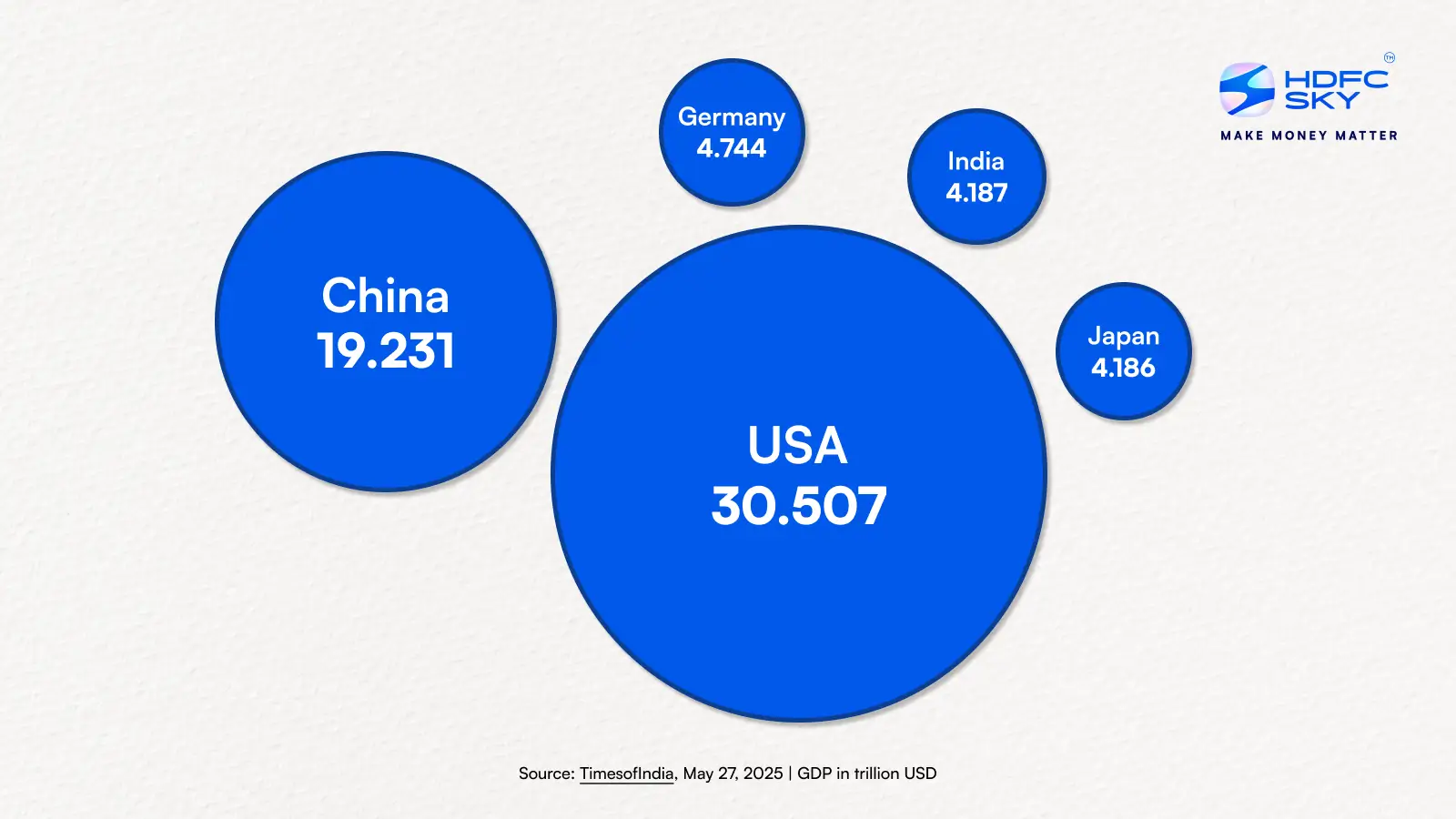
India has officially moved up the global rankings to become the fourth-largest economy in the world, overtaking Japan.
This milestone isn’t just symbolic-it reflects the growing depth and scale of India’s economic activity across sectors like manufacturing, services, and technology.
While India is the third largest economy by purchasing power parity (PPP), this ranking is based on market exchange rates in US dollars, giving a more direct and realistic picture of India’s position in the global economy.

How far India has come over the last 3 decades:
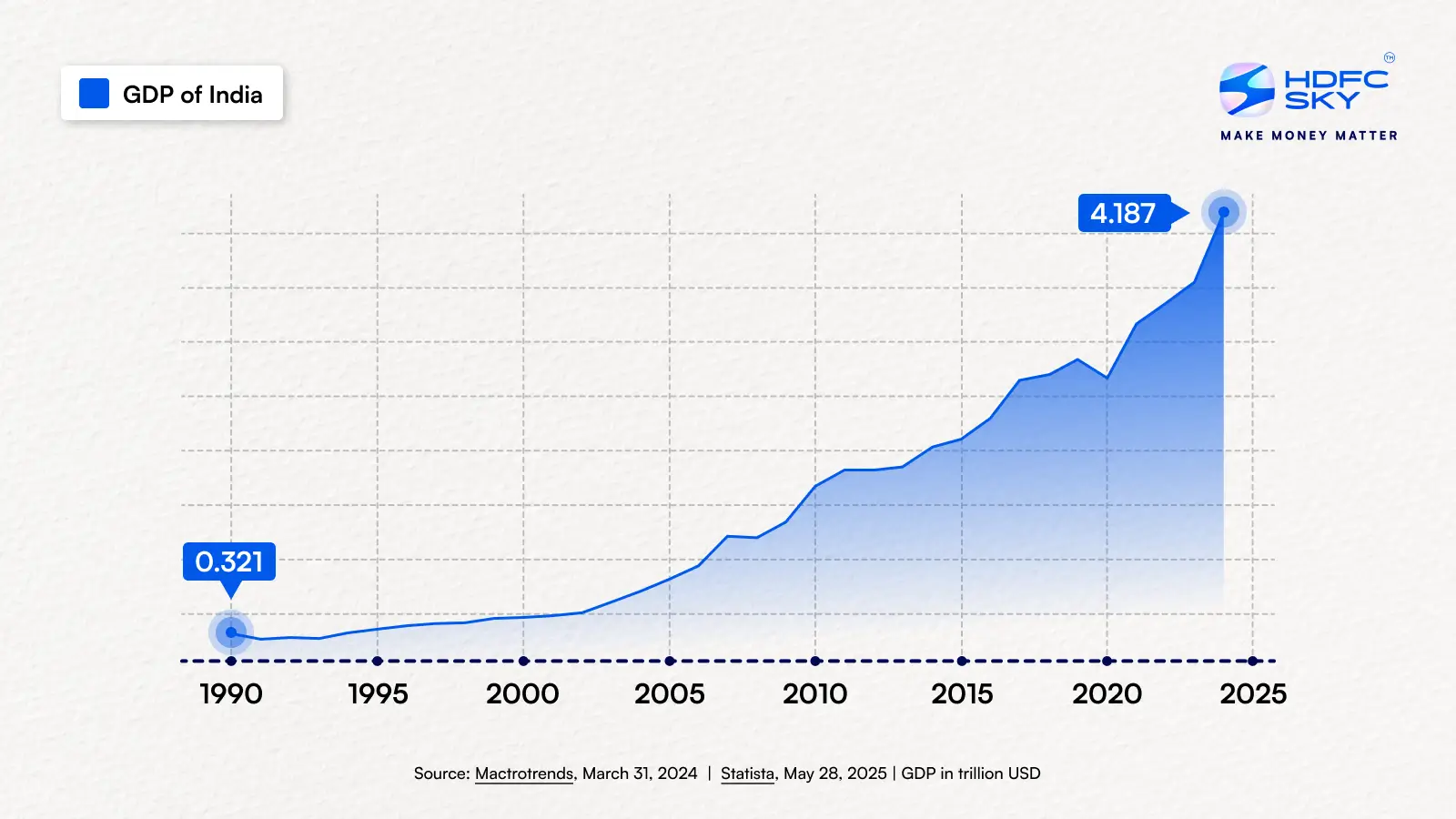
Source: Mactrotrends, March 31, 2024 | Statista, May 28, 2025
Sector wise contribution in India’s GDP
Back in 1950, more than half of India’s GDP came from the primary sector-mainly agriculture. The secondary and tertiary sectors were still in their early stages, contributing just 11.1% and 34.6% respectively.
Fast forward to FY2024, and the picture looks entirely different. The tertiary sector, which includes services like IT, finance, and communications, now makes up 54.9% of India’s GDP.
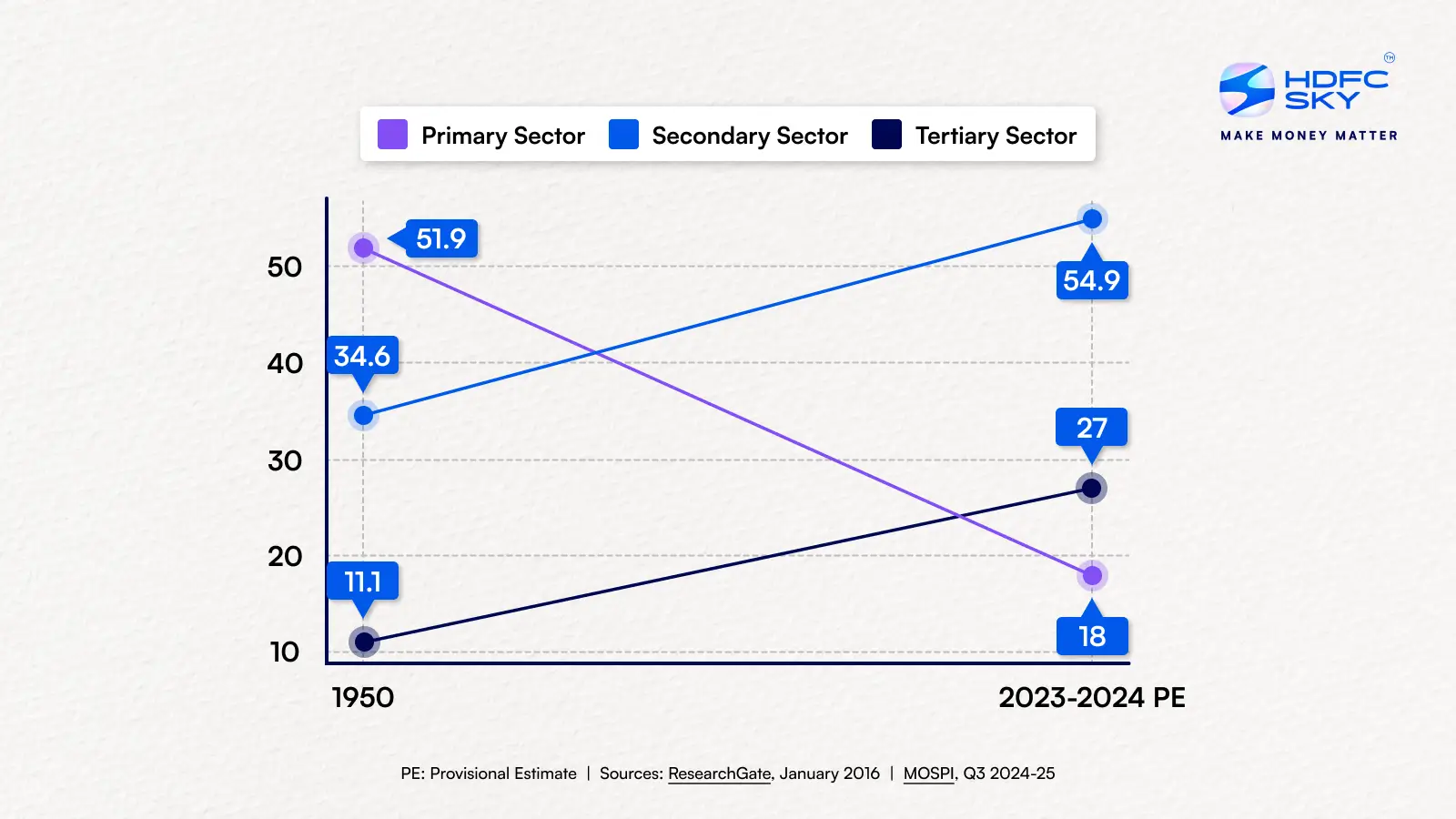
PE: Provisional Estimate | Sources: ResearchGate, January 2016 | MOSPI, Q3 2024-25
Important factors that fueled India’s growth story
This transformation didn’t happen overnight. While well-known drivers like India’s demographic dividend, rising domestic consumption, and supportive policy measures often take the spotlight.
– there’s also a set of quieter, less discussed factors working steadily in the background that have played a crucial role in shaping the country’s growth story.
1. The “Invisible Infrastructure” of India Stack
Most nations invested in physical infrastructure; India quietly built a layered digital public infrastructure (Aadhaar, UPI, DigiLocker, Open Network for Digital Commerce (ONDC)) that functioned like “protocols for commerce”-much like HTTP and TCP/IP did for the internet. This created near-zero marginal cost platforms for payments, identity, and documentation, unlocking scale effects that GDP stats often underestimate.
2. Semi-formalization of the Workforce
India didn’t suddenly formalize jobs-what happened instead was the semi-formalization of gig and blue-collar work via platforms like Swiggy, and ONDC. These workers remained outside traditional PF/ESI nets but became visible to credit systems, insurers, and policy tools, creating consumption and productivity multipliers.
3. Rural-Led Capex Cycle
The post-COVID period saw a silent surge in rural asset creation: borewells, solar pumps, electric two-wheelers, small warehouses. Fueled by DBT savings, MGNREGA wages, and gold loan liquidity, this cycle didn’t look like traditional capex but boosted rural productivity and non-farm income, especially in small districts.
4. Debt Laddering via BNPL and Embedded Credit
The explosion of Buy Now Pay Later (BNPL) and embedded credit in e-commerce and B2B platforms allowed first-time borrowers to ladder up the credit system. This credit-onboarding mechanism quietly pulled millions into formal consumption.
5. India’s Logistics Wasn’t Fixed-It Was Rerouted
Instead of overhauling everything, India bypassed its worst infrastructure by rerouting economic activity around new freight corridors, coastal shipping lanes, and multimodal hubs (like Dadri). The result? Freight cost per tonne-km dropped in key lanes, improving trade competitiveness without needing every road fixed.
Capital Expenditure as a percentage of GDP
After talking about the multiple factors, it’s time to mention the shift in how India approaches public investment now, particularly through Capital Expenditure (CapEx).
It has emerged as a quiet but powerful force behind India’s economic trajectory. Unlike revenue spending, which goes toward short-term needs like salaries or subsidies, CapEx focuses on creating long-term assets -such as highways, rail corridors, ports, and digital infrastructure.
These investments lay the foundation for productivity, improve connectivity, and unlock private sector participation by reducing logistical and operational bottlenecks.
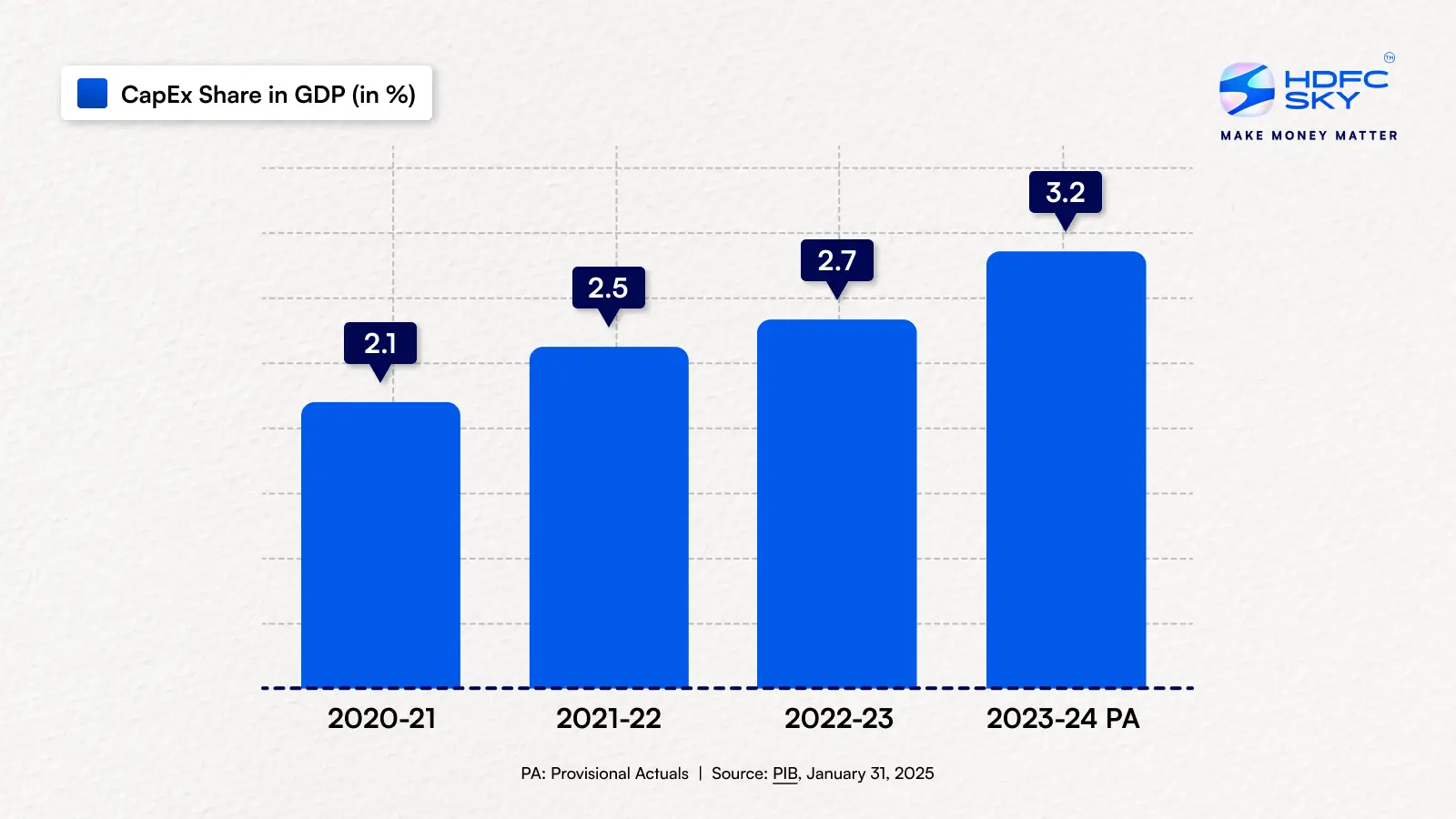
PA: Provisional Actuals | Source: PIB, January 31, 2025
And now what’s the way ahead?
Well, India is on track to become the third-largest economy in the world in the next 2–3 years, overtaking Germany. But here’s the thing: getting there is only part of the journey. The real challenge is in how we get there.
This transition can’t just be about scaling what’s already working. It needs a smarter playbook-one that doesn’t replicate past growth models but rethinks them for India’s unique realities.
That means building “Digital Capillaries” for Rural India, not just highways and ports. Think AI-powered AgriMesh networks for smarter farming, village cloud hubs that offer telemedicine and online learning, and ONDC-backed digital storefronts helping rural entrepreneurs tap into global markets.
And when it comes to infrastructure, it’s time for an innovation loop: borrow, deploy, monetize. Use AI to recycle and repurpose underused assets, create data trusts to unlock hidden value from infra usage, and tie public capex to MSME credit flows to power bottom-up industrialisation.
The opportunity is massive but only if we choose to build differently.
 Join Us
 Add as preferred source on Google


More International News








Open Free Demat Account
Open Free Demat Account











Invest Anytime, Anywhere


By signing up I certify terms, conditions & privacy policy