Nifty 50
- TCS₹2,34293.60 (4.16%)
- ICICI Bank₹1,422.80-20.20 (-1.40%)
- Tech Mahindra₹1,640.9055.90 (3.53%)
- Shriram Finance₹1,086.90-14.10 (-1.28%)
- Infosys₹1,14433.20 (2.99%)
- ITC₹266-3.00 (-1.12%)
- HCL Technologies₹1,316.1034.10 (2.66%)
- UltraTech Cement₹11,589-128.00 (-1.09%)
- Wipro₹180.954.55 (2.58%)
- Asian Paints₹2,608.70-22.30 (-0.85%)
- Bajaj Auto₹11,910190.00 (1.62%)
- SBI Life Insurance ₹1,761.10-12.10 (-0.68%)
- Hindalco Industries₹1,037.4013.40 (1.31%)
- Eicher Motors₹8,059-41.00 (-0.51%)
- HDFC Bank₹720.309.30 (1.31%)
- Maruti Suzuki₹13,376-64.00 (-0.48%)
- Tata Motors PV₹319.403.40 (1.08%)
- Bajaj Finserv₹2,002-9.00 (-0.45%)
- Grasim Industries₹3,29032.00 (0.98%)
- InterGlobe Aviation₹5,166-23.00 (-0.44%)

- Offerings
- Tools & Platforms
Tools & Calculators
- Open API
- Calculators
- SIP Calculator
- CAGR Calculator
- Compound Interest Calculator
- FD Calculator
- RD Calculator
- EPF Calculator
- Retirement Calculator
- HDFC SIP Calculator
- Mutual Fund Return Calculator
- Lumpsum Calculator
- Step Up SIP Calculator
- ETF SIP Calculator
- Brokerage Calculator
- Equity Margin Calculator
- SWP Calculator
- EMI Calculator
- MTF Calculator
- Margin Pledge Calculator
- Markets
Stocks
F&O
Mutual Funds
- More
India's Business Momentum Hits New High In June As Exports Boom: PMI Data
Authored By HDFC SKY | Last Modified: Jan 12, 2026 02:29 PM IST

Open Free Demat Account
Open Free Demat Account
India’s private sector saw a strong pick-up in activity this June, as businesses stepped up production to keep pace with rising demand at home and abroad. A new survey highlighted record growth in export orders and solid job creation across sectors.
Building on this momentum, the HSBC Flash India Composite PMI, compiled by S&P Global, climbed to 61.0 in June, a 14-month high. This marked a notable increase from 59.3 in May, pointing to a sharp rise in overall business activity across both manufacturing and services.
Flash PMI refers to a preliminary estimate of the Purchasing Managers’ Index (PMI) for the month. It is released before the final PMI and provides an early snapshot of economic conditions in sectors like manufacturing, services, or composite (a mix of both).
The HSBC Flash India Composite PMI for June 2025 at 61.0 suggests a strong start to the month’s business performance, ahead of the final confirmation.
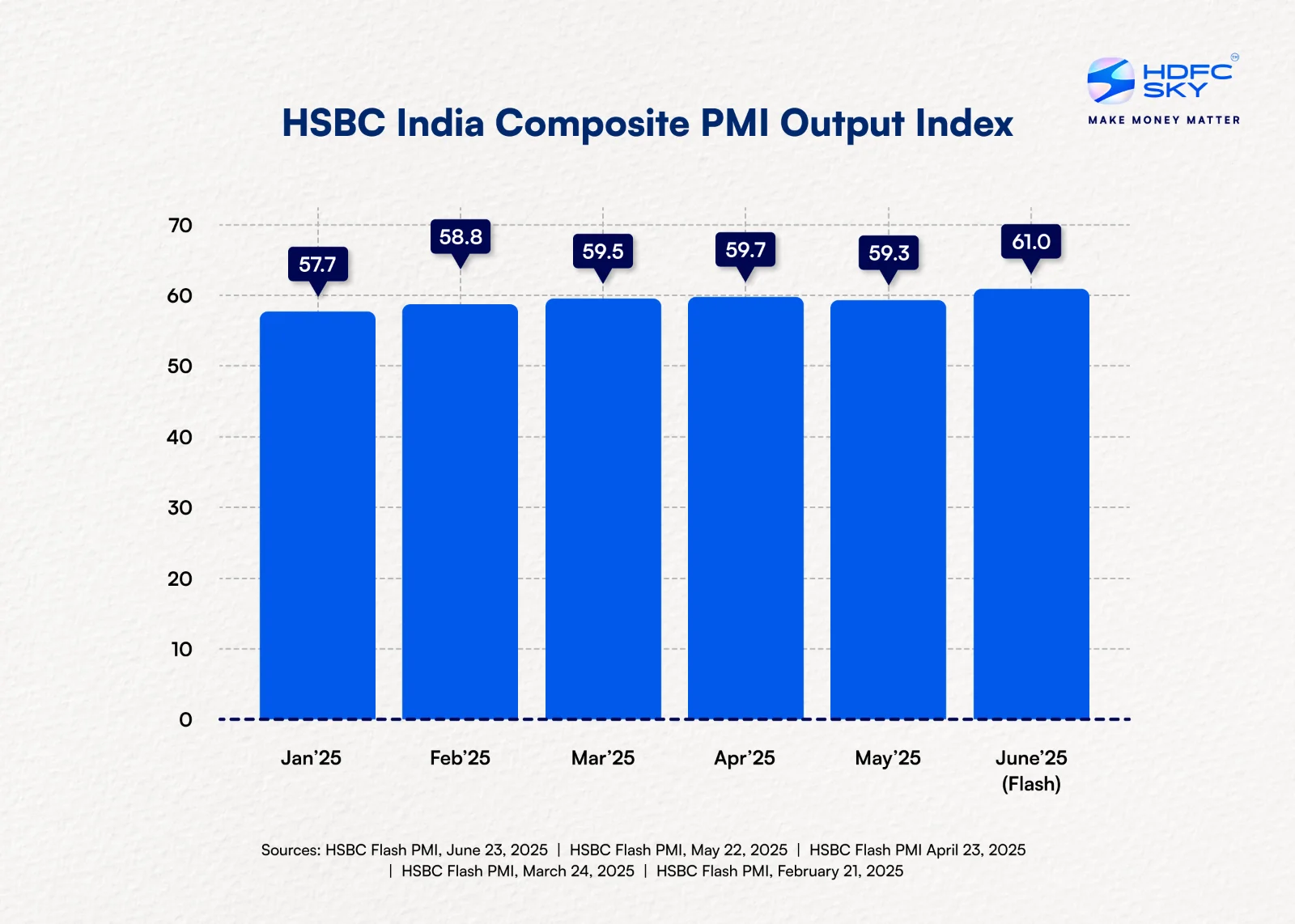
A closer look at the sectoral breakdown reveals more insights.
Both the services and manufacturing sectors gained momentum in June. The services activity index rose to 60.7, up from 58.8 in May, marking the strongest growth since August last year.
On the manufacturing side, the PMI increased to 58.4 June from 57.6 in May, signalling the best improvement in operating conditions since April 2024.
Commenting on the trend, Pranjul Bhandari, Chief India Economist at HSBC, noted that new export orders continued to power India’s private sector growth, especially in the manufacturing space. In fact, the composite new orders index rose at its fastest pace in 11 months, underlining the strength of current demand.
This momentum also reflects India’s structural strengths: a rising working-age population, a rapidly digitising economy, and proactive policy support for manufacturing and exports.

Understanding The Indicators Behind The Surge
To interpret these numbers, it helps to understand the PMI framework itself.
There are two types of PMI:
- Manufacturing PMI
- Services PMI.
Together, they form the Composite PMI, which reflects overall private sector activity.
What Is Manufacturing PMI?
The S&P Global India Manufacturing Purchasing Managers’ Index (PMI) tracks the performance of India’s manufacturing sector through a monthly survey of 500 manufacturing firms. It aggregates five key sub-indices, weighted as follows:
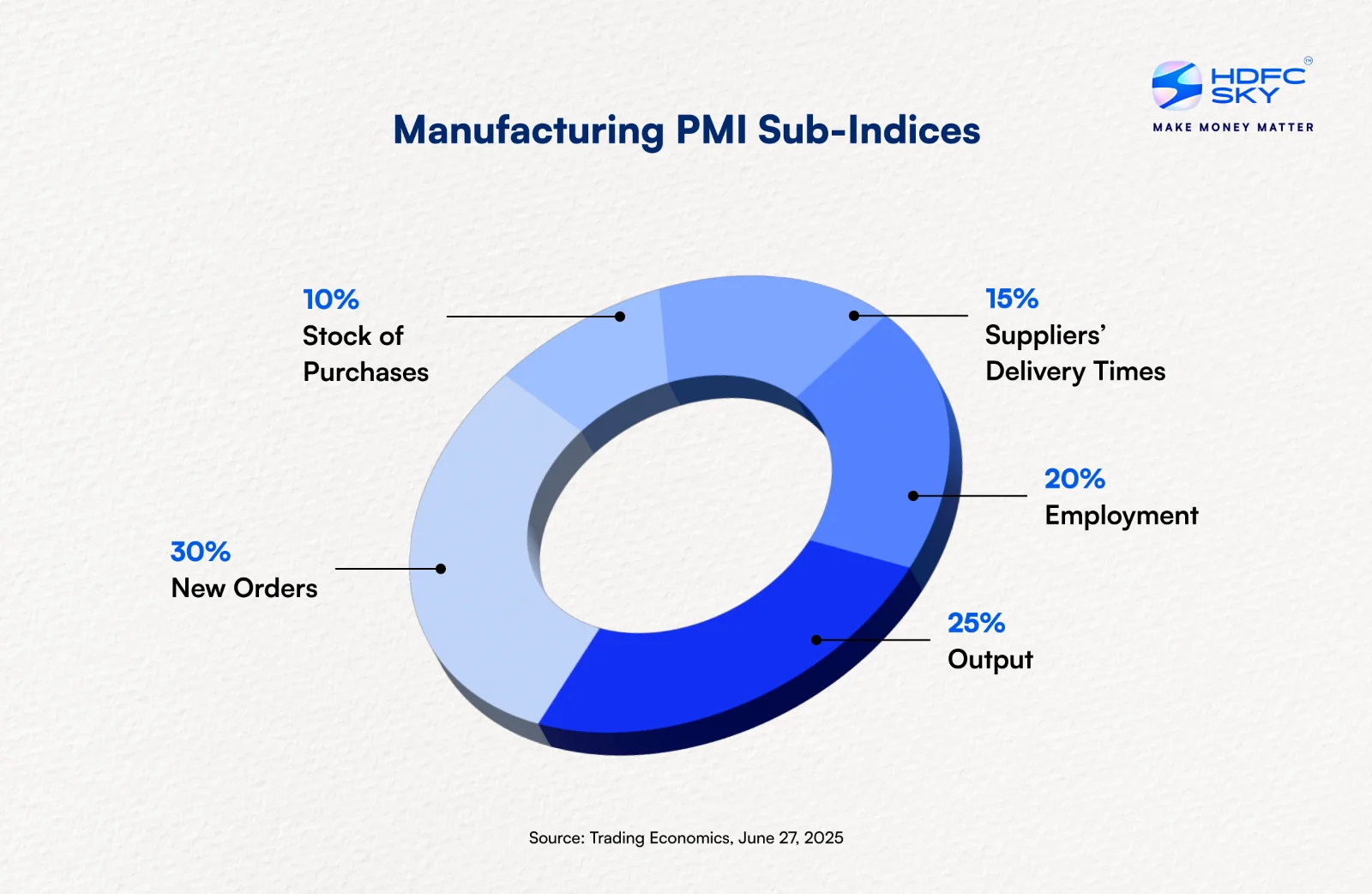
The index is simple to read:
Headline Number is a number between 0 and 100 indicating the overall health of an economy.
- Above 50 indicates expansion
- Below 50 signals contraction
- Exactly 50 reflects no change from the previous month
For example, the HSBC India Manufacturing PMI rose to 58.4 in June 2025 (Flash), which indicates a strong improvement in factory activity.
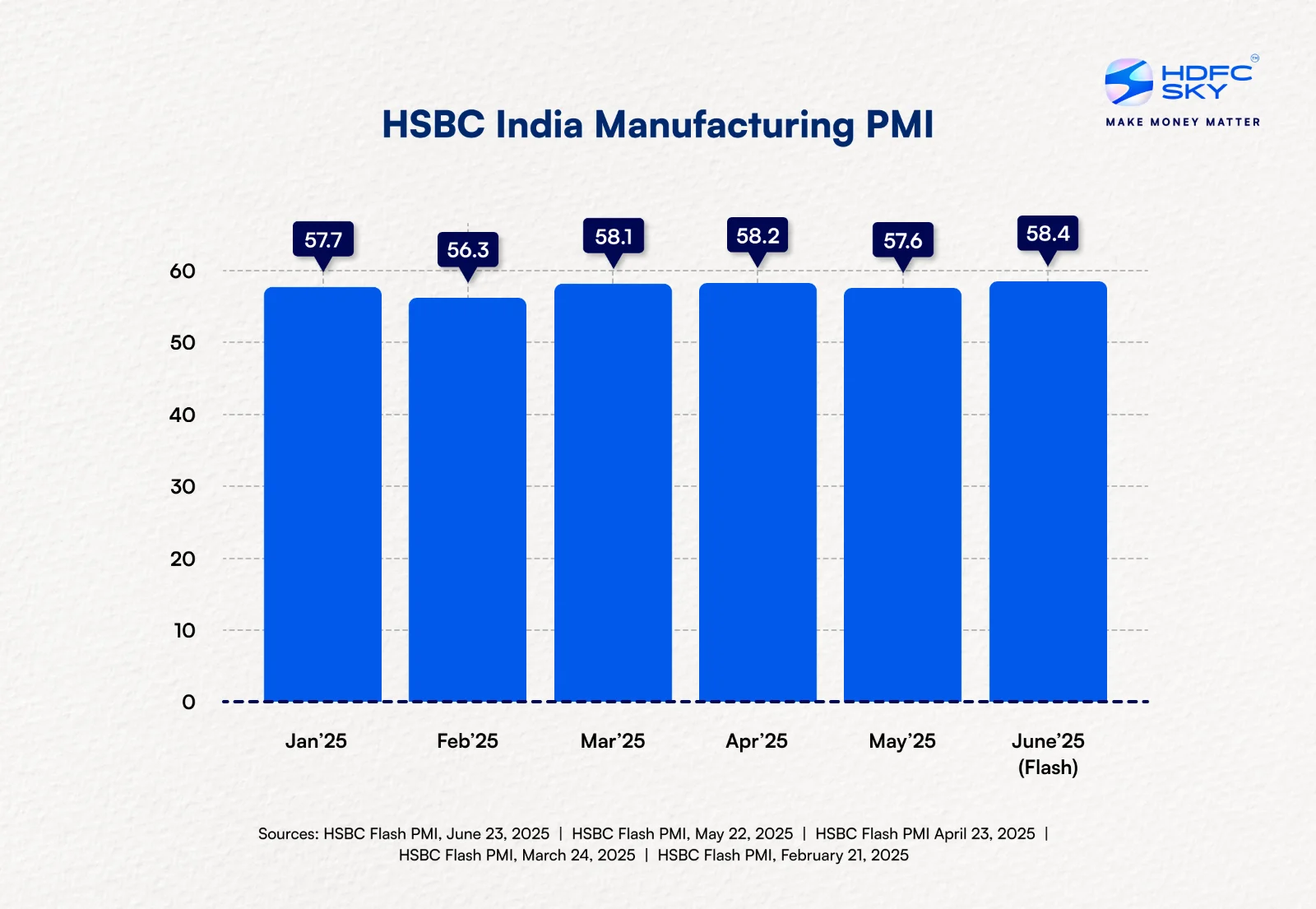
This index serves as a timely indicator of business conditions and overall economic momentum in the manufacturing sector.
What Is Services PMI?
The HSBC Services PMI tracks performance across ~350 private service sector firms, using a structured questionnaire. It measures indicators such as sales, employment, inventories, and prices.
As with reading:
- Above 50 indicates expansion
- Below 50 indicates contraction
For example, the HSBC India Services PMI climbed to 60.7 in June 2025 (Flash). This signals a strong rebound in services activity, driven by rising demand and increased job creation.
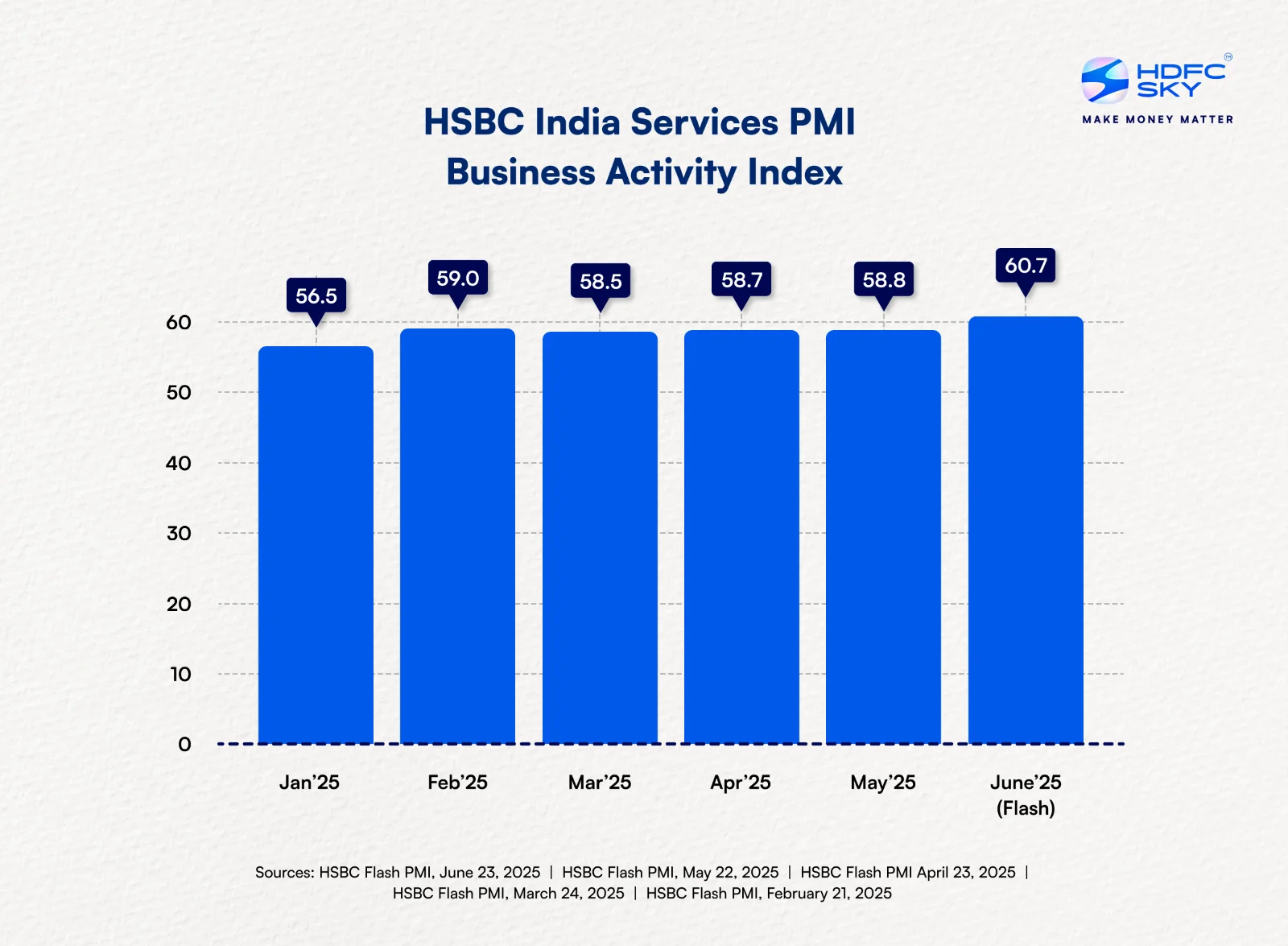
The services PMI is particularly valuable for a country like India, where the services sector contributes significantly to GDP and employment.
Why Does PMI matter?
PMI is a leading indicator, meaning it often moves ahead of broader economic markers like GDP or industrial output.
As GDP data is generally produced quarterly rather than at the PMI’s monthly frequency, the PMI provides an advance guide to each quarter’s GDP number, in most cases being used to anticipate the quarterly or annual rate of change in GDP.
It provides:
- Businesses with insights to align production with future demand
- Economists and policymakers with early signs of growth or slowdown
- Investors with cues on market sentiment and economic health
In short, PMI helps decode the direction the economy is heading, often before other hard data becomes available .
Who Uses The PMI?
PMI isn’t just a tool for economists, it has real-world applications across the business and financial ecosystem. Here’s how different stakeholders use it.
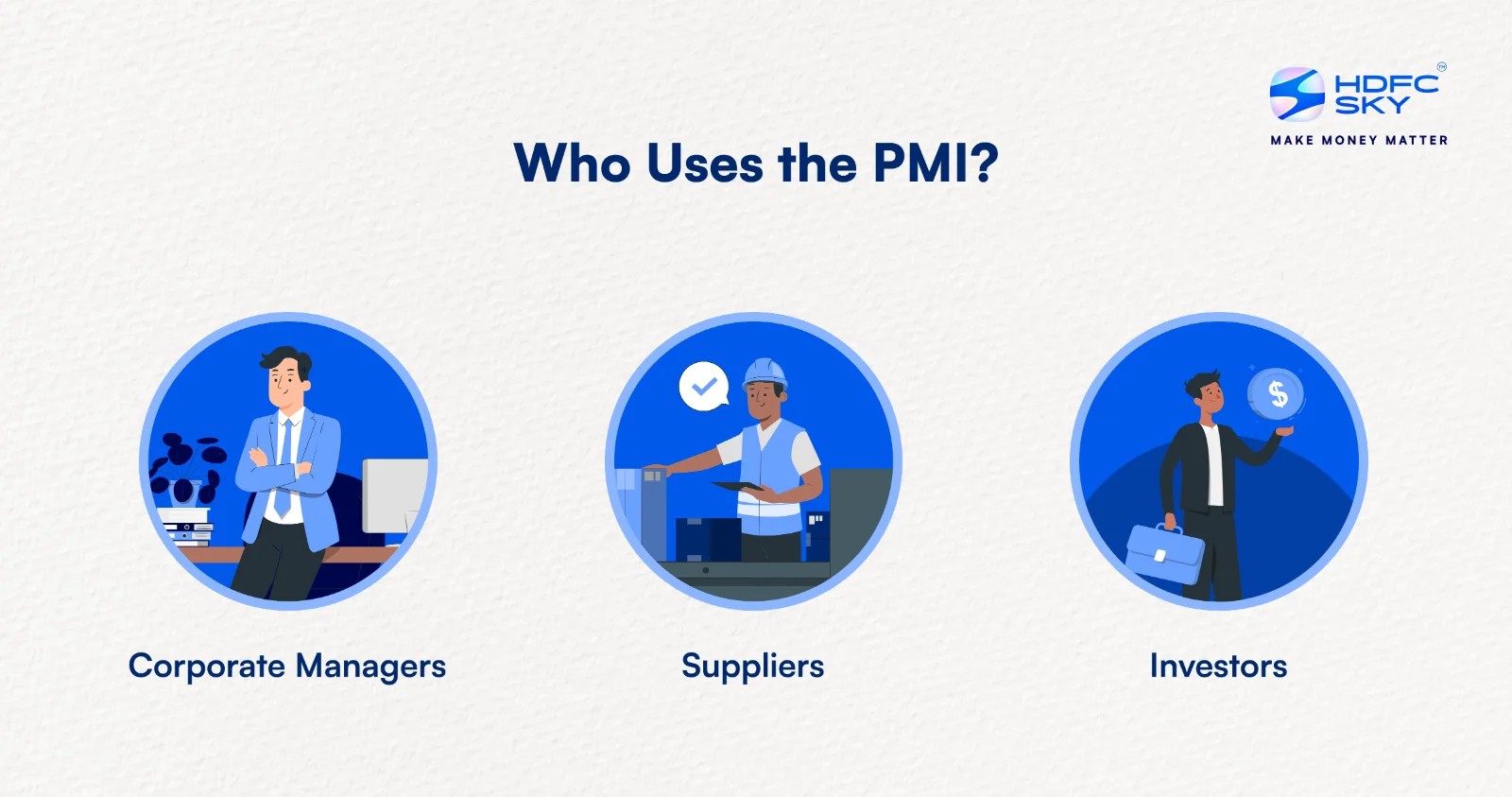
Corporate Managers: Business leaders rely on monthly PMI readings to make strategic decisions. For instance, an automobile manufacturer might adjust production plans based on new orders, which then influence purchases of components and raw materials. PMI trends help managers anticipate demand shifts and align operations accordingly.
Suppliers: For parts suppliers and vendors, the PMI acts as a pulse check on future demand. If manufacturing firms show increased activity, suppliers know they’ll need to ramp up inventory or production to meet upcoming orders. It’s an early signal to plan capacity and logistics.
Investors: To investors and market analysts, PMI serves as a leading economic indicator. It often signals turning points in GDP, industrial output, and employment before they appear in official data. Rising PMI numbers may prompt optimism in equity markets, while declining trends could trigger caution.
Final Thoughts: Reading The Pulse Of India’s Economy
The sharp rise in India’s PMI numbers for June is a reflection of strong demand conditions, growing export momentum, and improving business confidence. With the Composite PMI at a 14-month high, India’s private sector is clearly gaining traction, even as global uncertainties linger.
What makes this surge especially noteworthy is its broad-based nature: both manufacturing and services are expanding at a healthy pace. Record export orders, and a resilient domestic demand point to a maturing recovery that is gaining depth.
As India navigates a complex global environment in 2025, PMI will remain a critical tool for gauging resilience and recovery and if June is any sign, the second half of the year could be poised for continued strength.
However, sustained growth will depend on how global headwinds such as geopolitical tensions, commodity prices, and interest rate trends play out.
For now, though, the PMI data provides encouraging signs that India’s growth engine is not only running but gathering speed.
Disclaimer: At HDFC SKY, we take utmost care and due diligence in curating and presenting news and market-related content. However, inadvertent errors or omissions may occasionally occur.
If you have any concerns, questions, or wish to point out any discrepancies in our content, please feel free to write to us at content@hdfcsec.com
Please note that the information shared is intended solely for informational purposes and does not make any investment recommendations
 Join Us
 Add as preferred source on Google


More Business News








Open Free Demat Account
Open Free Demat Account







Invest Anytime, Anywhere


By signing up I certify terms, conditions & privacy policy