Nifty 50
- TCS₹2,34293.60 (4.16%)
- ICICI Bank₹1,422.80-20.20 (-1.40%)
- Tech Mahindra₹1,640.9055.90 (3.53%)
- Shriram Finance₹1,086.90-14.10 (-1.28%)
- Infosys₹1,14433.20 (2.99%)
- ITC₹266-3.00 (-1.12%)
- HCL Technologies₹1,316.1034.10 (2.66%)
- UltraTech Cement₹11,589-128.00 (-1.09%)
- Wipro₹180.954.55 (2.58%)
- Asian Paints₹2,608.70-22.30 (-0.85%)
- Bajaj Auto₹11,910190.00 (1.62%)
- SBI Life Insurance ₹1,761.10-12.10 (-0.68%)
- Hindalco Industries₹1,037.4013.40 (1.31%)
- Eicher Motors₹8,059-41.00 (-0.51%)
- HDFC Bank₹720.309.30 (1.31%)
- Maruti Suzuki₹13,376-64.00 (-0.48%)
- Tata Motors PV₹319.403.40 (1.08%)
- Bajaj Finserv₹2,002-9.00 (-0.45%)
- Grasim Industries₹3,29032.00 (0.98%)
- InterGlobe Aviation₹5,166-23.00 (-0.44%)

- Offerings
- Tools & Platforms
Tools & Calculators
- Open API
- Calculators
- SIP Calculator
- CAGR Calculator
- Compound Interest Calculator
- FD Calculator
- RD Calculator
- EPF Calculator
- Retirement Calculator
- HDFC SIP Calculator
- Mutual Fund Return Calculator
- Lumpsum Calculator
- Step Up SIP Calculator
- ETF SIP Calculator
- Brokerage Calculator
- Equity Margin Calculator
- SWP Calculator
- EMI Calculator
- MTF Calculator
- Margin Pledge Calculator
- Markets
Stocks
F&O
Mutual Funds
- More
India’s Growth Story In 2025: The Four Pillars Driving The Economy Forward
Authored By HDFC Sky | Last Modified: Jul 14, 2025 01:58 PM IST
Open Free Demat Account
Open Free Demat Account
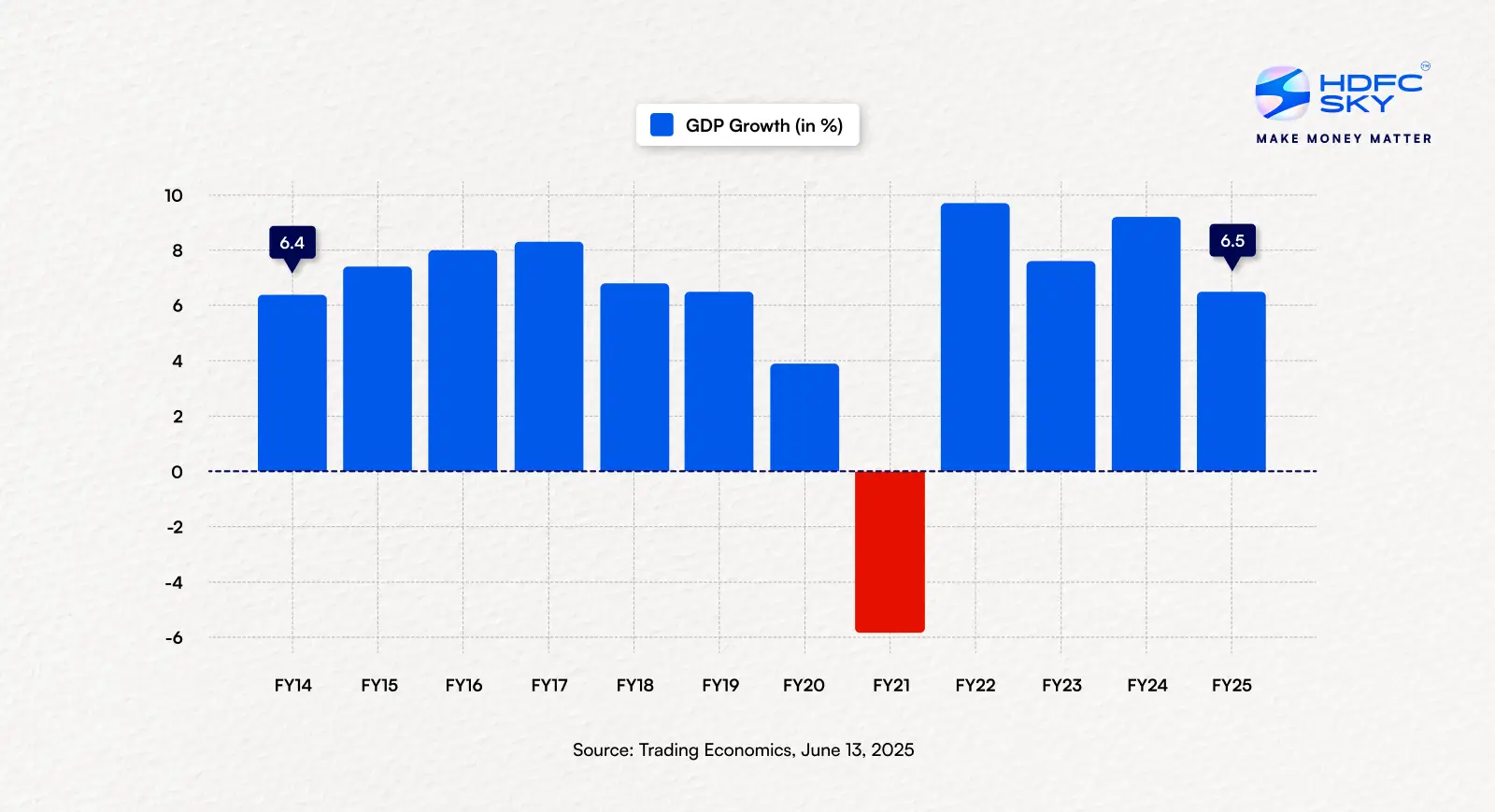
India’s economic engine is still humming, but with a slightly slower rhythm than before. According to the latest reports, GDP growth for FY25 slowed down to 6.5%, the lowest in four years.
This is quite a dip from the 9.2% growth India clocked in FY24. And yet, there’s plenty of reason to stay optimistic.
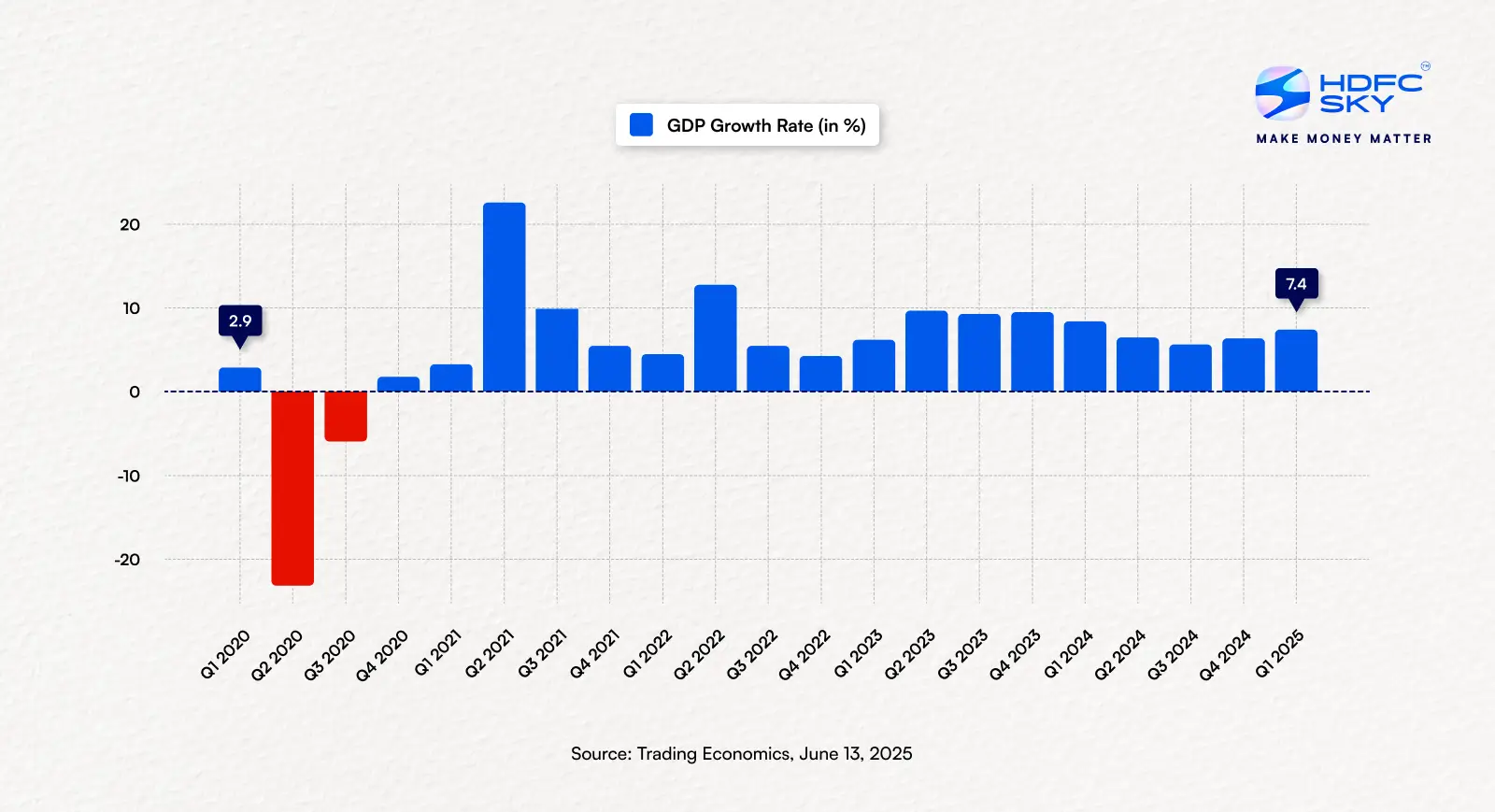
The March quarter of 2025 alone posted a strong 7.4% growth, defying many expectations and proving that the fundamentals of the Indian economy are still solid.
If this momentum continues, we could even achieve the GDP growth rate of 2024 and sustain it.
So what’s powering India’s economy at a time when the global environment is shaky and many major economies are slowing down?
Economists are pointing to four major growth drivers:
- Government spending,
- Rural consumption,
- Low interest rates, and
- A potential revival in consumer demand.

Let’s break these down in simple terms.
1. Government Spending:
In times of uncertainty, when private investment tends to slow down, the government often steps in to keep the economy moving. That’s exactly what’s happening in India right now.
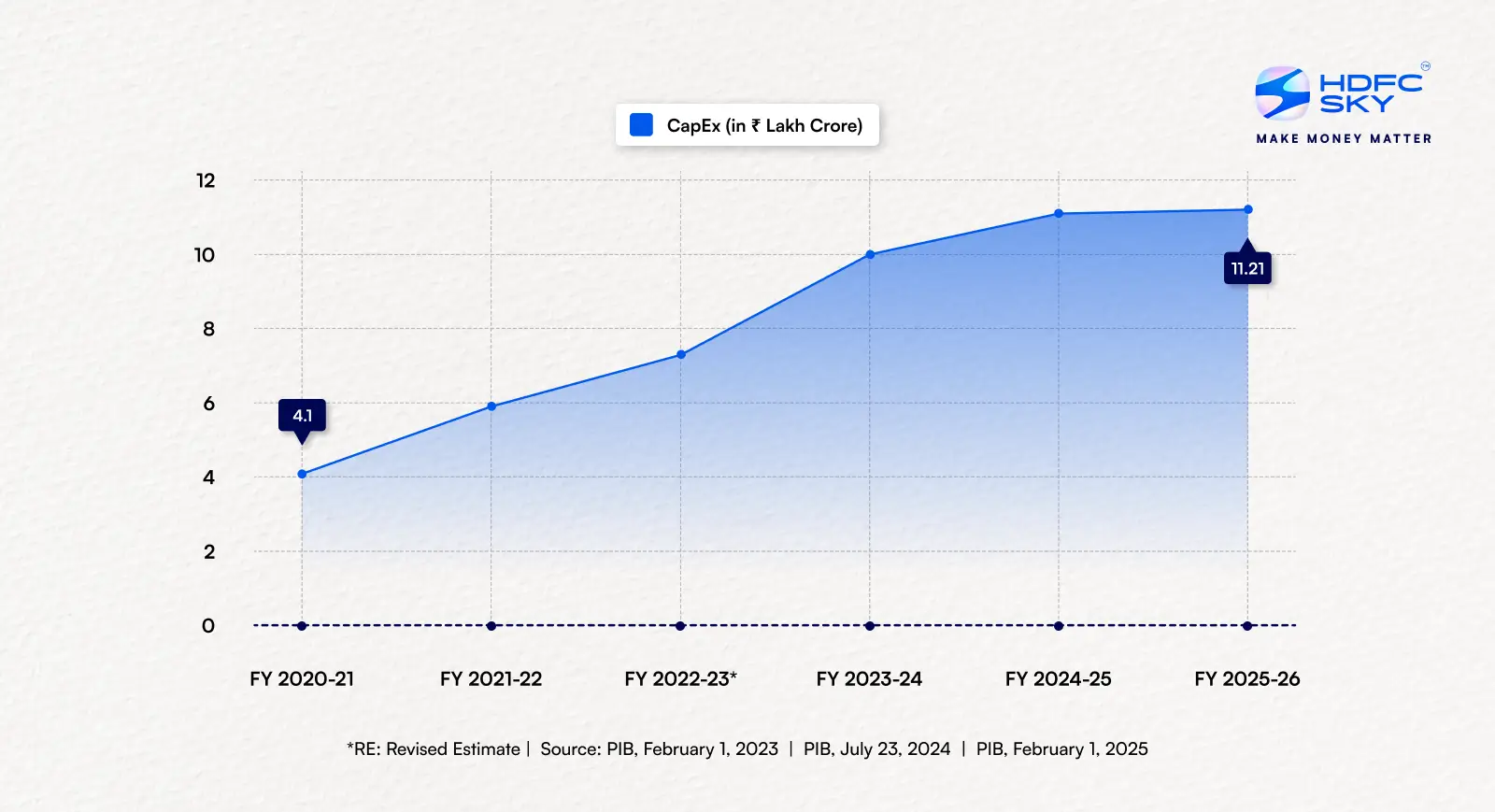
During the January-March quarter, one of the biggest reasons GDP growth picked up was higher government spending. According to a report by ICRA, the central government has budgetary room to spend an additional ₹0.8 trillion in FY26.
If that amount is directed entirely towards capital expenditure (CapEx), the total government capex could rise from ₹11.21 trillion (as budgeted) to ₹12 trillion. This would result in a 14.2% growth in capex, more than double the current rate of 6.6%.
Why does this matter?
Because capex is not just about spending money. It’s about building infrastructure, creating jobs, and stimulating demand across sectors.
It has a strong multiplier effect on the economy.
However, private companies are still cautious about investing, mainly due to concerns about global trade tensions, urban demand, and high US tariffs.
Until that changes, government spending will likely remain the primary fuel for growth.
2. Rural Consumption
While we often talk about metros and big cities, India’s rural economy plays a massive role in driving overall consumption.
And in 2025, rural India is stepping up.
Experts are noticing a trend that rural demand is doing better than urban demand.
After being hit hard by COVID-19 over the last few years, rural areas are now bouncing back, supported by:
- Above-average monsoons, which have boosted farm income.
- Lower inflation, making everyday items more affordable.
- Rising wages, especially after adjusting for inflation.
- Higher sales of tractors and two-wheelers, a strong sign of rural buying confidence.
Interestingly, demand for work under the rural employment scheme has also gone down. That’s not necessarily bad because it could mean that people are finding other, better-paying jobs.
So, while the cities are still waiting for a full recovery, rural India is quietly pushing the economy forward.
3. Low Interest Rates
One of the boldest moves by the Reserve Bank of India (RBI) recently was its decision to cut interest rates by 50 basis points, bringing the repo rate down to 5.5%.
That’s the third rate cut since February.
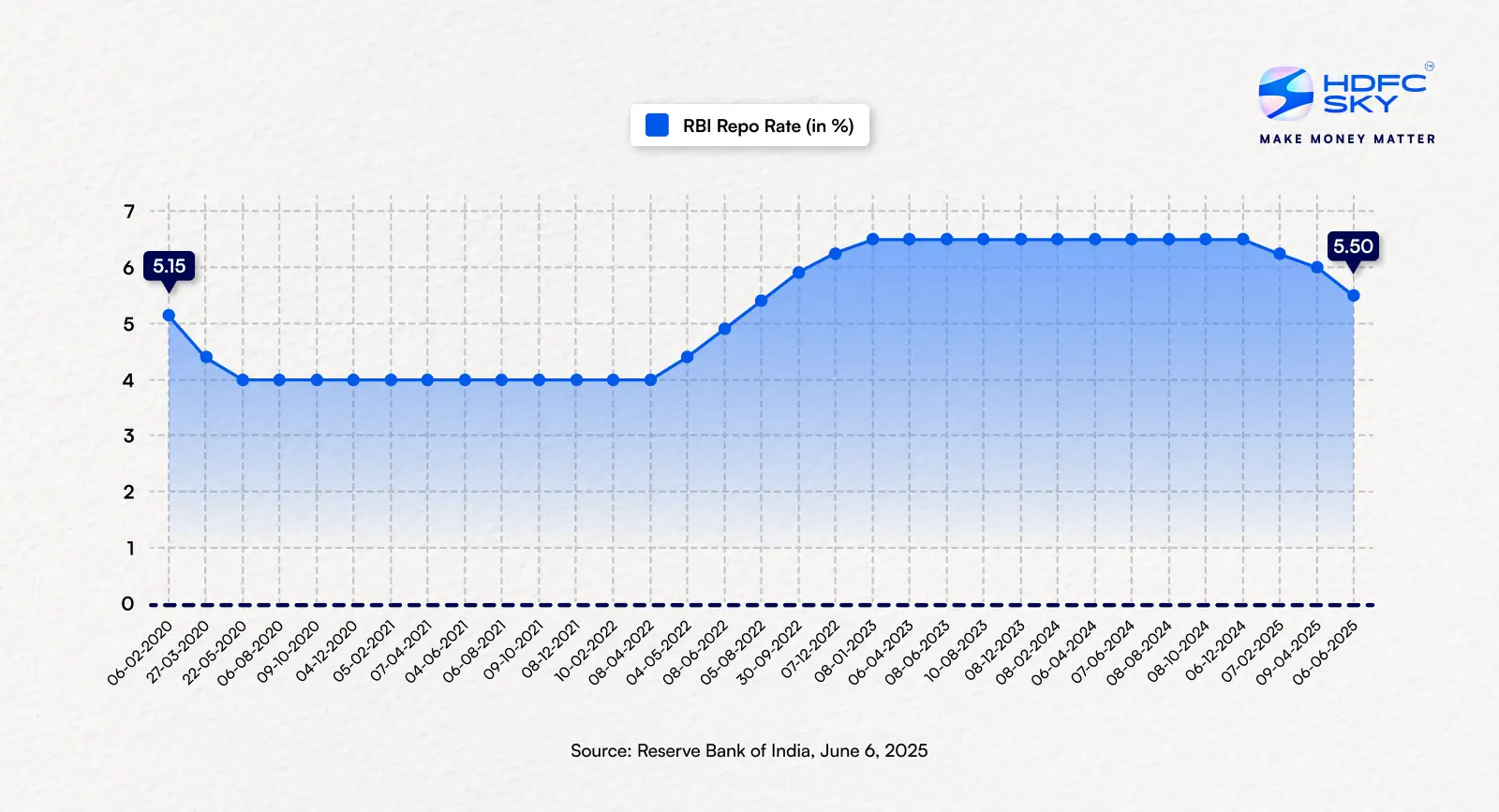
RBI also reduced the Cash Reserve Ratio (CRR), which means banks now have more liquidity to lend.
What does all this mean for the average person and for businesses?
- It’s now cheaper to borrow money whether you’re a business looking to expand or a family planning to buy a home.
- It sends a clear signal that at least for now, the RBI is prioritizing growth over inflation.
- It opens the door for more rate cuts later in the year, especially if inflation remains under control.
So, with lower rates and improved liquidity, we may see more borrowing, more investment, and more economic activity in the coming months.
4. Consumer Demand
Rural demand is already on a strong footing. But what about the cities?
Right now, urban consumption is still lagging behind. But experts believe this won’t last long.
Three big factors could soon revive consumer demand in urban India:
- Tax relief for lower-income groups in the recent Union Budget.
- Softening inflation, which increases purchasing power.
- Lower interest rates, making credit more affordable.
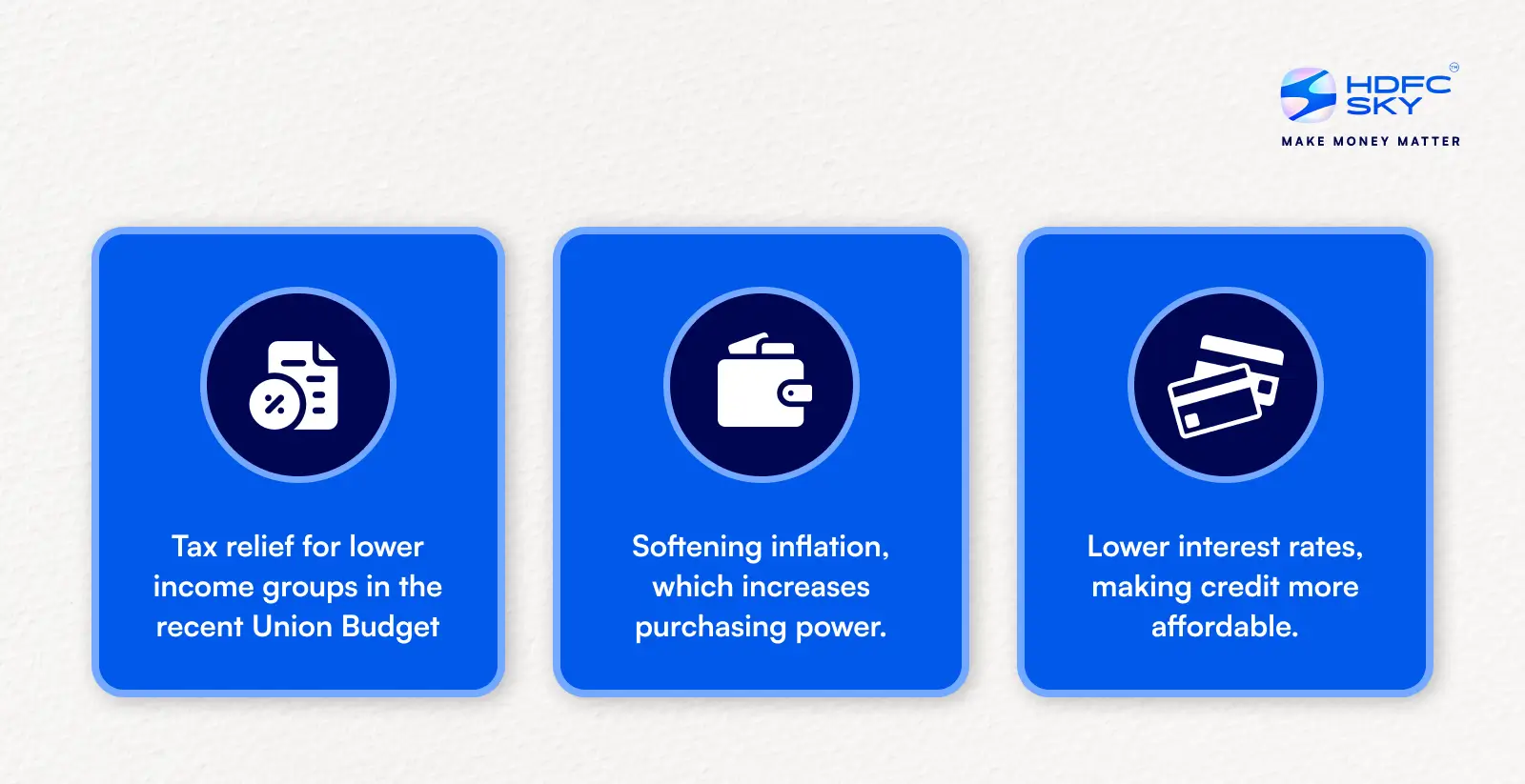
Experts expect a revival in consumption, especially from lower-income and middle-income households.
These were the hardest hit during the pandemic, and they’re now likely to bounce back the fastest.
This K-shaped recovery, where different income groups recover at different speeds, may finally start evening out in 2025. That is important for a balanced economic growth.
Even RBI Governor Malhotra recently pointed out that private consumption, which drives a large part of overall demand, is holding up well. Discretionary spending, things people buy beyond just the essentials, is gradually picking up. That’s a good sign.
He also mentioned that while rural demand holds firm, there are encouraging signs of improvement in urban consumption as well.
And that’s where the real shift could happen. If urban consumers start opening their wallets again, we could see a strong boost in sectors like retail, travel, housing, and electronics.
In other words, if people start spending again, it could give the recovery a real lift.
Wrapping Up
Despite a slowdown to 6.5% GDP growth, India remains the world’s fastest-growing major economy, according to the IMF.
But it’s not going to be an easy ride. Events like global trade tensions, weak private investment, and geopolitical uncertainty could still weigh us down.
Rising prices and unstable global markets could make things harder for our economy. India will also need to be careful about sudden changes from outside that might affect the flow of money and the strength of our currency.
But with the four key drivers, government spending, rural strength, low interest rates, and recovering demand, India has a solid foundation to build upon.
The road ahead will require smart policy moves, continued public investment, and targeted support to revive private investment.
If these pieces come together, India could be looking at not just a strong FY26, but a decade of sustained, inclusive growth.
Disclaimer: At HDFC SKY, we take utmost care and due diligence in curating and presenting news and market-related content. However, inadvertent errors or omissions may occasionally occur.
If you have any concerns, questions, or wish to point out any discrepancies in our content, please feel free to write to us at content@hdfcsec.com.
Please note that the information shared is intended solely for informational purposes and does not make any investment recommendations
 Join Us
 Add as preferred source on Google


More Business News








Open Free Demat Account
Open Free Demat Account







Invest Anytime, Anywhere


By signing up I certify terms, conditions & privacy policy