Pre-Budget Derivative Strategies: Budget 2026
Authored By Prime Research | Last Modified: Jan 30, 2026 04:32 PM IST
The Union Budget 2026 marks Finance Minister Nirmala Sitharaman’s ninth budget presentation. The budget session will unfold in two phases: the first from January 28th to February 13th, 2026, followed by the second from March 9th to April 2, 2026. The finance minister will present the Budget 2026 at 11 AM on February 1 at the Lok Sabha. The BSE and NSE will remain open on February 1, 2026, despite it being a Sunday. This is the first time the Indian Union Budget will be presented on a Sunday in at least a decade.
The 2026 Budget arrives at a pivotal moment, overshadowed by geopolitical instability, tariff-driven market distortions, and an economic slowdown. The union budget is introduced amid rising US trade conflicts under President Trump, which have levied tariffs of up to 50% on Indian exports. India is seeking to adjust trade policies to strengthen supply chains, support exporters, and maintain a GDP growth of 6.5-7% despite global tensions and pressures on the rupee.
The Union Budget 2026 is anticipated to prioritise economic stability by boosting public consumption, streamlining compliance, and providing incentives alongside infrastructure support for manufacturing, agriculture, green energy, MSMEs and AI/robotics technologies.
The upcoming Budget holds high significance for the capital markets If there is any tinkering with the tax rates with respect to LTCG or STCG. However, as the government has emphasized tax rationalisation with changes to capital gains tax in budget 2024, we expect only minor adjustments, if any, rather than any sweeping structural shifts. Depending on the budgetary announcements, Nifty may swing wildly on either side.
Though our markets have corrected more than 4% from the recent all-time high of 26373, they have risen more than two hundred per cent (230%) from the March 2020 lows and 65% from the June 2022 lows. Moreover, domestic indices have underperformed global peers recently due to relentless selling by Foreign Institutional Investors (FIIs) and trade deal-related uncertainties. Therefore, risk management becomes crucial in this environment.
Therefore, for long term investors who are fully invested, it is advisable to hedge your portfolio (full or partial) ahead of such big events. This can be done by buying Nifty Put Options. However, one should understand that hedging is like an Insurance, which comes with some cost(Premium).
For traders who understand derivatives (Risks and Rewards) and would like to take advantage of expected volatility arising from budget announcements, may implement the trading strategy we prescribe in this report
Derivative Strategy: For Investors Holding Large Portfolio
- For Investors who understand derivatives and want to protect their portfolio against the volatility expected from the Union Budget 2026
- The current market environment necessitates a proactive approach to portfolio protection. Despite a recent 4-5% correction from peak levels, the market remains at a significantly elevated stage, having surged more than 230% from March 2020 lows and 65% from June 2022 levels.
- Our markets have been underperforming global markets since last few quarters and If there are any major budgetary announcements related to capital
markets, there could be a lot of volatility in the Markets depending on the announcements from the budget. However, with notable changes to capital
gains tax in 2024, expectations are for only minor adjustments, if any, rather than major structural shifts in rates. - For large portfolio investors, implementing a hedging strategy through Nifty Put Options presents a prudent risk management approach.
- STRATEGY: BUY NIFTY 25500 PUT AT Rs 210 (03 FEB EXPIRY). LOT SIZE 65. CONTRACT VALUE Rs. 16,57,500
- The quantity of Put options that need to be bought will vary depending on the size and composition of the portfolio.
- Large cap Portfolio: A portfolio with predominantly large cap stocks is likely to move in sync with Index. (Beta around 1). Assuming the size of the portfolio is Rs 1 Cr, one need to buy 6 lots (100 lakh/16.25 lakh) of Nifty 25500 Put options.
- The cost of hedging Rs. 1 Cr portfolio will be approximately Rs. 0.82 lakhs (0.8% of portfolio value at Nifty 25500 levels).
Derivative Strategy For Traders: Nifty Long Butterfly With Calls
For Traders who understand derivatives (Risks and Rewards) and like to take advantage of volatility on account budget announcements.
LONG BUTTERFLY WITH CALLS:
We recommend a Long Butterfly Strategy for traders. A long butterfly spread with Calls is a three-leg strategy that is created by buying one call at a lower strike price,
selling two Calls with a higher strike price and buying one Call with an even higher strike price. It is to be used when one expects volatility will fall, and the price will stay in a narrow range.
Here’s the rationale:
- In the options segment, aggressive put writing is seen at the 25200-25300 level(03-Feb-Expiry), suggesting strong support around those levels. On the other hand, resistances are placed around 25700-25800 where calls have been written.
- The FIIs’ long-to-short ratio in index futures is placed at 0.14 levels, suggesting FIIS are holding their aggressive shorts. However, if there are any positive announcements in budget, we might see short covering from their side which augurs well for the markets in the coming days.
- Current Options IVs (14%) are lower than the 5-year average of 20.6% (two days before the Budget).
- Historical data from the past 10 years shows that IVs drop significantly on Budget Day (refer to slides 7 & 8).
- If IVs decline after the Budget announcements, it will favor the Long Butterfly Strategy.
- Based on options data, Nifty is expected to remain within the 25200–25800 range until the 03 Feb expiry
| STRATEGY | INDEX | NAME OF THE STRATEGY | OUTLOOK | LEG 1 | LEG 2 | LEG 3 | MAX PROFIT (Rs per lot) | MAX LOSS (Rs per lot) |
| 1 | NIFTY | LONG BUTTERFLY WITH CALLS | MODERATELY BULLISH | BUY 1 LOT 25200 CALL AT 344 (03‑Feb‑Expiry) | SELL 2 LOTS 25500 CALL AT 162 (03‑Feb‑Expiry) | BUY 1 LOT 25800 CALL AT 60 (03‑Feb‑Expiry) | 14300 | 5200 |
Strategy: Nifty Long Butterfly with Calls (Mildly Bullish)
Why Choose This Strategy?
Current options data suggests a tight range of 25200-25800, aligning with the butterfly’s structure. Historical data shows a drop in IVs after budget announcements, making this strategy beneficial. It allows traders to benefit from a mild bullish bias while limiting downside risk.
NIFTY(CMP 2) Lot size 65 EXPIRY (03 FEB)
- Leg 1 : Buy 1 Lot NIFTY 25200 CALL at Rs 344
- Leg 2 : Sell 2 Lot NIFTY 25500 CALL at Rs 162
- Leg 3 : Buy 1 Lot NIFTY 25800 CALL at Rs 60
- Max Risk Reward Ratio: 1:2.75
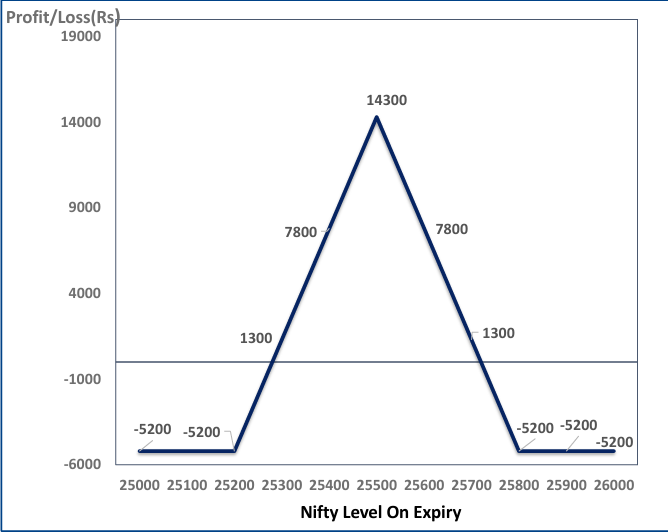
- Upper Breakeven Points: 25720. Lower Breakeven Points – 25280
Maximum Profit Rs 14300 If Nifty closes at 25500. Maximum loss of Rs 5200. Approx. Margin requirement : Rs 71000
Source: HSL Pre Budget Report 30 Jan 2026
 Join Us
 Add as preferred source on Google