Nifty 50
- TCS₹2,34293.60 (4.16%)
- ICICI Bank₹1,422.80-20.20 (-1.40%)
- Tech Mahindra₹1,640.9055.90 (3.53%)
- Shriram Finance₹1,086.90-14.10 (-1.28%)
- Infosys₹1,14433.20 (2.99%)
- ITC₹266-3.00 (-1.12%)
- HCL Technologies₹1,316.1034.10 (2.66%)
- UltraTech Cement₹11,589-128.00 (-1.09%)
- Wipro₹180.954.55 (2.58%)
- Asian Paints₹2,608.70-22.30 (-0.85%)
- Bajaj Auto₹11,910190.00 (1.62%)
- SBI Life Insurance ₹1,761.10-12.10 (-0.68%)
- Hindalco Industries₹1,037.4013.40 (1.31%)
- Eicher Motors₹8,059-41.00 (-0.51%)
- HDFC Bank₹720.309.30 (1.31%)
- Maruti Suzuki₹13,376-64.00 (-0.48%)
- Tata Motors PV₹319.403.40 (1.08%)
- Bajaj Finserv₹2,002-9.00 (-0.45%)
- Grasim Industries₹3,29032.00 (0.98%)
- InterGlobe Aviation₹5,166-23.00 (-0.44%)

- Offerings
- Tools & Platforms
Tools & Calculators
- Open API
- Calculators
- SIP Calculator
- CAGR Calculator
- Compound Interest Calculator
- FD Calculator
- RD Calculator
- EPF Calculator
- Retirement Calculator
- HDFC SIP Calculator
- Mutual Fund Return Calculator
- Lumpsum Calculator
- Step Up SIP Calculator
- ETF SIP Calculator
- Brokerage Calculator
- Equity Margin Calculator
- SWP Calculator
- EMI Calculator
- MTF Calculator
- Margin Pledge Calculator
- Markets
Stocks
F&O
Mutual Funds
- More
Could India’s Exit from Russian Crude Set Off a $200 Oil Shock?
Authored By Shishta Dutta | Published at: Oct 3, 2025 06:09 PM IST
Open Free Demat Account
Open Free Demat Account
India sits at the center of a global energy puzzle. The country has quickly become the biggest buyer of discounted Russian crude and is now reshaping trade flows and easing its import bill. This “import bill” refers to the total amount of money the country spends on importing crude oil and petroleum products from other countries.
The shift has also contributed to stabilizing international crude benchmarks. Now, the U.S. has increased pressure by doubling tariffs on many Indian exports. That pressure could force India to rethink its choices. Experts warn that if New Delhi stops buying Russian crude, the world could face a huge supply shortage and rising oil prices.

India’s Oil Dependency
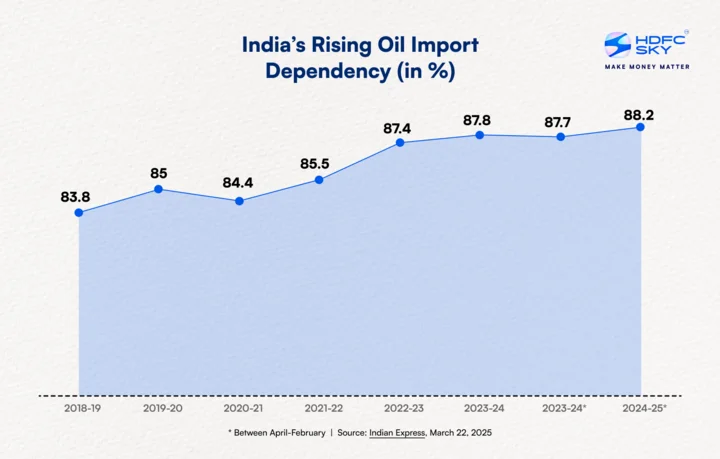
India imports about 85-90% of its crude oil needs. It also runs a massive refining network that can handle different grades of oil. The country’s total refining capacity is about 5.2 million barrels per day (bpd) . The Jamnagar refinery alone can process about 1.24 million bpd.
Before the war, in 2021, India imported only about 100,000 bpd of Russian crude. This jump came for two reasons. First, Moscow offered deep discounts after losing Western buyers. Second, Indian refiners adjusted operations to handle more medium-sour crudes.
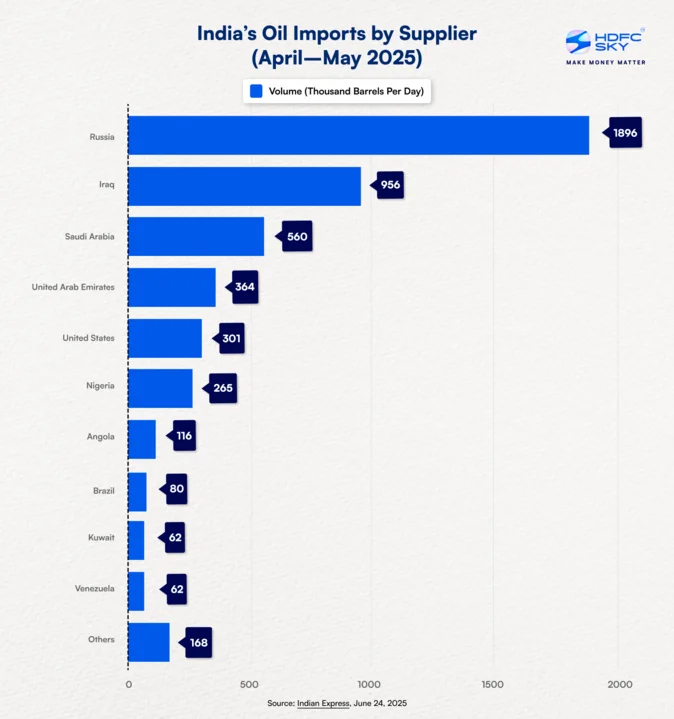
India moved from barely importing Russian crude to sourcing 36-40% of its oil from Russia in 2024-25. That comes to 1.796 million barrels per day in 2025. These purchases stabilized global supply after the Russia-Ukraine war and helped India cut its import bill.
Why Russian Crude Fits India’s Refineries
Indian refineries are designed to handle higher-sulfur , medium-sour crudes, similar to what the Persian Gulf supplies. Russia’s Urals grade fits this setup well. Complex refineries in India can process these grades to produce diesel, gasoline, and fuel oil at good yields.
Russian crude also came with flexible terms. Most shipments were sold on a spot basis , allowing price and delivery negotiations. This was different from long-term contracts that dominate Middle Eastern supply. The discounts and flexible deals made Russian cargoes appealing, even though shipping routes from the Baltic and Black Seas were longer.
The Economic Math for India
Reports often suggested India made exceptional economic gains, but the actual net economic benefit is lower. Brokerage CLSA estimated the net annual gain at about $2.5 billion . That figure is far lower than the claims of $10-25 billion .
The research shows discounts shrink once costs like shipping, insurance, and reinsurance are included, especially with CIF (cost, insurance and freight) contracts. The average discount fell from about $8.5 per barrel in FY24 to $3-5 in FY25 . Recently, it narrowed to just $1.5 . With discounts this small, India’s projected annual savings may decline to approximately $1 billion .
However, any disruption in Russian oil supplies could push crude prices up by $10-15 per barrel. The market has consistently reacted with volatility whenever concerns over Russian export sanctions have surfaced.
The Geopolitical and Policy Squeeze
The U.S. has hardened its stance. It first imposed a 25% tariff on several Indian exports, then raised it to 50% . The sectors hit include textiles, gems, footwear, and leather .
These tariffs are meant to impose trade penalties linked to India’s Russian crude procurement. India argues its purchases are compliant with G7 price cap regulations. It points to the G7’s price cap introduced in 2022, which allowed Russian crude to be sold legally if priced under $60 per barrel . India continues to defend the policy, saying it protects Indian consumers and helps stabilize global markets.
What Happens if India Stops Buying Russian Oil?
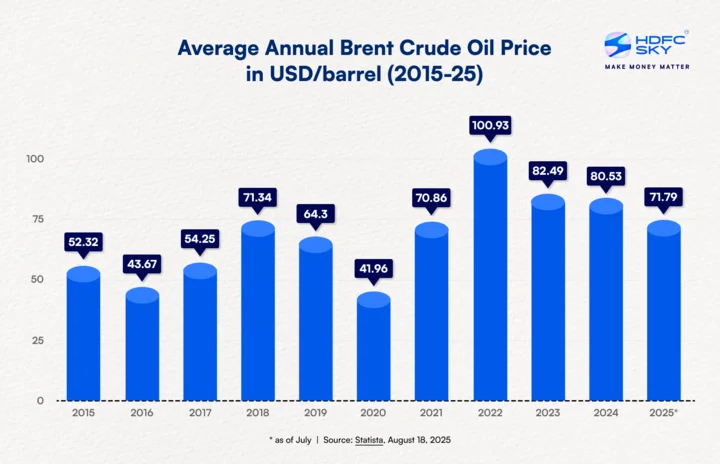
If India pulls out, about 1 million barrels per day (BPD) of Russian crude, nearly 1% of global supply, would lose its main buyer . This could cause short-term market disruption. Analysts predict crude could shoot up to $90-100 per barrel .
Dr. Sajjid Chinoy of JP Morgan explained that diverting India’s 1.7 million bpd of Russian intake back into the open market would create a severe shortage. Neither OPEC nor U.S. shale could increase output fast enough. That would push prices beyond $90 per barrel and damage the global economy.
Substitution Options and Limits
Switching to another supplier is not easy for India. Middle Eastern supplies are tied up in long-term contracts . U.S. crude is lighter and sweeter, a poor match for India’s refinery slate. In 2025 (January-July) , India imported only about 285,000 BPD of U.S. oil.
West African and South American crudes offer some flexibility , but rerouting those barrels could displace other buyers and raise costs. India’s crude import bill for FY 2023-24 was about $132–140 billion . Even small price changes have a significant effect on the national import expenditure.
India’s current account deficit is low, and inflation is low as well, which gives some resilience. But a sudden oil price spike would pressure the Reserve Bank of India . The RBI would face a policy trade-off between inflation targeting and sustaining GDP growth.
The decision to keep buying Russian crude is not only about saving money. It reflects refinery needs, logistical realities, and geopolitical choices.
Probability and Near-Term Outlook
Most experts expect India to keep buying Russian crude. Purchases are unlikely to stop unless India issues a clear policy directive or trade economics shift .
Indian firms are still releasing tenders to buy crude. Traders even expect imports from Russia to rise in September. At the same time, the EU’s tighter price cap of $47.60 , effective September 2, makes deals more complex when prices exceed that level. This will shape oil flows in the near term.
Conclusion
India’s shift to Russian oil has protected its economy while reshaping crude sourcing and sending a clear political signal.
The fiscal savings are modest compared to media claims, but external pressures are intensifying. Higher U.S. tariffs and stricter European rules now risk unsettling this balance. If India stops buying Russian oil, it would likely create a global oil shortage. Oil prices would surge sharply, leading to inflation everywhere.
Going forward, India must weigh its domestic energy security, refinery needs, and the competing demands of global partners.
Disclaimer: At HDFC SKY, we take utmost care and due diligence in curating and presenting news and market-related content. However, inadvertent errors or omissions may occasionally occur.
If you have any concerns, questions, or wish to point out any discrepancies in our content, please feel free to write to us at content@hdfcsec.com.
Please note that the information shared is intended solely for informational purposes and does not make any investment recommendations
 Join Us
 Add as preferred source on Google


More Business News







Open Free Demat Account
Open Free Demat Account






Invest Anytime, Anywhere


By signing up I certify terms, conditions & privacy policy