Nifty 50
- JSW Steel₹1,241.3025.00 (2.06%)
- Axis Bank₹1,236-54.00 (-4.19%)
- ONGC₹2253.00 (1.35%)
- Tata Motors PV₹278-8.85 (-3.09%)
- SBI₹973.7011.10 (1.15%)
- Infosys₹1,130.70-30.50 (-2.63%)
- L&T₹3,661.9034.80 (0.96%)
- Bajaj Finance₹957.35-24.75 (-2.52%)
- Eicher Motors₹7,34964.50 (0.89%)
- Apollo Hospitals₹7,700-190.00 (-2.41%)
- Adani Ports₹1,76615.20 (0.87%)
- UltraTech Cement₹10,650-257.00 (-2.36%)
- Dr. Reddy's Labs₹1,242.509.50 (0.77%)
- HDFC Bank₹712-16.85 (-2.31%)
- InterGlobe Aviation₹4,70013.10 (0.28%)
- Trent₹2,891.60-67.10 (-2.27%)
- Bharat Electronics₹377.200.35 (0.09%)
- Hindustan Unilever₹1,853.20-40.60 (-2.14%)
- NTPC₹309-6.15 (-1.95%)

- Offerings
- Tools & Platforms
Tools & Calculators
- Open API
- Calculators
- SIP Calculator
- CAGR Calculator
- Compound Interest Calculator
- FD Calculator
- RD Calculator
- EPF Calculator
- Retirement Calculator
- HDFC SIP Calculator
- Mutual Fund Return Calculator
- Lumpsum Calculator
- Step Up SIP Calculator
- ETF SIP Calculator
- Brokerage Calculator
- Equity Margin Calculator
- SWP Calculator
- EMI Calculator
- MTF Calculator
- Margin Pledge Calculator
- Algo Strategy
- Markets
Stocks
F&O
Mutual Funds
- More
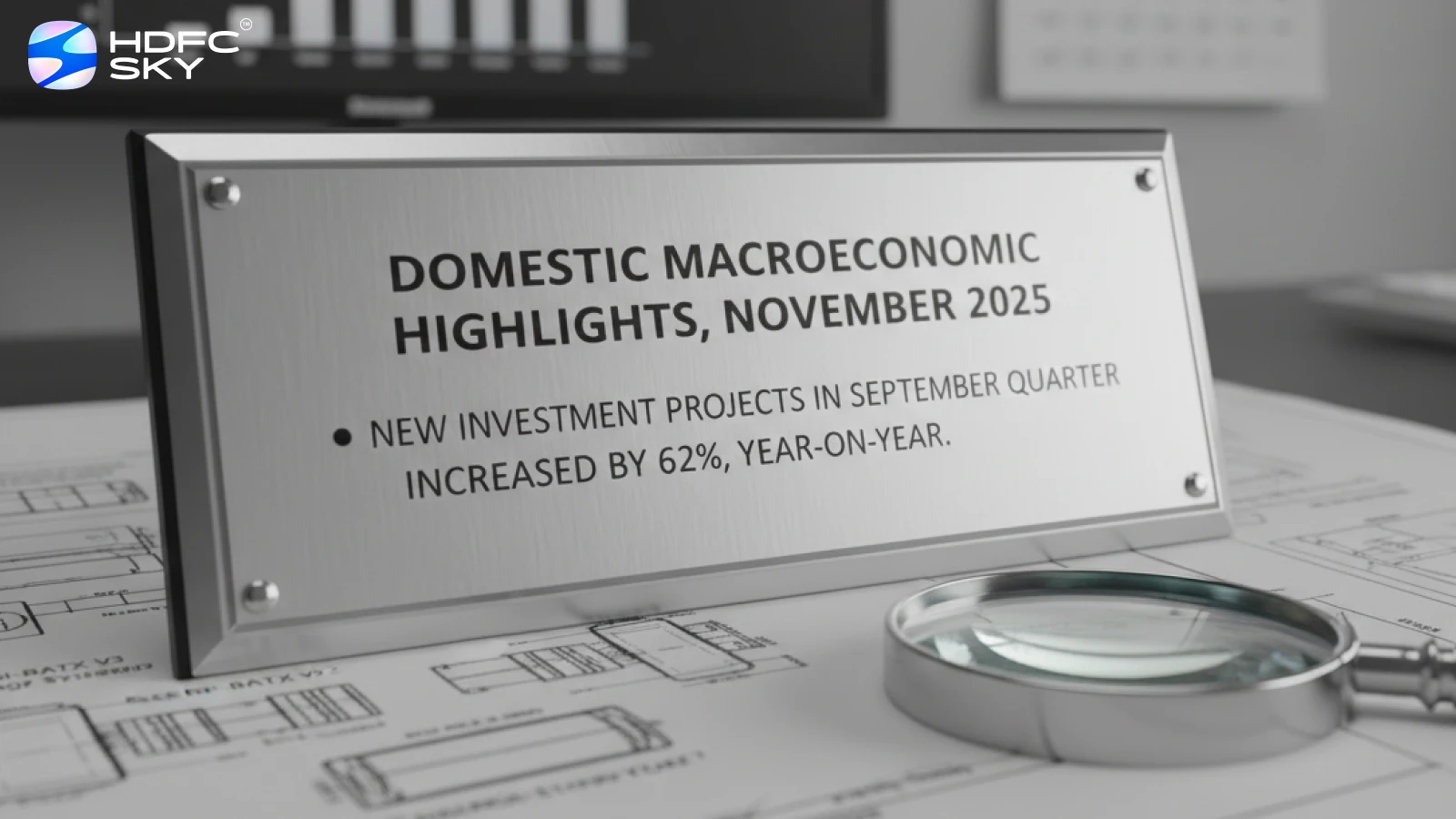
Domestic Macroeconomic Highlights, November, 2025: New investment projects in September quarter increased by 62%, year-on-year
Authored By Ankur Chandra | Last Modified: Dec 3, 2025 07:11 PM IST
Open Free Demat Account
Open Free Demat Account
Inflation: India’s consumer price inflation cooled sharply to 1.54% in September 2025 from 2.07% in August, marking the lowest level since June 2017. The decline was led by a steep 2.28% fall in food prices the sharpest drop since December 2018’s record 2.65% fall, reflecting easing supply pressures. Inflation also moderated slightly in categories such as clothing and footwear (2.28% vs. 2.33% in August) and fuel and light (1.98% vs. 2.32%). However, housing inflation accelerated to 3.98% from 3.09% in August, and miscellaneous items rose to 5.35% from 5.05%.
India’s PMI Shows Divergent Trends in October 2025: The HSBC Manufacturing PMI rose to 59.2 from 57.7 in September, reflecting stronger domestic orders and easing input cost pressures following GST relief measures. However, export growth slowed to its weakest level since March amid rising U.S. tariffs. Meanwhile, the Services PMI slipped to preliminary 58.8 from 60.9 in September, signaling the slowest expansion since May as competition intensified and weather disruptions curtailed activity. Similar to manufacturing, input cost inflation in services eased partly due to GST rate reductions, but output cost inflation accelerated. Despite these contrasts, both sectors remain optimistic about future output, buoyed by GST cuts and robust domestic demand.
IMF, World Bank Forecast Strong India Growth: The IMF expects India to grow at 6.6% in FY2025–26, an upward revision reflecting a strong Q1 performance and positioning the country ahead of China’s projected 4.8% growth. However, growth for FY2026-27 has been trimmed to 6.2%, suggesting momentum may moderate after the initial surge (7.8% Q1 growth). Separately, the World Bank raised India’s FY2026 growth forecast to 6.5% from its June estimate of 6.3%, citing resilient domestic consumption and positive impact of GST reforms. The revision reaffirms India’s position as the fastest-growing major economy globally, supported by strong consumer demand and investment momentum. However, the Bank revised down its FY2027 projection to 6.3%, warning that the 50% tariff imposed by the U.S. could dampen export competitiveness.
Indian Private Capex Set for Massive Surge: Fresh investment proposals from private promoters in H1 FY26 nearly doubled to Rs 10.55 trillion across approximately 1,800 projects, up from Rs 5.69 trillion in the same period last year. Overall, new investment projects in Q2 rose 62% to over Rs 15 trillion, taking H1 FY26 total outlays to Rs 34 trillion, a 22.3% increase over H2 FY25. Private sector plans now account for over 70% of the total (up from 61% in Q2 and H2 FY25), with foreign investors’ plans jumping 130% to Rs 3.56 trillion, and domestic private investments rising 32% (Data from Projects Today report). The RBI forecasts a 21.5% surge in private sector capital investment, reaching Rs 2.67 lakh crore in FY2025–26.
GST Collections: Gross GST collections for October rose 4.6% to Rs 1.96 lakh crore, compared to Rs 1.97 lakh crore in October 2024 and 1.89 lakh crore in Sept 2025. Gross GST revenue specifically rose 12.84% YoY to Rs 50,884 crore, though domestic revenue increased by only 2% at Rs 1.45 lakh crore. For the April-October period of FY26, total collections grew 9.0% to about Rs 13.89 lakh crore, compared to Rs 12.74 lakh crore in the same period last fiscal.
Disclaimer : This content is only for informational purpose. It does not make any recommendation to act or invest.
Source : HDFC Tru (www.hdfc-tru.com) email: tru@hdfcsec.com Ph: 9930203944
To see full report and disclaimer , click on: https://hdfc-tru.com/wp-content/uploads/2025/11/TRU-Insights-Nov-2025.pdf
Disclaimer
At HDFC SKY*, we take utmost care and due diligence in curating and presenting news and market-related content. However, inadvertent errors or omissions may occasionally occur.
If you have any concerns, questions, or wish to point out any discrepancies in our content, please feel free to write to us at content@hdfcsec.com.
Please Note: The information shared is intended solely for informational purposes and does not make any investment recommendations.
HDFC SKY from HDFC Securities, one of most trusted trading platforms in India, has been recognized with the *Next-Gen Digi Content Awards 2025-26.
 Join Us
 Add as preferred source on Google


More Markets News









Open Free Demat Account
Open Free Demat Account












Invest Anytime, Anywhere


By signing up I certify terms, conditions & privacy policy