Nifty 50
- TCS₹2,34293.60 (4.16%)
- ICICI Bank₹1,422.80-20.20 (-1.40%)
- Tech Mahindra₹1,640.9055.90 (3.53%)
- Shriram Finance₹1,086.90-14.10 (-1.28%)
- Infosys₹1,14433.20 (2.99%)
- ITC₹266-3.00 (-1.12%)
- HCL Technologies₹1,316.1034.10 (2.66%)
- UltraTech Cement₹11,589-128.00 (-1.09%)
- Wipro₹180.954.55 (2.58%)
- Asian Paints₹2,608.70-22.30 (-0.85%)
- Bajaj Auto₹11,910190.00 (1.62%)
- SBI Life Insurance ₹1,761.10-12.10 (-0.68%)
- Hindalco Industries₹1,037.4013.40 (1.31%)
- Eicher Motors₹8,059-41.00 (-0.51%)
- HDFC Bank₹720.309.30 (1.31%)
- Maruti Suzuki₹13,376-64.00 (-0.48%)
- Tata Motors PV₹319.403.40 (1.08%)
- Bajaj Finserv₹2,002-9.00 (-0.45%)
- Grasim Industries₹3,29032.00 (0.98%)
- InterGlobe Aviation₹5,166-23.00 (-0.44%)

- Offerings
- Tools & Platforms
Tools & Calculators
- Open API
- Calculators
- SIP Calculator
- CAGR Calculator
- Compound Interest Calculator
- FD Calculator
- RD Calculator
- EPF Calculator
- Retirement Calculator
- HDFC SIP Calculator
- Mutual Fund Return Calculator
- Lumpsum Calculator
- Step Up SIP Calculator
- ETF SIP Calculator
- Brokerage Calculator
- Equity Margin Calculator
- SWP Calculator
- EMI Calculator
- MTF Calculator
- Margin Pledge Calculator
- Markets
Stocks
F&O
Mutual Funds
- More
Ethanol at a Crossroads: India’s E20 Push, Public Concerns, and the Road Ahead
Authored By Shishta Dutta | Published at: Aug 28, 2025 03:28 PM IST
Open Free Demat Account
Open Free Demat Account
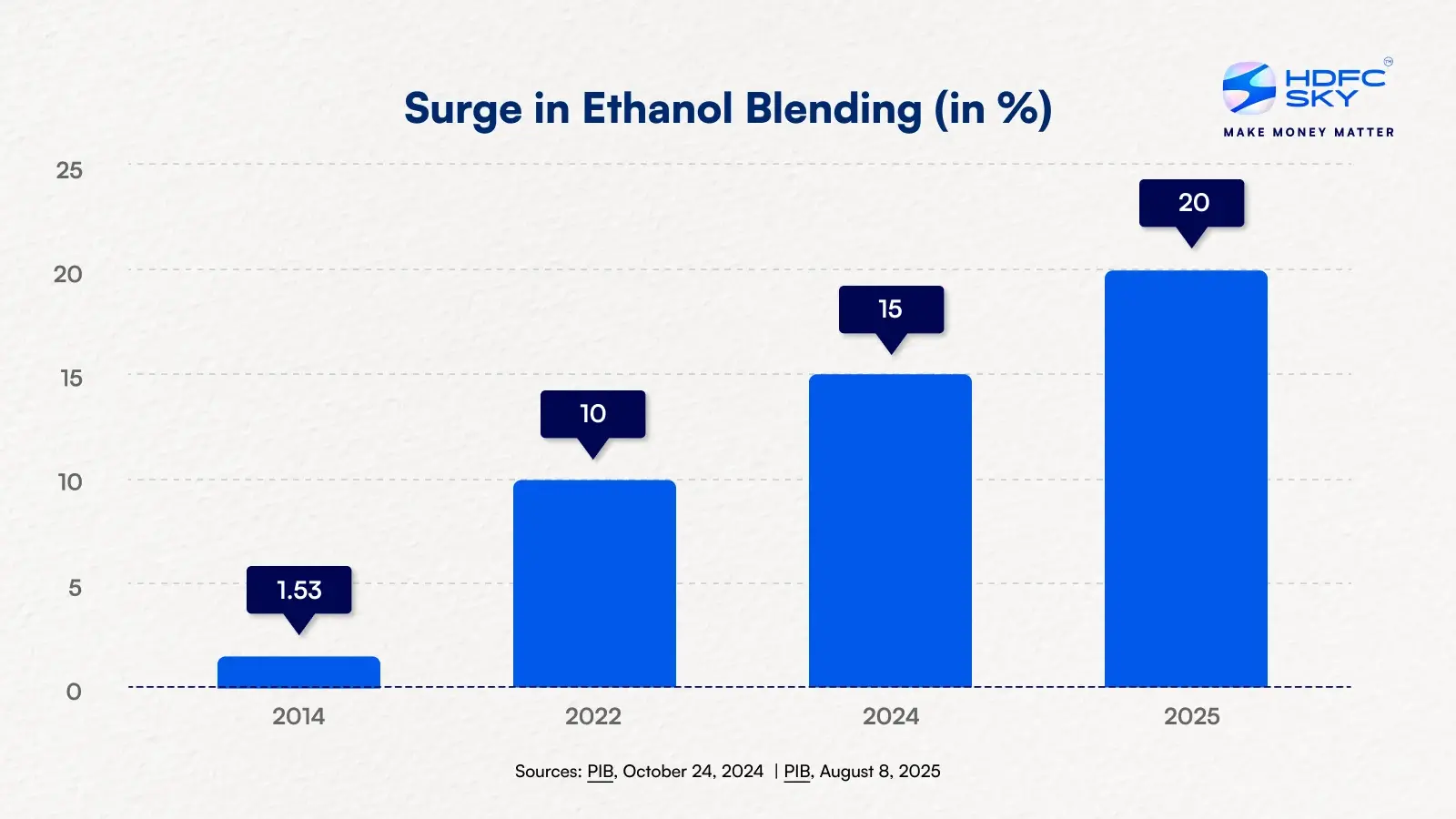
India has officially achieved 20% ethanol blending (E20) in petrol, marking a significant milestone in its push for cleaner fuels, reduced oil imports, and increased farmer income. This was a target initially set for 2030, now met ahead of schedule by 2025.
E20, or Ethanol 20, is petrol mixed with 20% ethanol, a biofuel usually derived from sugarcane, corn, or surplus grain.
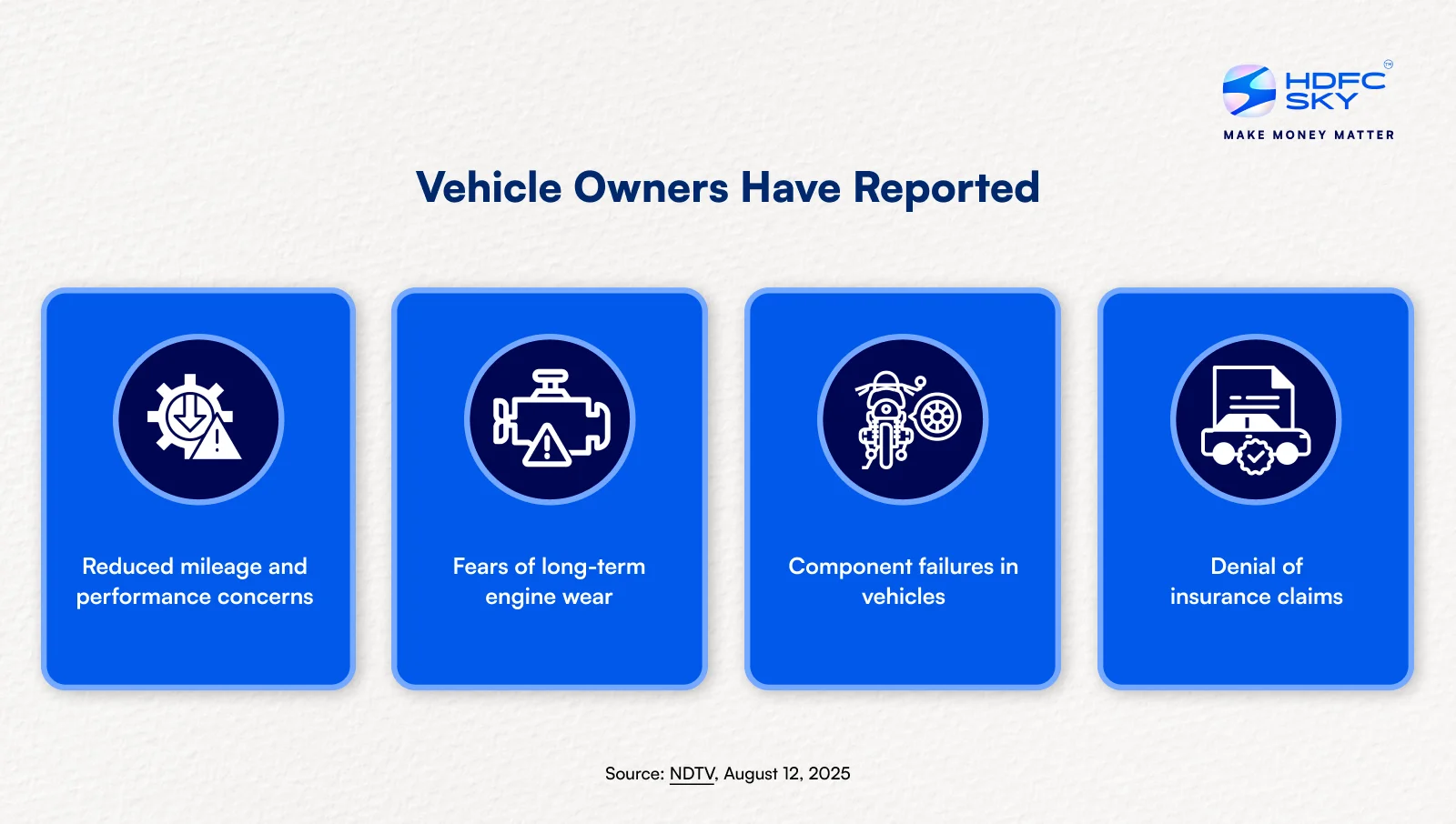
But as E20 rolls out at fuel stations nationwide, it’s also facing heat. Concerns have surfaced over vehicle compatibility, engine performance, and whether insurance claims might be affected. A public debate has followed, with the government issuing clarifications in response to growing consumer apprehension.
This article examines the big picture: the decade-long surge in ethanol blending, its economic and environmental payoffs, and the trade-offs India must now navigate as it scales further.

Ethanol Blending: A Decade of Acceleration
India’s ethanol blending program has evolved from a pilot policy into a cornerstone of its energy diversification agenda. The change has been especially dramatic over the past ten years.
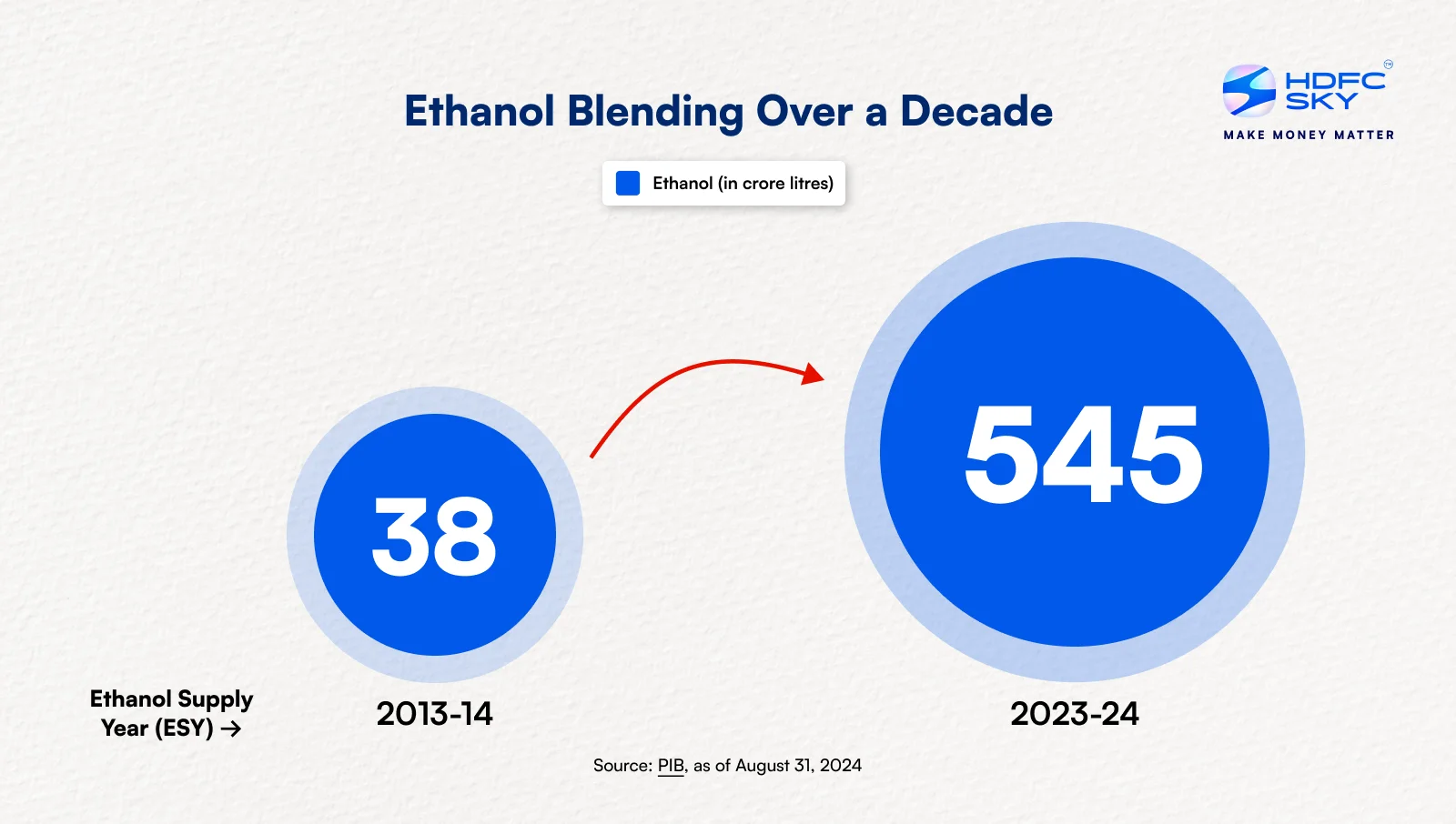
In 2013-14, India blended just 38 crore litres of ethanol into petrol. By 2023-24, this figure had surged to 545 crore litres, reflecting not just supply-side expansion but also policy urgency and infrastructure scaling.
This ramp-up was driven by:
⦁ Increased procurement from surplus rice
⦁ Introduction of flex-fuel vehicles and E20-compatible models
⦁ Investment in ethanol distillation capacity and 2G bio-refineries
The push was not without precedent: Brazil and the US have long adopted ethanol-blended fuels. But for India, the blend rate increase represents a policy shift from dependence on fossil fuels to leveraging agri-based alternatives.
Benefits and Trade-Offs of Ethanol Blending
India’s aggressive ethanol blending strategy has yielded gains across the economy, environment, and agriculture. But it has also begun to strain the country’s food system and cropping decisions in subtle but important ways.
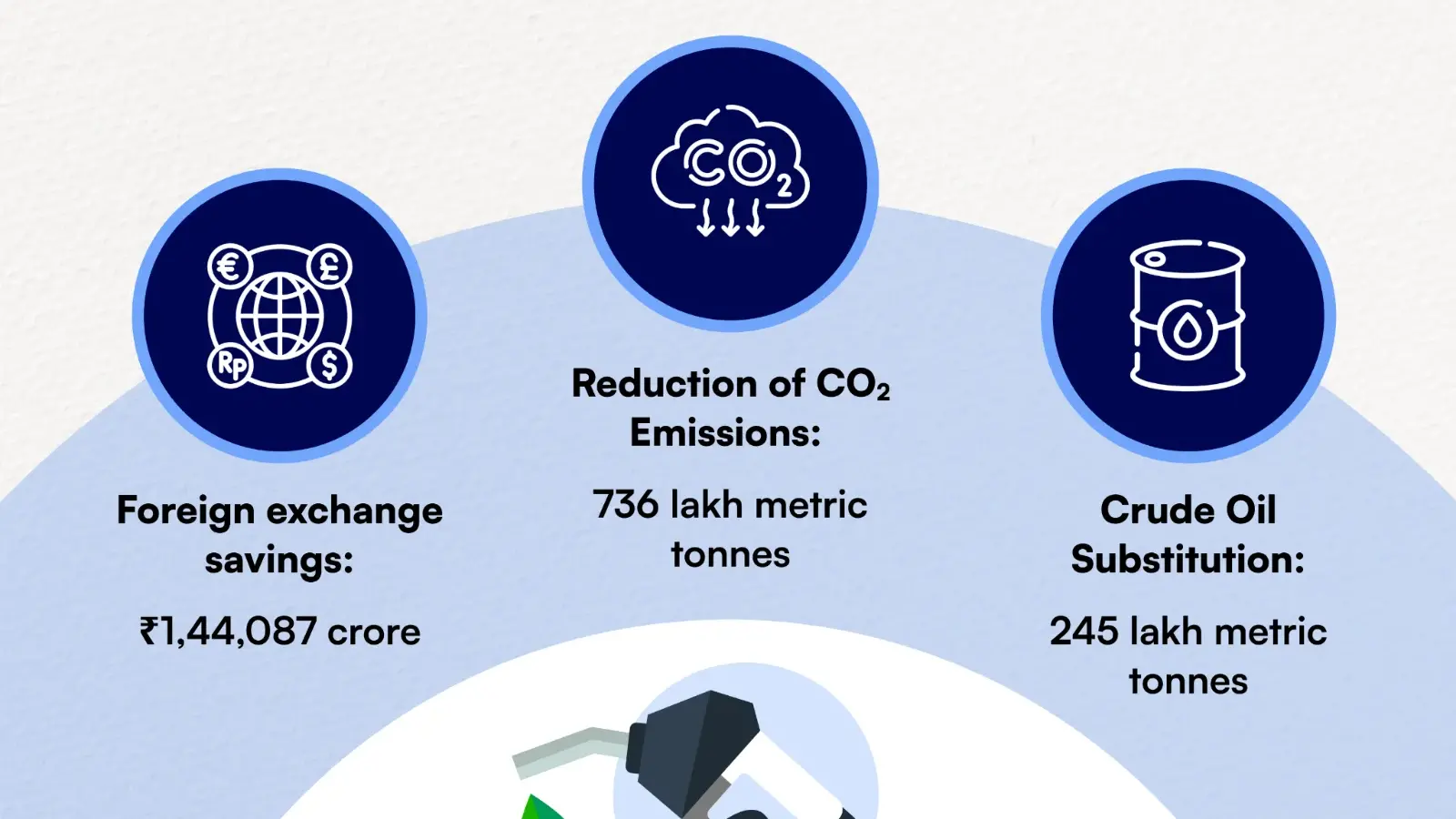
Additionally:
⦁ Farmers to receive nearly ₹40,000 crore for ethanol-linked crop procurement in 2024–25.
⦁ Surplus rice (5 million metric tonnes) was diverted to ethanol production, easing storage and food subsidy pressures.
⦁ Ethanol has a higher octane number than petrol, improving engine performance
As ethanol demand rises, so does pressure on key food crops.
Concerns include:
⦁ Edible Oil Self-Sufficiency at Risk: India imports around 57% of its edible oils, palm, soybean and sunflower for consumption of around 25 MT. Although the import has fallen in 2025 and the farmers have been shifting to maize, a key ethanol feedstock, which may lead to a decline in the production of oilseeds like soy and groundnut. This undermines the goal of 72% oil self-sufficiency by 2030-31.
⦁ Water Use and Monoculture Risk: First-generation ethanol crops like sugarcane and rice are water-intensive. Over-reliance may aggravate groundwater depletion and reduce crop diversity.
India now faces a balancing act: how to sustain ethanol gains without triggering long-term distortions in the food economy.
The next phase may require a deeper push into:
⦁ Crop planning aligned with both fuel and food security
⦁ Prioritize second-generation ethanol to ease pressure on food crops (from biomass, waste, bamboo)
⦁ Create region-specific blending strategies that reflect water and crop realities.
⦁ Maintain clear communication with consumers on vehicle compatibility and long-term fuel transition plans.
E20 Rollout Sparks Consumer Pushback
Despite the headline achievement of reaching 20% ethanol blending, the rollout hasn’t been entirely smooth. In recent weeks, public concerns have mounted over whether E20 fuel is truly compatible with all vehicles on Indian roads.
Government Response
The Ministry of Petroleum and Natural Gas issued multiple clarifications:
⦁ The use of E20 fuel not only delivers better acceleration and a smoother ride, but also cuts carbon emissions by around 30% compared to E10.
⦁ Vehicles tuned for E20 deliver better acceleration, an important advantage in city driving conditions.
⦁ Vehicle mileage depends on more than just the type of fuel used. Driving habits, regular maintenance such as timely oil changes and clean air filters, proper tyre pressure and alignment, and even air conditioning usage all play a role.
⦁ In India, the usage of E20 fuel has no impact on the validity of a vehicle’s insurance coverage.
⦁ A NITI Aayog study on the life-cycle emissions of ethanol found that greenhouse gas (GHG) emissions from sugarcane-based ethanol are about 65% lower, and from maize-based ethanol about 50% lower, compared to petrol.
Conclusion
India’s ethanol journey has been swift, ambitious, and largely successful on paper. From saving foreign exchange and reducing emissions to providing new income sources for farmers, the gains are real and measurable.
But the next phase demands more caution than celebration. The current model, driven by food crops like rice, maize, and sugarcane, is already beginning to strain other national priorities, from edible oil self-reliance to sustainable water use.
Ethanol can remain a pillar of India’s clean energy transition but only if it walks in step with food security, ecological balance, and public trust.
Disclaimer: At HDFC SKY, we take utmost care and due diligence in curating and presenting news and market-related content. However, inadvertent errors or omissions may occasionally occur.
If you have any concerns, questions, or wish to point out any discrepancies in our content, please feel free to write to us at content@hdfcsec.com.
Please note that the information shared is intended solely for informational purposes and does not make any investment recommendations
 Join Us
 Add as preferred source on Google


More Business News







Open Free Demat Account
Open Free Demat Account







Invest Anytime, Anywhere


By signing up I certify terms, conditions & privacy policy