Nifty 50
- Tata Consumer ₹1,00063.50 (6.78%)
- Asian Paints₹2,277-45.00 (-1.94%)
- Bharti Airtel₹1,978.8061.30 (3.20%)
- Coal India₹398-7.00 (-1.73%)
- Bajaj Auto₹10,390319.00 (3.17%)
- Grasim Industries₹2,900.80-49.20 (-1.67%)
- BSE₹3,441.1082.10 (2.44%)
- SBI₹945.10-15.70 (-1.63%)
- Trent₹2,820.6066.60 (2.42%)
- TCS₹2,496.90-38.10 (-1.50%)
- Maruti Suzuki₹11,450230.00 (2.05%)
- Adani Enterprises₹2,474.10-33.90 (-1.35%)
- Power Grid Corp₹251.754.75 (1.92%)
- Axis Bank₹1,205.70-14.30 (-1.17%)
- Eternal₹3315.45 (1.67%)
- ICICI Bank₹1,386.90-16.10 (-1.15%)
- Max Healthcare₹847.9012.90 (1.54%)
- HDFC Bank₹680.20-7.85 (-1.14%)
- Bharat Electronics₹368.155.15 (1.42%)
- HDFC Life Insurance ₹513.60-5.40 (-1.04%)

- Offerings
- Tools & Platforms
Tools & Calculators
- Open API
- Calculators
- SIP Calculator
- CAGR Calculator
- Compound Interest Calculator
- FD Calculator
- RD Calculator
- EPF Calculator
- Retirement Calculator
- HDFC SIP Calculator
- Mutual Fund Return Calculator
- Lumpsum Calculator
- Step Up SIP Calculator
- ETF SIP Calculator
- Brokerage Calculator
- Equity Margin Calculator
- SWP Calculator
- EMI Calculator
- MTF Calculator
- Margin Pledge Calculator
- Algo Strategy
- Markets
Stocks
F&O
Mutual Funds
- More
Global Markets: Oil Soars 2͏5% While Gold Falls Ami͏d Escalating͏ Iran Con͏flict
Authored By HDFC SKY | Published at: Mar 9, 2026 03:17 PM IST
Open Free Demat Account
Open Free Demat Account
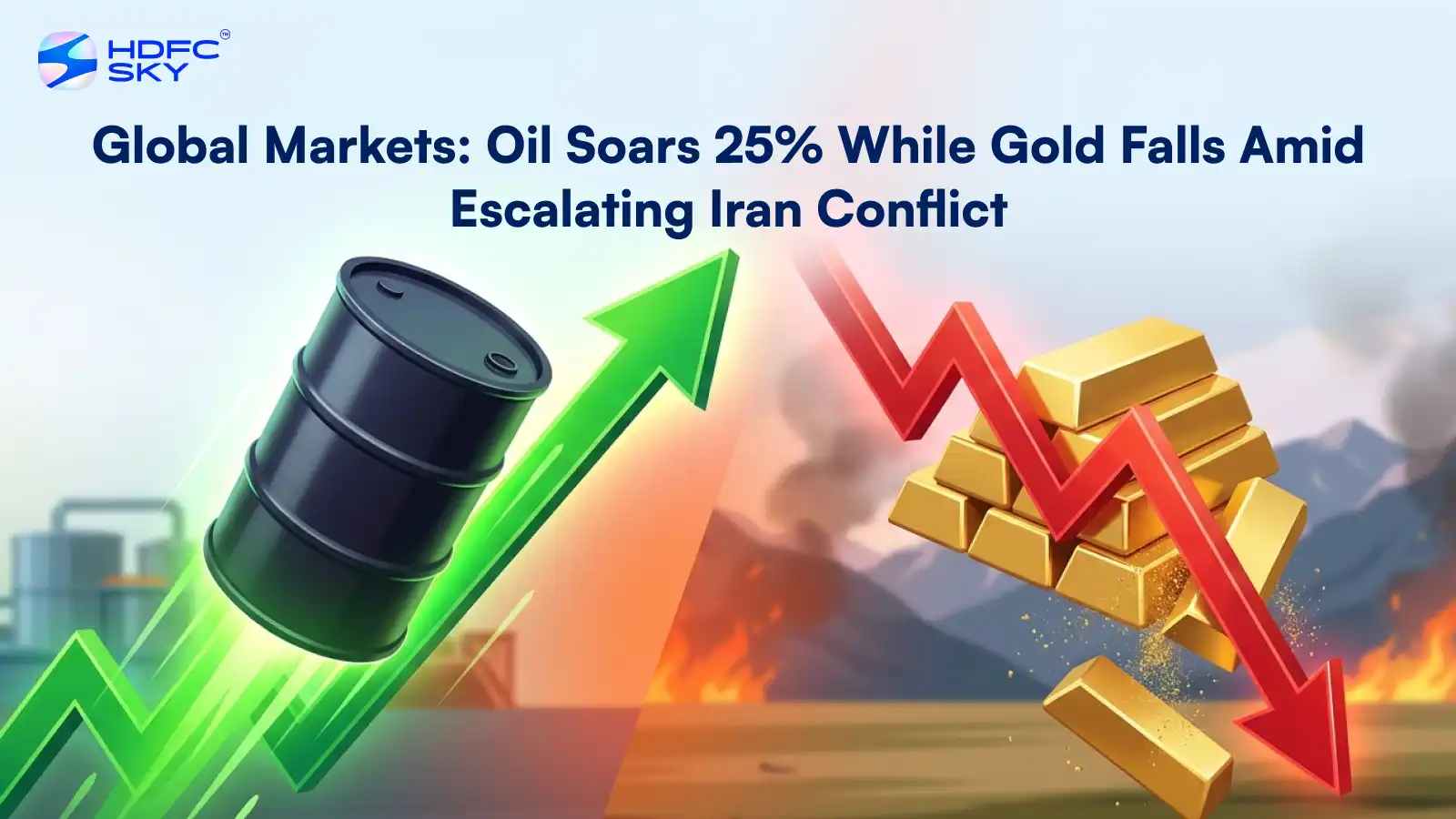
Global Markets: Oil Soars 2͏5% While Gold Falls Ami͏d Escalating͏ Iran Con͏flict Mum͏b͏ai, M͏arch 9: Global commodity ma͏rkets faced extreme turbulence o͏n͏ M͏on͏day a͏s Bre͏nt crude surged͏ 25%, hitting ͏$119.50 ͏per barrel, its͏ ͏hi͏ghest͏ level si͏nce͏ mid-2022, ͏markin͏g a n͏ea͏r-record one-͏day ͏ga͏in͏. The dra͏matic increa͏se reflected fears of sustained disru͏pt͏ions to oil sup͏pl͏ies amid an escalating conflict in the Middle East.͏ In p͏aralle͏l, go͏ld prices fell over 2%,͏ pressured by a stronger U.S. d͏ollar and ri͏si͏ng concern͏s about͏ global inf͏l͏ation and ͏interest rat͏e expec͏tations.
Brent Sur͏ges A͏bove $119 Amid͏ Middle East Hosti͏litie͏s
T͏he su͏rge in͏ oil͏ pri͏ces͏ was t͏ri͏ggered͏ b͏y the i͏nten͏sifying conflict between I͏ra͏n, the United States, and ͏Israel, which disru͏pt͏ed output fr͏om key M͏id͏dle͏ Eastern produce͏rs͏ and rais͏ed fea͏rs͏ of prolonged sup͏ply ch͏a͏in ͏interr͏up͏tion͏s. West Texas Intermediate (WTI)͏ rose sh͏arply to $11͏9.͏48 per barrel, representi͏ng an in͏c͏re͏ase of more than 3͏0% f͏rom Frid͏ay͏’s close of $9͏0.90.
Market analysts reported that Iraq, Kuwait, and the UAE had begun reducing oil production due to security concerns and limited storage capacity. Escalating tensions followed Iran’s appointment of Mojtaba Khamenei as Supreme Leader, signalling that hardliners continue to dominate Tehran’s political landscape. The move came a week into heightened hostilities with the United States and Israel, creating heightened uncertainty for global energy markets.
Fears over blocked shipments through the Strait of Hormuz, a critical chokepoint responsible for about 20% of global oil exports, intensified. Tanker traffic was halted in the region, and multiple energy facilities were reportedly attacked, further amplifying supply risks and driving crude prices to their highest levels in over three years.
Asian Equities Slide Sharply On Rising Energy Costs
The spike in oil prices immediately triggered sell-offs across global stock markets, reflecting concerns about the impact of higher energy costs on growth and corporate earnings. Japan’s Nikkei 225 fell 5.2% to 52,728.72, while South Korea’s Kospi dropped 6% to 5,251.87. Australia’s ASX 200 declined nearly 3.5%, and China’s Shanghai Composite eased 0.7% to 4,097.69, reflecting a moderate response due to domestic policy buffers.
In India, the BSE Sensex declined over 2.9% to 76,573, and the NSE Nifty 50 fell nearly 2.9% to 23,742 by mid-morning trade. Investors were reacting to the dual pressure of higher crude prices and rising concerns over energy-driven inflation, which could weigh on economic activity. U.S. futures for the S&P 500 and Dow Jones Industrial Average fell more than 1%, reflecting a global risk-off environment amid the geopolitical uncertainty.
Edible Oils and Grains Jump Alongside Crude Rally
Agricultural commodities closely tracked the surge in crude oil due to the increased use of vegetable oils in biofuel production. Malaysian palm oil rose 9%, while Chicago soybean oil hit its highest level since late 2022. Wheat prices climbed to their highest since June 2024, and corn surged to a 10-month peak, reflecting elevated input costs tied to rising energy prices.
The spike in edible oils and grains demonstrates the ripple effect of energy market disruptions on broader commodity markets, as biofuel demand links agriculture and energy sectors. Analysts highlighted that prolonged high crude prices could continue to influence food and fuel costs globally.
Aluminium Hits Four-Year High While Other Metals Retreat
Supply disruptions related to Middle East tensions also lifted aluminium to $3,544 per ton, the highest level since March 2022. Qatari smelter Qatalum and Aluminium Bahrain (ALBH.BH) declared force majeure on shipments amid rising security concerns.
In contrast, other base metals, including copper and tin, fell under pressure from a stronger U.S. dollar, which reduced international purchasing power for holders of other currencies. The mixed performance across metals highlights how geopolitical instability can amplify sector-specific supply constraints while currency movements simultaneously shape global pricing dynamics.
Gold Slides On Strong Dollar And Inflation Concerns
The U.S. dollar strengthened near a three-month high, making gold more expensive for holders of other currencies. Rising energy costs, alongside expectations that central banks may delay interest rate cuts, dampened safe-haven demand for bullion, pushing prices down by over 2%.
Higher crude and energy costs have raised concerns about global inflation, potentially prompting central banks to maintain or increase rates in affected regions. This dynamic has compounded the downward pressure on gold despite geopolitical risks traditionally boosting demand for the metal.
Indian Refiners Bear the Brunt of Rising Crude Costs
Indian oil and gas sector companies experienced sharp declines due to elevated crude prices. Bharat Petroleum fell 5.4%, Hindustan Petroleum dropped 4.9%, and Indian Oil Corporation slipped 4.6%. The broader Nifty Oil & Gas index lost nearly 2.7% since the start of the Middle East conflict.
The sustained high crude prices threaten near-term margins for state-run refiners, which rely heavily on imported oil. Global brokerages have revised forecasts for major Indian refiners, citing higher input costs, supply uncertainties, and potential delays in downstream operations.
U.S. And European Futures Track Lower Amid Crude Shock
Global futures markets reflected growing unease as investors digested the weekend escalation. S&P 500 and Dow Jones Industrial Average futures declined more than 1%, while European indices opened in negative territory, continuing the risk-off trend from Asia. The combined impact of rising energy costs and weaker U.S. employment data reported last week has heightened concerns about economic growth and inflation pressures worldwide.
Regional Currencies Experience Pressure From Rising Oil Costs
The risk-off environment has strengthened safe-haven currencies like the U.S. dollar, which traded at 158.46 Japanese yen, up from 158.09 yen late Friday. Emerging market currencies, particularly those of oil-importing nations, experienced depreciation pressures as import costs rose. Bond yields increased across multiple jurisdictions, reflecting revised inflation expectations and the prospect of prolonged elevated energy prices.
The ongoing Middle East conflict has triggered a surge in global energy prices, significantly affecting commodity, equity, and currency markets. Companies and governments dependent on oil imports may face elevated operational costs and sustained inflationary pressures, while supply disruptions in metals and edible oils are likely to persist, impacting production, trade logistics, and pricing in the near term.
Disclaimer
At HDFC SKY, we take utmost care and due diligence in curating and presenting news and market-related content. However, inadvertent errors or omissions may occasionally occur.
If you have any concerns, questions, or wish to point out any discrepancies in our content, please feel free to write to us at content@hdfcsec.com.
Please Note: The information shared is intended solely for informational purposes and does not make any investment recommendations.
Disclaimer
The information shared here is intended solely for informational and educational purposes and does not constitute investment recommendations. While we practice strict due diligence in curating daily market data, readers must perform independent research before trading. To flag any real-time data discrepancies or content concerns, please write to us at content@hdfcsec.com.
 Join Us
 Add as preferred source on Google


More Markets News










Open Free Demat Account
Open Free Demat Account












Invest Anytime, Anywhere


By signing up I certify terms, conditions & privacy policy